Back to Free Will and Determinism
Outline
Compatibilism
- Compatibilism (or Soft Determinism) is the view that free will and determinism are compatible, that people can have free will even though events in their brains are governed by deterministic laws.
- In a 2020 survey of academic philosophers
- 60% accepted or leaned towards Compatibilism
- 20% accepted or leaned towards Libertarianism
- 11% accepted or leaned towards No Free Will
Arguments for Compatibilism
“Could have done otherwise” is constitutionally iffy
- The argument:
- “Could have done otherwise” means “would have done otherwise if one had tried”
- “Would have done otherwise if one had tried” is compatible with determinism.
- Therefore “could have done otherwise” is compatible with determinism.
- The argument fails because the first premise is false.
- A straightforward way of refuting a claim that two expressions have the same meaning is to set forth a possible scenario where one expression is true and the other false.
- Here are scenarios where a person
- (a) could not have done X because it was psychologically impossible for him to try but
- (b) would have done X if he had tried.
- A person with a hand-washing compulsion is unable to refrain from washing his hands because he cannot bring himself to even try although, if he had, he would have succeeded.
- Likewise a person with a phobia of snakes is unable to pick up a snake because he cannot bring himself to try although, if he had, he would have succeeded.
- A person with everything to live for handles a loaded gun. It may be psychologically impossible for him to take his own life though, had he tried, he would have succeeded.
- In Luis Buñuel’s 1962 movie The Exterminating Angel partygoers find that no one can will to leave the apartment. The partygoers would have left the party had they willed. But they couldn’t leave because they were unable to so will.
- Thus if determinism is true, no one could tried to do otherwise and therefore could not have done otherwise. At the same time, though, they would have done otherwise if they had tried.
The Principle of Alternate Possibilities (PAP) is false
- The Hard Determinist argues that determinism implies there is no moral responsibility:
- If determinism is true no one could have avoided anything they do.
- A person is morally responsible for doing X only if they could have avoided doing X.
- Therefore if determinism is true no one is morally responsible for anything they do.
- But there are credible counterexamples to the second premise, the Principle of Alternate Possibilities
- Compatibilists can thus argue that people are morally responsible despite determinism.
- The problem is that, though the argument fails because of the second premise, the conclusion can be defended in its own right.
People believe they have free will, just not free will under the very same conditions
- When a person reflects on something they regret doing and asks themselves “what could I have done differently” are they asking what they could have done under the conditions existing at the time or under different conditions. According to John Stuart Mill it’s the latter:
- From “Chapter XXVI On the Freedom of the Will” of An Examination of Sir William Hamilton’s Philosophy Volume I
- “When we think of ourselves hypothetically as having acted otherwise than we did, we always suppose a difference in the antecedents: we picture ourselves as having known something that we did not know, or not known something that we did know; which is a difference in the external inducements; or as having desired something, or disliked something, more or less than we did; which is a difference in the internal inducements.”
- But Mill is mistaken. Sometimes we think of ourselves as having acting otherwise under the exact conditions that existed at the time, e.g should I have left a note on the Corvette I scraped in the parking lot, rather than driving a way.
Wolf’s Analysis of Ability
- Susan Wolf’s analysis of ability:
- S is able to X if and only if
- (1) S has the capacities, skills, talents, knowledge and so on necessary for X-ing and
- (2) nothing interferes with or prevents the exercise of the relevant capacities, skills, talents, and so on.
- (Susan Wolf Reason Within Reason, 1990, p 101-102)
- S is able to X if and only if
- Compare Wolf’s analysis to the following:
- S is able to X if and only if
- (1) S will succeed in doing X if she tries
- (2) S can try.
- S is able to X if and only if
- Suppose a shopper with kleptomania shoplifted a broach. It can be argued that she could not have refrained from shoplifting because she could not have tried
- Suppose a shopper with no mental problems shoplifted a broach but that determinism is true. It can be argued in an analogous way that she could not have refrained from shoplifting because she could not have tried, since her not trying was determined.
- But Wolf argues that the shopper with no mental problems could have refrained, because:
- (1) She had the general capacity to refrain from shoplifting
- (2) Nothing prevented her from exercising that capacity
- She was not psychologically determined to shoplift (p 111-112)
- Being physically determined did not prevent her from exercising that capacity.
- “physics does not interfere with her” (p 115)
- Therefore the shoplifter could have refrained.
- Thus Wolf argues in effect that, even though determinism is true, the shopper with no mental problems could have tried to refrain from shopping.
- Here’s a counterexample to Wolf’s analysis:
- A device is implanted in the shoplifter’s brain that prevents her from trying to refrain from shoplifting but allows her to succeed if she tries. Thus:
- (1) She had the general capacity to refrain from shoplifting, that is, if she had tried to refrain she would have succeeded
- (2) The implanted device prevents her from exercising her capacity to refrain, that is, by preventing her from trying to refrain.
- Therefore the shoplifter could not have refrained, contradicting Wolf’s conclusion above.
- A device is implanted in the shoplifter’s brain that prevents her from trying to refrain from shoplifting but allows her to succeed if she tries. Thus:
- Wolf’s conclusion also runs up against the Consequence Argument for Incompatibilism, which doesn’t care about the distinction between physical and psychological laws.
The main problem for Compatibilism
- The main problem for Compatibilism is refuting the Consequence Argument for Incompatibilism:
- If determinism is true, everything a person does is logically necessitated by laws of nature and events that have already taken place.
- No one can do anything that violates a law of nature.
- No one can undo an event that has already taken place.
- Therefore no one can refrain from anything they do.
- More at Consequence Argument
Addendum
David Hume’s Defense of Compatibilism
- David Hume, the most famous compatibilist, set forth his view on the matter in the chapter “Of Liberty and Necessity” of his classic work An Enquiry Concerning Human Understanding (1758).
- Hume uses “liberty” to mean free will and “necessity” to mean determinism.
- Here’s a reconstruction of Hume’s argument, with supporting quotes.
- The Problem of free will (“liberty”) and determinism (“necessity”) is resolved by clarifying the meanings of the terms.
- “But to proceed in this reconciling project with regard to the question of liberty and necessity; the most contentious question of metaphysics, the most contentious science; it will not require many words to prove, that all mankind have ever agreed in the doctrine of liberty as well as in that of necessity, and that the whole dispute, in this respect also, has been hitherto merely verbal.”
- Voluntary actions are determined by motives.
- “It is universally acknowledged that there is a great uniformity among the actions of men, in all nations and ages, and that human nature remains still the same, in its principles and operations. The same motives always produce the same actions: the same events follow from the same causes. Ambition, avarice, self-love, vanity, friendship, generosity, public spirit: these passions, mixed in various degrees, and distributed through society, have been, from the beginning of the world, and still are, the source of all the actions and enterprises, which have ever been observed among mankind.”
- Free will can’t mean acting without a motive. It must therefore mean acting according to a person’s will.
- “For what is meant by liberty, when applied to voluntary actions? We cannot surely mean that actions have so little connexion with motives, inclinations and circumstances, that one does not follow with a certain degree of uniformity from the other, and that one affords no inference by which we can conclude the existence of the other. For these are plain and acknowledged matters of fact. By liberty, then, we can only mean a power of acting or not acting, according to the determinations of the will; this is, if we choose to remain at rest, we may; if we choose to move, we also may.”
- Therefore free will and determinism are compatible
- “Now this hypothetical liberty is universally allowed to belong to every one who is not a prisoner and in chains. Here, then, is no subject of dispute.”
- The Problem of free will (“liberty”) and determinism (“necessity”) is resolved by clarifying the meanings of the terms.
- Thus for Hume:
- A person could have done otherwise if they would have done otherwise if they had willed (or chosen) to.
- Instead of willed or chosen other compatibilists use terms such as
- Tried
- Wanted
- Preferred
- Been inclined
- According to Hume, then:
- could have done means would have done if they had willed (tried, wanted, etc.)
- But there’s a problem with Hume’s analysis.
- A straightforward way of refuting a claim that two expressions have the same meaning is to set forth a possible scenario where one expression is true and the other false. Thus by mistake doesn’t mean by accident since, to use a famous philosophic example, if I go to shoot my old mule, and I shoot yours thinking it’s mine, I’ve shot your mule by mistake. But if I take aim at my mule and miss, hitting your mule instead, I’ve shot your mule by accident.
- Here are scenarios where a person
- (i) could not have done X because it was psychologically impossible for him to try but
- (ii) would have done X if he had tried.
- A person with a hand-washing compulsion is unable to refrain from washing his hands because he cannot bring himself to even try although, if he had, he would have succeeded.
- Likewise a person with a phobia of snakes is unable to pick up a snake because he cannot bring himself to try although, if he had, he would have succeeded.
- A person with everything to live for handles a loaded gun. It may be psychologically impossible for him to take his own life though, had he tried, he would have succeeded.
- A bizarre counterexample:
- In Luis Buñuel’s 1962 movie The Exterminating Angel partygoers find that no one can will to leave the apartment. The partygoers would have left the party had they willed. But they couldn’t leave because they were unable to so will.
- Thus if determinism is true, no one could have willed or tried or chosen to do otherwise and therefore could not have done otherwise. At the same time, though, they would have done otherwise if they had willed or tried or chosen to.
Diagrams of Hume’s hypothetical free will and “could have done otherwise” (categorical) free will.
For Hume, a person could have done otherwise only if the past had been different

For a Libertarian, a person could have done otherwise given that the past was the same.
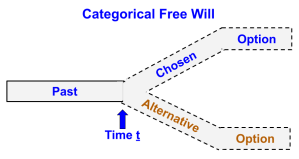
Capacity to Choose Among Alternatives
- plato.stanford.edu/archives/sum2016/entries/freewill
- “Free Will” is a philosophical term of art for a particular sort of capacity of rational agents to choose a course of action from among various alternatives.
- Does Deep Blue have free will?
Old Stuff
- Classical Compatibilism: “could have done otherwise” is constitutionally iffy
- To say that a person is able to do X is to say that they would X if they tried.
- For example:
- Person S is able to wiggle his ears means S would wiggle his ears if he tried.
- Person S is able to run a mile in under 10 minutes means S would run a mile in under 10 minutes if he tried.
- The Argument
- A person has free will if they could have done otherwise
- Could have done otherwise means was able to do otherwise
- Was able to do otherwise means would have done otherwise if they had tried
- Therefore, a person has free will if they would have done otherwise if they had tried
- That a person would have done otherwise if they had tried is compatible with determinism
- Therefore free will is compatible with determinism.
- However, the conditional analysis of “could have done otherwise” fails because it may be true that a person would do X if they tried but could not do X because it was psychologically impossible for them to even try.
- A person with a hand-washing compulsion may be unable to refrain from washing their hands because they cannot bring themselves to even try though, if they had, they would have succeeded.
- Likewise a person with a phobia of snake may be unable to touch a snake because they cannot bring themselves to try though, if they had, they would have succeeded.
- In Luis Buñuel’s 1962 movie The Exterminating Angel partygoers find that no one can will to leave the apartment.
- Conditional analyses of CHDO with different antecedents:
- “S could have done A” means that S would have done A if he had:
- willed to (Jonathan Edwards, CJ Ducasse, Thomas Hobbes, David Hume, Moritz Schlick),
- tried to (Richard Brandt),
- chosen to (GE Moore, A.J. Ayer, David Hume),
- wanted to (Alvin Goldman),
- preferred (John Stuart Mill),
- been so inclined (RE Hobart)
- “S could have done A” means that S would have done A if he had:
- Wolf’s argument
- Determinism is compatible with the conditions (1) and (2)
- Therefore, determinism is compatible with the ability to X, i.e. to do otherwise.
- Wolf claims that determinism does entail that (2) is false.
- A shopper with kleptomania shoplifted a broach
- She has the general capacity to refrain from shoplifting
- But something prevented her from exercising the capacity
- She was psychologically determined to take the broach (p 111-112)
- Therefore she was unable to refrain
- A shopper whose behavior is physically determined shoplifted a broach
- She has the general capacity to refrain from shoplifting
- Nothing prevented her from exercising the capacity
- That’s because
- She was not psychologically determined (p 111-112)
- Being physically determined did not prevent her from exercising the capacity
- That’s because
- Therefore she was able to refrain
- In the first case the shopper was psychologically determined to take the broach. In the second she was physically determined. The Consequence Argument doesn’t distinguish between physical and psychological laws. The key fact about laws for free will is that their lawfulness is beyond human control.
 A Philosopher's View