A deductive argument is an argument whose conclusion follows necessarily from its premises
Contents
- Deductive Arguments
- Examples
- Validity and Soundness
- Three Ways of Defining Validity
- Evaluating Deductive Arguments
- Ways of Proving Validity
- Ways of Proving Invalidity
- Evaluating Deductive Arguments: Premises
- Addendum
Deductive Arguments
- A deductive argument is an argument whose conclusion (purportedly) follows necessarily from its premises.
- The word purportedly allows for bad deductive arguments.

Examples of Deductive Arguments
- The classic example of a deductive argument is from the ancient Greeks:
- All humans are mortal.
- Socrates is a human.
- Therefore Socrates is mortal.
- Why John Oliver, an American citizen, can’t be president:
- Only natural-born U.S. citizens are eligible to be president
- John Oliver isn’t a natural-born U.S. citizen
- Therefore, John Oliver is not eligible to be president.
- An argument that Newton’s Theory of Gravitation is wrong:
- If Newton’s Theory of Gravitation were true, Mercury’s orbit would precess 5,557 seconds of arc per century.
- Mercury’s orbit does not precess 5,557 seconds of arc per century.
- Therefore, Newton’s Theory is false.
- The Greeks discovered that the Morning Star is the Evening Star:
- The Morning Star is the planet Venus.
- The Evening Star is the planet Venus.
- So the Morning Star is the Evening Star.
- An argument there’s no afterlife:
- Consciousness requires a functioning brain.
- A person’s brain ceases to function when they die.
- Therefore, a person ceases to be conscious when they die.
- Argument underlying Edwin Hubble’s discovery that the universe is more than just the Milky Way:
- The universe consists either of numerous galaxies including the Milky Way or of the Milky Way Galaxy alone.
- If the universe consists merely of the Milky Way Galaxy, the Andromeda Nebula would not be far more distant from Earth than the stars in the Milky Way.
- The Andromeda Nebula (as Hubble discovered) is far more distant from Earth than the stars in the Milky Way.
- Therefore, the universe consists of numerous galaxies including the Milky Way.
Validity and Soundness
- A deductive argument is valid if its conclusion follows from its premises by virtue of its form (regardless whether the premises are true or false).
- That is, a deductive argument is valid if the form of the argument is such that no argument of that form has true premises and a false conclusion.
- A deductive argument is sound if it’s valid and all its premises are true (and so therefore is its conclusion).
- The John Oliver argument above is valid and sound.
- Only natural-born U.S. citizens are eligible to be president
- John Oliver isn’t a natural-born U.S. citizen
- Therefore, John Oliver is not eligible to be president.
- The argument applied to Matt Damon is valid but unsound.
- Only natural-born U.S. citizens are eligible to be president
- Matt Damon isn’t a natural-born U.S. citizen
- Yet Damon is eligible to be president.
- The argument is unsound because the second premise is false.
- The argument is nevertheless valid, since validity concerns the form of an argument rather than its content and the Oliver and Damon arguments have the same form:
- Only Ns are Es.
- Person P is not an N.
- Therefore, person P is not an E.
- Indeed, every argument of this form is valid. Thus so is:
- Only beings with brains are conscious.
- The spider running across the floor lacks a brain.
- So, the spider isn’t conscious.
- All six arguments above are valid. All but one are sound: whether consciousness requires a functioning brain is up for debate.
Three Ways of Defining Validity
- Three ways:
- Rules of Inference
- An argument is valid if the conclusion follows from the premises per deductive, truth-preserving rules of inference.
- Form of Argument
- An argument is valid if the form of the argument is such that no argument of that form has true premises and a false conclusion.
- Modality
- An argument is valid if it’s logically impossible that its premises are true and conclusion false.
- Rules of Inference
- Consider the valid argument:
- Either Jones is lying or he’s innocent.
- He’s not lying.
- Therefore, he’s innocent
- According to the rules-of-inference account, the argument is valid because the conclusion follows from the premises per the rule:
- Infer Q from (i) P or Q and (ii) it’s false that P.
- According to the form-of-argument account, the argument is valid because no argument of the form
- P or Q
- It’s false that P
- Therefore Q
- has true premises and a false conclusion. That is, replacing “P” and “Q” with any two clauses always results in an argument whose conclusion is true if its premises are true. For example:
- Either whales are fish or whales are mammals.
- Whales aren’t fish.
- So, whales are mammals.
- According to the modal account, the argument is valid because it’s logically impossible that (i) Jones is lying or he’s innocent, (ii) Jones isn’t lying, and (iii) Jones is not innocent.
- Aristotle, the founder of Logic, developed the form-of-argument account to distinguish valid and invalid syllogisms.
- Formal Logic uses both the rule-of-inference and form-of-argument accounts to formalize the concept of validity.
- There are two versions of the modal account, depending on how “logical impossibility” is understood. Taken narrowly, logical impossibility means merely “false by virtue of its form.” In this sense, the modal account reduces to the form-of-argument account. But in a broader sense, logical impossibility means metaphysically impossible. In this sense, “logical impossibility” is too broad.
- It is nevertheless true that any argument valid in either the form-of-argument or rule-of-inference sense is such that it’s metaphysically impossible that its premises are true and conclusion false.
Evaluating Deductive Arguments
- Evaluating a deductive argument means determining whether the argument is sound, that is,
- determining whether the argument is valid;
- determining whether the premises are true.
- Regarding validity:
- An argument can be proved valid by
- citing a recognized valid form of Inference,
- deriving the conclusion from the premises.
- An argument can be proved invalid by
- a direct counterexample,
- refutation by logical analogy,
- citing a recognized invalid form of inference.
- An argument can be proved valid by
Ways of Proving Validity
1. Citing a Recognized Valid Form of Inference
- Argument that Newton’s Theory of Gravitation is wrong:
- If Newton’s Theory of Gravitation were true, Mercury’s orbit would precess 5,557 seconds of arc per century.
- Mercury’s orbit does not precess 5,557 seconds of arc per century.
- Therefore, Newton’s Theory of Gravitation is false.
- Valid Form of Inference
- The argument is valid because it has the valid argument form modus tollens:
- T → M
- ~M
- So, ~T
- Where
- T = Newton’s Theory of Gravitation is true
- M = Mercury’s orbit precess 5,557 seconds of arc per century
- → = if … then
- ~ = it’s false that
- The argument is valid because it has the valid argument form modus tollens:
2. Deriving the Conclusion from the Premises
- Argument the universe extends beyond the Milky Way Galaxy:
- The universe comprises either numerous galaxies including the Milky Way or the Milky Way Galaxy alone.
- If the universe comprises merely the Milky Way Galaxy, the Andromeda Nebula would not be more distant from Earth than the stars in the Milky Way.
- The Andromeda Nebula is more distant from Earth than the stars in the Milky Way.
- Therefore, the universe comprises numerous galaxies including the Milky Way.
- Derivation
- Let:
- G = the universe consists of numerous galaxies
- M = the universe consists of the Milky Way Galaxy alone
- A = the Andromeda Nebula is far more distant from Earth than the stars in the Milky Way.
- Argument in Symbols:
- G v M
- v = or
- M → ~A
- → = if … then
- ~ = it’s false that
- A
- So, G
- G v M
- Derivation
- ~M follows from #2 and #3 by modus tollens, the valid argument form:
- A→B
- ~B
- So, ~A
- G follows from ~M and #1 by disjunctive syllogism, the valid argument form:
- A v B
- ~A
- So, B
- ~M follows from #2 and #3 by modus tollens, the valid argument form:
- Let:
Ways of Proving Invalidity
- Consider the argument:
- Had Saddam Hussein been responsible for the 9/11 attacks, the U.S. invasion of Iraq would have been morally justified.
- But Hussein was not responsible for the 9/11 attacks.
- Therefore, the U.S. invasion of Iraq was not justified.
- Here are three ways of proving the argument invalid.
1. Direct Counterexample
- A direct counterexample is a logically consistent scenario where the premises are true and the conclusion false.
- The Hussein argument is invalid because of the logical possibility that:
- Hussein was not responsible for the 9/11 attacks
- Instead Hussein instead directly attacked the United States, justifying the US invasion.
2. Refutation by Logical Analogy
- Refutation by Logical Analogy is proving an argument invalid by identifying an obviously invalid argument of the same logical form.
- The Hussein argument has the same form as this silly argument:
- If Matt Damon were over seven feet tall, he would be over two feet tall.
- But Damon is not over seven feet tall
- Therefore, he’s not over two feet tall.
3. Citing a Recognized Invalid Form of Inference
- An argument can be shown invalid by identifying its invalid form of argument.
- The Hussein argument is invalid because it’s an instance of the fallacy of Denying the Antecedent:
- R → J
- ~R
- So, ~J
- Where
- R = Saddam Hussein was responsible for the 9/11 attacks
- J = U.S. invasion of Iraq was morally justified
- → = if then
- ~ = it’s false that
Evaluating Deductive Arguments: Premises
- Determining whether the premises of a deductive argument are true is outside the scope of Logic.
- But there is point to be made.
- If the premises of a valid argument are true, the conclusion is true.
- So you might think that if the premises are true beyond a reasonable doubt so too is the conclusion.
- Things are not that simple. When you make a deductive inference, you have to consider the epistemic probability of the premises: whether they’re certain, beyond a reasonable doubt, very likely, and so on.
- Suppose, for example, that the argument P1, P2, … Pn therefore C is valid. And suppose that it’s beyond a reasonable that P1 is true and beyond a reasonable that P2 is true and so on. It’s possible, nonetheless, that it’s not beyond reasonable doubt that C is true. That is, that the premises of a valid argument are all beyond a reasonable doubt does not logically guarantee that the conclusion too is beyond a reasonable doubt.
- View A Variation of the Lottery Paradox below.
Addendum
- Are these arguments valid?
- Metaphysical Modal Account is too Broad
- Formalization of Validity in Deductive Logic
- Syllogisms and Venn Diagrams
- A Variation of the Lottery Paradox
- Sundry Valid Argument Forms
- Multiple Senses of To Be
Are these arguments valid?
- Most US citizens speak English.
- Most people who speak English were not born in the US.
- Therefore, most US citizens were not born in the US.
View Answer
- ⅓ = 0.3333333…(ad infinitum)
- This is obvious.
- Therefore, 3 x ⅓ = 3 x 0.3333333…
- This results from multiplying both sides of line #1 by 3.
- 1 = 3 x ⅓
- This is obvious.
- 3 x 0.3333333… = 0.9999999…
- This is obvious.
- Therefore, 1 = 0.9999999…
- This follows from lines #2, #3, and #4.
View Answer
- Love is blind.
- God is love.
- Ray Charles is blind.
- Therefore, Ray Charles is God.
View Answer
- Everything ceases to exist at some time or other.
- Therefore, there is a time when nothing exists.
View Answer
- No integer is greater than itself.
- Therefore, no integer is greater than all integers.
View Answer
- Total pacifism is a good principle if every country practices it.
- But not every country does.
- So it isn’t.
View Answer
- Living human beings have brains.
- Human zygotes lack brains.
- Therefore, human zygotes aren’t living human beings.
View Answer
- Mark is eligible for paid vacation only if he has been employed for at least 90 days.
- Mark has been employed for 90 days.
- He’s therefore eligible for paid vacation.
View Answer
- The defendant’s statement and the plaintiff’s testimony cannot both be true.
- The defendant’s statement is false.
- Therefore the plaintiff’s testimony is true.
View Answer
- Some people speak both French and German.
- Some people speak both German and Italian.
- Therefore some people speak both French and Italian.
View Answer
- Sam speaks French or German.
- Sam speaks German or Italian.
- Therefore, Sam speaks French or Italian.
View Answer
- There will be no bonus unless the company makes a profit.
- The company will not make a profit.
- Therefore, there will be no bonus.
View Answer
- Without both a driver’s license and a credit card, they won’t cash your check.
- You have a driver’s license but you don’t have a credit card.
- Therefore, they won’t cash your check.
View Answer
- Not everyone who’s wealthy is conservative.
- Not everyone who’s conservative is a Republican.
- Therefore, not everyone who’s wealthy is a Republican.
View Answer
- All and only conscious beings have souls.
- Dogs do not have souls.
- Therefore, dogs are not conscious beings.
View Answer
- The Theory of Evolution and Genesis cannot both be true.
- If the Bible is the inerrant word of God, Genesis is true.
- There’s strong empirical evidence that the Theory of Evolution is true.
- Therefore, there’s strong empirical evidence that the Bible is not the inerrant word of God.
View Answer
- If human beings have free will, conscious thoughts can alter the course of events in the brain.
- If conscious thoughts can alter the course of events in the brain, telekinesis is real. But telekinesis isn’t real.
- Therefore, human beings don’t have free will.
View Answer
- Most college graduates have well-paying jobs.
- Therefore, most people who have well-paying jobs are college graduates.
View Answer
- If the Bible is the word of God, then every statement in the Bible is true.
- If every statement in the Bible is true, Jesus of Nazareth was crucified about 9:00 AM on Passover (Mark 15:25).
- If every statement in the Bible is true, Jesus of Nazareth was crucified about noon the day before Passover (John 19:14).
- It can’t both be true that Jesus of Nazareth was crucified about 9:00 AM on Passover and about noon the day before Passover.
- Therefore the Bible is not the word of God.
View Answer
- If the creation story in Genesis is a true literal description, then for the first three days of the earth’s existence there was no sun.
- There are no days and nights if there is no sun.
- Therefore, the creation story in Genesis is not a true literal description.
View Answer
- If the theory of evolution were true, there would be no gaps in the fossil record.
- There are gaps in the fossil record.
- Therefore, the theory of evolution is false.
View Answer
- If there’s free will, people can control some of their physical movements.
- A person can control a physical movement only if they can control the events that initiated it.
- Physical movements are initiated by neurons firing in the motor cortex of the brain.
- People can’t control neurons firing in the motor cortex of their brains.
- Hence, there’s no free will.
View Answer
- If Earth rotated on its axis, there would be constant hurricane-force winds at the equator.
- No such winds exist.
- Therefore, Earth does not rotate on its axis.
View Answer
- Any being that knows beforehand that innocent children will suffer and die and who could have easily prevented the suffering and dying but lets the suffering and dying happen anyway is morally reprehensible.
- Natural disasters sometimes happen that result in the suffering and death of innocent children.
- If there is a supreme being, that being knows beforehand that such disasters will happen (since that being is omniscient).
- If there is a supreme being, that being can easily prevent such disasters from happening (since that being is omnipotent).
- If there is a supreme being, that being is not morally reprehensible (since that being benevolent).
- Therefore, there is no supreme being.
View Answer
- For everything that begins to exist there is something else that caused it to begin to exist.
- The universe began to exist.
- Therefore, there is something other than the universe that caused it to exist.
View Answer
Metaphysical Modal Account is too Broad1:
- Examples of propositions that are metaphysically necessary (or broadly logically necessary):
- If not every swan is white then at least one swan is not white.
- Logically true per predicate logic
- Two people are cousins if one is a son of a brother of the other’s mother.
- Analytic
- 1000003 is a prime number.
- Mathematical truth
- There are infinitely many prime numbers.
- Mathematical truth
- Water is H20.
- “Water” and “H20″ are rigid designators.
- If not every swan is white then at least one swan is not white.
- One problem of the metaphysical modal account of validity is that any argument whose conclusion is (metaphysically) necessary is automatically valid, no matter the premises. If the conclusion of an argument is necessary, it’s impossible that it’s false. Therefore it’s impossible that the premises of the argument are true and conclusion false. Consider the argument:
- There are black swans.
- Therefore, there are infinitely many prime numbers.
- The conclusion doesn’t follow from the premise. But, since mathematical truths are necessary, it’s impossible that the premise is true and the conclusion false.
- A second problem is that, as Saul Kripke has shown, there are necessary propositions that are known only a posteriori, for example, that water is H20.
- Consider the argument:
- There’s water in the bucket.
- Therefore, there’s liquid H20 in the bucket.
- The conclusion doesn’t follow from the premise in any intuitive sense. Yet it’s impossible that the premise is true and the conclusion false. (If the liquid in the bucket weren’t H20 it wouldn’t be water.)
- Thus the metaphysical modal account of validity is broader than accounts in terms of form and rules of inference: the water-in-the-bucket argument is valid per the modal account but invalid based on form or rules of inference.
- Yet it seems that any argument valid based on form or rules of inference is such that it’s impossible that its premises are true and conclusion false.
Formalization of Validity in Deductive Logic
- Deductive Logic, the formal theory of deductive reasoning, uses both rules-of-inference and form-of-argument approaches to “formalize” the concept of validity.
- Take Propositional Logic, for example, which uses (i) capital letters to stand for statements and (ii) the symbols &, ~, v, and → to mean “and”, “not”, “or”, and “if then” respectively.
- Using the rules-of-inference approach:
- An argument in propositional logic is valid if the conclusion can be derived from the premises using a specific list of rules of inference such as:
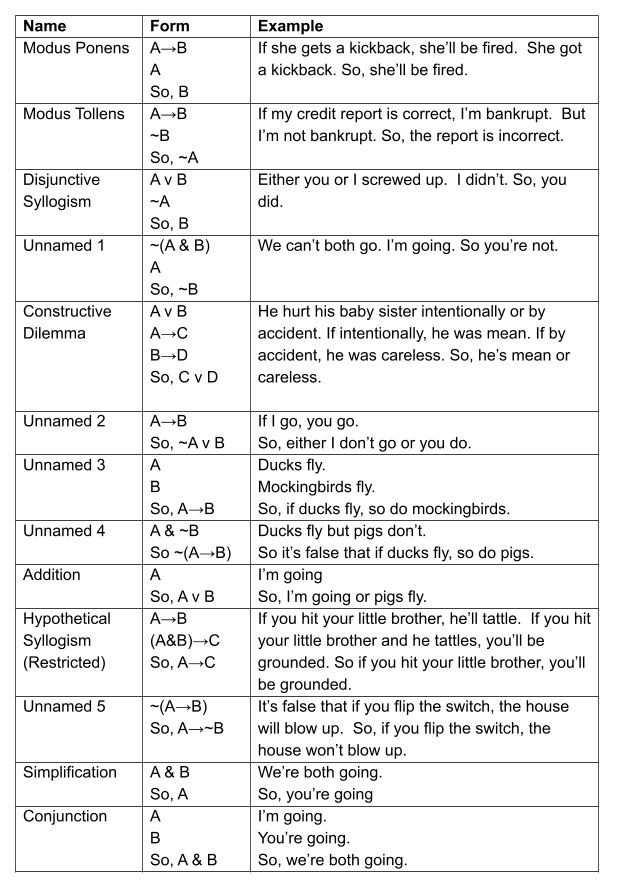
- Modus ponens: Infer Q from P → Q and P.
- Disjunctive syllogism: infer Q from P v Q and ~P.
- An argument in propositional logic is valid if the conclusion can be derived from the premises using a specific list of rules of inference such as:
- Using the form-of-argument approach:
- An argument in propositional logic is valid if there is no way of assigning the truth values T and F to its statement letters that makes the premises true and the conclusion false.
- Not surprisingly, the arguments valid per the rules-of-inference account are the same arguments valid per the form-of-argument account.
Syllogisms and Venn Diagrams
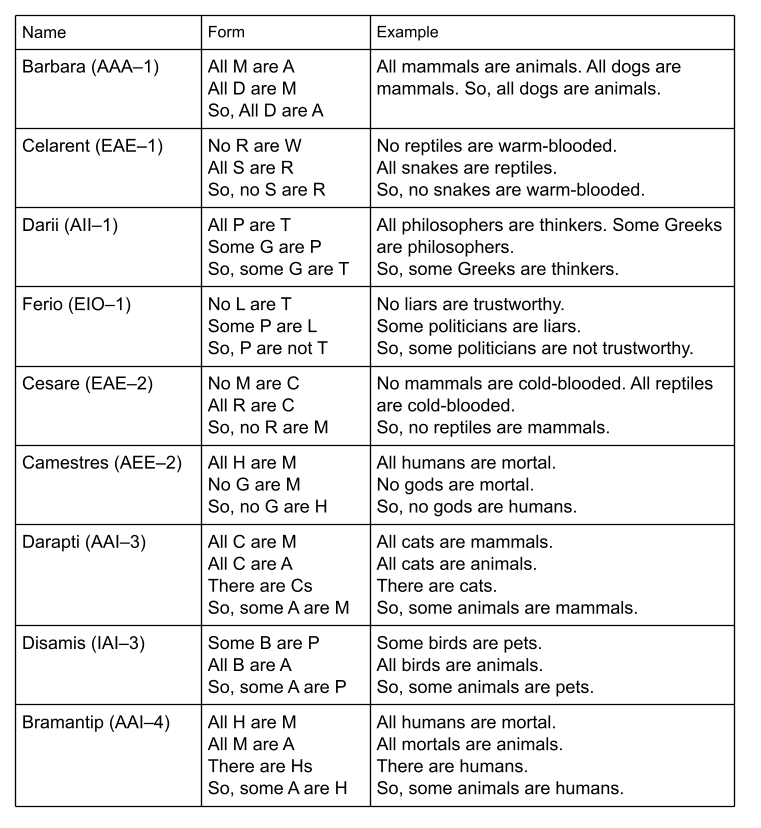
- A syllogism is an argument that has two premises and conclusion, each of which has one of the forms:
- All S are P
- No S are P
- Some S are P
- Some S is not P
- Venn Diagrams are used to determine whether syllogisms are valid.
View Syllogisms and Venn Diagrams
A Variation of the Lottery Paradox
- Here’s a counterexample to the contention that if the premises of a valid deductive argument are each beyond a reasonable doubt then so too is the conclusion.
- A judge conducts 10,000 trials where the defendant is (actually) guilty beyond a reasonable doubt (and not just found guilty). Consider the lengthy argument:
- Defendant 1 is guilty.
- Defendant 2 is guilty.
- …..
- Defendant 10,000 is guilty.
- Therefore, all the defendants, 1 through 10,000, are guilty.
- The argument is valid. Suppose the judge learns that DNA evidence has exonerated one of the defendants, but she doesn’t know which one. The conclusion is thus false: not all the defendants are guilty. So at least one premise is false. Yet each premise remains beyond a reasonable doubt, since a 1/10000 possibility of innocence doesn’t undermine the evidence of guilt beyond a reasonable doubt. (Or make it a billion defendants.)
- Therefore,
- The lengthy argument is valid,
- Each premise is beyond a reasonable doubt,
- The conclusion is not beyond a reasonable doubt.
- So the following principle is not logically necessary:
- If the premises of a valid deductive argument are beyond a reasonable doubt then the conclusion is beyond a reasonable doubt.
- There are two ways of dealing with the counterexample.
- The first is to add other things being equal to the principle:
- If the premises of a valid deductive argument are beyond a reasonable doubt then, other things being equal, the conclusion is beyond a reasonable doubt.
- The second is to argue that the phrase the premises are beyond a reasonable doubt is ambiguous.
- The phrase may be understood distributively, meaning that each premise is beyond a reasonable doubt.
- In this case the counterexample is successful.
- But the phrase may also be understood collectively, so that the principle is:
- If it’s beyond a reasonable doubt that every premise of a valid argument is true, the conclusion is beyond a reasonable doubt.
- The phrase may be understood distributively, meaning that each premise is beyond a reasonable doubt.
Sundry Valid Argument Forms
From Propositional Logic
Syllogisms from Aristotle
From Predicate Logic

Multiple Senses of To Be
- The is of predication ascribes a property to something or someone, e.g. that dynamite is dangerous, that George Washington was 6 feet 2 inches tall.
- The is of identity states that things are the same thing, e.g. that Mark Twain is Samuel Clemens, that water is H20.
- The is of existence asserts that something exists, e.g. that there are ghosts, that there is someone at home, that there is a solution, that I think therefore I am.
- The is of definition expresses a definition, e.g. that a square is a rectangle with four equal sides, i.e. the word “square” means rectangle with four equal sides.
- The is of class membership asserts that a thing belongs to a class, e.g. that a whale is a mammal.
- The is of class identity asserts that groups of things are identical, e.g. that these three books are the authoritative works on the president’s life.
- See plato.stanford.edu/entries/modality-varieties and plato.stanford.edu/entries/logical-consequence ↩︎
Answers
- Most US citizens speak English
- Invalid
- Refutation by Logical Analogy
- Most Texans are US citizens (true)
- Most US citizens do not live in Texas (true)
- Therefore, most Texans do not live in Texas (false
- 1 = 0.9999999
- Valid
- The derivation is a mathematical proof that 1 = 0.9999999…
- Statements #1, #3, and #4 are self-evident premises.
- Statement #2 is derived from #1 using the principle that
- if a = b and both a and b are multiplied by the same number n, then n x a = n x b.
- Statement #4 is derivied from #2, #3, and #4 by the transitivity of identity:
- a = b
- b = c
- Therefore a = c
- Ray Charles is blind
- Invalid
- There are multiple senses of the verb to be:
- The Ray Charles argument is valid only if the is of identity is used throughout the argument. But the first two premises use the is of predication:
- But not all premises of the Ray Charles argument use the is of identity:
- Ray Charles is blind, i.e. has the condition of being blind
- Love is blind, i.e. has the condition of being blind
- God = Love.
- Therefore, Ray Charles = God.
- Asserting that Ray Charles and love are blind ascribes to each the condition of blindness; it doesn’t say they’re identical to that condition. By contrast, the final premise and conclusion use the is of identity, asserting God is the same thing as Love and that Ray Charles is the same thing as God. The argument is thus invalid, having same form as the argument:
- Ernest Hemingway was American-born.
- Mark Twain was American-born.
- Samuel Clemens = Mark Twain.
- Therefore Ernest Hemingway = Samuel Clemens
- Everything ceases to exist at some time or other
- Invalid
- The argument can be rephrased:
- Everything is such that there is a time when it no longer exists.
- Therefore, there is a time such that everything no longer exist at that time.
- Refutation by logical analogy:
- Every integer is such that there is an integer greater than it. (true)
- There is an integer such that every integer is greater than it. (false)
- The argument, translated into predicate logic, is invalid:
- (x)(Ey)Gyx
- Therefore, (Ey)(x)Gyx
- where Gyx = integer y is greater than integer x.
- No integer is greater than itself
- Valid
- If there’s an integer greater than all integers, then it’s greater itself.
- But no integer is greater than itself, per the first premise.
- Therefore, my modus tollens, there’s no integer greater than all integers.
- The argument is valid in predicate logic, where G means greater than:
- ~(Ex)Gxx
- ~(Ex)(y)Gxy
- Total pacifism is a good principle
- Invalid
- Fallacy of Affirming the Consequence
- Invalid argument form
- A → B
- B
- Therefore, A.
- Living human beings have brains
- Valid
- If human zygotes were living human beings they would both have brains (because they’re human beings) and not have brains (because they’re human zygotes). But that’s impossible. So human zygotes aren’t living human beings.
- The argument in predicate logic:
- (x)(Hx → Bx)
- (x)(Zx → ~Bx)
- So, (x)(Zx → ~Hx)
- Mark is eligible for paid vacation
- Invalid
- To say that A only if B is to say that B is a necessary condition of A.
- Thus to say that a gun fires only if there’s a live round in the chamber is to say that a live round in the chamber is a necessary condition for the gun firing, i.e. that the gun won’t fire without a live round in the chamber.
- To say that Mark is eligible for paid vacation only if he has been employed for at least 90 days is to say that being employed for at least 90 days is a necessary condition for being eligible for paid vacation, i.e. he’s not eligible if hasn’t been employed for 90 days (~E → ~90)
- What it doesn’t say is that being employed for 90 days is a sufficient condition for being eligible, i.e. if he’s been employed for 90 days then he’s eligible (90 → E).
- The defendant’s statement
- Invalid
- Refutation by Logical Analogy
- The statements that all swans are white and that no swans are white cannot both be true (assuming there are swans).
- The statement that all swans are white is false. (Black swans exist.)
- Therefore, the statement that no swans are white is true. (false)
- Some people speak both
- Invalid
- Refutation by Logical Analogy:
- Some integers are both odd and greater than 10, e.g. 11
- Some integers are both greater than 10 and even, e.g. 12
- Therefore some integers are both odd and even. (false)
- Sam speaks French or German
- Invalid
- Counterexample: Sam speaks only German.
- In which case the premises are true and the conclusion false
- There will be no bonus
- Valid
- “A unless B” means “A if not B”.
- Thus to say that there will be no bonus unless the company makes a profit is to say that there will be no bonus if the company does not make a profit.
- The argument is thus valid per modus tollens:
- P → Q and ~Q therefore ~P.
- Without both
- Valid
- The first premise says they won’t cash your check if you don’t have both a driver’s license and a credit card.
- ~(D & C) → ~M
- That you don’t have a credit card logically implies you don’t have a driver’s license and a credit card.
- ~C entails ~(D & C)
- So by modus ponens they won’t cash your check.
- Not everyone who’s wealthy
- Invalid
- Refutation by Logical Analogy
- Not every integer greater than 10 is less than 7, e.g 11.
- True
- Not every integer less than 7 is greater than 5, e.g. 4.
- True
- Not every integer greater than 10 is greater than 5
- False
- Not every integer greater than 10 is less than 7, e.g 11.
- All and only conscious beings
- Valid
- That all and only conscious beings have souls implies that every conscious being has a soul.
- If dogs were conscious beings, then, they would have souls.
- But they don’t.
- So they’re not conscious beings.
- The Theory of Evolution and Genesis
- Valid
- There’s strong evidence that that theory of Evolution is true (premise 3).
- The Theory of Evolution and Genesis cannot both be true (premise 1).
- If (i) A is evidence for B and (ii) B and C are incompatible, then A is evidence that C is false.
- Hence, there’s strong evidence that Genesis is false. (~G)
- If the Bible is the inerrant word of God, Genesis is true. (B → G)
- B → G and ~G logically entail ~B, by modus tollens.
- If (i) A is evidence for B and (ii) B logically entails C, then A is evidence for C.
- Therefore, there’s strong evidence that the Bible is not the inerrant word of God.
- If human beings have free will
- Valid
- Form of Argument
- F → C
- C → T
- ~T
- So, ~F
- ~C follows from C → T and ~T by modus tollens
- ~F follows from F → C and ~C by modus tollens
- Most college graduates
- Invalid
- Refutation by Logical Analogy
- Most integers among the integers 11, 12, and 13 are odd numbers. (true)
- So, most odd numbers are among the integers 11, 12, and 13. (false)
- If the Bible is the word of God
- Valid
- Form of Argument
- B → T
- T → P
- T → D
- ~(P & D)
- So, ~B
- The first three premises imply B → (P&D)
- ~B follows from B → (P&D) and ~(P & D) by modus tollens
- If the creation story in Genesis
- Valid if the argument is this:
- Gen → No sun for first three days
- No sun for first three days → Days
- No sun for first three days → ~Sun
- ~Sun → (~Days &~Nights)
- So, ~Gen
- The argument is valid because, according to the argument, if there is no sun for the first three days then, during that time, there were days (three of them) and there were no days (no sun), which is impossible. Therefore:
- Gen → No sun for first three days
- No sun for first three days → (Days & ~Days)
- Therefore, Gen → (Days & ~Days).
- ~Gen follows by modus tollens since it can’t be true that Days & ~Days.
- Valid if the argument is this:
- If the theory of evolution were true
- Valid by modus tollens:
- E → G
- ~G
- So, ~E
- Valid by modus tollens:
- If there’s free will
- Valid
- The argument has a valid form in Predicate Logic:
- F → ∀x(Px → ∃y(My & Cxy))
- ∀x∀y(Px & My & Cxy → ∀z(Izy → Cxz))
- ∀x(Mx → ∃y(Ny & Iyx))
- ∀x∀y(Px & Ny → ~Cxy)
- So, ~F
- where F: there is free will, P: is a person, M: is a physical movement, C: controls, I: initiates, N: is neurons firing in the motor cortex
- If Earth rotated on its axis
- Valid by modus tollens
- R → H
- ~H
- So, ~R
- Valid by modus tollens
- Any being that knows beforehand
- Valid
- Argument in Predicate Logic
- ∀x∀y(Kxy & Dy & Pxy → Rx)
- ∃xDx
- ∀x∀y(Sx & Dy → Kxy))
- ∀x∀y(Sx & Dy → Pxy))
- ∀x(Sx → ~Rx)
- So, ~∃xSx
- where
- D: is a disaster that results in the suffering and death of innocent children.
- K: x knows beforehand that y will occur
- P: x could have prevented y
- R: is morally reprehensible
- Informal proof
- Suppose a and b are any entities such that Sa and Db
- Then
- Kab by premise 3
- Pab by premise 4
- Kab & Db & Pab → Ra by premise 1
- Therefore Ra by modus ponens
- Sa → ~Ra by premise 5
- ~Sa by modus tollens
- ∀x~Sx, since a was any entity
- Therefore ~∃xSx
- For everything that begins to exist
- Valid per Predicate Logic (universal specification and modus ponens)
- ∀x(Bx → ∃y(Cyx & y≠x))
- Bu
- So, ∃y(Cyu & y≠u)
- where B: begins to exist, C: 1 caused 2 to exist, and u = the universe.
- Valid per Predicate Logic (universal specification and modus ponens)
 A Philosopher's View