Argumentation (Dialectic) is the exchange of arguments, objections, and replies in the hope of shedding light on the matter at issue
Outline
Argumentation
- Progress in philosophy is often made through argumentation (dialectic), the exchange of arguments, objections, and replies in the hope of shedding light on the matter at issue.
- American Heritage Dictionary
- Dialectic is the art or practice of arriving at the truth by the exchange of logical arguments.
- Merriam-Webster
- Dialectic is discussion and reasoning by dialogue as a method of intellectual investigation
- American Heritage Dictionary
- Examples:
- After a philosopher reads a paper at a philosophy conference, e.g. conferences held by the American Philosophical Association, a commentator reads a critique and the audience gets involved.
- A paper published in a philosophic journal, like the Journal of Philosophy or The Philosophical Review, may lead to responses and replies to the responses. For example, Edmund Gettier’s three-page 1963 paper “Is Justified True Belief Knowledge?” led to the publication of hundreds of papers over the course of a decade.
- From the history of philosophy:
- Plato’s works consist of dialogues in which the Socrates character, representing Plato, engages in dialectic with often bewildered opponents.
- Immanuel Kant developed his philosophic system as an “answer to Hume,” responding to David Hume’s skeptical critique of metaphysics.
- Contemporary analytic philosophy is in part a reaction to the crazy metaphysics of the 19th century.
Responding to a Claim
Ways of Replying to a Doubtful claim
Appropriate Ways
Setting forth an argument refuting the claim
- Claim
- A person comes into being at conception as a single-celled human zygote.
- Refutation
- Persons are conscious. But, without a brain, a human zygote is not even sentient.
Requesting an argument for the claim
- Claim
- A person comes into being at conception as a single-celled human zygote.
- Request Argument
- What’s your reason for thinking that a person comes into being at conception rather than later in fetal development?
Less Appropriate Way
Bypassing the claim by making a counterclaim
- Claim
- A person comes into being at conception as a single-celled human zygote.
- Counterclaim
- You’re wrong. A person comes into being when they develop a functioning brain.
Inappropriate Way
Diverting attention with an irrelevant comment
- Claim
- A person comes into being at conception as a single-celled human zygote.
- Irrelevant Comment
- Let me guess. You’re an evangelical.
An Example of Refuting a Claim
Chris Wallace: “That’s not true, Sir.”
- Fox Transcript: ‘Fox News Sunday’ interview with President Trump (foxnews.com)
- TRUMP: I think we have one of the lowest mortality rates in the world.
- WALLACE: That’s not true, sir.
- WALLACE VOICE OVER: All right. It’s a little complicated. But bear with us. We went with numbers from Johns Hopkins University which charted the mortality rate for 20 countries hit by the virus. The US ranked 7th, better than the United Kingdom but worse than Brazil and Russia.
- [Wallace’s refutation of Trump’s claim]
- WALLACE VOICE OVER: The White House went with this chart from the European CDC which shows Italy and Spain doing worse. But countries like Brazil and South Korea doing better. Other countries doing better like Russia aren’t included in the White House chart.
- [Wallace’s criticism of Trump’s argument]
White House Graph
Case Fatality Rate

(Allows users to select countries)
Wallace’s Graph
Mortality Rate
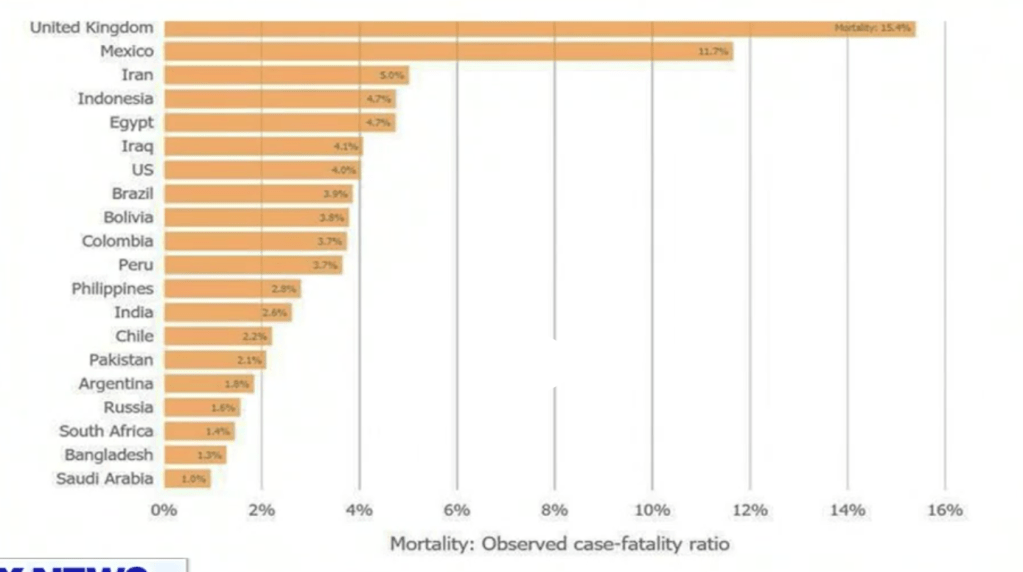
(Does not allow users to select countries)
An Example of Requesting an Argument
Lester Holt: “What evidence do you have?”
- In an interview with NBC’s Lester Holt in 2016, Trump claimed that Clinton’s email server had been hacked? Lester Holt asked “What evidence do you have?” When he got no response, Holt asked again, “But is there any evidence that it was hacked other than routine phishing?” Trump finally said that he heard or read about Clinton’s email being successfully hacked. Asked where he got that information, Trump said, “I will report back to you. I’ll give it to you.” (factcheck.org)
- A person making a claim has the burden of proof, the burden of producing an argument.
Ways of Requesting an Argument for Claim C
- How do you know C?
- Why do you believe C?
- Is there any credible evidence that C is true?
- What are your reasons for believing C?
- What’s the evidence for C?
- What’s the basis for your assertion that C?
- Is there any proof of C?
- What’s your argument for C?
- Can you back up your statement that C?
- What justifies your belief that C?
Advantage of Requesting an Argument over Attempting a Refutation
- When you try to refute a claim you assume the burden of proof. But requesting an argument puts the burden of proof on your opponent.
- Suppose the claim is that the Democrats stole the 2020 presidential election.
- To refute the claim you would need to prove the election legitimate, a time-consuming task.
- It’s easier to request an argument, for example:
- A: The Democrats stole the 2020 presidential election.
- B: What’s the evidence?
- A: There were a lot of voting irregularities and many questions have been raised.
- B: With so many irregularities, you should be able give me one confirmed case of significant voter fraud.
- A: Sure. I can even give you proof: 2000 Mules.
- B: Great. Let’s take a look at factcheck.org/2022/06/evidence-gaps-in-2000-mules/
- Alternative ending:
- B: With so many irregularities, you should be able give me one confirmed case of significant voter fraud.
- A: But here’s the thing. With election fraud, especially vote-by-mail, you’ll never have proof.
- B: Why would you believe something — something really important — without proof beyond a reasonable doubt?
Responding to an Argument
Ways of Responding to an Argument
- Set forth an argument that refutes one of the premises
- Request an argument for one of the premises
- Set forth an argument that refutes the conclusion
- Prove that the conclusion doesn’t follow from the premises.
- Bypass the argument by making a counterargument or counterclaim
- Divert attention with an irrelevant comment
Appropriate Ways
Setting forth an argument refuting one of the premises
- Argument
- The US was justified in invading Iraq because, based on the intelligence, the US was warranted in believing that Iraq had WMDs that might be used against it.
- Refute a premise
- The US belief that Iraq had WMDs was not warranted, per the Report On the U.S. Intelligence Community’s Prewar Intelligence Assessments on Iraq 2004
Requesting an argument for one of the premises
- Argument
- We need stringent voter fraud laws so that the next presidential election won’t be stolen like the last.
- Request an argument for a premise
- What’s the evidence that the last election was stolen?
Showing that the conclusion doesn’t follow from the premises.
- Argument
- A person comes into being at conception because the human zygote has the full complement of 23 pairs of human chromosomes.
- The conclusion doesn’t follow from the premises
- A red blood cell also has 23 pairs of chromosomes but it’s not a person. So the fact that a zygote has 23 pairs of chromosomes doesn’t mean it’s a person.
Setting forth an argument refuting the conclusion
- Argument
- Killing a person is wrong because it deprives the victim of a future conscious life yours and mine. Abortion is wrong for the same reason: that it deprives the fetus of a future conscious life like yours and mine.
- Argument that refutes the conclusion
- The problem with your argument is that killing a fetus is not morally wrong because a fetus is not yet a person.
Less Appropriate Way
Bypassing the argument by making a counterclaim
- Argument
- Killing a person is wrong because it deprives the victim of a future conscious life yours and mine. Abortion is wrong for the same reason, that it deprives the fetus of a future conscious life like yours and mine.
- Counterclaim
- You forget that a woman has a right to control her body and her pregnancy.
Inappropriate Way
Diverting attention with an irrelevant comment
- Argument
- Killing a person is wrong because it deprives the victim of a future conscious life yours and mine. Abortion is wrong for the same reason: that it deprives the fetus of a future conscious life like yours and mine.
- Irrelevant comment
- That’s a silly academic argument. Abortion is a real problem with real consequences.
Addendum
- Irrelevant Comments
- Common Missteps
- Analysis of a Dialectic
- Burden of Proof
- Beyond a Reasonable Doubt
- Difference between Dialectic and Debate
- Kinds of Arguments
- Assessment of the claim that the federal indictments of Trump are politically motivated
Irrelevant Comments
- Ad Hominem
- An ad hominem is a remark directed at a person’s character, motives, beliefs, predispositions, biases, or other personal attributes rather than to the substance of their claim, proposal, or argument.
- View Ad Hominem
- Ignoratio Elenchi
- Ignoratio Elenchi (Irrelevant Refutation, Irrelevant Conclusion) is an attempted refutation that fails because it’s irrelevant to the claim or argument set forth.
- View Ignoratio Elenchi
- Red Herring
- A remark intended to distract from the matter at hand.
- View Red Herring
- Whataboutism
- Diverting attention from a criticism by alleging it applies to others as well.
- View Whataboutism
View Artifices of Deception and Distraction
Common Missteps
- Bypassing opponent’s claims and arguments
- Extraneous Remarks
- Ad Hominem
Analysis of a Dialectic
- Dialectic on Abortion, With Commentary
- Connor
- In our democracy it’s the citizens, through their elected representatives, who decide whether murder, euthanasia, rape, suicide, and other conduct violates moral standards and should be punished as a crime. The same is true for abortion.
- Comment
- Connor puts forth the argument:
- In our democracy citizens decide matters through their elected representatives,
- Therefore, citizens should decide abortion matters through their elected representatives.
- Connor puts forth the argument:
- Libby
- The vast citizenry of America are NOT in favor of banning abortion.
- To find out what the kinds of abortion laws people want, there should be a referendum in all states on the extent of abortion restrictions people want in each state.
- Comment
- Libby replies that the citizens do not favor banning abortion.
- Connor
- Congress passing a national abortion law would be unconstitutional, since usurping a power reserved to the individual states violates the Tenth Amendment.
- The states should have full control over their own environment and living conditions. There’s no good reason for people in California or New York to vote on legislation that affects Texans.
- Comment
- Connor replies that it doesn’t matter that most US citizens are against banning abortion because Congress doesn’t have the power to pass a national abortion law (because of the Tenth Amendment).
- Libby
- I think you may have forgotten, or more likely, do not care, that we are one country under GOD. You would have fought hard for the Confederacy if you lived in the 1860’s. Why should New York tell us we cannot have slaves! DAMN YANKEES!!
- Comment
- Libby doesn’t reply to Connor’s argument that a national abortion law would be unconstitutional
- Instead Libby launches an ad hominem attack.
- Connor
Burden of Proof
- A person making a claim has the burden of proof
- A person making a claim has the burden of proof, the obligation to prove the claim beyond a reasonable doubt.
- Politifact
- The burden of proof is on the speaker, and we rate statements based on the information known at the time the statement is made.
- Law
- In a criminal proceeding the prosecution bears the burden of proof for the facts it alleges.
- Corollary
- What is asserted without evidence may be dismissed without evidence.
Beyond a Reasonable Doubt
- The standard of evidence is beyond a reasonable doubt
- Beyond a reasonable doubt is the standard of evidence for criminal trials in the United States and Great Britain. It’s also the standard used in everyday affairs.
- In the law reasonable doubt is described as the kind of doubt that would make a reasonable person hesitate to act in the most important of his affairs.
- It is beyond a reasonable doubt that is weaker than it is certain that and stronger than it is very likely that.
- View Beyond a Reasonable Doubt
Difference between Dialectic and Debate
- Philosophic dialectic and formal debate both involve exchanging arguments, objections, and replies. The difference is that the objective of the former is finding the truth; the objective of the latter winning the debate.
Kinds of Arguments
- An argument is an instance of reasoning, from premises to a conclusion.
- A deductive argument is an argument whose conclusion (purportedly) follows necessarily from its premises.
- An evidential argument is an argument whose premises are evidence (purportedly) making its conclusion probable.
- A normative argument is an argument whose premises are (purportedly) reasons why a particular action should (or shouldn’t) be done.
- An analogical argument is an argument that, because things are alike in certain respects, they are therefore (purportedly) alike in a further respect.
Assessment of the claim that the federal indictments of Trump are politically motivated
- The claim: that the federal indictments of Trump are politically motivated
- There are two ways of responding to an unsupported claim:
- Request evidence
- Try to refute the claim.
- Asking for evidence
- A person who makes a claim has the burden of proof.
- So in this case we can ask:
- What’s the evidence that the grand jury’s indictment (or the prosecutor’s presentation to the grand jury) was politically motivated rather than the result of an impartial assessment of the evidence and law?
- Refuting the claim
- Argument to prove the claim false
- If the Trump indictments were politically motivated, then if Trump had not been the likely Republican nominee he would not have been indicted on the basis of the facts and the law presented in the indictment.
- But non-politicians have been prosecuted for the same crimes as Trump based on similar facts.
- Therefore it’s false that had Trump had not been the likely Republican nominee he would not have been indicted on the basis of the facts and the law presented in the indictment.
- Therefore the Trump indictments are not politically motivated
- Form of Argument is Modus Tollens
- P → (~L → ~I )
- ~(~L → ~I )
- Therefore ~P
- Support for Premise 2:
- Cases where non-politicians have been prosecuted for the same crimes as Trump based on similar facts:
- Documents Case
- Fact check: Multiple non-spies have received prison sentences under Espionage Act provision Trump is charged with violating, Daniel Dale CNN Facts First
- Election Conspiracy Case
- The facts of the case are unique since it’s a former president who’s charged with conspiracy to remain in office after losing an election.
- But many people are charged under the same statutes as Trump.
- 18 USC 371 Conspiracy to Defraud the United States
- People are charged under 18 USC 371 for various kinds of fraud, eg. healthcare fraud, wire fraud, bank fraud, and securities fraud.
- 18 USC 1512 Obstruction of and Attempt to Obstruct an Official Proceeding
- This statute has been used to prosecute hundreds of Capitol rioters.
- 18 USC 241 Conspiracy Against Rights
- Section 241 is used in cases involving law enforcement misconduct
- 18 USC 371 Conspiracy to Defraud the United States
- Documents Case
- Cases where non-politicians have been prosecuted for the same crimes as Trump based on similar facts:
- Argument to prove the claim false
- Judge Chutkan on the claim:
- Trump Barred From Releasing Sensitive Evidence in Jan. 6 Case WSJ
- The judge [Tanya Chutkan] interrupted Trump’s lawyer, John Lauro, when he said the Justice Department’s goal was to interfere with Trump’s ability to run for president. “I’m not going to accept that,” she said. “I have seen no evidence that this is politically motivated.”
- Trump Barred From Releasing Sensitive Evidence in Jan. 6 Case WSJ
 A Philosopher's View