- Mathematica Program for Single Transferable Vote and Ranked Choice Voting
- Scenario
- Initialization Program
- Flowchart
- Outline
- Program
- Summary and Rounds
- Subroutines
- Mathematica Program for Largest Remainder
- Mathematica Program for Highest Average
Mathematica Program for Single Transferable Vote and Ranked Choice Voting
Scenario
- Number of Seats = 5
- Candidates
- Orange Party: O1, O2, O3, O4, O5
- Green Party: G1, G2, G3, G4, G5
- Number of Votes = 500
- Votes for Orange Candidates = 265
- Votes for Green Candidates = 235
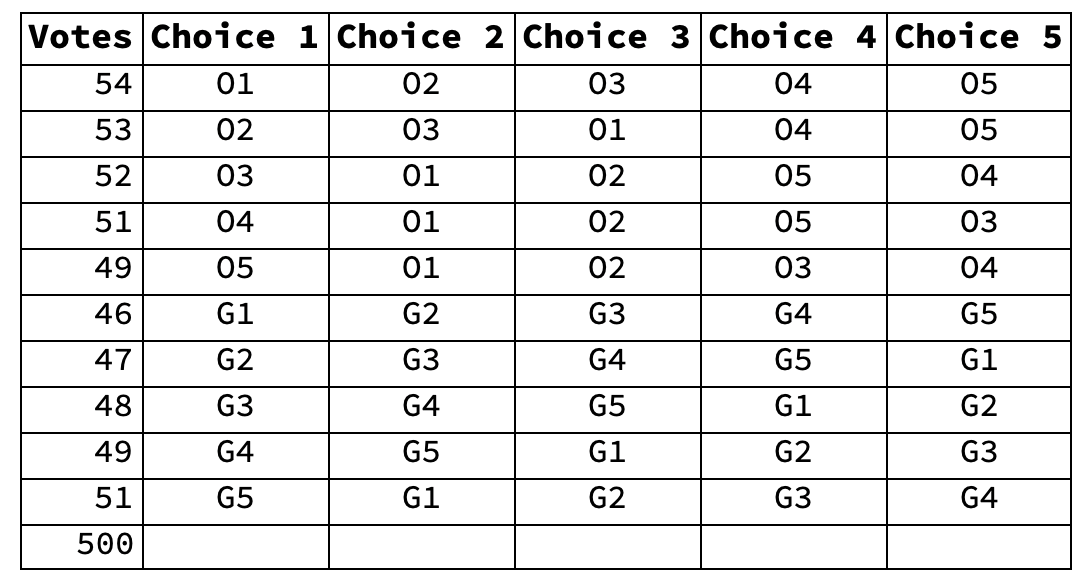
- Ballot Spreadsheet
Initialization Program
- This program
- initializes the Ballot Spreadsheet
- initializes the variables nbrofseats and can
- calculates the quota
- (* Initialize Variables *)
- nbrofseats = 5;
- (* Candidates *)
- can ={O1, O2, O3, O4, O5, G1, G2, G3, G4, G5};
- (* Initialize the Ballot Spreadsheet.
- Columns: ballot id, votes, first choice, second choice, third choice, etc
- The number after each ballot is the number of ballots. So, for example, there are
- 54 ballots with preference list O1, O2, O3, O4, O5. *)
- ballots = Join[
- Table[PadRight[{1, 1, O1, O2, O3, O4, O5}, 10], 54],
- Table[PadRight[{2, 1, O2, O3, O1, O4, O5}, 10], 53],
- Table[PadRight[{3, 1, O3, O1, O2, O5, O4}, 10], 52],
- Table[PadRight[{4, 1, O4, O1, O2, O5, O3}, 10], 51],
- Table[PadRight[{5, 1, O5, O1, O2, O3, O4}, 10], 49],
- Table[PadRight[{6, 1, G1, G2, G3, G4, G5}, 10], 46],
- Table[PadRight[{7, 1, G2, G3, G4, G5, G1}, 10], 47],
- Table[PadRight[{8, 1, G3, G4, G5, G1, G2}, 10], 48],
- Table[PadRight[{9, 1, G4, G5, G1, G2, G3}, 10], 49],
- Table[PadRight[{10, 1, G5, G1, G2, G3, G4}, 10], 51]];
- (* Calculate the Droop Quota *)
- quota = Floor[(Length[ballots]/(nbrofseats + 1))] + 1;
- (* Make the Ballot Spreadsheet the first entry in a sequence of spreadsheets *)
- ball = {ballots};
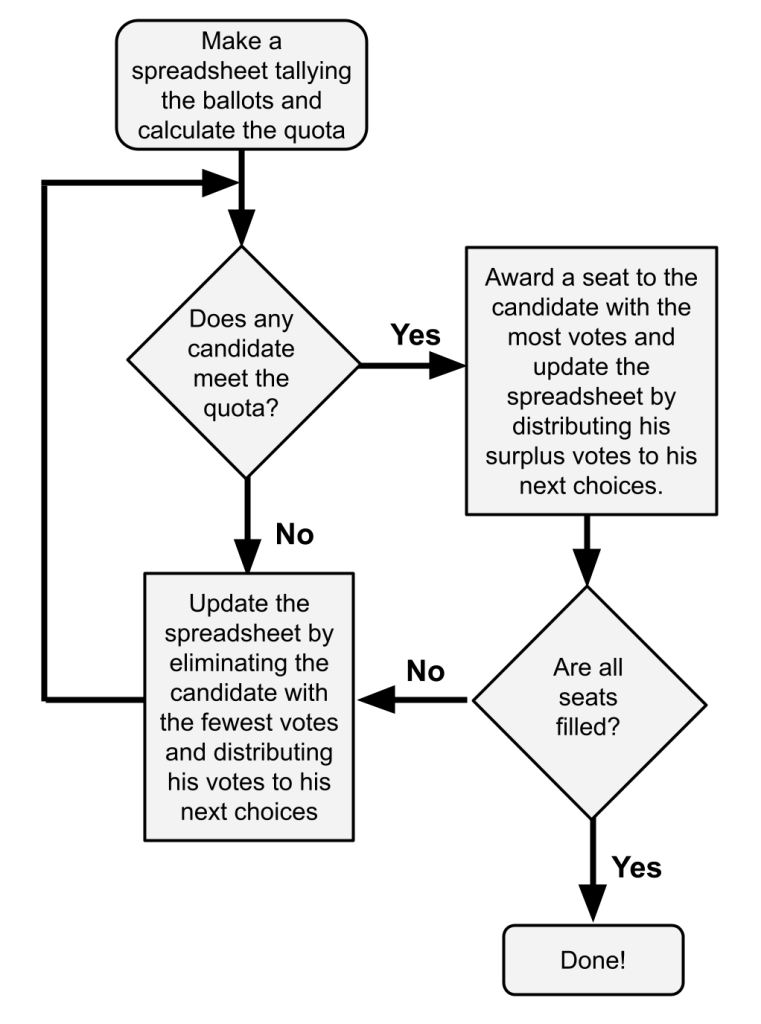
Flowchart
Outline
- (*
- Start of Program
- Make ballot spreadsheet
- Calculate quota
- Start of Loop
- The program scans the Ballot Spreadsheet to see whether any candidate’s votes meet or exceed the quota.
- If so:
- Process Top-Vote-Getter
- The top vote-getter wins a seat and the Ballot Spreadsheet is updated as follows:
- The winner’s surplus votes are transferred to all his next choices.
- (surplus votes = winner’s votes minus the quota)
- The winner is erased from the spreadsheet.
- The program checks whether all seats are filled.
- If so, it goes to End of Program
- If not, it goes to Process Lowest-Vote-Getter
- If not:
- Process Lowest-Vote-Getter
- The lowest vote-getter is eliminated and the Ballot Spreadsheet is updated as follows:
- All the eliminated loser’s votes are transferred to his next choices.
- The loser is erased from the spreadsheet.
- End of Loop
- End of Program
- *)
Program
- n=1; winner = 0; votes = 0; surplus=0; ProcessLoserY1N0 = 0;
- winnerlist = List[]; loserlist = List[]; winloss = List[];
- Do[ (* BEGIN DO LOOP *)
- If[Total[ball[[n]][[All,3]]]==0,Print[“No More Candidates”]; Break[]];
- {winner,votes,surplus} = topwinner[ball[[n]],can,quota];
- If[winner > 0, (* if winner *)
- (* Process winner *)
- AppendTo[winnerlist,winner];
- AppendTo[winloss,(winner 10)];
- balltmp1 = DistributeWinnerSurplus[ball[[n]],winner,surplus];
- balltmp2 = EliminateCandidate[balltmp1,winner];
- ball = Join[ball,{Null}];
- n = n + 1;
- balltmp3 = Select[balltmp2,#[[3]] + #[[4]] + #[[5]] + #[[6]] + #[[7]] + #[[8]] + #[[9]] + #[[10]] > 0&];
- ball[[n]] = balltmp3;
- If[nbrofseats == Length[winnerlist],
- Print[“All Seats Filled”];
- Break[]
- ]; (* end if nbrofseats == *)
- ProcessLoserY1N0 = 1;
- , (* else if no winner *)
- ]; (* end if winner *)
- If[ProcessLoserY1N0 == 1, (* if process loser *)
- loser =bottomloser[ball[[n]],can,quota];
- If[loser > 0, (* if loser > 0 *)
- AppendTo[loserlist,loser];
- AppendTo[winloss,(loser 10)+1];
- balltmp1=EliminateCandidate[ball[[n]],loser];
- balltmp2 =Select[balltmp1,#[[3]] + #[[4]] + #[[5]] + #[[6]] + #[[7]] + #[[8]] + #[[9]] + #[[10]] >0&];
- ball = Join[ball,{Null}];
- n = n+ 1;
- ball[[n]] = balltmp2;
- ]; (* end if loser > 0 *)
- ProcessLoserY1N0 = 0;
- ]; (* end if process loser *)
- , {100}]; (* END DO LOOP *)
- Print[“Winners: “, winnerlist];
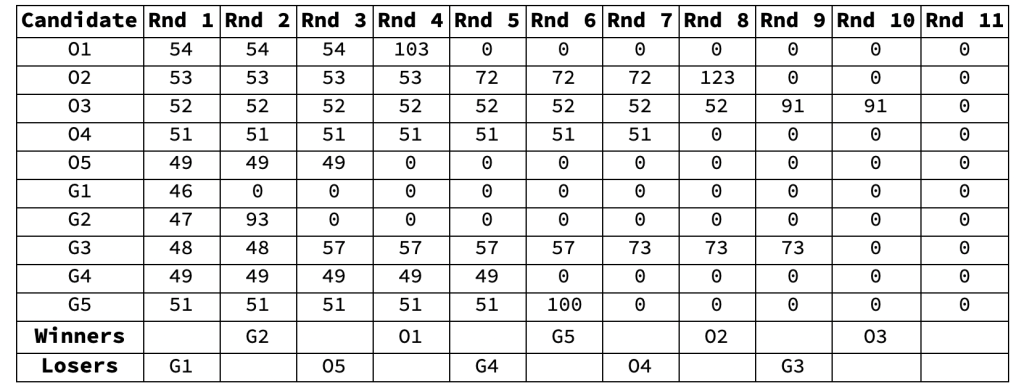
Summary and Rounds
- Number of Seats = 5
- Number of Votes = 500
- Candidates
- Orange Party: O1, O2, O3, O4, O5,
- Green Party : G1, G2, G3, G4, G5
- Quota = (500 / (5 + 1)) + 1 = 84
- Winners: G2, O1, G5, O2, O3
Subroutines
- Subroutine topwinner
- (*
- Winner = the top vote-getter who exceeds quota
- plus the number of his votes and the surplus.
- Winner = 0 if no candidate exceeds quota.
- *)
- topwinner[ball_,can_,quota_] :=
- Module[{voten,winner=0,votes=0,surplus=0,topscore = 0},
- topscore = Max[Table[Total[Select[ball,#[[3]] == n&][[All,2]]],{n,can}]];
- Do[voten =Total[Select[ball,#[[3]] == n&][[All,2]]];
- If[voten>=quota && voten >=topscore,
- winner =n;
- surplus = voten-quota;
- votes = voten;
- Break[]
- ],
- {n,can}];
- {winner,votes,surplus}
- ];
- Subroutine bottomloser
- (*
- Bottomloser = the lowest vote-getter who fails to exceed quota
- Bottomloser = 0 if no candididate fails to exceed quota
- *)
- bottomloser[ball_,can_,quota_] :=
- Module[{voten =0,votesbycan=0,minvote=0,output = 0},
- votesbycan = List[];
- Do[voten =Total[Select[ball,#[[3]] == n&][[All,2]]];
- If[voten >0,AppendTo[votesbycan,{n,voten}]],
- {n,can}];
- minvote = Min[votesbycan[[All,2]]];
- If[minvote>quota,output = 0,
- output =First[Select[votesbycan,#[[2]] == minvote&][[All,1]]];
- output]]
- Subroutine EliminateCandidate
- (*
- Subroutine eliminates can2del from the ballot spreadsheet
- *)
- EliminateCandidate[ball_,can2del_] :=
- Module[{balltmp = List[],pre,core,pos,output},
- If[can2del > 0, (* Begin If can2del *)
- Do[
- pre =Take[ball[[n]],2];
- core =Drop[ball[[n]],2];
- If[Length[Select[core,#==can2del&]] >0, (* Begin if length *)
- pos =Extract[{1}][Flatten[Position[core,can2del]]];
- core =Join[Take[core,pos-1],Take[core,pos-Length[core]],{0}];
- ]; (* End if length *)
- AppendTo[balltmp,Join[pre,core]],
- {n,Length[ball]}]; (* End Do Loop *)
- output =balltmp
- , (* Else if can2del > 0 *)
- ;(* End if can2del > 0 *)
- output
- ];
- Subroutine DistributeWinnerSurplus
- (*
- Subroutine distributes winner’s surplus votes to next choices
- *)
- DistributeWinnerSurplus[ball_,winner_,surplus_] :=
- Module[{record=0,newrecords,multiplier=0},
- multiplier =N[surplus/Total[Select[ball,#[[3]] == winner&][[All,2]]]];
- newrecords = List[];
- Do[
- record =Select[ball,#[[3]] == winner&][[r]];
- record[[2]] = record[[2 ]]multiplier;
- AppendTo[newrecords,record],
- {r,Length[Select[ball,#[[3]] == winner&]]}]; (* Do End *)
- Join[newrecords, Select[ball,#[[3]] != winner&]]
- ]
Mathematica Program for Largest Remainder
- (* Number of Seats *)
- (* Election results for candidates 1, 2, 3, … *)
- can = { {1,463,0,0},{2, 426, 0,0},{3,111,0,0}};
- (* Format of can ={candidate id,votes,seats, remainder} *)
- (* Constants indicating locations of fields in can brackets *)
- fid = 1; fvotes = 2; fseats = 3; fdec = 4;
- totalvotes = Total[can[[All,fvotes]]];
- quota = totalvotes/nbrofseats;
- nbrofparties = Length[can];
- (* Calculate number of seats for each party and remainder *)
- Do[
- can[[n,fseats]]=QuotientRemainder[can[[n,fvotes]],quota][[1]];
- can[[n,fdec]]=N[QuotientRemainder[can[[n,fvotes]],quota][[2]]],
- {n,nbrofparties}];
- (* Calculate remaining number of seats to be filled *)
- seatsneeded =nbrofseats- Total[can[[All,fseats]]];
- (* Add remaining seats to parties with highest remainders *)
- can = ReverseSortBy[can,Last];
- Do[
- can[[n,fseats]] +=1,
- {n,seatsneeded}];
- can = SortBy[can,First];
- (* Print results *)
- Do[
- Print[“Party “,can[[n,fid]], “: “, can[[n,fseats]],” seats”],
- {n,nbrofparties}];
- Print[“Total : “,Total[can[[All,fseats]]],” seats” ];
- Party 1: 5 seats
- Party 2: 4 seats
- Party 3: 1 seats
- Total : 10 seats
Mathematica Program for Highest Average
- (* Number of seats *)
- (* Election results for candidates 1, 2, 3, … *)
- can = { {1, 463, 463, 0}, {2, 426, 426, 0}, {3, 111, 111, 0}};
- (* Can data items = {party identifier, number of votes, running score, number of seats}*)
- (* Constants indicating the location of data items within the can brackets *)
- fid = 1; fvotes = 2; fscore = 3; fseats = 4;
- nbrofparties = Length[can];
- (* Set method to 1 for D’Hondt or 2 for Sainte-Lague *)
- method = 1;
- (* Print[“Round “,0 ,”: “,can]*)
- (* Loop through the rounds, one at a time *)
- Do[
- (* Quit if all seats have been filled *)
- If[Total[can[[All, fseats]]] == nbrofseats, Goto[end]];
- (* Find the (first) winner of the current round *)
- id = First[Select[can, #[[fscore]] == Max[can[[All, fscore]]] &]][[1]];
- (* Increment the winner’s total seats *)
- (* Compute the winner’s score for the next round *)
- can[[id, fscore]] = N[can[[id, fvotes]]/( method can[[id, fseats]] + 1)];
- (* Print[“Round “,n ,”: “,can];*)
- Label[end],
- {n, nbrofseats}]
- (* Print Results *)
- Do[
- Print[“Party “, can[[n, fid]], “: “, can[[n, fseats]], ” seats”],
- {n, nbrofparties}];
- Print[“Total : “, Total[can[[All, fseats]]], ” seats” ];
- Party 1: 5 seats
- Party 2: 4 seats
- Party 3: 1 seats
- Total : 10 seats

 A Philosopher's View