Outline
- Two Basic Kinds of Probability
- Epistemic Probability of a Proposition
- Basic Epistemic Probabilities
- Epistemic Probability is Relative to a Body of Knowledge
- Epistemic Operators
- Various Epistemic Operators
- True and False are Not Epistemic Operators
- Epistemic Operators in the Law, Intelligence Assessment, and Philosophy
- Addendum
Two Basic Kinds of Probability
- Objective (or physical) probability is the kind of probability supported or refuted by relative frequencies. The kind used in statements such as:
- The probability of rolling a seven with two dice is 1/6.
- If both parent pea plants have yellow-green alleles for seed color, the probability that a child plant has yellow peas is 3/4.
- The probability that a free neutron decays within 611 seconds is 1/2.
- Epistemic (or evidential) probability is the kind of probability relative to evidence. The kind used in statements such as:
- The Tunguska Event of 1908 was most likely caused by a meteor.
- The probability of rain tomorrow is 90 percent.
- It’s very likely the defendant is guilty based on the evidence presented at trial.
- An objective probability may be epistemically probable, for example:
- In all likelihood, the probability that a free neutron decays within 611 seconds is 1/2.
Epistemic Probability of a Proposition
- The epistemic probability of a proposition is how much it’s supported by the evidence and arguments.
Basic Epistemic Probabilities
- “In our reasonings concerning matter of fact, there are all imaginable degrees of assurance, from the highest certainty to the lowest species of [probable] evidence. A wise man, therefore, proportions his belief to the evidence.” (David Hume, 1758)

Epistemic Probability is Relative to a Body of Knowledge
- A standard deck of 52 cards is shuffled and placed face-down. Based only on this information, the probability the top card is an ace is 4/52. But for someone who’s peeked at the top card, it’s either certain or impossible that the top card is an ace.
- That is:
- The probability that the top card is an ace is 4/52, based only on the fact that the deck is a well-shuffled standard deck of 52 cards.
- It’s certain that the top card is an ace, based on the the peeker’s evidence that he saw that the top card was an ace.
- It’s impossible that the top card is an ace, based on the the peeker’s evidence that he saw that the top card was not an ace.
Epistemic Operators
- An epistemic operator is a sentential operator expressing a degree or range of epistemic probability.
- It’s certain that
- The probability is 1.0 that
- It’s virtually certain that
- It is beyond a reasonable doubt that
- It’s reasonable to believe that
- It’s very likely that
- There’s clear and convincing evidence that
- There is a preponderance of evidence that
- It’s a toss-up whether
- It’s an open question whether
- There’s probable cause that illegal drugs are in the house.
- It’s uncertain whether
- It’s unknown whether
- There’s a chance that
- It’s possible that
- It’s plausible that
- It’s credible that
- It’s doubtful that
- It’s unlikely that
- There’s a remote possibility that
- It’s far-fetched that
- It’s impossible that
- The probability is zero that
Examples
- It’s certain that the sun will rise tomorrow.
- It’s beyond a reasonable doubt that Russia interfered with the 2016 election in support of Trump.
- In all likelihood Oswald acted alone in assassinating President Kennedy.
- It’s doubtful that Echinacea prevents colds.
- It’s very likely that Jefferson fathered at least some of Sally Hemings’ children.
- The Tunguska Event of 1908 was most likely caused by a meteor.
- The idea the CIA assassinated Kennedy is absurd.
- The nature of dark matter is an open question.
- It’s unlikely the tumor is malignant.
- His statistics are questionable.
- Chances are he died instantly.
- It’s impossible that Frederick Douglass founded the NAACP.
Various Epistemic Operators
Certain, Impossible, and Toss-up
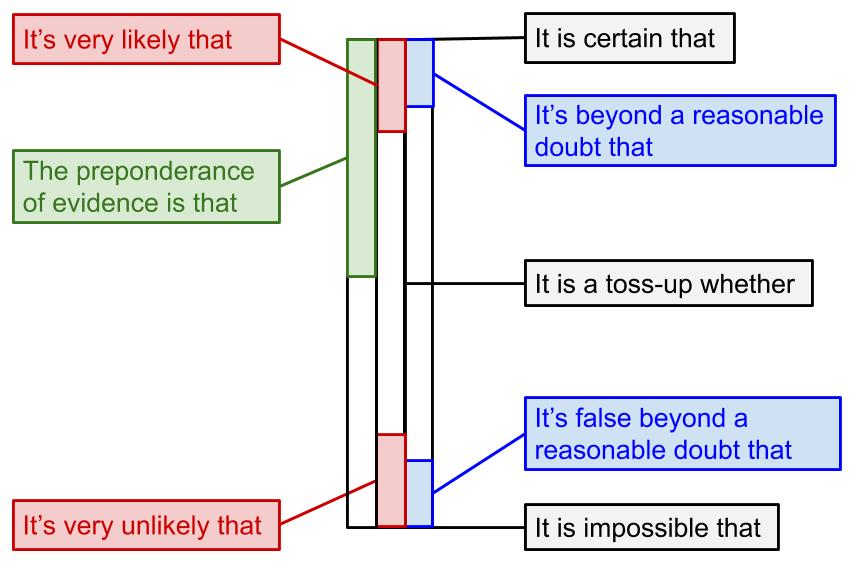
- Certainty and impossibility are the upper and lower bounds of epistemic operators, corresponding to probabilities one and zero.
- A proposition is certain if its falsehood is impossible, if there’s no chance of it being false.
- A proposition is impossible if it’s certainly false, if there’s no chance of it being true. As you read this sentence, for example, it’s certain you have a functioning brain and impossible you don’t.
- Midway between the extremes is toss-up, where the probability of being true equals the probability of being false. Flip a coin and it’s a toss-up whether it lands heads.
- Certainty logically entails truth, as GE Moore noted in “Certainty.”
- Impossibility entails falsehood.
- The epistemic operators between entail neither.
- It is certain that is logically equivalent to:
- it is known that
- it is known for certain that
- it is an established fact that
- Two Senses of Impossible
- Incapability Sense
- It’s impossible to trisect an angle using only a straightedge and compass
- It’s impossible for a human being to run 100 miles an hour.
- It’s impossible that an object with mass be accelerated beyond the speed of light.
- It’s impossible for Smith to rob a bank and be in jail at the time.
- Epistemic Sense
- It’s impossible that Amy is in Alaska, since she’s right next to me here in Texas.
- It’s Impossible that Smith robbed the bank, since he was in jail at the time.
- Incapability Sense
Preponderance of Evidence and Very Likely
- Certainty, impossibility and toss-up are points on the probability continuum. By contrast, preponderance of evidence and very likely are ranges of probabilities, line-segments rather than points.
- A preponderance of evidence exists for a proposition if it’s more probable than not. There’s a preponderance of evidence, for example, that New Year’s resolutions to lose weight don’t survive past February. Preponderance of evidence is the standard of evidence in civil actions, where a plaintiff sues a defendant.
- A proposition is very likely if its probability is significantly greater than 0.5, if it’s in all likelihood true. Flip a coin three times and it’s very likely it lands heads at least once.
Beyond a Reasonable Doubt
- Beyond a reasonable doubt is the standard of evidence for criminal trials in the United States and Great Britain. It’s also the standard used in everyday affairs.
- In the law reasonable doubt is described as the kind of doubt that would make a reasonable person hesitate to act in the most important of his affairs.
- law.cornell.edu/wex/beyond_a_reasonable_doubt
- In a criminal case, the prosecution bears the burden of proving that the defendant is guilty beyond all reasonable doubt. This means that the prosecution must convince the jury that there is no other reasonable explanation that can come from the evidence presented at trial. In other words, the jury must be virtually certain of the defendant’s guilt in order to render a guilty verdict. This standard of proof is much higher than the civil standard, called “preponderance of the evidence,” which only requires a certainty greater than 50 percent.
- Beyond a reasonable doubt is weaker than certain: everything certain is beyond a reasonable doubt, but not the reverse. As I leave work my belief my car is where I parked it is beyond a reasonable doubt, given that locked cars generally stay put. But it’s not certain, since even locked cars are stolen or towed.
- Beyond a reasonable doubt is stronger than very likely: every belief beyond a reasonable doubt is very likely, but not vice versa. It’s very likely you won’t roll two sixes, but not beyond a reasonable doubt.
- Beyond a reasonable doubt seems synonymous with certain for all intents and purposes.
- Reasonable doubt exists if there’s credible evidence the statement is false, if there’s a plausible, competing hypothesis.
- A statement is either:
- true beyond a reasonable doubt, or
- false beyond a reasonable doubt, or
- an open question.
- A person who states something as fact assumes the burden of proof, the burden of proving the statement beyond a reasonable doubt.
True and False are Not Epistemic Operators
- It is true that and it is false that are not epistemic operators
- The epistemic probability of a proposition depends on evidence
- Truth and falsehood depend on reality.
- Consider the hypothesis that Aunt Flo’s tumor is malignant. Its truth depends on whether the tumor is in fact malignant. Its epistemic probability, by contrast, is a function of the evidence: symptoms, family history, blood tests, scans, biopsies.
- Truth and falsehood depend on what’s real; epistemic operators depend on the evidence.

Epistemic Operators in the Law, Intelligence Assessment, and Philosophy
The Law
- Beyond a reasonable doubt: This is the standard of evidence in a criminal trial. The prosecution has the burden of proof, i.e. to prove the defendant guilty beyond a reasonable doubt; otherwise the defendant is found innocent. The law doesn’t define the phrase.
- Clear and convincing evidence: Weaker than beyond a reasonable doubt, this is the standard for removing a child from a home or terminating parental rights. The operator is sometimes said to mean substantially more probable than not.
- Preponderance of evidence: This is the standard used in civil cases, where a plaintiff sues a defendant. The operator means more probable than not.
- Probable cause: This is the standard used by police to arrest or search a person without a warrant.
- Reasonable suspicion: A police officer is justified in stopping and briefly detaining a person if there’s a reasonable suspicion of involvement in a crime
Intelligence Assessment
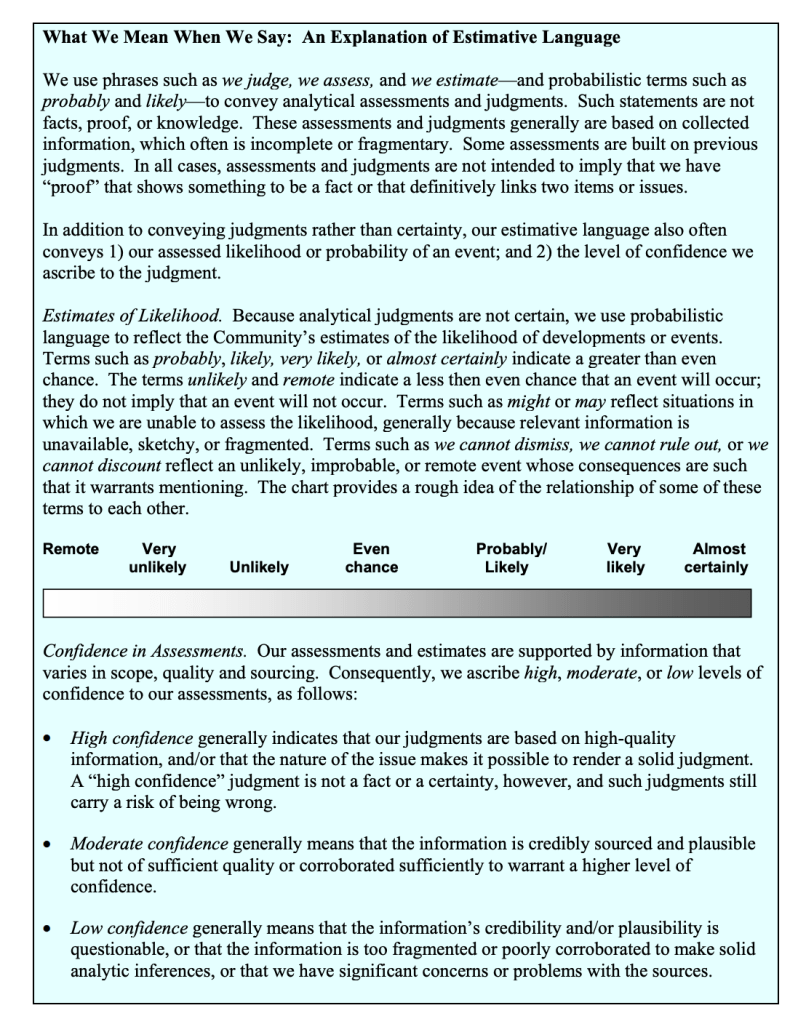
- National Intelligence Estimates are summaries of the intelligence assessments of sixteen agencies of the United States Government, including the CIA, the Department of Defense, and the Department of Justice.
- Intelligence assessments have the form:
- We judge (assess) with high (moderate, low) confidence that X
- We judge (assess) with high (moderate, low) confidence that it is likely (unlikely, very likely, very unlikely, almost certainly, remotely possible, an even chance) that X
- For example:
- We assess with low confidence that Iran probably has imported at least some weapons-usable fissile material, but still judge with moderate-to-high confidence it has not obtained enough for a nuclear weapon.
- We judge with moderate confidence that the earliest possible date Iran would be technically capable of producing enough HEU for a weapon is late 2009, but that this is very unlikely.
- From a National Intelligence Estimate:
- Links
Philosophy
Theory of Knowledge, 3rd Edition, Roderick Chisholm
- Basic Locution:
- Doxastic attitude A is at least as justified for S as doxastic attitude B, where doxastic attitudes are:
- believing P
- disbelieving P (believing ~P)
- withholding P (neither believing nor disbelieving P)
- Doxastic attitude A is at least as justified for S as doxastic attitude B, where doxastic attitudes are:
- Definitions
- Doxastic attitude A is more justified for S than doxastic B =df it is false that B is at least as justified for S as is A
- P is certain for S =df for every Q, believing P is more justified for S than withholding Q, and believing P is at least as justified for S as is believing Q
- P is obvious for S =df for every Q, S is more justified in believing P than in withholding Q
- P is evident for S =df for every proposition Q, believing P is at least as justified for S as withholding Q
- P is beyond reasonable doubt for S =df S is more justified in believing P than in withholding P
- P is epistemically in the clear for S =df S is not more justified in withholding P than in believing P
- P is probable for D =df S is more justified in believing P than in believing ~P
- P is counterbalanced for S =df S is no more justified in believing P than believing ~P and S is no more justified in believing ~P than believing P
- Axioms
- A1: If A is more justified than B for S, then B is not more justified than A for S
- A2: If A is more justified than B for S and if B is more justified than C for S, then If A is more justified than C for S
- A3: If P&Q is beyond reasonable doubt for S, then believing P&Q is more justified for S than believing P and withholding Q.
- A4: If anything is probable for S, then something is certain for S.
- A5: If S knows that P, then, if S believes that he knows that P, S knows that he knows that P
Addendum
- Knowledge
- Prove, Show, Establish, Disprove, Refute
- Principle of Indifference and Indeterminate Probabilities
- Sentential Operators
Knowledge
- Two millennia ago Plato proved that knowledge is not the same thing true belief.
- “Suppose a jury has been justly persuaded of some matter which only an eyewitness could know, and which cannot otherwise be known; suppose they come to their decision based on hearsay, forming a true belief: then they have decided the case without knowledge.”
- Plato’s Theaetetus
- “Suppose a jury has been justly persuaded of some matter which only an eyewitness could know, and which cannot otherwise be known; suppose they come to their decision based on hearsay, forming a true belief: then they have decided the case without knowledge.”
- Thus the jurors form a true belief about some matter — let’s say that the defendant stole the jewels — but they don’t know that the defendant is guilty because their belief is based only on hearsay.
- So, Plato concluded, knowledge is more than just true belief. But what more is it?
- A plausible suggestion is that knowledge is true belief plus certainty.
- That is, a person knows that P if and only if:
- it’s true that P
- the person believes that P
- it is certain that P, based on the person’s evidence.
- Thus, to say that a witness knows that the defendant stole the jewels is to say, not only that the witness correctly believes that the defendant is guilty, but also that the witness has evidence that makes it certain the defendant is guilty.
- View Analysis of Knowledge.
Prove, Show, Establish, Disprove, Refute
- Arguments or evidence establish, show, or prove a proposition if they make it true beyond a reasonable doubt.
- From Merriam-Webster:
- Prove
- to establish the existence, truth, or validity of (as by evidence or logic)
- Show
- to demonstrate or establish by argument or reasoning
- Establish
- to put beyond doubt : prove
- Prove
- Arguments or evidence disprove or refute a proposition if they make it false beyond a reasonable doubt.
Principle of Indifference and Indeterminate Probabilities
Easy Problem
- An urn has 100 balls, 50 red, 50 white. You randomly select a ball. It’s clear that the probability the ball is red is 0.5, other things being equal. Or, in other words:
- The odds are even the ball is red.
- There’s a 50-50 chance the ball is red.
- It’s a tossup whether the ball is red.
Hard Problem
- An urn has 100 balls, each red or white. But it’s unknown how many are red and how many are white. You randomly select a ball. What’s the probability the ball is red?
- A Problematic Answer:
- The probability the ball is red is 0.5.
- The argument uses the Principle of Indifference:
- Competing hypotheses are equally likely if there’s no evidence that one is more likely than another.
- The argument uses the Principle of Indifference:
- But the argument fails:
- If it’s reasonable to believe there’s a 50-50 chance the ball is red, it’s reasonable to believe that at least one ball is red. The latter is false since it’s unknown how many are red and how many are white. It’s therefore not reasonable to believe the probability of the ball’s being red is 1/2.
- The probability the ball is red is 0.5.
- A Better Answer
- The probability the ball is red is unknown and indeterminate.
- The probability is unknown since the probability depends on the number of red and white balls in the urn, which is unknown.
- The probability is indeterminate since there’s no way of determining the probability based on the evidence we have, which does not include evidence regarding the number of red and white balls.
- The probability the ball is red is unknown and indeterminate.
Sentential Operators
A sentential operator is a word or phrase that generates an independent clause when combined other independent clauses.

 A Philosopher's View