Federal indictment of Trump for conspiring to overturn the legitimate results of the 2020 presidential election
Outline
- Lamb’s Synopsis
- Overview
- Count 1: Conspiracy to Defraud the United States
- Count 2: Conspiracy to Obstruct an Official Proceeding
- Count 3: Obstruction of, and Attempt to Obstruct, an Official Proceeding
- Count 4: Conspiracy Against Rights
- Addendum
- INDICTMENT
- Detailed Contents
Lamb’s Synopsis
- On December 14, 2020, electors of the 50 states and the District of Columbia formally cast their votes for president, resulting in 306 electoral votes for Biden and 232 for Trump. Unless something extraordinary happened, Congress would certify Biden the winner on January 6, 2021.
- Trump, working with allies, tried to prevent that from happening and to get himself declared the winner instead. So Trump’s lawyers filed over 60 lawsuits contesting the election. But that didn’t work.
- Then, according to the indictment, Trump tried something else, something illegal. Fraud. Along with others he devised a scheme using trickery and deceit to acquire electoral votes to which he was not entitled. In so doing, per the indictment, Trump committed fraud against the United States. Moreover, since it was a group effort, Trump was indicted specifically for conspiracy to commit fraud, i.e.
- Conspiracy to Defraud the United States (18 U.S.C. 371).
View The Crime of Fraud
Overview
- The Grand Jury’s indictment charges Trump with four crimes based on the same set of alleged facts but different laws:
- Count 1: Conspiracy to Defraud the United States (18 U.S.C. 371)
- By using dishonesty, fraud, and deceit to obstruct or defeat the lawful government processing of electoral votes.
- Count 2: Conspiracy to Obstruct an Official Proceeding (18 U.S.C. 1512(k))
- That is, to conspire to obstruct the certification of electoral votes on Jan 6.
- Count 3 : Obstruction of and Attempt to Obstruct an Official Proceeding (18 U.S.C.1512(c)(2) and 18 U.S.C. 2)
- That is, to obstruct the certification of electoral votes on Jan 6.
- Count 4: Conspiracy Against Rights (18 U.S.C. 241)
- That is, to conspire to oppress one or more people in the free exercise of the right to vote and having that vote counted.
- Count 1: Conspiracy to Defraud the United States (18 U.S.C. 371)
- The main charge is Count 1, which takes up most of the indictment. Counts 2, 3, and 4 piggyback on the facts alleged in Count 1.
- Trump is not charged with Seditious Conspiracy 18 U.S.C. 2384
- Which requires the use of force.
- The indictment charges only Trump. The co-conspirators are not charged:
- Rudy Giuliani, John Eastman, Sidney Powell, Jeffrey Clark, Kenneth Chesebro, Boris Epshteyn
Count 1: Conspiracy to Defraud the United States
Charge
- “From on or about November 14, 2020, through on or about January 20, 2021, in the District of Columbia and elsewhere, the Defendant, Donald J Trump, did knowingly combine, conspire, confederate, and agree with co-conspirators, known and unknown to the Grand Jury, to defraud the United States by using dishonesty, fraud, and deceit to impair, obstruct, and defeat the lawful federal government function by which the results of the presidential election are collected, counted, and certified by the federal government.” (In violation of 18 U.S.C. 371)
- That is, paraphrased, Trump conspired with co-conspirators to impair, obstruct, and defeat, by fraud and deceit, the lawful government processing of electoral votes.
The Law
- 18 U.S.C. 371 Conspiracy to Defraud the United States
- If two or more persons conspire either to commit any offense against the United States, or to defraud the United States, or any agency thereof in any manner or for any purpose, and one or more of such persons do any act to effect the object of the conspiracy, each shall be fined under this title or imprisoned not more than five years, or both.
- About 18 U.S.C. 371 – Conspiracy to Defraud the United States, thefederalcriminalattorneys.com
- Three standards must be met to qualify as conspiracy under 18 U.S.C. 371:
- Two (or more) people must conspire, or agree, to commit a federal crime;
- One (or more) of these same people must make an overt act toward the completion of the agreed-upon crime;
- The individual was aware of the unlawfulness of the plan.
- Three standards must be met to qualify as conspiracy under 18 U.S.C. 371:
- From Supreme Court Opinion Haas v. Henkel, 216 U.S. 462 (1910)
- The statute is broad enough in its terms to include any conspiracy for the purpose of impairing, obstructing or defeating the lawful function of any department of government
- From the Supreme Court Opinion Hammerschmidt v. United States 265 U.S. 182 (1924)
- To conspire to defraud the United States means primarily to cheat the Government out of property or money, but it also means to interfere with or obstruct one of its lawful governmental functions by deceit, craft or trickery, or at least by means that are dishonest. It is not necessary that the Government shall be subjected to property or pecuniary loss by the fraud, but only that its legitimate official action and purpose shall be defeated by misrepresentation, chicane or the overreaching of those charged with carrying out the governmental intention.
Section on Purpose
- “The purpose of the conspiracy was to overturn the legitimate results of the 2020 presidential election by using knowingly false claims of election fraud to obstruct the federal government function by which those results are collected, counted, and certified.” (page 3)
- That is, the purpose of the conspiracy was to overturn the results of the election by using false claims of election fraud to obstruct the the lawful government processing of electoral votes
Co-Conspirators
- Rudy Giuliani
- Co-Conspirator 1, an attorney who was willing to spread knowingly false claims and pursue strategies that the Defendant’s 2020 re-election campaign attorneys would not.
- John Eastman
- Co-Conspirator 2, an attorney who devised and attempted to implement a strategy to leverage the Vice President’s ceremonial role overseeing the certification proceeding to obstruct the certification of the presidential election.
- Sidney Powell
- Co-Conspirator 3, an attorney whose unfounded claims of election fraud the Defendant privately acknowledged to others sounded “crazy.” Nonetheless, the Defendant embraced and publicly amplified Co-Conspirator 3’s disinformation.
- Jeffrey Clark
- Co-Conspirator 4, a Justice Department official who worked on civil matters and who, with the Defendant, attempted to use the Justice Department to open sham election crime investigations and influence state legislatures with knowingly false claims of election fraud.
- Kenneth Chesebro
- Co-Conspirator 5, an attorney who assisted in devising and attempting to implement a plan to submit fraudulent slates of presidential electors to obstruct the certification proceeding.
- Boris Epshteyn
- Co-Conspirator 6, a political consultant who helped implement a plan to submit fraudulent slates of presidential electors to obstruct the certification proceeding.
The Argument of Count 1
- Anyone who conspires to impair, obstruct, and defeat a lawful government function by fraud and deceit violates 18 U.S. Code § 371, Conspiracy to defraud United States
- The lawful government processing of electoral votes is a lawful government function.
- Therefore, anyone who conspires to impair, obstruct, and defeat the lawful government processing of electoral votes by fraud and deceit violates 18 U.S. Code § 371.
- Trump conspired to impair, obstruct, and defeat the lawful government processing of electoral votes by fraud and deceit.
- Therefore, Trump violated 18 U.S. Code § 371.
- The evidence for Premise 4 is outlined in the section on Manner and Means and detailed in the section The Criminal Agreement and Acts to Effect the Object of the Conspiracy.
- “The lawful government processing of electoral votes” means the federal government function by which the results of the election for President of the United States are collected, counted, and certified.
Section on Manner and Means
In Manner and Means the indictment describes five ways in which the conspirators used deception to try to obstruct and defeat the lawful government processing of electoral votes.
Changing State Electoral Votes
- By using false claims of election fraud to try to get state officials to change electoral votes from Biden to Trump.
- An example is Trump’s Jan 6 phone call with Brad Raffensperger, during which “the Defendant lied to the Georgia Secretary of State to induce him to alter Georgia’s popular vote count.”
- View section of the indictment on:
Fake Electors Scheme
- By using fraudulent slates of electors
- The fraudulent electors of seven states simulated legitimate electors, including attending sham proceedings on Dec 14 (the day all the legitimate electors met) and transmitting their false certificates to Congress to be counted on January 6.
- View section of the indictment on:
Fraudulent DOJ Letter
- By attempting to send a fraudulent DOJ letter to Georgia that said
- the DOJ had “identified significant concerns that may have impacted the election outcome in multiple states” and
- the Georgia General Assembly needed to decide between the slates of electors for Trump and for Biden.
- View Clark’s Letter
- View section of the indictment on:
Convincing Pence
- By using false claims of election fraud to try to get Pence to go along with the fake elector scheme
- View section of the indictment on:
Postponing Certification
- By using false claims of election fraud to convince members of Congress to postpone certification as the Capitol was under attack
- View section of the indictment on:
Analysis of Manner and Means
- Of the five Manner and Means the first (trying to get state officials to change electoral votes) was an initial failed attempt. And the last (trying to get members of Congress to postpone certification) was a final act of desperation. The other three Manner and Means, by contrast, form the core plot of the conspiracy:
- Fake electors Scheme
- Fraudulent DOJ letter
- Convincing Pence
- The Core Plot
- “On December 14, the legitimate electors of all 50 states and the District of Columbia met in their respective jurisdictions to formally cast their votes for president, resulting in a total of 232 electoral votes for the Defendant and 306 for Biden.”
- “On the same day, at the direction of the Defendant and Co-Conspirator 1, fraudulent electors convened sham proceedings in the seven targeted states to cast fraudulent electoral ballots in favor of the Defendant. In some states, in order to satisfy legal requirements set forth for legitimate electors under state law, state officials were enlisted to provide the fraudulent electors access to state capitol buildings so that they could gather and vote there.”
- Targeted states: Arizona, Georgia, Michigan, Nevada, New Mexico, Pennsylvania, and Wisconsin
- “Shortly after the fraudulent electors met on December 14, the targeted states’ fraudulent elector certificates were mailed to the President of the Senate, the Archivist of the United States, and others.”
- “The plan was to falsely present the fraudulent slates as an alternative to the legitimate slates at Congress’s certification proceeding.”
- In one version of the plan Pence would “supplant legitimate electors with the Defendant’s fake electors and certify the Defendant as president.”
- View Chesebro’s Fraudulent Elector Memo (Condition 1c)
- In another version Pence would announce that because of the conflicting slates of electors “there are no electors that can be deemed validly appointed in those States” and therefore Trump wins 232 electoral votes to Biden’s 222, totaling 454 “electors appointed.”
- View First Eastman Memorandum (Step 3)
- In still another version Pence would “would send the elector slates to the state legislatures to determine which slate to count.”
- View Second Eastman Memorandum (Alternative IIId)
- In one version of the plan Pence would “supplant legitimate electors with the Defendant’s fake electors and certify the Defendant as president.”
- The plot was supposed to be supported by a fraudulent letter sent to Georgia and the other targeted states from the Justice Department that said:
- the DOJ had “identified significant concerns that may have impacted the election outcome in multiple states”
- the DOJ believes that two slates of electors, one for Biden and one for Trump, cast their ballots at the proper location and that both sets of ballots were transmitted to Washington DC
- the DOJ “urges the Georgia General Assembly to convene in special session to address this pressing matter of overriding national importance.”
- View Clark’s Letter
- Pence had to be persuaded to go along.
- Trump pressured Pence to change the outcome of the election directly, in phone calls and meetings, and indirectly, through surrogates and by publicly announcing that Pence had the power to alter the election results.
- Chesebro and Eastman laid out the plot in a handful of memos.
View Similarities and Differences between Federal and Georgia Conspiracy Indictments
Defenses
Trump has a right to free speech, including false speech
- Renato Mariotti
- “Many crimes involve speaking to others. Fraud is one of them. It is well-settled in the law that freedom of speech does not give you the right to commit fraud or engage in criminal conspiracies.”
- Unprotected Speech:
- Incitement, True Threats, Fighting Words, Obscenity, Defamation, Fraud and Perjury, Speech Integral to Criminal Conduct
- The First Amendment Does Not Protect Speech Integral to Criminal Conduct
- Model Prosecution Just Security, page 187
- It is a long-accepted rule that “First Amendment rights are not immunized from regulation when they are used as an integral part of conduct which violates a valid statute.”
- Unprotected speech includes advice on how to commit a crime and speech that amounts to an agreement to commit a crime. So Trump cannot claim, for instance, that his urging Pence to unilaterally discard votes or to delay the counting of electors are statements by him that are protected by the First Amendment.
Trump was acting on the advice of counsel
- Jennifer Rubin WaPo
- As a legal matter, an advice of counsel claim defense fails if the lawyers are part of the illegal scheme and/or if the advice is unreasonable.
- Lawyers part of the scheme:
- The so-far unindicted co-conspirators Eastman, Rudy Giuliani, Sidney Powell, Jeffrey Clark and Kenneth Chesebro cannot shield Trump from the crime they allegedly were committing together.
- Advice unreasonable
- Given that Trump’s entire campaign staff, Justice Department and vice president knew the plan was bonkers, it’s fair to say reliance on the Eastman scheme could not have been reasonable. (Legal scholars and case law have clarified that you cannot shop around for legal advice to justify illegal conduct. If you do, you’re obviously looking to find a stooge, not independent legal advice.)
- Lawyers part of the scheme:
- As a legal matter, an advice of counsel claim defense fails if the lawyers are part of the illegal scheme and/or if the advice is unreasonable.
- More Jennifer Rubin WaPo
- Why did you ignore them and decide to listen to a new outside group of attorneys?” He responded that he didn’t “respect them.” He explained, “You know who I listen to? Myself. I saw what happened, I watched that election, and I thought the election was over at 10 o’clock in the evening. My instincts are a big part of it. That’s been the thing that’s gotten me to where I am — my instincts.”
- His attorneys might now be barred from even raising the defense. Prosecutors in Georgia state court and in federal court in D.C. will argue that when the client expressly disclaims following lawyers’ advice, they cannot tell a jury they were following their lawyers’ counsel. Unless his lawyers are willing to put Trump on the stand to explain his interview answers (which would open him to devastating cross-examination and waive his Fifth Amendment rights), the advice of counsel defense might be gone for good.
- Advice of Counsel is No Defense
- Model Prosecution Just Security, page 195
- Trump could not plausibly argue that he lacked the requisite dishonest or corrupt state of mind merely because he acted on advice of counsel, relying on guidance from Giuliani, Eastman, or Chesebro.
- First: To the extent that a defendant claiming advice of counsel must show that the advisor was actually his lawyer, Trump may fail. It is true that Judge Carter, in Eastman v. Thompson, found Eastman was functioning as Trump’s lawyer. But that proceeding also showed that Eastman could not produce a signed retainer agreement, and further investigation may undercut any claim that Eastman was Trump’s lawyer.
- Second: Trump embraced a false narrative about fraud and proved willing to use the power of the federal government to partisan ends, before either Eastman or Chesebro came on the scene. So the notion that he was merely following counsel’s advice is factually unpersuasive. He had malign intent long before they appeared.
- Third, and relatedly: The advice of counsel defense is not available when the purported lawyer is a co-conspirator. Thus, in U.S. v. Carr, the Fifth Circuit held that a defendant could not avail himself of an advice of counsel defense where the attorney in question had been “integrally involved in the sham operation.”
- Fourth, and finally: The defense only works if it is reasonable for the defendant to rely on counsel, and that also means a defendant cannot have shopped around until finding a lawyer to say otherwise (like private attorney Eastman) when his other attorneys (here, including White House lawyers) have advised that the law clearly does permit his actions.
Trump truly believed the election was stolen
- Breaking Down Trump’s January 6 Indictment, Randall Eliason
- Legally it doesn’t matter whether Trump truly believed he lost the election. Even if he sincerely believed there was fraud, that wouldn’t mean he could use illegal methods to overturn the result. If I honestly believe a bank had cheated me and owes me money, that doesn’t mean I can rob the bank to get my money back.
- O.J Simpson
- In 2008 O.J. Simpson was found guilty stealing memorabilia at gunpoint.
- Afterwards he said:
- “You’ve got to understand, this ain’t somebody going to steal somebody’s drugs or something like that. This is somebody going to get his private [belongings] back. That’s it. That’s not robbery.” (Wiki)
- Jennifer Rubin WaPo
- The argument that Trump really thought he won is both wrong and irrelevant. Both the indictment and the Jan. 6 House select committee testimony underscored that at times Trump dropped the facade and acknowledged Joe Biden had won the presidency.
- Moreover, U.S. District Judge Royce Lamberth already rejected the “but he really believed it” defense in the case of another Jan. 6 defendant. He found that even if the Jan. 6 defendant “genuinely believed the election was stolen and that public officials had committed treason, that does not change the fact that he acted corruptly with consciousness of wrongdoing.” Lamberth added: “Belief that your actions are serving a greater good does not negate consciousness of wrongdoing.”
View Willful Blindness
Good Faith Defenses
- Good Faith Defenses:
- The fake elector plan was merely a symbolic protest.
- The fake elector plan was simply a contingency plan should the courts find fraud.
- The purpose of the fake elector plan was merely to buy time so that the investigation of voter fraud could continue.
- Analogy:
- Suppose conspirators submit a fraudulent will to probate court. How would jurors react to the claims that:
- The fake will was merely a symbolic protest against the original will
- The fake will was simply a contingency plan should the original will be rejected
- The purpose of the fake will was merely to buy time for further investigation of the original will
- Suppose conspirators submit a fraudulent will to probate court. How would jurors react to the claims that:
- A “Good Faith” Defense Cannot Save Trump or His High-Level CoConspirators
- Model Prosecution Just Security, page 192
- It is factually and legally unsustainable that Trump or any of his high-level allies assisting in his scheme acted in good faith. As explained above, they all knew that Trump had lost the election in each of the states that submitted phony electoral certificates—and they knew the express purpose of submitting those electoral certificates was to overturn a lawful election.
Federal fraud statutes criminalize only schemes to acquire property
- Federal Indictment of Donald Trump Is Weaponization of American Political System Hans A. von Spakovsky Heritage Foundation
- Finally, relevant to this charge of defrauding the U.S., as Justice Clarence Thomas wrote for a unanimous Supreme Court in May in Ciminelli v. U.S., “federal fraud statutes criminalize only schemes to deprive people of traditional property rights,” i.e., money or property. As the court said, federal “fraud statutes do not vest a general power in ‘the Federal government … to enforce (its view of) integrity in broad swaths of state and local policymaking.’”
- In brief:
- Thomas’ statement that “We have held that federal fraud statutes criminalize only schemes to deprive people of traditional property rights.” is a comment, not a ruling.
- Spakovsky misinterprets the statement to mean “We have held that ALL federal fraud statutes criminalize…” rather than “We have held that federal fraud statutes GENERALLY criminalize…”
- Reconstruction of Spakovsky’s Argument
- “We have held that federal fraud statutes criminalize only schemes to deprive people of traditional property rights.” (Thomas, Ciminelli v. United States)
- Trump did not conspire to defraud the US out of property.
- Therefore Trump did not conspire to defraud the US in violation of 18 U.S.C. 371 Conspiracy to Defraud the United States.
- There are two ways of understanding Thomas’ remark:
- “We have held that ALL federal fraud statutes criminalize…”
- “We have held that federal fraud statutes GENERALLY criminalize…”
- The more reasonable interpretation is the second.
- Compare two interpretations of “Democrats support abortion rights.”
- All Democrats support abortion rights.
- Democrats generally support abortion rights
- It’s true that Democrats support abortion rights, but not necessarily every Democrat.
- Compare two interpretations of “Democrats support abortion rights.”
- Taking Thomas’ remark to mean GENERALLY rather than ALL, Spakovsky’s argument is deductively invalid.
- Had Thomas meant “We have held that ALL federal fraud statutes criminalize…,” his comment would have been false.
- Supreme Court Opinion Hammerschmidt v. United States 265 U.S. 182 (1924)
- “To conspire to defraud the United States means primarily to cheat the Government out of property or money, but it also means to interfere with or obstruct one of its lawful governmental functions by deceit, craft or trickery, or at least by means that are dishonest. It is not necessary that the Government shall be subjected to property or pecuniary loss by the fraud, but only that its legitimate official action and purpose shall be defeated by misrepresentation, chicane or the overreaching of those charged with carrying out the governmental intention.”
- Supreme Court Opinion Hammerschmidt v. United States 265 U.S. 182 (1924)
- Thomas doesn’t mention 18 U.S.C. 371 Conspiracy to Defraud the United States.
- Moreover, Thomas refers to Cleveland v. United States, which also doesn’t mention 18 U.S.C 371.
- Ciminelli v. United States, Thomas
- Cleveland v United States, Ginsburg
- Supreme Court Throws Out Fraud Convictions in Albany Scandals NYT
Competing Slates of Hawaii Electors in the 1960 Presidential Election
- The argument
- Two slates of electors for Hawaii were submitted to Congress and on Jan 6 the VP chose one of the slates.
- Therefore there’s precedent for the VP choosing among competing slates of electors
- But the reason for the two slates in Hawaii was that a recount was still in progress when electors voted on Dec 19. The VP chose the slate that had won the recount.
- The Fake Electors Scheme, Explained nyt
- In one of the first legal memos laying out the details of the fake elector scheme, a pro-Trump lawyer named Kenneth Chesebro justified the plan by pointing to an odd episode in American history: a quarrel that took place in Hawaii during the 1960 presidential race between Senator John F. Kennedy and Vice President Richard M. Nixon.
- The results of the vote count in Hawaii remained in dispute — by about 100 ballots — even as a crucial deadline for the Electoral College to meet and cast its votes drew near. A recount was underway but it did not appear as though it would be completed by the time the Electoral College was expected to convene, on Dec. 19, 1960.
- Despite the unfolding recount, Mr. Nixon claimed he had won the state, and the governor formally certified a slate of electors declaring him the victor. At the same time, Mr. Kennedy’s campaign, holding out hope that he would eventually prevail, drafted its own slate of electors, claiming that he had in fact won the race.
- In his memo, Mr. Chesebro suggested that this unusual situation set a precedent not only for drafting and submitting two competing slates of electors to the Electoral College, but also for pushing back the latest possible time for settling the election results to Jan. 6 — the date set by federal law for a joint session of Congress to certify the final count of electors.
- The competing slate conundrum in Hawaii was ultimately put to rest when Mr. Kennedy prevailed in the recount, and a new governor of Hawaii certified a freshly drafted slate of his electors.
- Then, on Jan. 6, 1961, Mr. Nixon, overseeing the congressional certification session in his role as president of the Senate, received all three slates of electors — his own, the initial Kennedy slate and the certified Kennedy slate — but agreed that the last one should be formally accepted.
- wikipedia.org/wiki/1960_United_States_presidential_election_in_Hawaii
- Despite the apparent tabulation errors, Acting Governor Kealoha certified Nixon’s 141-vote victory on November 28.[9] Kealoha certified the result after two audits of the tabulation sheets by his office, and may have had no option other than to certify, as he lacked authority to inspect or retabulate the actual ballots cast
- Litigation was still ongoing on December 13, the safe harbor deadline for certification under the Electoral Count Act. As only the Republican slate had so far been certified by the state’s governor, its votes would be the only ones eligible for safe harbor status. Republicans argued that the litigation should end, since even if the recount should result in a Kennedy victory, under the rules of the Electoral Count Act Congress was required to presume that the Republican electors were the validly appointed electors for Hawaii.
- However, the following day, the presiding circuit court judge Ronald B. Jamieson ordered a partial recount to begin. A limited retabulation showed Nixon’s margin over Kennedy decreasing, and as more ballots were opened and retabulated on subsequent days, Nixon’s lead shrank and eventually disappeared. By December 18, the partial recount showed Kennedy leading Nixon in the state by 55 votes.
- The recount was thus still ongoing on December 19, the day specified in U.S. law for the casting of votes by the members of the electoral college. As a consequence, both the officially certified Republican slate of electors (Gavien A. Bush, J. Howard Worrall, and O. P. Soares) and an “unofficial” Democratic slate of electors (Jennie K. Wilson, William H. Heen, and Delbert E. Metzger) convened in the ʻIolani Palace and cast competing electoral votes for Nixon and Kennedy just one minute apart. Certificates for both slates’ electoral votes were sent to Franklin G. Floete, the Administrator of General Services.
- Also on December 19, Jamieson ordered a complete statewide recount, which concluded on December 28 and showed a Kennedy victory by 115 votes. Based on this recount, Jamieson ordered that the Democratic slate of Wilson, Heen, and Metzger be named the validly appointed presidential electors for the state of Hawaii on December 30. Attorney General Kashiwa declined to appeal the verdict, and Governor William F. Quinn, a Republican, certified the Democratic slate of electors on January 4, 1961, in a letter to Administrator Floete. The state government also rushed a letter to Congress by air mail to indicate that a new certification was on its way.
- During the Congressional joint session to tabulate electoral votes on January 6, 1961, Nixon (who presided over the session in his capacity as President of the Senate), presented both the Republican and Democratic electoral certificates. To head off the possibility of a floor objection by Democrats such as Representative Daniel Inouye, Nixon then requested and received unanimous consent from the joint session for the Democratic certificate to be counted and the Republican certificate to be set aside, though he specified that this was being done “without the intent of establishing a precedent”
Executive Immunity from Prosecution
- The argument that Trump has executive immunity from prosecution:
- A president, or ex-president, has executive immunity from criminal prosecution for actions taken while president relating to his official duties.
- Investigating voter fraud relates to his official duties.
- Therefore Trump has executive immunity from criminal prosecution for Investigating voter fraud.
- Jennifer Rubin WaPo
- Trump’s defense rests on the notion that he was engaged in his presidential duties and, therefore, is immune from prosecution. But U.S. District Judge Steve C. Jones points out that:
- “As a constitutional matter, executive power does not extend to overseeing states’ elections. … Here, there is clear constitutional authority delegating the procedures of elections to the States.”
- “The executive branch cannot claim power to involve itself in States’ election procedures when the Constitution clearly grants the States the power to manage elections under the Elections Clause.”
- In other words, Trump had no legal role as chief executive in post-election vote determination.
- Trump’s defense rests on the notion that he was engaged in his presidential duties and, therefore, is immune from prosecution. But U.S. District Judge Steve C. Jones points out that:
- Why Trump’s vow to appeal his D.C. trial date probably won’t work wapo
- Lauro also told the judge that Trump’s lawyers are “going to have a very, very unique and extensive motion that deals with executive immunity” — arguing that in 2020 and early 2021 Trump was acting in his capacity as president and therefore immune from prosecution. Such a motion could be filed in the first half of this month, he suggested.
- Of all the legal issues Lauro has raised since his client was indicted in the case in early August, it’s the executive immunity claim that, once decided by Chutkan, probably has the best chance of reaching a higher court before trial — what lawyers call an interlocutory appeal.
- law.cornell.edu/wex/interlocutory_appeal
- An interlocutory appeal is an appeal of a non-final order issued during the course of litigation.
- law.cornell.edu/wex/interlocutory_appeal
- Article II: Presidential Immunity to Criminal and Civil Suits FindLaw
- The President is immune from civil liability absolutely for suits arising from actions relating to official duties. This includes all acts in the “outer perimeter” of those duties. However, the President is not immune from actions arising from unofficial conduct.
- Opinion | Trump Says He Has Immunity. Will the Supreme Court Beg to Differ? Politico
Claim that the indictment is politically motivated
- Wall Street Journal
- The judge [Tanya Chutkan] interrupted Trump’s lawyer, John Lauro, when he said the Justice Department’s goal was to interfere with Trump’s ability to run for president. “I’m not going to accept that,” she said. “I have seen no evidence that this is politically motivated.”
- Claim: The indictment is politically motivated.
- In particular, the indictment was brought to impede Trump’s campaign, thus reducing his chances of winning the general election.
- Evidence
- Trump is running for president as a Republican
- A federal grand jury indicted Trump on Aug 1, 2023 for conspiracy to defraud the US.
- The indictment was filed by Jack Smith, a Special Counsel appointed by US Attorney General Merrick Garland, who was nominated by Democratic President Joe Biden.
- The indictment was brought in the middle of Trump’s campaign for president (Nov 15, 2022 to Nov 5, 2024)
- Competing hypotheses
- The indictment is politically motivated.
- The indictment is the result an impartial assessment of the law and evidence
- Burden of Proof
- A person who makes a claim has the burden of proof. So a person claiming that the indictment is politically motivated has the burden of establishing that the indictment is indeed politically motivated (beyond a reasonable doubt).
- How strong is the evidence?
- Beyond a Reasonable Doubt
- Does this argument establish that the conclusion (5) is true? Pretend you’re on a jury.
- Trump is running for president as a Republican
- A federal grand jury indicted Trump on Aug 1, 2023 for conspiracy to defraud the US.
- The indictment was filed by Jack Smith, a Special Counsel appointed by US Attorney General Merrick Garland, who was nominated by Democratic President Joe Biden.
- The indictment was brought in the middle of Trump’s campaign for president
- Therefore, it’s beyond a reasonable doubt that the indictment is politically motivated rather than the result of an impartial assessment of the evidence and law.
- Does this argument establish that the conclusion (5) is true? Pretend you’re on a jury.
- Preponderance of Evidence
- Does this argument establish that the conclusion (5) is true? Pretend you’re on a jury.
- Trump is running for president as a Republican
- A federal grand jury indicted Trump on Aug 1, 2023 for conspiracy to defraud the US.
- The indictment was filed by Jack Smith, a Special Counsel appointed by US Attorney General Merrick Garland, who was nominated by Democratic President Joe Biden.
- The indictment was brought in the middle of Trump’s campaign for president
- Therefore, it’s more likely that the indictment is politically motivated than the result of an impartial assessment of the evidence and law.
- Does this argument establish that the conclusion (5) is true? Pretend you’re on a jury.
- Beyond a Reasonable Doubt
- Making an amorphous idea into a theory
- Ideas, when formed, are amorphous and need to be spelled out. For example, it took Einstein eight years to work out his theory of gravitation. No one, so far as know, has put any meat on the idea that the Democrats stole the election. Nor has anyone said who, if anyone, ordered the DOJ to take legal action against Trump.
- Plausible scenario where the indictment is the result an impartial assessment of the evidence and law
- Based on the House Jan 6 Investigation, the DOJ investigates whether a crime was committed. After concluding that Trump probably committed fraud, the Special Counsel presents the evidence to a grand jury, which indicts Trump
- Possible Scenario where the indictment is politically, bordering on a conspiracy theory.
- The Democratic powers that be instruct Garland to use the law to prevent Trump from winning the general election. So Garland searches for some basis to indict Trump. After considering the possibilities, he chooses (1) Trump’s attempt to overturn the election and (2) Trump’s keeping secret documents.
- Who are the Democratic powers that be?
- Did the Democratic powers that be also give instructions to Fani Wills and other prosecutors?
Count 2: Conspiracy to Obstruct an Official Proceeding
Charge
- Trump conspired with co-conspirators to corruptly obstruct and impede the certification of electoral votes on January 6.
- From on or about November 14, 2020, through on or about January 7, 2021, in the District of Columbia and elsewhere, the Defendant, Donald J Trump, did knowingly combine, conspire, confederate, and agree with co-conspirators, known and unknown to the Grand Jury, to corruptly obstruct and impede an official proceeding, that is, the certification of the electoral vote, in violation of Title 18, United States Code, Section 1512(c)(2). (In violation of Title 18, United States Code, Section 1512(k))
The Law
- 18 U.S.C. 1512(k)
- Whoever conspires to commit any offense under this section [18 U.S.C 1512] shall be subject to the same penalties as those prescribed for the offense the commission of which was the object of the conspiracy.
- 18 U.S.C. 1512(k) is the conspiracy version of 18 U.S.C.1512(c)(2) of Count 3
Comment
- Breaking Down Trump’s January 6 Indictment, Randall Eliason
- This is the same charge the Justice Department has successfully used to prosecute hundreds of the Capitol rioters. Although Capitol riot defendants have challenged the use of this statute, so far it has been upheld. In this case the conspiracy to obstruct is much broader than the January 6 riot and includes all the same aspects of the scheme set forth in Count One.
Count 3: Obstruction of, and Attempt to Obstruct, an Official Proceeding
Charge
- Trump tried and succeeded in corruptly obstructing and impeding the certification of electoral votes on January 6.
- From on or about November 14, 2020, through on or about January 7, 2021, in the District of Columbia and elsewhere, the Defendant, Donald J Trump, attempted to, and did, corruptly obstruct and impede an official proceeding, that is, the certification of the electoral vote. (In violation of Title 18, United States Code, Sections 1512(c)(2), 2)
The Law
- 18 U.S.C.1512(c)(2)
- Whoever corruptly obstructs, influences, or impedes any official proceeding, or attempts to do so, shall be fined under this title or imprisoned not more than 20 years, or both
- 18 U.S.C. 2
- (a) Whoever commits an offense against the United States or aids, abets, counsels, commands, induces or procures its commission, is punishable as a principal.
- (b) Whoever willfully causes an act to be done which if directly performed by him or another would be an offense against the United States, is punishable as a principal.
Comment
- In January 2021 Judge David O Carter ruled that it was more probable than not that Trump had violated 18 U.S.C.1512(c)(2)
Count 4: Conspiracy Against Rights
Charge
- Trump conspired with co-conspirators to oppress one or more people in the free exercise of the right to vote and having that vote counted.
- From on or about November 14, 2020, through on or about January 20, 2021, in the District of Columbia and elsewhere, the Defendant, Donald J Trump, did knowingly combine, conspire, confederate, and agree with co-conspirators, known and unknown to the Grand Jury, to injure, oppress, threaten, and intimidate one or more persons in the free exercise and enjoyment of a right and privilege secured to them by the Constitution and laws of the United States—that is, the right to vote, and to have one’s vote counted. (In violation of Title 18, United States Code, Section 241)
The Law
- 18 U.S.C. 241
- If two or more persons conspire to injure, oppress, threaten, or intimidate any person in any State, Territory, Commonwealth, Possession, or District in the free exercise or enjoyment of any right or privilege secured to him by the Constitution or laws of the United States, or because of his having so exercised the same, they shall be fined under this title or imprisoned not more than ten years, or both
Addendum
- Similarities and Differences between Federal and Georgia Conspiracy Indictments
- Indictment on Trump’s knowledge that his claims of election fraud were false
- Indictment on The Federal Government Function
- Willful Blindness
- Clark’s Letter
- Kenneth Chesbro’s Memoranda Setting Forth the Fake Elector Plan
- Count 1 as a Deductive Proof
- The Grand Jury
- The Crime of Conspiracy
- The Crime of Fraud
- Potential Electors
- Links to Informative, Free Articles
Similarities and Differences between Federal and Georgia Conspiracy Indictments
- Overview
- The main counts of both indictments (Count 1 in each case) allege that Trump and his allies conspired to unlawfully change the outcome of the election in favor of Trump, But they cite different statutes:
- The federal indictment is streamlined, charging only Trump. The co-conspirators are not charged.
- The Georgia indictment is broad, charging nineteen defendants with conspiracy, including Trump.
- Both indictments spell out how the conspirators tried to carry out the conspiracy, detailing their individual actions.
- Scheduled Trial Dates
- Federal Indictment
- March 4, 2024
- Georgia Indictment
- Kenneth Chesebro and Sidney Powell
- Oct 23, 2023
- Everyone else
- No trial date set
- The prosecution estimates it will take four months to present its case, calling roughly 150 witnesses.
- Kenneth Chesebro and Sidney Powell
- Federal Indictment
- Defendants
- Federal Indictment
- Only Trump
- Unindicted co-conspirators
- Rudy Giuliani, John Eastman, Sidney Powell, Jeffrey Clark, Kenneth Chesebro, Boris Epshteyn
- Georgia Indictment
- Trump
- 18 Others
- View Defendants
- Federal Indictment
- Major Count
- Federal Indictment
- Count 1: Conspiracy to obstruct and defeat the lawful government processing of electoral votes. 18 U.S.C. 371 Conspiracy to Defraud the United States
- Manner and Means:
- Using false claims of election fraud to get state officials to change electoral votes
- Using fraudulent slates of electors
- Leveraging the DOJ to get state officials to change electoral votes
- Trying to get VP Pence to change the election results on Jan 6
- Using false claims of election fraud to convince members of Congress to postpone certification as the Capitol was under attack
- Georgia Indictment
- Count 1: Conspiracy to unlawfully change the outcome of the election in favor of Trump Georgia Code 16-14-4. Racketeer Influenced and Corrupt Organizations (RICO)
- Manner and Methods:
- Making false statements to and soliciting state legislatures and high-ranking state officials
- Creating and distributing false electoral college documents
- Soliciting high-ranking DOJ officials
- Soliciting VP Pence
- Harassing and intimidating Fulton County election worker Ruby Freeman
- Unlawfully breaching election equipment in Georgia and elsewhere
- Acting in furtherance of the conspiracy and the cover up
- Federal Indictment
- Other Counts
- Federal Indictment
- Counts 2-4 charge Trump with:
- Conspiracy to Obstruct an Official Proceeding (18 U.S.C. 1512(k)), that is, the certification of electoral votes on Jan 6.
- Obstruction of an Official Proceeding (18 U.S.C.1512(c)(2) and 18 U.S.C. 2)
- Conspiracy to suppress people’s right to vote (18 U.S.C. 241)
- Counts 2-4 charge Trump with:
- Georgia Indictment
- Counts 2-41 charge individual conspirators, including Trump, with the specific crimes they committed as part of the conspiracy charged in Count 1, such as solicitation, forgery, false statements and writings, filing false documents, influencing witnesses, unlawful possession of ballots, computer trespass, and perjury.
- Trump faces 12 counts in addition to Count 1
- View Counts 27, 28, and 29
- Federal Indictment
- Possibility of Pardon
- Federal Indictment
- By the president
- Georgia Indictment (wiki)
- The Georgia State Board of Pardons and Paroles is a five-member panel authorized to grant paroles, pardons, reprieves, remissions, commutations, and to remove civil and political disabilities imposed by law.
- Georgia is one of the four states (Georgia, Nebraska, Nevada, Utah) whose governor does not have the authority to grant clemency, although the governor retains indirect influence by virtue of his power to appoint board members.
- Federal Indictment
Indictment on Trump’s knowledge that his claims of election fraud were false
- In the section The Defendant’s Knowledge of the Falsity of His Election Fraud Claims the indictment asserts that:
- Trump and his co-conspirators made knowingly false specific claims that there had been substantial fraud in certain states, for example, that large numbers of dead, non-resident, non-citizen or otherwise ineligible voters had cast ballots, and that voting machines had changed votes for Trump to votes for Biden.
- These claims were false, and Trump knew they were false.
- Trump was told repeatedly that his claims were false—often by the people on whom he relied for candid advice on important matters, and who were best positioned to know the facts.
- A jury gets to decide
- Elizabeth Holmes, founder of Theranos, was indicted on charges of defrauding investors.
- Theranos produced a laboratory testing device, called the Edison, that was “claimed to run more than 1,000 medical tests on an individual after collecting only a few drops of blood” (Britannica)
- Testifying in her defense, Holmes claimed that she really believed the Edison worked. But the prosecution presented evidence that she had been informed in detail that the Edison consistently produced faulty results.
- The jury concluded that Holmes knew the Edison didn’t work and found her guilty.
- On January 6 Trump asserted that there had been 205,000 more votes than voters in Pennsylvania. But Trump’s Acting Attorney General and Acting Deputy Attorney General had earlier explained to him that this was false.
- A jury gets to decide whether Trump knew his assertion was false.
- Elizabeth Holmes, founder of Theranos, was indicted on charges of defrauding investors.
- The prosecution can also argue that Trump was willfully blind.
- View Willful Blindness
Indictment on The Federal Government Function
- In the section The Federal Government Function the indictment describes the federal government function by which the results of the election for President of the United States are collected, counted, and certified.
- The states determine the electors who will represent the state’s voters by casting electoral votes on behalf of the candidate who had won the popular vote
- The executive of the state certifies to the federal government the identities of those electors.
- The electors cast votes on a certain day
- The electoral votes, along with the state executive’s certification that they were the state’s legitimate electors, are sent to the United States Congress to be counted and certified in an official proceeding.
- Congress meets on Jan 6 in a Joint Session for a certification proceeding, presided over by the Vice President as President of the Senate, to count the electoral votes, resolve any objections, and announce the result—thus certifying the winner of the presidential election as president-elect.”
- About the Electors National Archives
- Choosing each State’s electors is a two-part process.
- First, the political parties in each State choose slates of potential electors sometime before the general election.
- Second, during the general election, the voters in each State select their State’s electors by casting their ballots.
- Choosing each State’s electors is a two-part process.
Willful Blindness
- There’s a Good Chance Trump Will Be Found ‘Willfully Blind’ Burt Neuborne nyt
- A dozen years ago, in the case of Global-Tech Appliances v. SEB, Justice Samuel Alito, writing for all but one justice, ruled that proof of willful blindness is the legal equivalent of proving guilty knowledge.
- As Justice Alito explained it, “Many criminal statutes require proof that a defendant acted knowingly or willfully, and courts applying the doctrine of willful blindness hold that defendants cannot escape the reach of these statutes by deliberately shielding themselves from clear evidence of critical facts that are strongly suggested by the circumstances.”
- In other words, when a defendant, like Mr. Trump, is on notice of the potential likelihood of an inconvenient fact (Mr. Biden’s legitimate victory) and closes his eyes to overwhelming evidence of that fact, the willfully blind defendant is just as guilty as if he actually knew the fact. While this argument is not a slam dunk, there’s an excellent chance that 12 jurors will find, beyond a reasonable doubt, that Mr. Trump hid from the truth by adopting willful blindness.
- merriam-webster.com/legal/willful%20blindness
- : deliberate failure to make a reasonable inquiry of wrongdoing (as drug dealing in one’s house) despite suspicion or an awareness of the high probability of its existence
- NOTE: Willful blindness involves conscious avoidance of the truth and gives rise to an inference of knowledge of the crime in question.
- Willful ignorance in law and morality, Alexander Sarch
Clark’s Letter
Kenneth Chesbro’s Memoranda Setting Forth the Fake Elector Plan
- “The memoranda evolved over time from a legal strategy to preserve the Defendant’s rights to a corrupt plan to subvert the federal government function by stopping Biden electors’ votes from being counted and certified.” (Paragraph 54)
- Wisconsin Memo
- “The November 18 Memorandum (“Wisconsin Memo”) advocated that, because of the ongoing recount in Wisconsin, the Defendant’s electors there should meet and cast votes on December 14—the date the ECA required appointed electors to vote—to preserve the alternative of the Defendant’s Wisconsin elector slate in the event the Defendant ultimately prevailed in the state.” (Paragraph 54)
- From the first page:
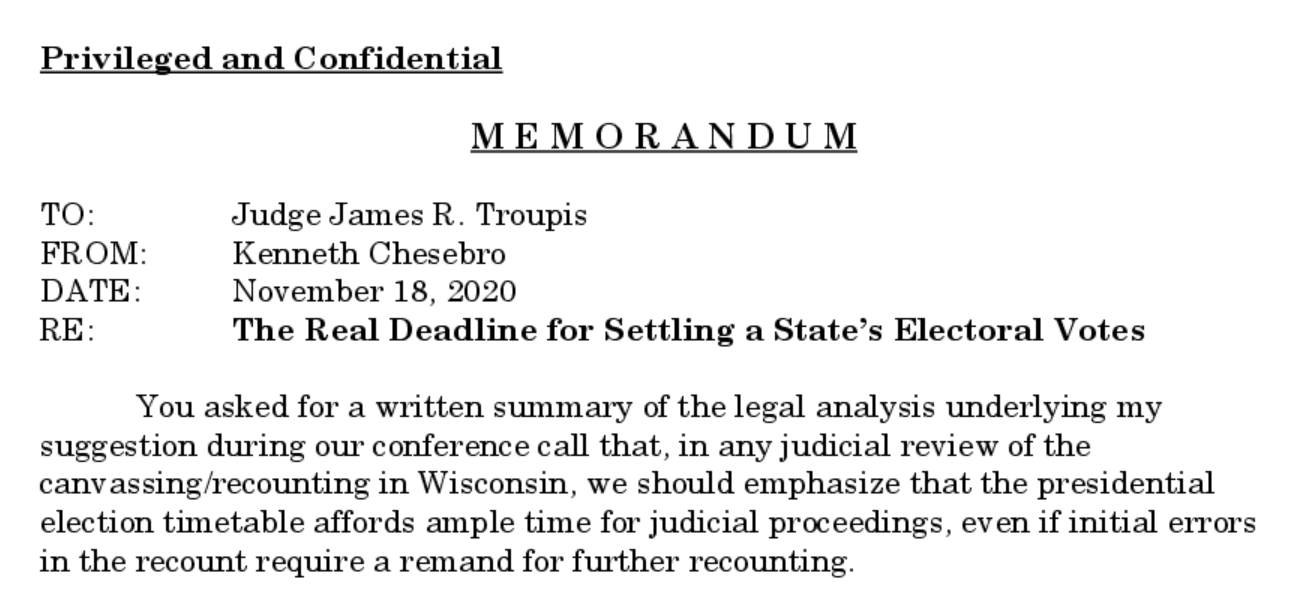
View Wisconsin Memo
- Fraudulent Elector Memo
- “The December 6 Memorandum (“Fraudulent Elector Memo“) marked a sharp departure from Co-Conspirator 5’s Wisconsin Memo, advocating that the alternate electors originally conceived of to preserve rights in Wisconsin instead be used in a number of states as fraudulent electors to prevent Biden from receiving the 270 electoral votes necessary to secure the presidency on January 6. The Fraudulent Elector Memo suggested that the Defendant’s electors in six purportedly “contested” states (Arizona, Georgia, Michigan, Nevada, Pennsylvania, and Wisconsin) should meet and mimic as best as possible the actions of the legitimate Biden electors, and that on January 6, the Vice President should open and count the fraudulent votes, setting up a fake controversy that would derail the proper certification of Biden as president-elect.” (Paragraph 54)
- The first page of the memorandum:
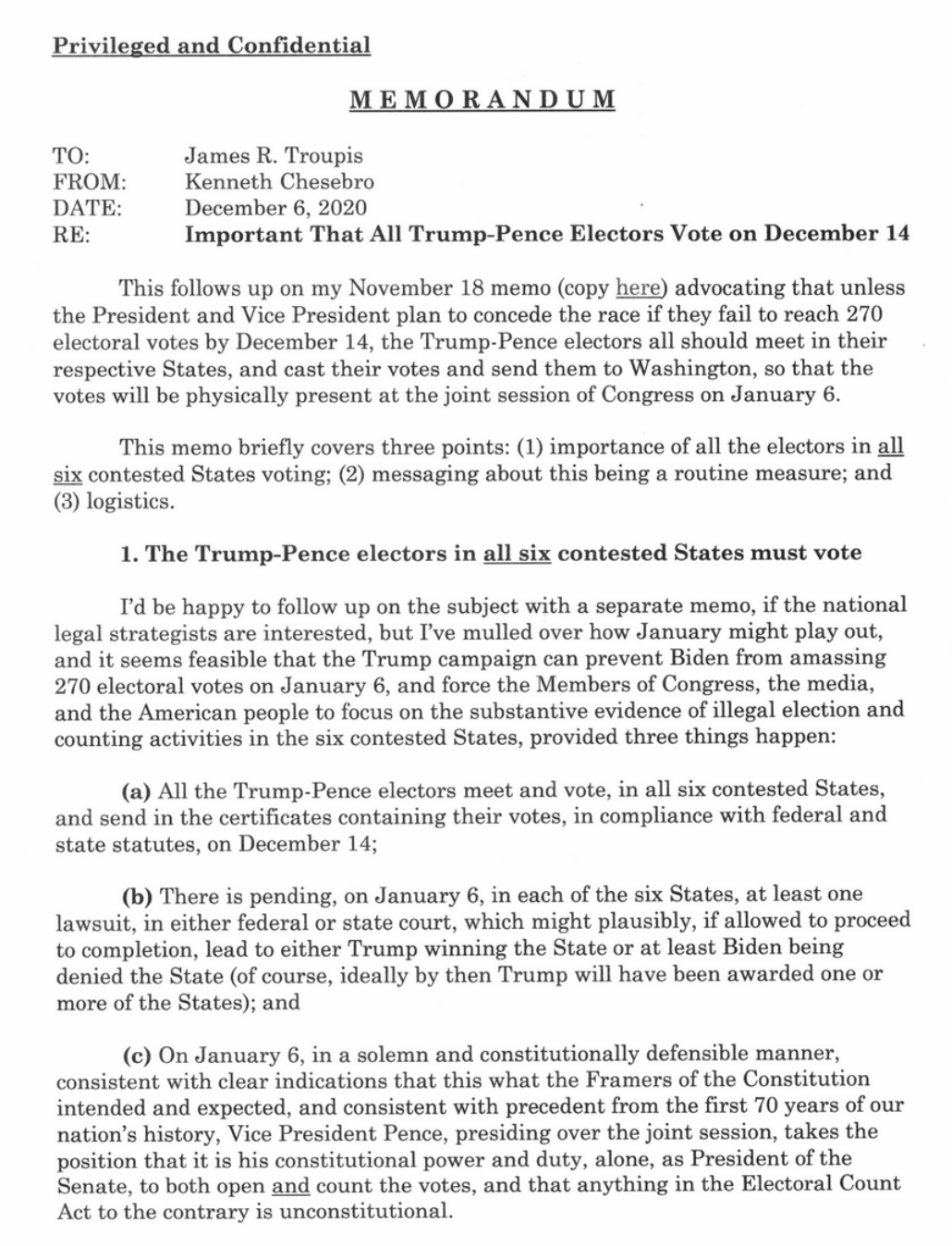
- Fraudulent Elector Instructions
- “The December 9 Memorandum (“Fraudulent Elector Instructions“) consisted of Co-Conspirator 5’s instructions on how fraudulent electors could mimic legitimate electors in Arizona, Georgia, Michigan, Nevada, Pennsylvania, and Wisconsin. Co-Conspirator 5 noted that in some states, it would be virtually impossible for the fraudulent electors to successfully take the same steps as the legitimate electors because state law required formal participation in the process by state officials, or access to official resources.” (Paragraph 54)
- From the first page:
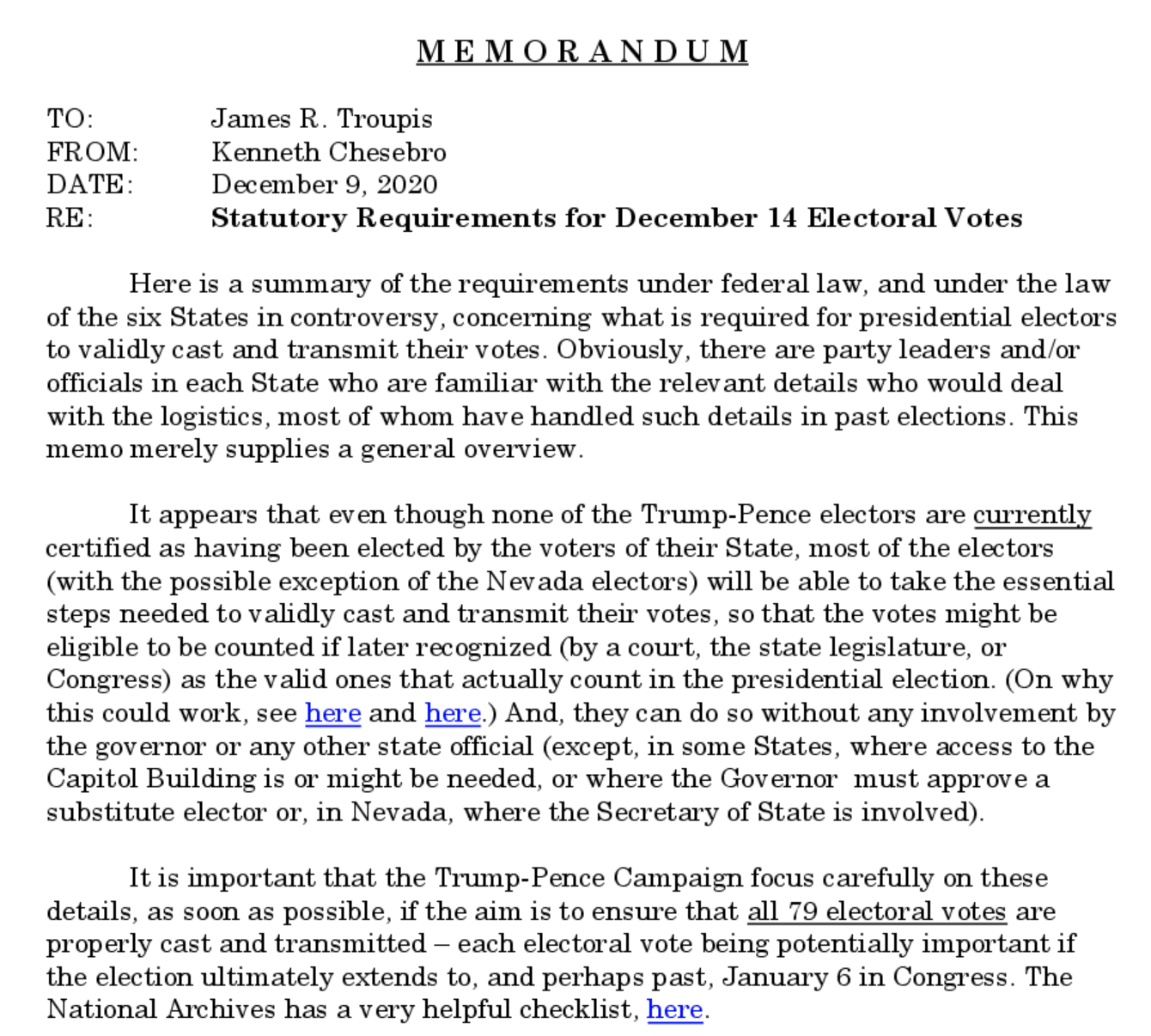
View Fraudulent Elector Instructions
Count 1 as a Deductive Proof
- To simplify the proof, I use the phrase the processing of electoral votes as an abbreviation for:
- “the federal government function by which the results of the election for President of the United States are collected, counted, and certified”
- The Law: 18 U.S. Code § 371 – Conspiracy to commit offense or to defraud United States
- If a person conspires (with co-conspirators) to defraud the US for the purpose of impairing, obstructing or defeating the lawful function of any department of government, they violate 18 U.S.C. 371.
- The penalty is a fine, imprisonment for not more than five years, or both.
- View The Law
- From the Indictment
- The federal government function by which the results of the election for President of the United States are collected, counted, and certified is a lawful government function.
- Therefore
- If a person conspires (with co-conspirators) to defraud the US for the purpose of impairing, obstructing or defeating the federal government function by which the results of the election for President of the United States are collected, counted, and certified, they violate 18 U.S.C. 371
- Thus, using our abbreviation:
- If a person conspires (with co-conspirators) to defraud the US for the purpose of impairing, obstructing or defeating the processing of electoral votes, they violate 18 U.S.C. 371
- From the Indictment
- Trump conspired (with co-conspirators) to defraud the US for the purpose of impairing, obstructing or defeating the processing of electoral votes
- By using knowingly false claims of election fraud to get state legislators and election officials to subvert the legitimate election results and change electoral votes from Biden to Trump
- By organizing fraudulent slates of electors who simulated legitimate electors, including transmitting their false certificates to the VP and other government officials to be counted at the certification proceeding on January 6.
- By attempting to get the DOJ to send a letter to the states urging their legislatures to convene so they would have the opportunity to choose the fraudulent electors over the legitimate electors.
- By using false claims of election fraud to get Pence to use the fraudulent electors, reject legitimate electoral votes, or send legitimate electoral votes to state legislatures for review rather than counting them.
- By using false claims of election fraud as the violence at the Capitol took place to convince Members of Congress to further delay the certification based on those claims.
- Supporting evidence at The Defendant’s Exploitation of the Violence and Chaos at the Capitol
- Trump conspired (with co-conspirators) to defraud the US for the purpose of impairing, obstructing or defeating the processing of electoral votes
- Therefore, from steps 4 and 5:
- Trump violated 18 U.S.C. 371
The Grand Jury
- Grand Jury, Wex Definitions
- A grand jury is a group of people selected to sit on a jury that decide whether the prosecutor’s evidence provides probable cause to issue an indictment. An indictment formally charges a person with committing a crime and begins the criminal prosecution process.
- In the United States, a grand jury consists of 16 to 23 people. Grand juries convene for a period of one month up to one year. The grand jury proceedings are held in private; the suspected criminal actor is usually not present at the proceedings.
- The grand jury acts as an investigative body, acting independently of either prosecuting attorney or judge. Criminal prosecutors present the case to the grand jury. The prosecutors attempt to establish probable cause to believe that a criminal offense has been committed. The grand jury may request that the court compel further evidence, including witness testimony and subpoenas of documents. The grand jury is generally free to pursue its investigations unhindered by external influence or supervision.
- As noted in United States v. Williams, grand juries act as a buffer between the Government and the people, providing a check on governmental power.
- How is an indictment different from an “information”? Nolo
- Both an information and indictment contain the criminal charges being levied against a defendant.
- When filing a felony complaint, a prosecutor must typically go in front of a judge with a factual basis for the charges. This presentation occurs in a preliminary hearing. After the preliminary hearing in many states, the complaint gives way to an “information.”
- For an indictment, the prosecutor presents evidence in support of criminal charges to a grand jury. If the grand jury finds sufficient evidence of criminal behavior, it returns an indictment. In federal court, felonies typically proceed through the grand jury process.
- Both an indictment and a typical complaint or information signify a determination by a neutral third party (grand jury or judge) that there is a factual basis for criminal charges. The purpose is to prevent defendants from facing unfounded criminal accusations.
The Crime of Conspiracy
- Conspiracy to Commit a Crime Justia
- A conspiracy occurs when two or more people agree to commit an illegal act and take some step toward its completion.
- Conspiracy does not require that the illegal act actually have been completed. For instance, a group of individuals can be convicted of conspiracy to commit burglary even if the actual burglary never happens.
- Unlike attempt, a defendant can be charged with both conspiracy to commit a crime and the crime itself (if completed).
- Elements needed to prove conspiracy
- Two or more people agreed to commit a crime
- All conspirators had the specific intent to commit the crime
- At least one of the conspirators committed an overt act taken in furtherance of the crime.
The Crime of Fraud
- Fraud is using a deliberate scheme to get something of value by using false statements.
- In Trump’s case:
- The things of value are electoral votes to which Trump is not entitled.
- The false statements are false claims of election fraud.
- Criminal Fraud Justia
- A deliberate scheme to obtain financial or similar gain by using false statements, misrepresentations, concealment of important information, or deceptive conduct is known as fraud. Fraud typically involves getting property to which someone is not legally entitled, but it is different from criminal offenses categorized as theft in two important ways.
- Theft generally involves directly obtaining money or something else of value by stealing it, or by the use or threat of force. The offenses included in the category of fraud, by contrast, involve a “scheme or artifice” to convince someone to give something of value based on false statements or false pretenses. Fraud is therefore often considered a form of white collar crime, unlike most forms of theft.
- The second key difference between fraud and theft is that the “scheme or artifice” is the key element of a fraud offense, instead of the actual wrongful acquisition of property. This means that a person could be found guilty of fraud even if the scheme does not succeed.
- A deliberate scheme to obtain financial or similar gain by using false statements, misrepresentations, concealment of important information, or deceptive conduct is known as fraud. Fraud typically involves getting property to which someone is not legally entitled, but it is different from criminal offenses categorized as theft in two important ways.
Potential Electors
- About the Electors, National Archives
- Who selects the electors?
- Choosing each State’s electors is a two-part process. First, the political parties in each State choose slates of potential electors sometime before the general election. Second, during the general election, the voters in each State select their State’s electors by casting their ballots.
- The first part of the process is controlled by the political parties in each State and varies from State to State. Generally, the parties either nominate slates of potential electors at their State party conventions or they chose them by a vote of the party’s central committee. This happens in each State for each party by whatever rules the State party and (sometimes) the national party have for the process. This first part of the process results in each Presidential candidate having their own unique slate of potential electors.
- Political parties often choose individuals for the slate to recognize their service and dedication to that political party. They may be State elected officials, State party leaders, or people in the State who have a personal or political affiliation with their party’s Presidential candidate. (For specific information about how slates of potential electors are chosen, contact the political parties in each State.)
- The second part of the process happens during the general election. When the voters in each State cast votes for the Presidential candidate of their choice they are voting to select their State’s electors. The potential electors’ names may or may not appear on the ballot below the name of the Presidential candidates, depending on election procedures and ballot formats in each State.
- The winning Presidential candidate’s slate of potential electors are appointed as the State’s electors—except in Nebraska and Maine, which have proportional distribution of the electors. In Nebraska and Maine, the State winner receives two electors and the winner of each congressional district (who may be the same as the overall winner or a different candidate) receives one elector. This system permits Nebraska and Maine to award electors to more than one candidate.
Links to Informative, Free Articles
- Q&A on Trump’s Jan. 6 Indictment factcheck.org
- Indictment Details Trump’s Attempt to Overturn Swing State Election Outcomes factcheck.org
- What Trump Asked of Pence factcheck.org
- Trump’s First Amendment Defense factcheck.org
- Trump’s Defense Lawyer Spins the Facts factcheck.org
- About the Electors National Archives
- 21 Donald Trump election lies listed in his new indictment Daniel Dale CNN Facts First
Comment
- Compare two hypothetical conspiracies:
- Trump conspired to remain President after losing the election — by using military force.
- Trump conspired to remain President after losing the election — by changing some electoral votes from Biden to Trump.
- Though the means are different, the objective is the same.
- If Trump should be prosecuted for the first, by analogy he should be prosecuted for the second.
THE INDICTMENT
INDICTMENT
- The Grand Jury charges that, at all times material to this Indictment, on or about the dates and at the approximate times stated below:
INTRODUCTION
- 1. The Defendant, DONALD J. TRUMP, was the forty-fifth President of the United States and a candidate for re-election in 2020. The Defendant lost the 2020 presidential election.
- 2. Despite having lost, the Defendant was determined to remain in power. So for more than two months following election day on November 3, 2020, the Defendant spread lies that there had been outcome-determinative fraud in the election and that he had actually won. These claims were false, and the Defendant knew that they were false. But the Defendant repeated and widely disseminated them anyway—to make his knowingly false claims appear legitimate, create an intense national atmosphere of mistrust and anger, and erode public faith in the administration of the election.
- 3. The Defendant had a right, like every American, to speak publicly about the election and even to claim, falsely, that there had been outcome-determinative fraud during the election and that he had won. He was also entitled to formally challenge the results of the election through lawful and appropriate means, such as by seeking recounts or audits of the popular vote in states or filing lawsuits challenging ballots and procedures. Indeed, in many cases, the Defendant did pursue these methods of contesting the election results. His efforts to change the outcome in any state through recounts, audits, or legal challenges were uniformly unsuccessful.
- 4. Shortly after election day, the Defendant also pursued unlawful means of discounting legitimate votes and subverting the election results. In so doing, the Defendant perpetrated three criminal conspiracies:
- A conspiracy to defraud the United States by using dishonesty, fraud, and deceit to impair, obstruct, and defeat the lawful federal government function by which the results of the presidential election are collected, counted, and certified by the federal government, in violation of 18 U.S.C. 371
- A conspiracy to corruptly obstruct and impede the January 6 congressional proceeding at which the collected results of the presidential election are counted and certified (“the certification proceeding”), in violation of 18 U.S.C. 1512(k); and
- A conspiracy against the right to vote and to have one’s vote counted, in violation of 18 U.S.C. 241.
COUNT ONE
- (Conspiracy to Defraud the United States—18 U.S.C. 371)
- 5. The allegations contained in paragraphs 1 through 4 of this Indictment are realleged and fully incorporated here by reference.
The Conspiracy
- From on or about November 14, 2020, through on or about January 20, 2021, in the District of Columbia and elsewhere, the Defendant, Donald J Trump, did knowingly combine, conspire, confederate, and agree with co-conspirators, known and unknown to the Grand Jury, to defraud the United States by using dishonesty, fraud, and deceit to impair, obstruct, and defeat the lawful federal government function by which the results of the presidential election are collected, counted, and certified by the federal government.
Purpose of the Conspiracy
- The purpose of the conspiracy was to overturn the legitimate results of the 2020 presidential election by using knowingly false claims of election fraud to obstruct the federal government function by which those results are collected, counted, and certified.
The Defendant’s Co-Conspirators
- 1 = Rudy Giuliani
- 2 = John Eastman
- 3 = Sidney Powell
- 4 = Jeffrey Clark
- 5 = Kenneth Chesebro
- 6 = Boris Epshteyn
The Federal Government Function
- The federal government function by which the results of the election for President of the United States are collected, counted, and certified was established through the Constitution and the Electoral Count Act (ECA), a federal law enacted in 1887. The Constitution provided that individuals called electors select the president, and that each state determine for itself how to appoint the electors apportioned to it. Through state laws, each of the fifty states and the District of Columbia chose to select their electors based on the popular vote in the state. After election day, the ECA required each state to formally determine—or “ascertain”—the electors who would represent the state’s voters by casting electoral votes on behalf of the candidate who had won the popular vote, and required the executive of each state to certify to the federal government the identities of those electors. Then, on a date set by the ECA, each state’s ascertained electors were required to meet and collect the results of the presidential election—that is, to cast electoral votes based on their state’s popular vote, and to send their electoral votes, along with the state executive’s certification that they were the state’s legitimate electors, to the United States Congress to be counted and certified in an official proceeding. Finally, the Constitution and ECA required that on the sixth of January following election day, the Congress meet in a Joint Session for a certification proceeding, presided over by the Vice President as President of the Senate, to count the electoral votes, resolve any objections, and announce the result—thus certifying the winner of the presidential election as president-elect. This federal government function—from the point of ascertainment to the certification—is foundational to the United States’ democratic process, and until 2021, had operated in a peaceful and orderly manner for more than 130 years.
Manner and Means
- The Defendant and co-conspirators used knowingly false claims of election fraud to get state legislators and election officials to subvert the legitimate election results and change electoral votes for the Defendant’s opponent, Joseph R.Biden, Jr., to electoral votes for the Defendant. That is, on the pretext of baseless fraud claims, the Defendant pushed officials in certain states to ignore the popular vote; disenfranchise millions of voters; dismiss legitimate electors; and ultimately, cause the ascertainment of and voting by illegitimate electors in favor of the Defendant
- The Defendant and co-conspirators organized fraudulent slates of electors in seven targeted states (Arizona, Georgia, Michigan, Nevada, New Mexico, Pennsylvania, and Wisconsin) , attempting to mimic the procedures that the legitimate electors were supposed to follow under the Constitution and other federal and state laws. This included causing the fraudulent electors to meet on the day appointed by federal law on which legitimate electors were to gather and cast their votes; cast fraudulent votes for the Defendant; and sign certificates falsely representing that they were legitimate electors. Some fraudulent electors were tricked into participating based on the understanding that their votes would be used only if the Defendant succeeded in outcome-determinative lawsuits within their state, which the Defendant never did. The Defendant and co-conspirators then caused these fraudulent electors to transmit their false certificates to the Vice President and other government officials to be counted at the certification proceeding on January 6.
- The Defendant and co-conspirators attempted to use the power and authority of the Justice Department to conduct sham election crime investigations and to send a letter to the targeted states that falsely claimed that the Justice Department had identified significant concerns that may have impacted the election outcome; that sought to advance the Defendant’s fraudulent elector plan by using the Justice Department’s authority to falsely present the fraudulent electors as a valid alternative to the legitimate electors; and that urged, on behalf of the Justice Department, the targeted states legislatures to convene to create the opportunity to choose the fraudulent electors over the legitimate electors.
- The Defendant and co-conspirators attempted to enlist the Vice President to use his ceremonial role at the January 6 certification proceeding to fraudulently alter the election results. First, using knowingly false claims of election fraud, the Defendant and co-conspirators attempted to convince the Vice President to use the Defendant’s fraudulent electors, reject legitimate electoral votes , or send legitimate electoral votes to state legislatures for review rather than counting them. When that failed, on the morning of January 6, the Defendant and co-conspirators repeated knowingly false claims of election fraud to gathered supporters, falsely told them that the Vice President had the authority to and might alter the election results, and directed them to the Capitol to obstruct the certification proceeding and exert pressure on the Vice President to take the fraudulent actions he had previously refused.
- After it became public on the afternoon of January 6 that the Vice President would not fraudulently alter the election results, a large and angry crowd including many individuals whom the Defendant had deceived into believing the Vice President could and might change the election results violently attacked the Capitol and halted the proceeding. As violence ensued, the Defendant and co-conspirators exploited the disruption by redoubling efforts to levy false claims of election fraud and convince Members of Congress to further delay the certification based on those claims
The Defendant’s Knowledge of the Falsity of His Election Fraud Claims
- The Defendant, his co-conspirators, and their agents made knowingly false claims that there had been outcome-determinative fraud in the 2020 presidential election. These prolific lies about election fraud included dozens of specific claims that there had been substantial fraud in certain states, such as that large numbers of dead, non-resident, non-citizen, or otherwise ineligible voters had cast ballots, or that voting machines had changed votes for the Defendant to votes for Biden. These claims were false, and the Defendant knew that they were false. In fact, the Defendant was notified repeatedly that his claims were untrue—often by the people on whom he relied for candid advice on important matters, and who were best positioned to know the facts— and he deliberately disregarded the truth. For instance:
- a. The Defendant’s Vice President—who personally stood to gain by remaining in office as part of the Defendant’s ticket and whom the Defendant asked to study fraud allegations—told the Defendant that he had seen no evidence of outcome-determinative fraud.
- b. The senior leaders of the Justice Department—appointed by the Defendant and responsible for investigating credible allegations of election crimes— told the Defendant on multiple occasions that various allegations of fraud were unsupported.
- c. The Director of National Intelligence—the Defendant’s principal advisor on intelligence matters related to national security—disabused the Defendant of the notion that the Intelligence Community’s findings regarding foreign interference would change the outcome of the election.
- d. The Department of Homeland Security’s Cybersecurity and Infrastructure Security Agency (“CISA”)—whose existence the Defendant signed into law to protect the nation’s cybersecurity infrastructure from attack—joined an official multi-agency statement that there was no evidence any voting system had been compromised and that declared the 2020 election “the most secure in American history.” Days later, after the CISA Director—whom the Defendant had appointed—announced publicly that election security experts were in agreement that claims of computer-based election fraud were unsubstantiated, the Defendant fired him.
- e. Senior White House attorneys—selected by the Defendant to provide him candid advice—informed the Defendant that there was no evidence of outcome-determinative election fraud, and told him that his presidency would end on Inauguration Day in 2021
- f. Senior staffers on the Defendant’s 2020 re-election campaign (“Defendant’s Campaign” or “Campaign”)—whose sole mission was the Defendant’s reelection—told the Defendant on November 7, 2020, that he had only a five to ten percent chance of prevailing in the election, and that success was contingent on the Defendant winning ongoing vote counts or litigation in Arizona, Georgia, and Wisconsin. Within a week of that assessment, the Defendant lost in Arizona—meaning he had lost the election.
- g. State legislators and officials—many of whom were the Defendant’s political allies, had voted for him, and wanted him to be re-elected— repeatedly informed the Defendant that his claims of fraud in their states were unsubstantiated or false and resisted his pressure to act based upon them.
- h. State and federal courts—the neutral arbiters responsible for ensuring the fair and even-handed administration of election laws—rejected every outcome-determinative post-election lawsuit filed by the Defendant, his co-conspirators, and allies, providing the Defendant real-time notice that his allegations were meritless.
- The Defendant widely disseminated his false claims of election fraud for months, despite the fact that he knew, and in many cases had been informed directly, that they were not true. The Defendant’s knowingly false statements were integral to his criminal plans to defeat the federal government function, obstruct the certification, and interfere with others’ right to vote and have their votes counted. He made these knowingly false claims throughout the post-election time period, including those below that he made immediately before the attack on the Capitol on January 6:
- a.The Defendant insinuated that more than ten thousand dead voters had voted in Georgia. Just four days earlier, Georgia’s Secretary of State had explained to the Defendant that this was false.
- b. The Defendant asserted that there had been 205,000 more votes than voters in Pennsylvania. The Defendant’s Acting Attorney General and Acting Deputy Attorney General had explained to him that this was false.
- c. The Defendant said that there had been a suspicious vote dump in Detroit, Michigan. The Defendant’s Attorney General had explained to the Defendant that this was false, and the Defendant’s allies in the Michigan state legislature—the Speaker of the House of Representatives and Majority Leader of the Senate—had publicly announced that there was no evidence of substantial fraud in the state.
- d. The Defendant claimed that there had been tens of thousands of double votes and other fraud in Nevada. The Nevada Secretary of State had previously rebutted the Defendant’s fraud claims by publicly posting a “Facts vs. Myths” document explaining that Nevada judges had reviewed and rejected them, and the Nevada Supreme Court had rendered a decision denying such claims.
- e. The Defendant said that more than 30,000 non-citizens had voted in Arizona. The Defendant’s own Campaign Manager had explained to him that such claims were false, and the Speaker of the Arizona House of Representatives, who had supported the Defendant in the election, had issued a public statement that there was no evidence of substantial fraud in Arizona.
- f. The Defendant asserted that voting machines in various contested states had switched votes from the Defendant to Biden. The Defendant’s Attorney General, Acting Attorney General, and Acting Deputy Attorney General all had explained to him that this was false, and numerous recounts and audits had confirmed the accuracy of voting machines.
The Criminal Agreement and Acts to Effect the Object of the Conspiracy
The Defendant’s Use of Deceit to Get State Officials to Subvert the Legitimate Election Results and Change Electoral Votes
- Co-Conspirators Involved
- 1 = Rudy Giuliani
- 2 = John Eastman
- 3 = Sidney Powell
- 13. Shortly after election day—which fell on November 3, 2020—the Defendant launched his criminal scheme.
- On November 13, the Defendant’s Campaign attorneys conceded in court that he had lost the vote count in the state of Arizona—meaning, based on the assessment the Defendant’s Campaign advisors had given him just a week earlier, the Defendant had lost the election.
- So the next day, the Defendant turned to Co-Conspirator 1, whom he announced would spearhead his efforts going forward to challenge the election results. From that point on, the Defendant and his co-conspirators executed a strategy to use knowing deceit in the targeted states to impair, obstruct, and defeat the federal government function, including as described below.
- Arizona 36,000 non-citizens voted
- 14. On November 13, 2020, the Defendant had a conversation with his Campaign Manager, who informed him that a claim that had been circulating, that a substantial number of non-citizens had voted in Arizona, was false.
- 15. On November 22, eight days before Arizona’s Governor certified the ascertainment of the state’s legitimate electors based on the popular vote, the Defendant and Co-Conspirator 1 called the Speaker of the Arizona House of Representatives and made knowingly false claims of election fraud aimed at interfering with the ascertainment of and voting by Arizona’s electors, as follows:
- a. The Defendant and Co-Conspirator 1 falsely asserted, among other things, that a substantial number of non-citizens, non-residents, and dead people had voted fraudulently in Arizona. The Arizona House Speaker asked Co-Conspirator 1 for evidence of the claims, which Co-Conspirator 1 did not have, but claimed he would provide. Co-Conspirator 1 never did so.
- b. The Defendant and Co-Conspirator 1 asked the Arizona House Speaker to call the legislature into session to hold a hearing based on their claims of election fraud. The Arizona House Speaker refused, stating that doing so would require a two-thirds vote of its members, and he would not allow it without actual evidence of fraud.
- c. The Defendant and Co-Conspirator 1 asked the Arizona House Speaker to use the legislature to circumvent the process by which legitimate electors would be ascertained for Biden based on the popular vote, and replace those electors with a new slate for the Defendant. The Arizona House Speaker refused, responding that the suggestion was beyond anything he had ever heard or thought of as something within his authority.
- 16. On December 1, Co-Conspirator 1 met with the Arizona House Speaker. When the Arizona House Speaker again asked Co-Conspirator 1 for evidence of the outcome-determinative election fraud he and the Defendant had been claiming, Co-Conspirator 1 responded with words to the effect of, “We don’t have the evidence, but we have lots of theories.”
- 17. On December 4, the Arizona House Speaker issued a public statement that said, in part:
- No election is perfect, and if there were evidence of illegal votes or an improper count, then Arizona law provides a process to contest the election: a lawsuit under state law. But the law does not authorize the Legislature to reverse the results of an election.
- As a conservative Republican, I don’t like the results of the presidential election. I voted for President Trump and worked hard to reelect him. But I cannot and will not entertain a suggestion that we violate current law to change the outcome of a certified election.
- I and my fellow legislators swore an oath to support the U.S. Constitution and the constitution and laws of the state of Arizona. It would violate that oath, the basic principles of republican government, and the rule of law if we attempted to nullify the people’s vote based on unsupported theories of fraud. Under the laws that we wrote and voted upon, Arizona voters choose who wins, and our system requires that their choice be respected.
- 18. On the morning of January 4, 2021, Co-Conspirator 2 called the Arizona House Speaker to urge him to use a majority of the legislature to decertify the state’s legitimate electors. Arizona’s validly ascertained electors had voted three weeks earlier and sent their votes to Congress, which was scheduled to count those votes in Biden’s favor in just two days’ time at the January 6 certification proceeding. When the Arizona House Speaker explained that state investigations had uncovered no evidence of substantial fraud in the state, Co-Conspirator 2 conceded that he “[didn’t] know enough about facts on the ground” in Arizona, but nonetheless told the Arizona House Speaker to decertify and “let the courts sort it out.” The Arizona House Speaker refused, stating that he would not “play with the oath” he had taken to uphold the United States Constitution and Arizona law.
- 19. On January 6, the Defendant publicly repeated the knowingly false claim that 36,000 non-citizens had voted in Arizona.
- Georgia State Farm Arena video and 10,300 dead people voted
- 20. On November 16, 2020, on the Defendant’s behalf, his executive assistant sent Co-Conspirator 3 and others a document containing bullet points critical of a certain voting machine company, writing, “See attached – Please include as is, or almost as is, in lawsuit.” Co-Conspirator 3 responded nine minutes later, writing, “IT MUST GO IN ALL SUITS IN GA AND PA IMMEDIATELY WITH A FRAUD CLAIM THAT REQUIRES THE ENTIRE ELECTION TO BE SET ASIDE in those states and machines impounded for non-partisan professional inspection.” On November 25, Co-Conspirator 3 filed a lawsuit against the Governor of Georgia falsely alleging “massive election fraud” accomplished through the voting machine company’s election software and hardware. Before the lawsuit was even filed, the Defendant retweeted a post promoting it. The Defendant did this despite the fact that when he had discussed Co-Conspirator 3’s far-fetched public claims regarding the voting machine company in private with advisors, the Defendant had conceded that they were unsupported and that Co-Conspirator 3 sounded “crazy.” Co-Conspirator 3’s Georgia lawsuit was dismissed on December 7.
- 21. On December 3, Co-Conspirator 1 orchestrated a presentation to a Judiciary Subcommittee of the Georgia State Senate, with the intention of misleading state senators into blocking the ascertainment of legitimate electors. During the presentation:
- a. An agent of the Defendant and Co-Conspirator 1 falsely claimed that more than 10,000 dead people voted in Georgia. That afternoon, a Senior Advisor to the Defendant told the Defendant’s Chief of Staff through text messages, “Just an FYI . [A Campaign lawyer] and his team verified that the 10k+ supposed dead people voting in GA is not accurate. . . . It was alleged in [Co-Conspirator 1’s] hearing today.” The Senior Advisor clarified that he believed that the actual number was 12.
- b. Another agent of the Defendant and Co-Conspirator 1 played a misleading excerpt of a video recording of ballot-counting at State Farm Arena in Atlanta and insinuated that it showed election workers counting “suitcases” of illegal ballots.
- c. Co-Conspirator 2 encouraged the legislators to decertify the state’s legitimate electors based on false allegations of election fraud.
- 22. Also on December 3, the Defendant issued a Tweet amplifying the knowingly false claims made in Co-Conspirator 1’s presentation in Georgia: “Wow! Blockbuster testimony taking place right now in Georgia. Ballot stuffing by Dems when Republicans were forced to leave the large counting room. Plenty more coming, but this alone leads to an easy win of the State!”
- 23. On December 4, the Georgia Secretary of State’s Chief Operating Officer debunked the claims made at Co-Conspirator 1’s presentation the previous day, issuing a Tweet stating, “The 90 second video of election workers at State Farm arena, purporting to show fraud was watched in its entirety (hours) by @GaSecofState investigators. Shows normal ballot processing. Here is the fact check on it.” On December 7, he reiterated during a press conference that the claim that there had been misconduct at State Farm Arena was false.
- 24. On December 8, the Defendant called the Georgia Attorney General to pressure him to support an election lawsuit filed in the Supreme Court by another state’s attorney general. The Georgia Attorney General told the Defendant that officials had investigated various claims of election fraud in the state and were not seeing evidence to support them.
- 25. Also on December 8, a Senior Campaign Advisor—who spoke with the Defendant on a daily basis and had informed him on multiple occasions that various fraud claims were untrue—expressed frustration that many of Co-Conspirator 1 and his legal team’s claims could not be substantiated. As early as mid-November, for instance, the Senior Campaign Advisor had informed the Defendant that his claims of a large number of dead voters in Georgia were untrue. With respect to the persistent false claim regarding State Farm Arena, on December 8, the Senior Campaign Advisor wrote in an email, “When our research and campaign legal team can’t back up any of the claims made by our Elite Strike Force Legal Team, you can see why we’re 0-32 on our cases. I’ll obviously hustle to help on all fronts, but it’s tough to own any of this when it’s all just conspiracy shit beamed down from the mothership.”
- 26. On December 10, four days before Biden’s validly ascertained electors were scheduled to cast votes and send them to Congress, Co-Conspirator 1 appeared at a hearing before the Georgia House of Representatives’ Government Affairs Committee. Co-Conspirator 1 played the State Farm Arena video again, and falsely claimed that it showed “voter fraud right in front of people’s eyes” and was “the tip of the iceberg.” Then, he cited two election workers by name, baselessly accused them of “quite obviously surreptitiously passing around USB ports as if they are vials of heroin or cocaine,” and suggested that they were criminals whose “places of work, their homes, should have been searched for evidence of ballots, for evidence of USB ports, for evidence of voter fraud.” Thereafter, the two election workers received numerous death threats.
- 27. On December 15, the Defendant summoned the incoming Acting Attorney General, the incoming Acting Deputy Attorney General, and others to the Oval Office to discuss allegations of election fraud. During the meeting, the Justice Department officials specifically refuted the Defendant’s claims about State Farm Arena, explaining to him that the activity shown on the tape Co-Conspirator 1 had used was “benign.”
- 28. On December 23, a day after the Defendant’s Chief of Staff personally observed the signature verification process at the Cobb County Civic Center and notified the Defendant that state election officials were “conducting themselves in an exemplary fashion” and would find fraud if it existed, the Defendant tweeted that the Georgia officials administering the signature verification process were trying to hide evidence of election fraud and were “[t]errible people!”
- 29. In a phone call on December 27, the Defendant spoke with the Acting Attorney General and Acting Deputy Attorney General. During the call, the Defendant again pressed the unfounded claims regarding State Farm Arena, and the two top Justice Department officials again rebutted the allegations, telling him that the Justice Department had reviewed videotape and interviewed witnesses, and had not identified any suspicious conduct.
- 30. On December 31, the Defendant signed a verification affirming false election fraud allegations made on his behalf in a lawsuit filed in his name against the Georgia Governor. In advance of the filing, Co-Conspirator 2—who was advising the Defendant on the lawsuit— acknowledged in an email that he and the Defendant had, since signing a previous verification, “been made aware that some of the allegations (and evidence proffered by the experts) has been inaccurate” and that signing a new affirmation “with that knowledge (and incorporation by reference) would not be accurate.” The Defendant and Co-Conspirator 2 caused the Defendant’s signed verification to be filed nonetheless.
- 31. On January 2, four days before Congress’s certification proceeding, the Defendant and others called Georgia’s Secretary of State. During the call, the Defendant lied to the Georgia Secretary of State to induce him to alter Georgia’s popular vote count and call into question the validity of the Biden electors’ votes, which had been transmitted to Congress weeks before, including as follows:
- a. The Defendant raised allegations regarding the State Farm Arena video and repeatedly disparaged one of the same election workers that Co-Conspirator 1 had maligned on December 10, using her name almost twenty times and falsely referring to her as “a professional vote scammer and hustler.” In response, the Georgia Secretary of State refuted this: “You’re talking about the State Farm video. And I think it’s extremely unfortunate that [Co-Conspirator 1] or his people, they sliced and diced that video and took it out of context.” When the Georgia Secretary of State then offered a link to a video that would disprove Co-Conspirator 1’s claims, the Defendant responded, ” I don’t care about a link, I don’t need it. I have a much, [Georgia Secretary of State], I have a much better link.”
- b. The Defendant asked about rumors that paper ballots cast in the election were being destroyed, and the Georgia Secretary of State’s Counsel explained to him that the claim had been investigated and was not true.
- c. The Defendant claimed that 5,000 dead people voted in Georgia, causing the Georgia Secretary of State to respond, “Well, Mr. President, the challenge that you have is the data you have is wrong…. The actual number were two. Two. Two people that were dead that voted. And so [your information]’s wrong, that was two.”
- d. The Defendant claimed that thousands of out-of-state voters had cast ballots in Georgia’s election, which the Georgia Secretary of State’s Counsel refuted, explaining, “We’ve been going through each of those as well, and those numbers that we got, that [Defendant’s counsel] was just saying, they’re not accurate. Every one we’ve been through are people that lived in Georgia, moved to a different state, but then moved back to Georgia legitimately . . . they moved back in years ago. This was not like something just before the election.”
- e. In response to multiple other of the Defendant’s allegations, the Georgia Secretary of State’s Counsel told the Defendant that the Georgia Bureau of Investigation was examining all such claims and finding no merit to them.
- f. The Defendant said that he needed to “find” 11,780 votes, and insinuated that the Georgia Secretary of State and his Counsel could be subject to criminal prosecution if they failed to find election fraud as he demanded, stating, “And you are going to find that they are—which is totally illegal— it’s, it’s, it’s more illegal for you than it is for them because you know what they did and you’re not reporting it. That’s a criminal, you know, that’s a criminal offense. And you know, you can’t let that happen. That’s a big risk to you and to [the Georgia Secretary of State’s Counsel], your lawyer.”
- 32. The next day, on January 3, the Defendant falsely claimed that the Georgia Secretary of State had not addressed the Defendant’s allegations, publicly stating that the Georgia Secretary of State “was unwilling, or unable, to answer questions such as the ‘ballots under table’ scam, ballot destruction, out of state ‘voters’, dead voters, and more. He has no clue!”
- 33. On January 6, the Defendant publicly repeated the knowingly false insinuation that more than 10,300 dead people had voted in Georgia.
- Michigan Vote Dump
- 34. On November 5, 2020, the Defendant claimed that there had been a suspicious dump of votes—purportedly illegitimate ballots—stating, “In Detroit, there were hours of unexplained delay in delivering many of the votes for counting. The final batch did not arrive until four in the morning and—even though the polls closed at eight o’clock. So they brought it in, and the batches came in, and nobody knew where they came from.”
- 35. On November 20, three days before Michigan’s Governor signed a certificate of ascertainment notifying the federal government that, based on the popular vote, Biden’s electors were to represent Michigan’s voters, the Defendant held a meeting in the Oval Office with the Speaker of the Michigan House of Representatives and the Majority Leader of the Michigan Senate. In the meeting, the Defendant raised his false claim, among others, of an illegitimate vote dump in Detroit. In response, the Michigan Senate Majority Leader told the Defendant that he had lost Michigan not because of fraud, but because the Defendant had underperformed with certain voter populations in the state. Upon leaving their meeting, the Michigan House Speaker and Michigan Senate Majority Leader issued a statement reiterating this:
- The Senate and House Oversight Committees are actively engaged in a thorough review of Michigan’s elections process and we have faith in the committee process to provide greater transparency and accountability to our citizens. We have not yet been made aware of any information that would change the outcome of the election in Michigan and as legislative leaders, we will follow the law and follow the normal process regarding Michigan’s electors, just as we have said throughout this election.
- 36. On December 1, the Defendant raised his Michigan vote dump claim with the Attorney General, who responded that what had occurred in Michigan had been the normal vote-counting process and that there was no indication of fraud in Detroit
- 37. Despite this, the next day, the Defendant made a knowingly false statement that in Michigan, “[a]t 6:31 in the morning, a vote dump of 149,772 votes came in unexpectedly. We were winning by a lot. That batch was received in horror. Nobody knows anything about it. . . . It’s corrupt. Detroit is corrupt. I have a lot of friends in Detroit. They know it. But Detroit is totally corrupt.”
- 38. On December 4, Co-Conspirator 1 sent a text message to the Michigan House Speaker reiterating his unsupported claim of election fraud and attempting to get the Michigan House Speaker to assist in reversing the ascertainment of the legitimate Biden electors, stating, “Looks like Georgia may well hold some factual hearings and change the certification under Artll sec 1 cl 2 of the Constitution. As [Co-Conspirator 2] explained they don’t just have the right to do it but the obligation. .. . Help me get this done in Michigan.”
- 39. Similarly, on December 7, despite still having established no fraud in Michigan, Co-Conspirator 1 sent a text intended for the Michigan Senate Majority Leader: “So I need you to pass a joint resolution from the Michigan legislature that states that, * the election is in dispute, * there’s an ongoing investigation by the Legislature, and * the Electors sent by Governor Whitmer are not the official Electors of the State of Michigan and do not fall within the Safe Harbor deadline of Dec 8 under Michigan law.”
- 40. On December 14—the day that electors in states across the country were required to vote and submit their votes to Congress—the Michigan House Speaker and Michigan Senate Majority Leader announced that, contrary to the Defendant’s requests, they would not decertify the legitimate election results or electors in Michigan. The Michigan Senate Majority Leader’s public statement included, “[ W]e have not received evidence of fraud on a scale that would change the outcome of the election in Michigan.” The Michigan House Speaker’s public statement read, in part:
- We’ve diligently examined these reports of fraud to the best of our ability. . . .
- . . . I fought hard for President Trump. Nobody wanted him to win more than me. I think he’s done an incredible job. But I love our republic, too. I can’t fathom risking our norms, traditions and institutions to pass a resolution retroactively changing the electors for Trump, simply because some think there may have been enough widespread fraud to give him the win. That’s unprecedented for good reason. And that’s why there is not enough support in the House to cast a new slate of electors. I fear we’d lose our country forever. This truly would bring mutually assured destruction for every future election in regards to the Electoral College. And I can’t stand for that. I won’t.
- 41. On January 6, 2021, the Defendant publicly repeated his knowingly false claim regarding an illicit dump of more than a hundred thousand ballots in Detroit.
- Pennsylvania 205,000 more votes than voters
- 42. On November 11, 2020, the Defendant publicly maligned a Philadelphia City Commissioner for stating on the news that there was no evidence of widespread fraud in Philadelphia. As a result, the Philadelphia City Commissioner and his family received death threats.
- 43. On November 25, the day after Pennsylvania’s Governor signed a certificate of ascertainment and thus certified to the federal government that Biden’s electors were the legitimate electors for the state, Co-Conspirator 1 orchestrated an event at a hotel in Gettysburg attended by state legislators. Co-Conspirator 1 falsely claimed that Pennsylvania had issued 1.8 million absentee ballots and received 2.5 million in return. In the days thereafter, a Campaign staffer wrote internally that Co-Conspirator 1’s allegation was “just wrong” and “[t]here’s no way to defend it.” The Deputy Campaign Manager responded, “We have been saying this for a while. It’s very frustrating.”
- 44. On December 4, after four Republican leaders of the Pennsylvania legislature issued a public statement that the General Assembly lacked the authority to overturn the popular vote and appoint its own slate of electors, and that doing so would violate the state Election Code and Constitution, the Defendant re-tweeted a post labeling the legislators cowards.
- 45. On December 31 and January 3, the Defendant repeatedly raised with the Acting Attorney General and Acting Deputy Attorney General the allegation that in Pennsylvania, there had been 205,000 more votes than voters. Each time, the Justice Department officials informed the Defendant that his claim was false.
- 46. On January 6, 2021, the Defendant publicly repeated his knowingly false claim that there had been 205,000 more votes than voters in Pennsylvania.
- Wisconsin More Votes than Voters
- 47. On November 29,2020, a recount in Wisconsin that the Defendant’s Campaign had petitioned and paid for did not change the election result, and in fact increased the Defendant’s margin of defeat.
- 48. On December 14, the Wisconsin Supreme Court rejected an election challenge by the Campaign. One Justice wrote, “[N]othing in this case casts any legitimate doubt that the people of Wisconsin lawfully chose Vice President Biden and Senator Harris to be the next leaders of our great country.”
- 49. On December 21, as a result of the state Supreme Court’s decision, the Wisconsin Governor—who had signed a certificate of ascertainment on November 30 identifying Biden’s electors as the state’s legitimate electors—signed a certificate of final determination in which he recognized that the state Supreme Court had resolved a controversy regarding the appointment of Biden’s electors, and confirmed that Biden had received the highest number of votes in the state and that his electors were the state’s legitimate electors.
- 50. That same day, in response to the court decision that had prompted the Wisconsin Governor to sign a certificate of final determination, the Defendant issued a Tweet repeating his knowingly false claim of election fraud and demanding that the Wisconsin legislature overturn the election results that had led to the ascertainment of Biden’s electors as the legitimate electors.
- 51. On December 27, the Defendant raised with the Acting Attorney General and Acting Deputy Attorney General a specific fraud claim—that there had been more votes than voters in Wisconsin. The Acting Deputy Attorney General informed the Defendant that the claim was false.
- 52. On January 6, 2021, the Defendant publicly repeated knowingly false claims that there had been tens of thousands of unlawful votes in Wisconsin.
The Defendant’s Use of Dishonesty, Fraud, and Deceit to Organize Fraudulent Slates of Electors and Cause Them to Transmit False Certificates to Congress
- Co-Conspirators Involved
- 1 = Rudy Giuliani
- 2 = John Eastman
- 5 = Kenneth Chesebro
- 6 = Boris Epshteyn
- 53. As the Defendant’s attempts to obstruct the electoral vote through deceit of state officials met with repeated failure, beginning in early December 2020, he and co-conspirators developed a new plan: to marshal individuals who would have served as the Defendant’s electors, had he won the popular vote, in seven targeted states—Arizona, Georgia, Michigan, Nevada, New Mexico, Pennsylvania, and Wisconsin—and cause those individuals to make and send to the Vice President and Congress false certifications that they were legitimate electors. Under the plan, the submission of these fraudulent slates would create a fake controversy at the certification proceeding and position the Vice President—presiding on January 6 as President of the Senate—to supplant legitimate electors with the Defendant’s fake electors and certify the Defendant as president.
- 54. The plan capitalized on ideas presented in memoranda drafted by Co-Conspirator 5, an attorney who was assisting the Defendant’s Campaign with legal efforts related to a recount in Wisconsin. The memoranda evolved over time from a legal strategy to preserve the Defendant’s rights to a corrupt plan to subvert the federal government function by stopping Biden electors’ votes from being counted and certified, as follows:
- a. The November 18 Memorandum (“Wisconsin Memo”) advocated that, because of the ongoing recount in Wisconsin, the Defendant’s electors there should meet and cast votes on December 14—the date the ECA required appointed electors to vote—to preserve the alternative of the Defendant’s Wisconsin elector slate in the event the Defendant ultimately prevailed in the state.
- b. The December 6 Memorandum (“Fraudulent Elector Memo“) marked a sharp departure from Co-Conspirator 5’s Wisconsin Memo, advocating that the alternate electors originally conceived of to preserve rights in Wisconsin instead be used in a number of states as fraudulent electors to prevent Biden from receiving the 270 electoral votes necessary to secure the presidency on January 6. The Fraudulent Elector Memo suggested that the Defendant’s electors in six purportedly “contested” states (Arizona, Georgia, Michigan, Nevada, Pennsylvania, and Wisconsin) should meet and mimic as best as possible the actions of the legitimate Biden electors, and that on January 6, the Vice President should open and count the fraudulent votes, setting up a fake controversy that would derail the proper certification of Biden as president-elect.
- c. The December 9 Memorandum (“Fraudulent Elector Instructions“) consisted of Co-Conspirator 5’s instructions on how fraudulent electors could mimic legitimate electors in Arizona, Georgia, Michigan, Nevada, Pennsylvania, and Wisconsin. Co-Conspirator 5 noted that in some states, it would be virtually impossible for the fraudulent electors to successfully take the same steps as the legitimate electors because state law required formal participation in the process by state officials, or access to official resources.
- 55. The plan began in early December, and ultimately, the conspirators and the Defendant’s Campaign took the Wisconsin Memo and expanded it to any state that the Defendant claimed was “contested”—even New Mexico, which the Defendant had lost by more than ten percent of the popular vote. This expansion was forecast by emails the Defendant’s Chief of Staff sent on December 6, forwarding the Wisconsin Memo to Campaign staff and writing, “We just need to have someone coordinating the electors for states.”
- 56. On December 6, the Defendant and Co-Conspirator 2 called the Chairwoman of the Republican National Committee to ensure that the plan was in motion. During the call, Co-Conspirator 2 told the Chairwoman that it was important for the RNC to help the Defendant’s Campaign gather electors in targeted states, and falsely represented to her that such electors’ votes would be used only if ongoing litigation in one of the states changed the results in the Defendant’s favor. After the RNC Chairwoman consulted the Campaign and heard that work on gathering electors was underway, she called and reported this information to the Defendant, who responded approvingly.
- 57. On December 7, Co-Conspirator 1 received the Wisconsin Memo and the Fraudulent Elector Memo. Co-Conspirator 1 spoke with Co-Conspirator 6 regarding attorneys who could assist in the fraudulent elector effort in the targeted states, and he received from Co-Conspirator 6 an email identifying attorneys in Arizona, Georgia, Michigan, Nevada, New Mexico, Pennsylvania, and Wisconsin.
- 58. The next day, on December 8, Co-Conspirator 5 called the Arizona attorney on Co-Conspirator 6’s list. In an email after the call, the Arizona attorney recounted his conversation with Co-Conspirator 5 as follows:
- I just talked to the gentleman who did that memo, [Co-Conspirator 5]. His idea is basically that all of us (GA, WI, AZ, PA, etc.) have our electors send in their votes (even though the votes aren’t legal under federal law ~ because they’re not signed by the Governor); so that members of Congress can fight about whether they should be counted on January 6th. (They could potentially argue that they’re not bound by federal law because they’re Congress and make the law, etc.) Kind of wild/creative ~ I’m happy to discuss. My comment to him was that I guess there’s no harm in it, (legally at least) ~ i.e. we would just be sending in “fake” electoral votes to Pence so that “someone” in Congress can make an objection when they start counting votes, and start arguing that the “fake” votes should be counted.
- 59. At Co-Conspirator 1’s direction, on December 10, Co-Conspirator 5 sent to points of contact in all targeted states except Wisconsin (which had already received his memos) and New Mexico a streamlined version of the Wisconsin Memo—which did not reveal the intended fraudulent use of the Defendant’s electors—and the Fraudulent Elector Instructions, along with fraudulent elector certificates that he had drafted.
- 60. The next day, on December 11, through Co-Conspirator 5, Co-Conspirator 1 suggested that the Arizona lawyer file a petition for certiorari in the Supreme Court as a pretext to claim that litigation was pending in the state, to provide cover for the convening and voting of the Defendant’s fraudulent electors there. Co-Conspirator 5 explained that Co-Conspirator 1 had heard from a state official and state provisional elector that “it could appear treasonous for the AZ electors to vote on Monday if there is no pending court proceeding . . . .”
- 61. To manage the plan in Pennsylvania, on December 12, Co-Conspirator 1, Co-Conspirator 5, and Co-Conspirator 6 participated in a conference call organized by the Defendant’s Campaign with the Defendant’s electors in that state. When the Defendant’s electors expressed concern about signing certificates representing themselves as legitimate electors, Co-Conspirator 1 falsely assured them that their certificates would be used only if the Defendant succeeded in litigation. Subsequently, Co-Conspirator 6 circulated proposed conditional language to that effect for potential inclusion in the fraudulent elector certificates. A Campaign official cautioned not to offer the conditional language to other states because “[t]he other States are signing what he prepared – if it gets out we changed the language for PA it could snowball.” In some cases, the Defendant’s electors refused to participate in the plan.
- 62. On December 13, Co-Conspirator 5 sent Co-Conspirator 1 an email memorandum that further confirmed that the conspirators’ plan was not to use the fraudulent electors only in the circumstance that the Defendant’s litigation was successful in one of the targeted states—instead, the plan was to falsely present the fraudulent slates as an alternative to the legitimate slates at Congress’s certification proceeding.
- 63. On December 13, the Defendant asked the Senior Campaign Advisor for an update on “what was going on “with the elector plan and directed him to “put out [a] statement on electors.” As a result, Co-Conspirator 1 directed the Senior Campaign Advisor to join a conference call with him, Co-Conspirator 6, and others. When the Senior Campaign Advisor related these developments in text messages to the Deputy Campaign Manager, a Senior Advisor to the Defendant, and a Campaign staffer, the Deputy Campaign Manager responded, “Here’s the thing the way this has morphed it’s a crazy play so I don’t know who wants to put their name on it.” The Senior Advisor wrote, “Certifying illegal votes.” In turn, the participants in the group text message refused to have a statement regarding electors attributed to their names because none of them could “stand by it.”
- 64. Also on December 13, at a Campaign staffer’s request, Co-Conspirator 5 drafted and sent fraudulent elector certificates for the Defendant’s electors in New Mexico, which had not previously been among the targeted states, and where there was no pending litigation on the Defendant’s behalf. The next day, the Defendant’s Campaign filed an election challenge suit in New Mexico at 11:54 a.m., six minutes before the noon deadline for the electors’ votes, as a pretext so that there was pending litigation there at the time the fraudulent electors voted.
- 65. On December 14, the legitimate electors of all 50 states and the District of Columbia met in their respective jurisdictions to formally cast their votes for president, resulting in a total of 232 electoral votes for the Defendant and 306 for Biden. The legitimate electoral votes that Biden won in the states that the Defendant targeted, and the Defendant’s margin of defeat, were as follows: Arizona (11 electoral votes; 10,457 votes), Georgia (16 electoral votes; 11,779 votes), Michigan (16 electoral votes; 154,188 votes), Nevada (6 electoral votes; 33,596 votes), New Mexico (5 electoral votes; 99,720 votes), Pennsylvania (20 electoral votes; 80,555 votes), and Wisconsin (10 electoral votes; 20,682 votes).
- 66. On the same day, at the direction of the Defendant and Co-Conspirator 1, fraudulent electors convened sham proceedings in the seven targeted states to cast fraudulent electoral ballots in favor of the Defendant. In some states, in order to satisfy legal requirements set forth for legitimate electors under state law, state officials were enlisted to provide the fraudulent electors access to state capitol buildings so that they could gather and vote there. In many cases, however, as Co-Conspirator 5 had predicted in the Fraudulent Elector Instructions, the fraudulent electors were unable to satisfy the legal requirements.
- 67. Nonetheless, as directed in the Fraudulent Elector Instructions, shortly after the fraudulent electors met on December 14, the targeted states’ fraudulent elector certificates were mailed to the President of the Senate, the Archivist of the United States, and others. The Defendant and co-conspirators ultimately used the certificates of these fraudulent electors to deceitfully target the government function, and did so contrary to how fraudulent electors were told they would be used.
- 68. Unlike those of the fraudulent electors, consistent with the ECA, the legitimate electors’ signed certificates were annexed to the state executives’ certificates of ascertainment before being sent to the President of the Senate and others.
- 69. That evening, at 6:26 p.m., the RNC Chairwoman forwarded to the Defendant, through his executive assistant, an email titled, “Electors Recap – Final,” which represented that in “Six Contested States”—Arizona, Georgia, Michigan, Nevada, Pennsylvania, and Wisconsin—the Defendant’s electors had voted in parallel to Biden’s electors. The Defendant’s executive assistant responded, “It’s in front of him!”
The Defendant’s Attempt to Leverage the Justice Department to Use Deceit to Get State Officials to Replace Legitimate Electors and Electoral Votes with the Defendant’s
- Co-Conspirator Involved
- 4 = Jeffrey Clark
- 70. In late December 2020, the Defendant attempted to use the Justice Department to make knowingly false claims of election fraud to officials in the targeted states through a formal letter under the Acting Attorney General’s signature, thus giving the Defendant’s lies the backing of the federal government and attempting to improperly influence the targeted states to replace legitimate Biden electors with the Defendant’s.
- 71. On December 22, the Defendant met with Co-Conspirator 4 at the White House. Co-Conspirator 4 had not informed his leadership at the Justice Department of the meeting, which was a violation of the Justice Department’s written policy restricting contacts with the White House to guard against improper political influence.
- 72. On December 26, Co-Conspirator 4 spoke on the phone with the Acting Attorney General and lied about the circumstances of his meeting with the Defendant at the White House, falsely claiming that the meeting had been unplanned. The Acting Attorney General directed Co-Conspirator 4 not to have unauthorized contacts with the White House again, and Co-Conspirator 4 said he would not.
- 73. The next morning, on December 27, contrary to the Acting Attorney General’s direction, Co-Conspirator 4 spoke with the Defendant on the Defendant’s cell phone for nearly three minutes.
- 74. That afternoon, the Defendant called the Acting Attorney General and Acting Deputy Attorney General and said, among other things, “People tell me [Co-Conspirator 4] is great. I should put him in.” The Defendant also raised multiple false claims of election fraud, which the Acting Attorney General and Acting Deputy Attorney General refuted. When the Acting Attorney General told the Defendant that the Justice Department could not and would not change the outcome of the election, the Defendant responded, “Just say that the election was corrupt and leave the rest to me and the Republican congressmen.”
- 75. On December 28, Co-Conspirator 4 sent a draft letter to the Acting Attorney General and Acting Deputy Attorney General, which he proposed they all sign. The draft was addressed to state officials in Georgia, and Co-Conspirator 4 proposed sending versions of the letter to elected officials in other targeted states. The proposed letter contained numerous knowingly false claims about the election and the Justice Department, including that:
- a. The Justice Department had “identified significant concerns that may have impacted the outcome of the election in multiple States[.]”
- b. The Justice Department believed that in Georgia and other states, two valid slates of electors had gathered at the proper location on December 14, and that both sets of ballots had been transmitted to Congress. That is, Co-Conspirator 4’s letter sought to advance the Defendant’s fraudulent elector plan by using the authority of the Justice Department to falsely present the fraudulent electors as a valid alternative to the legitimate electors.
- c. The Justice Department urged that the state legislature convene a special legislative session to create the opportunity to, among other things, choose the fraudulent electors over the legitimate electors.
- 76. The Acting Deputy Attorney General promptly responded to Co-Conspirator 4 by email and told him that his proposed letter was false, writing, “Despite dramatic claims to the contrary, we have not seen the type of fraud that calls into question the reported (and certified) results of the election.” In a meeting shortly thereafter, the Acting Attorney General and Acting Deputy Attorney General again directed Co-Conspirator 4 not to have unauthorized contact with the White House.
- 77. On December 31, the Defendant summoned to the Oval Office the Acting Attorney General, Acting Deputy Attorney General, and other advisors. In the meeting, the Defendant again raised claims about election fraud that Justice Department officials already had told him were not true—and that the senior Justice Department officials reiterated were false—and suggested he might change the leadership in the Justice Department.
- 78. On January 2, 2021, just four days before Congress’s certification proceeding, Co-Conspirator 4 tried to coerce the Acting Attorney General and Acting Deputy Attorney General to sign and send Co-Conspirator 4’s draft letter, which contained false statements, to state officials. He told them that the Defendant was considering making Co-Conspirator 4 the new Acting Attorney General, but that Co-Conspirator 4 would decline the Defendant’s offer if the Acting Attorney General and Acting Deputy Attorney General would agree to send the proposed letter to the targeted states. The Justice Department officials refused.
- 79. The next morning, on January 3, despite having uncovered no additional evidence of election fraud, Co-Conspirator 4 sent to a Justice Department colleague an edited version of his draft letter to the states, which included a change from its previous claim that the Justice Department had “concerns” to a stronger false claim that “[a]s of today, there is evidence of significant irregularities that may have impacted the outcome of the election in multiple States …”
- 80. Also on the morning of January 3, Co-Conspirator 4 met with the Defendant at the White House—again without having informed senior Justice Department officials—and accepted the Defendant’s offer that he become Acting Attorney General.
- 81. On the afternoon of January 3, Co-Conspirator 4 spoke with a Deputy White House Counsel. The previous month, the Deputy White House Counsel had informed the Defendant that “there is no world, there is no option in which you do not leave the White House [o]n January 20th.” Now, the same Deputy White House Counsel tried to dissuade Co-Conspirator 4 from assuming the role of Acting Attorney General. The Deputy White House Counsel reiterated to Co-Conspirator 4 that there had not been outcome-determinative fraud in the election and that if the Defendant remained in office nonetheless, there would be “riots in every major city in the United States.” Co-Conspirator 4 responded, “Well, [Deputy White House Counsel], that’s why there’s an Insurrection Act.”
- 82. Also that afternoon, Co-Conspirator 4 met with the Acting Attorney General and told him that the Defendant had decided to put Co-Conspirator 4 in charge of the Justice Department. The Acting Attorney General responded that he would not accept being fired by a subordinate and immediately scheduled a meeting with the Defendant for that evening.
- 83. On the evening of January 3, the Defendant met for a briefing on an overseas national security issue with the Chairman of the Joint Chiefs of Staff and other senior national security advisors. The Chairman briefed the Defendant on the issue—which had previously arisen in December—as well as possible ways the Defendant could handle it. When the Chairman and another advisor recommended that the Defendant take no action because Inauguration Day was only seventeen days away and any course of action could trigger something unhelpful, the Defendant calmly agreed, stating, “Yeah, you’re right, it’s too late for us. We’re going to give that to the next guy.”
- 84. The Defendant moved immediately from this national security briefing to the meeting that the Acting Attorney General had requested earlier that day, which included Co-Conspirator 4, the Acting Attorney General, the Acting Deputy Attorney General, the Justice Department’s Assistant Attorney General for the Office of Legal Counsel, the White House Counsel, a Deputy White House Counsel, and a Senior Advisor. At the meeting, the Defendant expressed frustration with the Acting Attorney General for failing to do anything to overturn the election results, and the group discussed Co-Conspirator 4’s plans to investigate purported election fraud and to send his proposed letter to state officials—a copy of which was provided to the Defendant during the meeting. The Defendant relented in his plan to replace the Acting Attorney General with Co-Conspirator 4 only when he was told that it would result in mass resignations at the Justice Department and of his own White House Counsel.
- 85. At the meeting in the Oval Office on the night of January 3, Co-Conspirator 4 suggested that the Justice Department should opine that the Vice President could exceed his lawful authority during the certification proceeding and change the election outcome. When the Assistant Attorney General for the Office of Legal Counsel began to explain why the Justice Department should not do so, the Defendant said, “No one here should be talking to the Vice President. I’m talking to the Vice President,” and ended the discussion.
The Defendant’s Attempts to Enlist the Vice President to Fraudulently Alter the Election Results at the January 6 Certification Proceeding
- Co-Conspirator Involved
- 2 = John Eastman
- 86. As the January 6 congressional certification proceeding approached and other efforts to impair, obstruct, and defeat the federal government function failed, the Defendant sought to enlist the Vice President to use his ceremonial role at the certification to fraudulently alter the election results. The Defendant did this first by using knowingly false claims of election fraud to convince the Vice President to accept the Defendant’s fraudulent electors, reject legitimate electoral votes, or send legitimate electoral votes to state legislatures for review rather than count them. When that failed, the Defendant attempted to use a crowd of supporters that he had gathered in Washington, D.C., to pressure the Vice President to fraudulently alter the election results.
- 87. On December 19, 2020, after cultivating widespread anger and resentment for weeks with his knowingly false claims of election fraud, the Defendant urged his supporters to travel to Washington on the day of the certification proceeding, tweeting, “Big protest in D.C. on January 6th. Be there, will be wild!” Throughout late December, he repeatedly urged his supporters to come to Washington for January 6.
- 88. On December 23, the Defendant re-tweeted a memo titled “Operation ‘PENCE’ CARD,” which falsely asserted that the Vice President could, among other things, unilaterally disqualify legitimate electors from six targeted states.
- 89. On the same day, Co-Conspirator 2 circulated a two-page memorandum outlining a plan for the Vice President to unlawfully declare the Defendant the certified winner of the presidential election. In the memorandum, Co-Conspirator 2 claimed that seven states had transmitted two slates of electors and proposed that the Vice President announce that “because of the ongoing disputes in the 7 States, there are no electors that can be deemed validly appointed in those States.” Next, Co-Conspirator 2 proposed steps that he acknowledged violated the ECA, advocating that, in the end, “Pence then gavels President Trump as re-elected.” Just two months earlier, on October 11, Co-Conspirator 2 had taken the opposite position, writing that neither the Constitution nor the ECA provided the Vice President discretion in the counting of electoral votes, or permitted him to “make the determination on his own.”
- 90. On several private phone calls in late December and early January, the Defendant repeated knowingly false claims of election fraud and directly pressured the Vice President to use his ceremonial role at the certification proceeding on January 6 to fraudulently overturn the results of the election, and the Vice President resisted, including:
- a. On December 25, when the Vice President called the Defendant to wish him a Merry Christmas, the Defendant quickly turned the conversation to January 6 and his request that the Vice President reject electoral votes that day. The Vice President pushed back, telling the Defendant, as the Vice President already had in previous conversations, “You know I don’t think I have the authority to change the outcome.”
- b. On December 29, as reflected in the Vice President’s contemporaneous notes, the Defendant falsely told the Vice President that the “Justice Dept [was] finding major infractions.”
- c. On January 1, the Defendant called the Vice President and berated him because he had learned that the Vice President had opposed a lawsuit seeking a judicial decision that, at the certification, the Vice President had the authority to reject or return votes to the states under the Constitution. The Vice President responded that he thought there was no constitutional basis for such authority and that it was improper. In response, the Defendant told the Vice President, “You’re too honest.” Within hours of the conversation, the Defendant reminded his supporters to meet in Washington before the certification proceeding, tweeting, “The BIG Protest Rally in Washington, D.C, will take place at 11.00 A.M. on January 6th. Locational details to follow. StopTheSteal!”
- d. On January 3, the Defendant again told the Vice President that at the certification proceeding, the Vice President had the absolute right to reject electoral votes and the ability to overturn the election. The Vice President responded that he had no such authority, and that a federal appeals court had rejected the lawsuit making that claim the previous day.
- 91. On January 3, Co-Conspirator 2 circulated a second memorandum that included a new plan under which, contrary to the ECA, the Vice President would send the elector slates to the state legislatures to determine which slate to count.
- 92. On January 4, the Defendant held a meeting with Co-Conspirator 2, the Vice President, the Vice President’s Chief of Staff, and the Vice President’s Counsel for the purpose of convincing the Vice President, based on the Defendant’s knowingly false claims of election fraud, that the Vice President should reject or send to the states Biden’s legitimate electoral votes, rather than count them. The Defendant deliberately excluded his White House Counsel from the meeting because the White House Counsel previously had pushed back on the Defendant’s false claims of election fraud.
- 93. During the meeting, as reflected in the Vice President’s contemporaneous notes, the Defendant made knowingly false claims of election fraud, including, “Bottom line—won every state by 100,000s of votes” and “We won every state,” and asked—regarding a claim his senior Justice Department officials previously had told him was false, including as recently as the night before—”What about 205,000 votes more in PA than voters?” The Defendant and Co-Conspirator 2 then asked the Vice President to either unilaterally reject the legitimate electors from the seven targeted states, or send the question of which slate was legitimate to the targeted states’ legislatures. When the Vice President challenged Co-Conspirator 2 on whether the proposal to return the question to the states was defensible, Co-Conspirator 2 responded, “Well, nobody’s tested it before.” The Vice President then told the Defendant, “Did you hear that? Even your own counsel is not saying I have that authority.” The Defendant responded, “That’s okay, I prefer the other suggestion” of the Vice President rejecting the electors unilaterally.
- 94. Also on January 4, when Co-Conspirator 2 acknowledged to the Defendant’s Senior Advisor that no court would support his proposal, the Senior Advisor told Co-Conspirator 2, “[Y]ou’re going to cause riots in the streets.” Co-Conspirator 2 responded that there had previously been points in the nation’s history where violence was necessary to protect the republic. After that conversation, the Senior Advisor notified the Defendant that Co-Conspirator 2 had conceded that his plan was “not going to work.”
- 95. On the morning of January 5, at the Defendant’s direction, the Vice President’s Chief of Staff and the Vice President’s Counsel met again with Co-Conspirator 2. Co-Conspirator 2 now advocated that the Vice President do what the Defendant had said he preferred the day before: unilaterally reject electors from the targeted states. During this meeting, Co-Conspirator 2 privately acknowledged to the Vice President’s Counsel that he hoped to prevent judicial review of his proposal because he understood that it would be unanimously rejected by the Supreme Court. The Vice President’s Counsel expressed to Co-Conspirator 2 that following through with the proposal would result in a “disastrous situation” where the election might “have to be decided in the streets.”
- 96. That same day, the Defendant encouraged supporters to travel to Washington on January 6, and he set the false expectation that the Vice President had the authority to and might use his ceremonial role at the certification proceeding to reverse the election outcome in the Defendant’s favor, including issuing the following Tweets:
- a. At 11:06 a.m., “The Vice President has the power to reject fraudulently chosen electors.” This was within 40 minutes of the Defendant’s earlier reminder, “See you in D.C.”
- b. At 5:05 p.m., “Washington is being inundated with people who don’t want to see an election victory stolen . . . . Our Country has had enough, they won’t take it anymore! We hear you (and love you) from the Oval Office.”
- c. At 5:43 p.m., ” I will be speaking at the SAVE AMERICA RALLY tomorrow on the Ellipse at 11AM Eastern. Arrive early — doors open at 7AM Eastern. BIG CROWDS!”
- 97. Also on January 5, the Defendant met alone with the Vice President. When the Vice President refused to agree to the Defendant’s request that he obstruct the certification, the Defendant grew frustrated and told the Vice President that the Defendant would have to publicly criticize him. Upon learning of this, the Vice President’s Chief of Staff was concerned for the Vice President’s safety and alerted the head of the Vice President’s Secret Service detail.
- 98. As crowds began to gather in Washington and were audible from the Oval Office, the Defendant remarked to advisors that the crowd the following day on January 6 was going to be “angry.”
- 99. That night, the Defendant approved and caused the Defendant’s Campaign to issue a public statement that the Defendant knew, from his meeting with the Vice President only hours earlier, was false: “The Vice President and I are in total agreement that the Vice President has the power to act.”
- 100. On January 6, starting in the early morning hours, the Defendant again turned to knowingly false statements aimed at pressuring the Vice President to fraudulently alter the election outcome, and raised publicly the false expectation that the Vice President might do so:
- a. At 1:00 a.m., the Defendant issued a Tweet that falsely claimed, “If Vice President @Mike_Pence comes through for us, we will win the Presidency. Many States want to decertify the mistake they made in certifying incorrect & even fraudulent numbers in a process NOT approved by their State Legislatures (which it must be). Mike can send it back!”
- b. At 8:17 a.m., the Defendant issued a Tweet that falsely stated, “States want to correct their votes, which they now know were based on irregularities and fraud, plus corrupt process never received legislative approval. All Mike Pence has to do is send them back to the States, AND WE WIN. Do it Mike, this is a time for extreme courage!”
- 101. On the morning of January 6, an agent of the Defendant contacted a United States Senator to ask him to hand-deliver documents to the Vice President. The agent then facilitated the receipt by the Senator’s staff of the fraudulent certificates signed by the Defendant’s fraudulent electors in Michigan and Wisconsin, which were believed not to have been delivered to the Vice President or Archivist by mail. When one of the Senator’s staffers contacted a staffer for the Vice President by text message to arrange for delivery of what the Senator’s staffer had been told were “[alternate slate[s] of electors for MI and WI because archivist didn’t receive them,” the Vice President’s staffer rejected them.
- 102. At 11:15 a.m., the Defendant called the Vice President and again pressured him to fraudulently reject or return Biden’s legitimate electoral votes. The Vice President again refused. Immediately after the call, the Defendant decided to single out the Vice President in public remarks he would make within the hour, reinserting language that he had personally drafted earlier that morning—falsely claiming that the Vice President had authority to send electoral votes to the states—but that advisors had previously successfully advocated be removed.
- 103. Earlier that morning, the Defendant had selected Co-Conspirator 2 to join Co-Conspirator 1 in giving public remarks before his own. When they did so, based on knowingly false election fraud claims, Co-Conspirator 1 and Co-Conspirator 2 intensified pressure on the Vice President to fraudulently obstruct the certification proceeding:
- a. Co-Conspirator 1 told the crowd that the Vice President could “cast [the ECA] aside” and unilaterally “decide on the validity of these crooked ballots[.]” He also lied when he claimed to “have letters from five legislatures begging us” to send elector slates to the legislatures for review, and called for “trial by combat.”
- b. Co-Conspirator 2 told the crowd, “[A]ll we are demanding of Vice President Pence is this afternoon at one o’clock he let the legislatures of the state look into this so we get to the bottom of it and the American people know whether we have control of the direction of our government or not. We no longer live in a self-governing republic if we can’t get the answer to this question.”
- 104. Next, beginning at 11:56 a.m., the Defendant made multiple knowingly false statements integral to his criminal plans to defeat the federal government function, obstruct the certification, and interfere with others’ right to vote and have their votes counted. The Defendant repeated false claims of election fraud, gave false hope that the Vice President might change the election outcome, and directed the crowd in front of him to go to the Capitol as a means to obstruct the certification and pressure the Vice President to fraudulently obstruct the certification. The Defendant’s knowingly false statements for these purposes included:
- a. The Defendant falsely claimed that, based on fraud, the Vice President could alter the outcome of the election results, stating:
- I hope Mike is going to do the right thing. I hope so, I hope so. Because if Mike Pence does the right thing, we win the election. All he has to do—all, this is, this is from the number one, or certainly one of the top, Constitutional lawyers in our country—he has the absolute right to do it. We’re supposed to protect our country, support our country, support our Constitution, and protect our Constitution. States want to revote. The states got defrauded. They were given false information. They voted on it. Now they want to recertify. They want it back. All Vice President Pence has to do is send it back to the states to recertify and we become president and you are the happiest people.
- b. After the Defendant falsely stated that the Pennsylvania legislature wanted “to recertify their votes. They want to recertify. But the only way that can happen is if Mike Pence agrees to send it back,” the crowd began to chant, “Send it back.”
- c. The Defendant also said that regular rules no longer applied, stating, “And fraud breaks up everything, doesn’t it? When you catch somebody in a fraud, you’re allowed to go by very different rules.”
- d. Finally, after exhorting that “we fight. We fight like hell. And if you don’t fight like hell, you’re not going to have a country anymore,” the Defendant directed the people in front of him to head to the Capitol, suggested he was going with them, and told them to give Members of Congress “the kind of pride and boldness that they need to take back our country.”
- a. The Defendant falsely claimed that, based on fraud, the Vice President could alter the outcome of the election results, stating:
- 105. During and after the Defendant’s remarks, thousands of people marched toward the Capitol.
The Defendant’s Exploitation of the Violence and Chaos at the Capitol
- Co-Conspirator Involved
- 1 = Rudy Giuliani
- 2 = John Eastman
- 6 = Boris Epshteyn
- 106. Shortly before 1:00 p.m., the Vice President issued a public statement explaining that his role as President of the Senate at the certification proceeding that was about to begin did’ not include “unilateral authority to determine which electoral votes should be counted and which should not.”
- 107. Before the Defendant had finished speaking, a crowd began to gather at the Capitol. Thereafter, a mass of people—including individuals who had traveled to Washington and to the Capitol at the Defendant’s direction—broke through barriers cordoning off the Capitol grounds and advanced on the building, including by violently attacking law enforcement officers trying to secure it.
- 108. The Defendant, who had returned to the White House after concluding his remarks, watched events at the Capitol unfold on the television in the dining room next to the Oval Office.
- 109. At 2:13 p.m., after more than an hour of steady, violent advancement, the crowd at the Capitol broke into the building.
- 110. Upon receiving news that individuals had breached the Capitol, the Defendant’s advisors told him that there was a riot there and that rioters had breached the building. When advisors urged the Defendant to issue a calming message aimed at the rioters, the Defendant refused, instead repeatedly remarking that the people at the Capitol were angry because the election had been stolen.
- 111. At 2:24 p.m., after advisors had left the Defendant alone in his dining room, the Defendant issued a Tweet intended to further delay and obstruct the certification: “Mike Pence didn’t have the courage to do what should have been done to protect our Country and our Constitution, giving States a chance to certify a corrected set of facts, not the fraudulent or inaccurate ones which they were asked to previously certify. USA demands the truth!”
- 112. One minute later, at 2:25 p.m., the United States Secret Service was forced to evacuate the Vice President to a secure location.
- 113. At the Capitol, throughout the afternoon, members of the crowd chanted, “Hang Mike Pence!”; “Where is Pence? Bring him out!”; and “Traitor Pence!”
- 114. The Defendant repeatedly refused to approve a message directing rioters to leave the Capitol, as urged by his most senior advisors—including the White House Counsel, a Deputy White House Counsel, the Chief of Staff, a Deputy Chief of Staff, and a Senior Advisor. Instead, the Defendant issued two Tweets that did not ask rioters to leave the Capitol but instead falsely suggested that the crowd at the Capitol was being peaceful, including:
- a. At 2:38 p.m., “Please support our Capitol Police and Law Enforcement. They are truly on the side of our Country. Stay peaceful!”
- b. At 3:13 p.m., ” I am asking for everyone at the U.S. Capitol to remain peaceful. No violence! Remember, WE are the Party of Law & Order-respect the Law and our great men and women in Blue. Thank you!”
- 115. At 3:00 p.m., the Defendant had a phone call with the Minority Leader of the United States House of Representatives. The Defendant told the Minority Leader that the crowd at the Capitol was more upset about the election than the Minority Leader was.
- 116. At 4:17 p.m., the Defendant released a video message on Twitter that he had just taped in the White House Rose Garden. In it, the Defendant repeated the knowingly false claim that “[w]e had an election that was stolen from us,” and finally asked individuals to leave the Capitol, while telling them that they were “very special” and that “we love you.”
- 117. After the 4:17 p.m. Tweet, as the Defendant joined others in the outer Oval Office to watch the attack on the Capitol on television, the Defendant said, “See, this is what happens when they try to steal an election. These people are angry. These people are really angry about it. This is what happens.”
- 118. At 6:01 p.m., the Defendant tweeted, “These are the things and events that happen when a sacred landslide election victory is so unceremoniously & viciously stripped away from great patriots who have been badly & unfairly treated for so long. Go home with love & in peace. Remember this day forever!”
- 119. On the evening of January 6, the Defendant and Co-Conspirator 1 attempted to exploit the violence and chaos at the Capitol by calling lawmakers to convince them, based on knowingly false claims of election fraud, to delay the certification, including:
- a. The Defendant, through White House aides, attempted to reach two United States Senators at 6:00 p.m.
- b. From 6:59 p.m. until 7:18 p.m., Co-Conspirator 1 placed calls to five United States Senators and one United States Representative.
- c. Co-Conspirator 6 attempted to confirm phone numbers for six United States Senators whom the Defendant had directed Co-Conspirator 1 to call and attempt to enlist in further delaying the certification.
- d. In one of the calls, Co-Conspirator 1 left a voicemail intended for a United States Senator that said, “We need you, our Republican friends, to try to just slow it down so we can get these legislatures to get more information to you. And I know they’re reconvening at eight tonight but the only strategy we can follow is to object to numerous states and raise issues so that we get ourselves into tomorrow—ideally until the end of tomorrow.”
- e. In another message intended for another United States Senator, Co- Conspirator 1 repeated knowingly false allegations of election fraud, including that the vote counts certified by the states to Congress were incorrect and that the governors who had certified knew they were incorrect; that “illegal immigrants” had voted in substantial numbers in Arizona; and that “Georgia gave you a number in which 65,000 people who were underage voted.” Co-Conspirator 1 also claimed that the Vice President’s actions had been surprising and asked the Senator to “object to every state and kind of spread this out a little bit like a filibuster[.]”
- 120. At 7:01 p.m., while Co-Conspirator 1 was calling United States Senators on behalf of the Defendant, the White House Counsel called the Defendant to ask him to withdraw any objections and allow the certification. The Defendant refused.
- 121. The attack on the Capitol obstructed and delayed the certification for approximately six hours, until the Senate and House of Representatives came back into session separately at 8:06 p.m. and 9:02 p.m., respectively, and came together in a Joint Session at 11:35 p.m.
- 122. At 11:44 p.m., Co-Conspirator 2 emailed the Vice President’s Counsel advocating that the Vice President violate the law and seek further delay of the certification. Co-Conspirator 2 wrote, ” I implore you to consider one more relatively minor violation [of the ECA] and adjourn for 10 days to allow the legislatures to finish their investigations, as well as to allow a full forensic audit of the massive amount of illegal activity that has occurred here.”
- 123. At 3:41 a.m. on January 7, as President of the Senate, the Vice President announced the certified results of the 2020 presidential election in favor of Biden.
- 124. The Defendant and his co-conspirators committed one or more of the acts to effect the object of the conspiracy alleged above in Paragraphs 13, 15-16, 18-22, 24, 26, 28, 30-33, 35, 37-39, 41, 43-44, 46, 50, 52, 54, 56, 57-64, 67, 71-75, 78-82, 84, 85, 87-97, 99-100, 102-104, 111, 114, 116, 118-119, and 122. (In violation of Title 18, United States Code, Section 371)
COUNT TWO
- (Conspiracy to Obstruct an Official Proceeding—18 U.S.C. 1512(k))
- 125. The allegations contained in paragraphs 1 through 4 and 8 through 123 of this Indictment are re-alleged and fully incorporated here by reference.
- 126. From on or about November 14, 2020, through on or about January 7, 2021, in the District of Columbia and elsewhere, the Defendant, Donald J Trump, did knowingly combine, conspire, confederate, and agree with co-conspirators, known and unknown to the Grand Jury, to corruptly obstruct and impede an official proceeding, that is, the certification of the electoral vote, in violation of Title 18, United States Code, Section 1512(c)(2). (In violation of Title 18, United States Code, Section 1512(k))
COUNT THREE
- (Obstruction of, and Attempt to Obstruct, an Official Proceeding—18 U.S.C. §§ 1512(c)(2), 2)
- 127. The allegations contained in paragraphs 1 through 4 and 8 through 123 of this Indictment are re-alleged and fully incorporated here by reference.
- 128. From on or about November 14, 2020, through on or about January 7, 2021, in the District of Columbia and elsewhere, the Defendant, Donald J Trump, attempted to, and did, corruptly obstruct and impede an official proceeding, that is, the certification of the electoral vote. (In violation of Title 18, United States Code, Sections 1512(c)(2), 2)
COUNT FOUR
- (Conspiracy Against Rights—18 U.S.C. 241)
- 129. The allegations contained in paragraphs 1 through 4 and 8 through 123 of this Indictment are re-alleged and fully incorporated here by reference.
- 130. From on or about November 14, 2020, through on or about January 20, 2021, in the District of Columbia and elsewhere, the Defendant, Donald J Trump, did knowingly combine, conspire, confederate, and agree with co-conspirators, known and unknown to the Grand Jury, to injure, oppress, threaten, and intimidate one or more persons in the free exercise and enjoyment of a right and privilege secured to them by the Constitution and laws of the United States—that is, the right to vote, and to have one’s vote counted. (In violation of Title 18, United States Code, Section 241)
Detailed Contents
- Lamb’s Synopsis
- Overview
- Count 1: Conspiracy to Defraud the United States
- Count 2: Conspiracy to Obstruct an Official Proceeding
- Count 3: Obstruction of, and Attempt to Obstruct, an Official Proceeding
- Count 4: Conspiracy Against Rights
- Addendum
- Similarities and Differences between Federal and Georgia Conspiracy Indictments
- Indictment on Trump’s knowledge that his claims of election fraud were false
- Indictment on The Federal Government Function
- Willful Blindness
- Clark’s Letter
- Kenneth Chesbro’s Memoranda Setting Forth the Fake Elector Plan
- Count 1 as a Deductive Proof
- The Grand Jury
- The Crime of Conspiracy
- The Crime of Fraud
- Potential Electors
- Links to Informative, Free Articles
- Comment
- INDICTMENT
- INTRODUCTION
- COUNT ONE
- The Conspiracy
- Purpose of the Conspiracy
- The Defendant’s Co-Conspirators
- The Federal Government Function
- Manner and Means
- The Defendant’s Knowledge of the Falsity of His Election Fraud Claims
- The Criminal Agreement and Acts to Effect the Object of the Conspiracy
- The Defendant’s Use of Deceit to Get State Officials to Subvert the Legitimate Election Results and Change Electoral Votes
- The Defendant’s Use of Dishonesty, Fraud, and Deceit to Organize Fraudulent Slates of Electors and Cause Them to Transmit False Certificates to Congress
- The Defendant’s Attempt to Leverage the Justice Department to Use Deceit to Get State Officials to Replace Legitimate Electors and Electoral Votes with the Defendant’s
- The Defendant’s Attempts to Enlist the Vice President to Fraudulently Alter the Election Results at the January 6 Certification Proceeding
- The Defendant’s Exploitation of the Violence and Chaos at the Capitol
- COUNT TWO
- COUNT THREE
- COUNT FOUR
- Detailed Contents
 A Philosopher's View