Back to Free Will and Determinism
Outline
- Nature of Free Will
- Objects of Free Will
- Free Will Seems Obvious
- What Free Will and Determinism Look Like
- Formulations of Free Will
Nature of Free Will
Traditional Account
- The traditional idea of free will is expressed by “could have done otherwise.”
- A person decided or acted of their own free will if they could have decided or acted otherwise.
- Or equivalently:
- A person decided or acted of their own free will if they were able to decide or act otherwise.
Alternative Account
- A alternative account of free will uses the notion of avoidability.
- Suppose a life guard got the job by lying about her credentials and can’t swim. So’s she’s unable to save a child from drowning. (From Arnold Kaufman Ability, JPhil, 1963)
- Therefore
- She did not save the child from drowning
- She could not have done otherwise, that is, she could not have not saved the child from drowning.
- But she could have avoided not saving the child, by not becoming a life guard under false pretenses.
- Thus an alternative account of free will is:
- A person did X (or decided to do X) of their own free will if they could have avoided doing X (or could have avoided deciding to do X).
- [Since the lifeguard is morally responsibility for not saving the child, the Principle of Alternate Possibilities must use could have avoided rather than could have done otherwise to express free will:
- A person is morally responsible for doing X (or not doing X) only if they could have avoided doing X (or avoided not doing X).]
Objects of Free Will
- People have free will regarding:
- Decisions
- Making decisions
- Changing one’s mind
- Actions (which include acts of will and simple body movements)
- Doing something
- Refraining from doing something
- Events
- Making something happen
- Letting something happen
- Preventing something from happening
- Decisions
Free Will Seems Obvious
- People seem to have free will
- For example, while parking your car you accidentally scrape the side of a Corvette. After brief deliberation, you decide to leave a note. It seems obvious you could have simply driven off instead.
What Free Will and Determinism Look Like
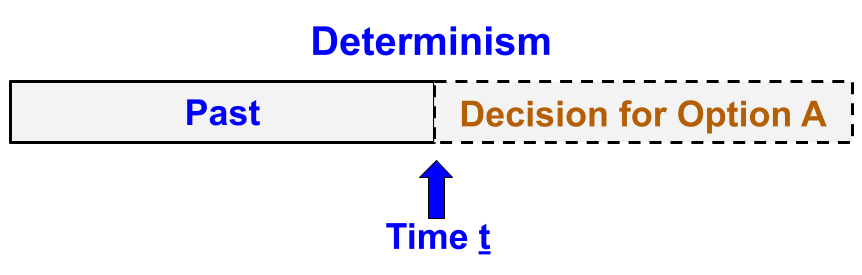
- Free Will branches, that is, the course of events can at a given time take one of several possible paths.

- Determinism never branches, though it may appear to do so. That’s the illusion of free will.
Formulations of Free Will
- britannica.com/topic/free-will
- Free will is the supposed power or capacity of humans to make decisions or perform actions independently of any prior event or state of the universe.
- merriam-webster.com/dictionary/free%20will
- 1. voluntary choice or decision
- 2. freedom of humans to make choices that are not determined by prior causes or by divine intervention
- plato.stanford.edu/archives/sum2016/entries/freewill
- “Free Will” is a philosophical term of art for a particular sort of capacity of rational agents to choose a course of action from among various alternatives.
- britannica.com/topic/problem-of-moral-responsibility
- One way to formalize the intuitive idea of free action is to say that a person acts freely if it is true that he could have acted otherwise. Buying apples is ordinarily a free action because in ordinary circumstances one can buy oranges instead;
- ahdictionary.com/word/search.html?q=free+will
- 1. The ability or discretion to choose; free choice:
- 2. The power of making choices that are neither determined by natural causality nor predestined by fate or divine will.
- wikipedia.org/wiki/Free_will
- Free will is the ability to choose between different possible courses of action unimpeded
- lexico.com/definition/free_will
- The power of acting without the constraint of necessity or fate; the ability to act at one’s own discretion.
- wordnetweb.princeton.edu/perl/webwn?s=free+will
- The power of making free choices unconstrained by external agencies
 A Philosopher's View