Back to Free Will and Determinism
Outline
- Other Arguments Against Free Will
- Other Arguments for Free Will
- Epiphenomenalism
- Fundamental Theories of Physics
- Free Will and Determinism for Deep Blue
Other Arguments Against Free Will
Psychological Determinism
View Psychological Determinism
Divine Foreknowledge
View Free Will and Divine Foreknowledge
Foretruth / Logical Fatalism
View Logical Fatalism
Other Arguments for Free Will
Evolution
Evidence for Ability
Paradigm Case
Epiphenomenalism
- plato.stanford.edu/entries/epiphenomenalism/
- “Epiphenomenalism is the view that mental events are caused by physical events in the brain, but have no effects upon any physical events. Behavior is caused by muscles that contract upon receiving neural impulses, and neural impulses are generated by input from other neurons or from sense organs. On the epiphenomenalist view, mental events play no causal role in this process. Thomas Huxley (1874), who held the view, compared mental events to a steam whistle that contributes nothing to the work of a locomotive. William James (1879), who rejected the view, characterized epiphenomenalists’ mental events as not affecting the brain activity that produces them “any more than a shadow reacts upon the steps of the traveller whom it accompanies”.”
Fundamental Theories of Physics
- The two fundamental theories of physics:
- Einstein’s General Relativity, which governs the force of gravity
- The Standard Model of Particle Physics, which governs the other basic forces:
- Electromagnetic Force
- Strong Nuclear Force
- Weak Nuclear Force
- The predictions of General Relativity are categorical, e.g. that the bowling balls collide in 13 days.
- View Interactive
- The predictions of the Standard Model are probabilities, e.g. that the probability a silver atom passing through a Stern-Gerlach is deflected upwards equals ½.
- Which raises the question whether the Standard Model makes room for free will, discussed later.
Free Will and Determinism for Deep Blue

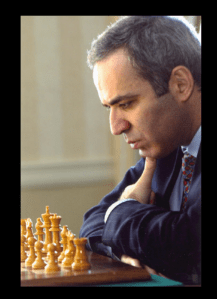
Deep Blue
- britannica.com/topic/Deep-Blue
- “Deep Blue is a computer chess-playing system designed by IBM that in 1997 beat Russian grandmaster and world champion Garry Kasparov in a six-game match under tournament conditions”
- The computer’s moves are the result of a sophisticated algorithm that analyzes possible moves, given the positions of the pieces on the board, and assigns a score to each.
- An algorithm is a step-by-step procedure which, after a finite number of steps, computes a result, e.g. the common algorithm for multiplying two numbers.
- Kasparov has moved his rook, leaving Deep Blue only two possible moves: Knight-to-E6 and Knight-to-C6. DB applies its evaluation function, yielding scores of 90 for Knight-to-E6 and 10 for Knight-to-C6.
- Accordingly DB moves its Knight to E6.
- Could DB have moved its Knight to C6 instead?
- Not under the conditions at the time, i.e. the positions of the pieces and DB’s algorithm.
- Under those conditions
- DB could not move its Knight to C6
- DB could not have moved its Knight to C6 instead
- It was not possible for DB to move its Knight to C6
- It was not possible for DB to have moved its Knight to C6 instead
- DB was not able to move its Knight to C6
- DB was not able to have moved its Knight to C6
- DB could not move its Knight to C6
- DB’s move was determined by the positions of the pieces and its algorithm.
- Moreover,
- Faced with the same position of the pieces, DB always moves its Knight to E6.
- A person who knows the algorithm and the positions of the pieces can in theory predict how DB will move.
Deep Blue Diagram
- Timeline
- DB learns the positions of the pieces
- DB evaluates its possible movies, yielding scores:
- 90 for Knight to E6
- 10 for Knight to C6.
- DB makes the move with the highest score.

- DB could not have moved its Knight to C6, under the conditions at the time.
Probabilistic Deep Blue
- Let’s modify Deep Blue by making its moves a matter of probability. A random number generator yields a 1 or a 0 with probabilities 0.9 and 0.1. If the generated number is 1, Probabilistic Deep Blue moves Knight to E6. If the number is 0, it moves Knight to C6.
- Suppose that again Deep Blue moves its Knight to E6. It now appears that DB could have moved its Knight to C6 instead.
- Are the following true:
- Is was under Deep Blue’s control whether he moved his Knight to E6 or C6.
- Is was up to Deep Blue’s whether he moved his Knight to E6 or C6.
 A Philosopher's View