“The most contentious question of metaphysics, the most contentious science” — David Hume, 1758
Big Picture
The Problem
- It seems obvious people have free will. People deliberate about matters such as what job offer to take, whether to get married and have children, and whether to undergo surgery. No matter what people decide, it seems evident they could have decided otherwise.
- But it also appears that the universe is governed by laws of nature, that events unfold according to scientific laws:
- The planets orbit around the Sun according to the laws of gravitation
- Electromagnetic waves propagate according to the laws of electromagnetism.
- Atoms, subatomic particles, and photons interact per the laws of quantum physics
- The neural impulses of the billions of neurons that comprise the human nervous system are governed by the laws of chemistry and physics.
- So the question is:
- Do people have control over what they do and decide?
- Or are people’s actions and decisions the outcome of events governed by scientific laws and beyond their control?
Basic Concepts
Free Will
- The traditional idea of free will is the ability to do otherwise.
- A person decided or acted of their own free will if they could have decided or acted otherwise.
- People seem to have free will.
- For example, while parking your car you accidentally scrape the side of a Corvette. After brief deliberation, you decide to leave a note. It seems obvious you could have simply driven off instead.
- View Free Will
Determinism
- The basic idea of determinism:
- Laws of Nature + Earlier Events → Later Events
- General Determinism
- Every event is “determined by” antecedent conditions and laws of nature
- That is, every event is a logical consequence of antecedent conditions and scientific laws
- General Determinism is a generalization from the laws of Classical Physics.
- Evidence for Classical Physics is therefore evidence for General Determinism
- View General Determinism
- Every event is “determined by” antecedent conditions and laws of nature
- Neural Determinism
- Every neural impulse in the human nervous system is a logical consequence of antecedent physical events and the laws of chemistry and physics.
- Neural Determinism is a generalization from the Neural Theory of Behavior
- Neuroscientific evidence for the Neural Theory of Behavior is therefore evidence for Neural Determinism
- View Neural Determinism
Moral Responsibility
- A person is morally responsible for an act or omission if they deserve blame or punishment, praise or reward.
- People, it seems, are morally responsible for most of their acts and omissions.
- For example, you’re morally responsible for the damage to the Corvette
- Determinism seems to imply no one is morally responsible.
- If determinism is true, no one could have avoided anything they do.
- A person is morally responsible for something they do only if they could have avoided doing it.
- This is the Principle of Alternate Possibilities (PAP)
- Therefore, if determinism is true, no one is morally responsible for anything they do.
- In particular, no one deserves to be punished.
- View Moral Responsibility
Basic Positions
Hard Determinism
General Determinism
- General Determinism is the view that
- Every event is a logical consequence of antecedent conditions and scientific laws
- Laws of Nature + Earlier Events → Later Events
- View General Determinism
- General Determinism is a generalization from Classical Physics
- Free will is incompatible with General Determinism
- Therefore, people do not have free will
- Free will is an illusion
- Moreover, people are morally responsible only if they have free will
- So, no one is morally responsible for what they do.
- In particular, no one deserves to be punished.
- Every event is a logical consequence of antecedent conditions and scientific laws
- Hard Determinists include Spinoza, Baron d’Holbach, and B.F. Skinner.
Argument that Quantum Physics Undermines General Determinism
- The predictions of Quantum Physics are fundamentally probabilistic.
- Fundamental means the probability of the predictions is not the result of unknown variables but is rather a basic feature of the physical world.
- Fundamentally probabilistic predictions are incompatible with General Determinism
- The evidence for Quantum Physics is overwhelming
- Therefore the evidence that General Determinism is false is overwhelming.
Neural Determinism
- Neural Determinism is the view that
- Every neural impulse in the human nervous system is a logical consequence of antecedent physical events and the laws of chemistry and physics.
- View Neural Determinism
- Neural determinism is supported by the neuroscientific evidence for the Neural Theory of Behavior
- Free will is incompatible with Neural Determinism
- Therefore, people do not have free will
- Free will is an illusion
- Moreover, people are morally responsible only if they have free will
- So no one is morally responsible for what they do.
- In particular, no one deserves to be punished.
- Every neural impulse in the human nervous system is a logical consequence of antecedent physical events and the laws of chemistry and physics.
- Neural Hard Determinists include:
- Sam Harris in Free Will (2012)
- Robert Sapolsky in Determined: A Science of Life Without Free Will (2023)
Raising your arm

- When you raise your arm
- Upper motor neurons fire
- Which cause lower motor neurons to fire, releasing the neurotransmitter acetylcholine across synapses with muscles.
- Which cause the muscles to contract
- Which causes your arm to rise
- The upper motor neurons fire because their presynaptic neurons fire, and they in turn fire because their presynaptic neurons, and so on back through the maze of 86 billion neurons and 100 trillion synaptic connections.
- Accompanying the firing of the upper motor neurons is a sensation of willing your arm to move, but the sensation has no effect on the UMNs.
Argument that Quantum Physics Does Not Undermine Neural Determinism
- Though Quantum Physics undermines General Determinism, Neural Determinism is nonetheless true because quantum indeterminacies among subatomic particles are cancelled out at cellular and molecular levels. Thus, the human nervous system, for all intents are purposes, behaves according to the laws of Classical Physics.
- View the Argument
Neural Determinism and Epiphenomenalism
- If Neural Determinism is true, neural events are completely determined by physical events and scientific laws. Mental acts such has decisions and acts of will have no effect on brain events.
- Neural Determinism thus implies, Epiphenomenalism, the view that neural events cause mental events but never the reverse. The causal relation is only one way.
Libertarianism
- Libertarianism is the view that
- People have free will
- A person decided or acted of their own free will if they could have decided or acted otherwise.
- Free will is incompatible with determinism
- People have free will
- Libertarians include Rene Descartes, Roderick Chisholm, and John Eccles, Nobel laureate in neuroscience
Libertarian free will is branchy

Raising your arm
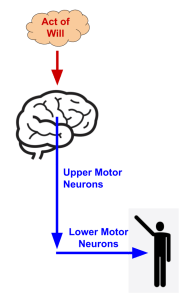
- When you raise your arm
- Upper motor neurons fire
- Which cause lower motor neurons to fire, releasing the neurotransmitter acetylcholine across synapses with muscles.
- Which cause the muscles to contract
- Which causes your arm to rise
- When you raise your arm, you cause the upper motor neurons to fire by a certain mental effort on your part to raise your arm, a mental act that’s variously called an act of will, an endeavoring, a trying, or a volition.
- When you raise your arm of your own free will it’s under your control whether the act of will takes place
- Your act of will is therefore not determined by laws of nature and prior events.
- Moreover, when you raise your arm of your own free will it’s under your control whether the upper motor neurons fire.
Dialectic between Libertarian and Neural Determinist
- Argument against Libertarianism
- Neural Determinism is true
- Libertarianism is incompatible with Neural Determinism
- Therefore Libertarianism is false
- Libertarian Reply
- Quantum Physics makes room for free will
- People can alter the course of events in their brains by affecting the probability of quantum events associated with their decisions, acts of will, and other mental acts.
- Quantum Physics makes room for free will
- First Reply to Libertarian
- There’s no evidence of probabilistic quantum events in the brain.
- Second Reply to Libertarian
- That human beings can affect the probability of quantum events is incompatible with Quantum Physics
- View the Argument
- The evidence for Quantum Physics is overwhelming
- Therefore there is overwhelming evidence that human beings can’t affect any quantum events in their brains.
- That human beings can affect the probability of quantum events is incompatible with Quantum Physics
- View Libertarianism
Compatibilism
- Compatibilism (or Soft Determinism) is the view that
- People have free will
- Free Will is compatible with Determinism
- So there’s no problem
- In a 2020 survey of academic philosophers
- 60% accepted or leaned towards Compatibilism
- 20% accepted or leaned towards Libertarianism
- 11% accepted or leaned towards No Free Will
- Famous compatibilists include the philosophers David Hume, John Stuart Mill, and G.E. Moore.
- Arguments for Compatibilism
- “Could have done otherwise” is constitutionally iffy
- The Principle of Alternate Possibilities (PAP) is false
- People believe they have free will, just not free will under the very same conditions
- Wolf’s Analysis of Ability
- The main problem for Compatibilism:
- Refuting the Consequence Argument for Incompatibilism
- View Compatibilism
Developments Since 1900
Quantum Physics
- Werner Heisenberg, Max Born, Pascual Jordan, and Erwin Schrödinger published papers in 1925 and 1926 laying the foundation of Quantum Mechanics, the theory that governs the behavior of atoms and subatomic particles
- The predictions of Quantum Physics are probabilistic.
- For example, quantum mechanics predicts that a silver atom passing through a Stern Gerlach magnet will be deflected upwards, rather than downwards, with a probability of ½.
- Such phenomena seem to disprove determinism and make room for free will.
Neuroscience
- Santiago Ramón y Cajal, who won the Nobel Prize in 1906 for his studies of the neuron, is the Father of Neuroscience. Since then, neuroscience has made tremendous progress in discovering how the nervous system works and how it explains human behavior.
- The Neural Theory of Behavior provides the strongest evidence that human decisions and actions are determined
Neural Networks and Machine Learning, the Core of AI
- The brain learns by changing itself, specifically by altering its synaptic connections.
- A neural network computer program also learns by changing itself, specifically by modifying an internal block of numbers called weights.
- View Neural Networks
Related Issues
Free Will and Divine Foreknowledge
- If God is omniscient then, before I was born, He knew the course of my entire life.
- I just raised my hand.
- So God knew before I was born I would raise my hand.
- There is nothing I can do to change what God knew before I was born.
- Therefore I could not have refrained from raising my hand.
Logical Fatalism
- Propositions are either true or false, including those about the future, e.g. that it will either snow somewhere in Frisco TX tomorrow or it won’t.
- So it’s either true or false that I will raise my arm in the next minute. And it was true or false yesterday, the day before, and indeed before I was born.
- People can’t change what’s true before they are born.
- So if it was true before I was born that I would raise my arm in the next minute, I can’t help doing so.
- And if it was false before I was born that I would raise my arm in the next minute, it’s impossible that I raise it.
- Either way, what happens is beyond my control.
- View Free Will Addendum
Pages
- Free Will and Determinism
- Determinism
- Free Will
- Moral Responsibility
- Libertarianism
- Consequence Argument for Incompatibilism
- Compatibilism
- Free Will and Quantum Physics
- Neural Theory of Behavior
- Neural Determinism
- Psychological Determinism
- Neural Networks
- Addendum
Big Picture Graphic

 A Philosopher's View