Back to Free Will and Determinism
Neural impulses in the human nervous system are the logical consequence of antecedent conditions and the laws of chemistry and physics
Outline
- Neural Determinism
- Human Nervous System
- Basic Unit of the Nervous System: the Neuron
- Mission of the Neuron: to Fire
- Bending My Finger
- The Action Potential
- Synaptic Transmission
- Neuroscientific Experiments of Free Will
- Addendum
Neural Determinism
- Neural Determinism is the view that
- Every neural impulse in the human nervous system is a logical consequence of antecedent neural events and the laws of chemistry and physics.
- Neural determinism is supported by the neuroscientific evidence for the Neural Theory of Behavior
Human Nervous System
- The human nervous system comprises a network of 86 billion neurons connected at 100 trillion synapses.
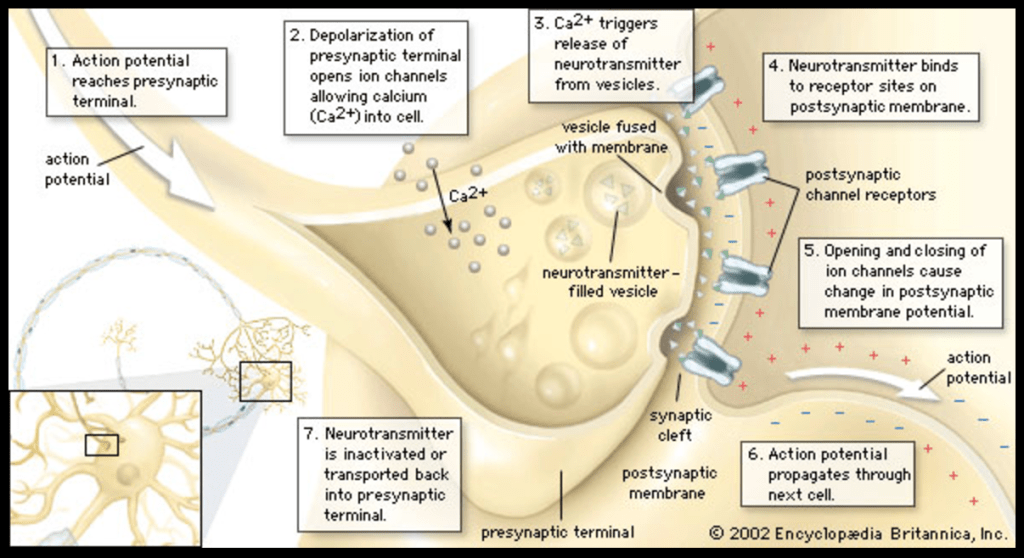
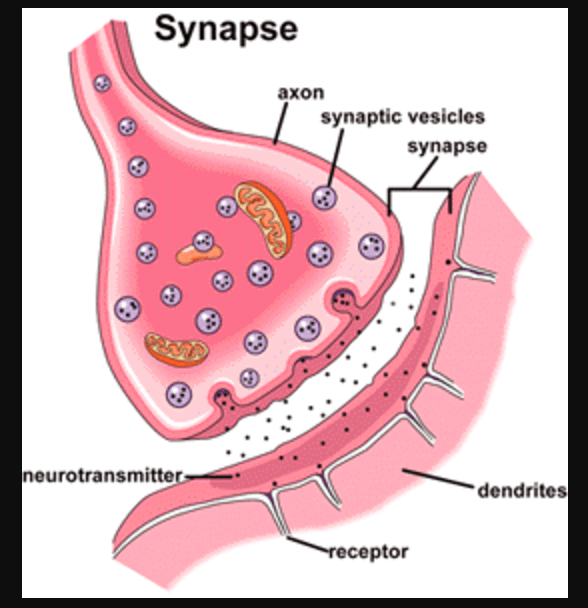
- A synapse is a small gap between neurons, across which ions and neurotransmitter molecules travel.
- On the input side, sensory neurons receive signals from sensory receptors in the ears, eyes, mouth, nose, skin, and internal organs.
- On the output side, motor neurons cause muscles to contract
Basic Unit of the Nervous System: the Neuron
The human nervous system has 86 billion neurons, some 1 meter long

Image Credit: Wikipedia
Neurons are cells with the usual organelles (e.g. nucleus, ribosomes, mitochondria) but designed for transmitting an electric signal.
Mission of the Neuron: to Fire
- The mission of the neuron is to fire, that is, to generate an electrical signal that travels from the cell body, down the axon, to the axon terminals.
- The official name of the traveling signal is action potential. Another name is nerve impulse.

Bending My Finger
How I bend my finger
I just bend it

How my neurons bend my finger
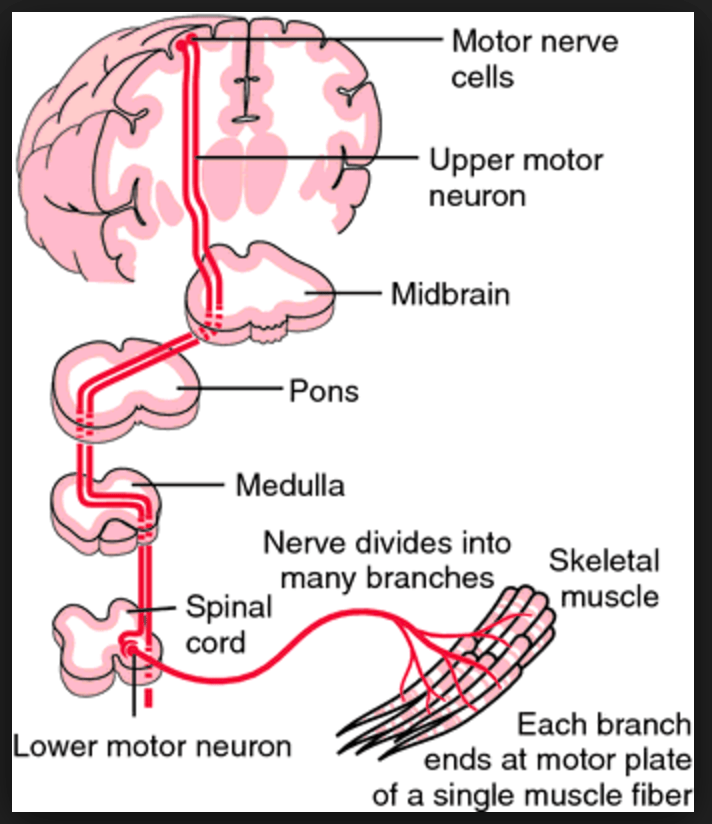
Upper motor neurons run from the primary motor cortex of the brain down the spinal column, where they synapse on lower motor neurons, which run from the spinal column to the hand, where they synapse on the muscles controlling bending the finger.
- Upper motor neurons fire
- Which cause lower motor neurons to fire, releasing the neurotransmitter acetylcholine across synapses with muscles.
- Which cause the muscles to contract
- Which causes my finger to bend
Primary Motor Area (in purple) of the Cerebral Cortex
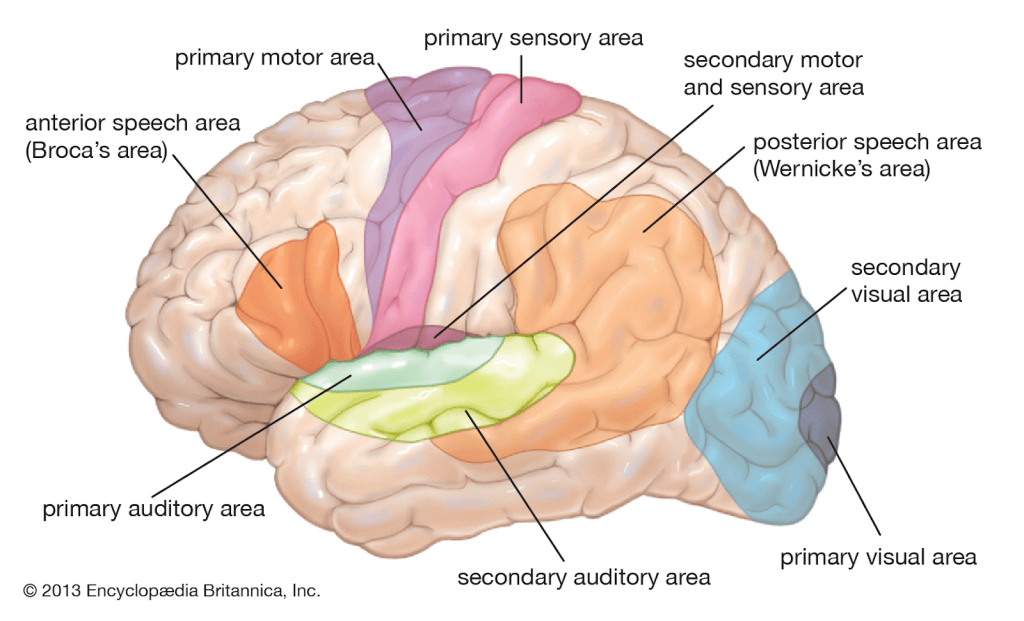
Image Credit britannica.com/science/human-nervous-system
The Action Potential
- The job of the neuron is to undergo an action potential given appropriate input from presynaptic neurons.
- Action potentials are also called electrical signals, nerve impulses, and neuronal firings.
- The action potential is a temporary voltage reversal that travels from the cell body, down the axon, to the axon terminals, releasing ions or neurotransmitter molecules into synapses.
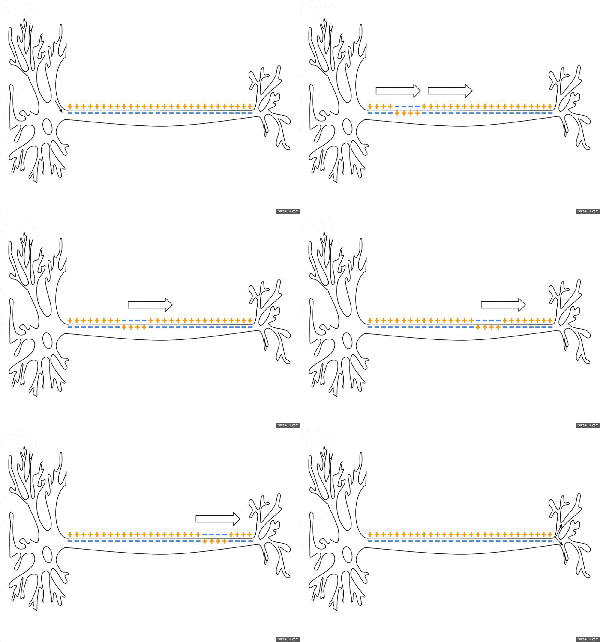
By Laurentaylorj – Own work, CC BY-SA 3.0
- At rest there is a voltage difference between the inside and outside of a neuron, like the voltage difference between the poles of a battery. When not firing, the outside of the neuron is more positive than the inside by 75 mV.
- One volt = 1,000 millivolts (mV)
- What’s called the resting potential (inside voltage minus outside) is about -70 mV.
Resting Potential

- An action potential begins when the difference in electric charge reaches a threshold of about -60 mV due to the influx of neurotransmitters at its dendrites. The action potential consists of a temporary voltage reversal (about +55 mV) that quickly travels down the axon, releasing neurotransmitters at the axon terminals.
- The action potential in the diagram is the blue segment.
Action Potential
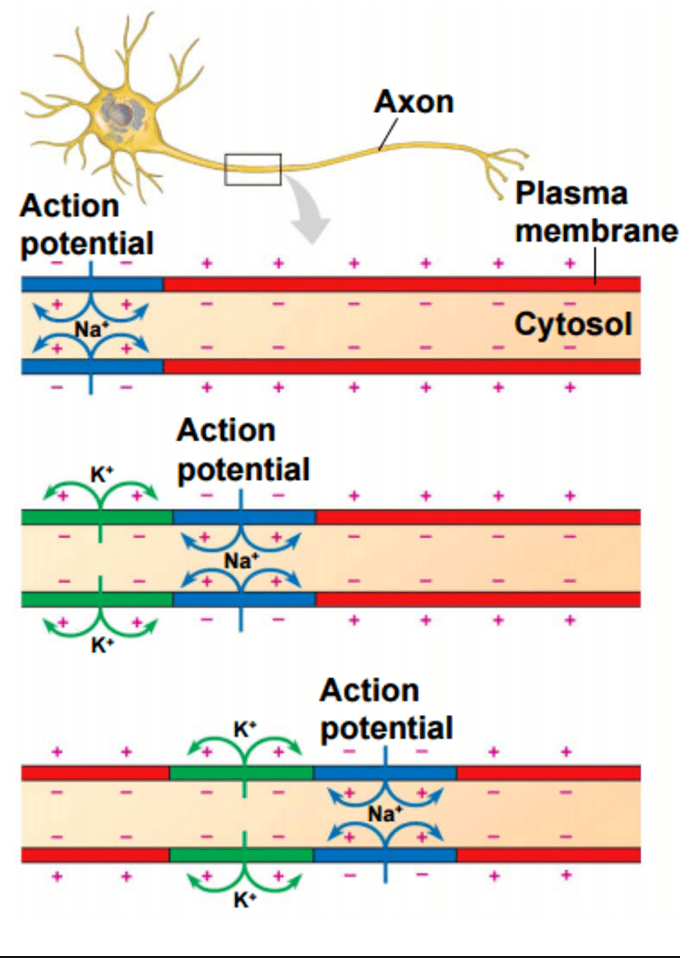
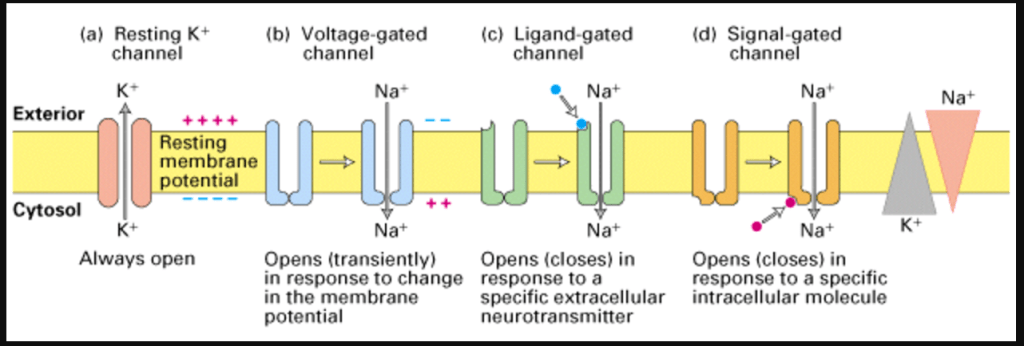
- The traveling reversal of voltage difference is caused by ion channels in the neuron’s membrane that temporarily open to let positively charged ions move from one side to the other, thus changing the voltage difference.
Ion Channels
Animations
- Action Potential in the Neuron Harvard
- Start – 1:15 and 11:00 – End
- Alila Medical Media Action Potential
- Start – 1:00
Synaptic Transmission
How the action potentials of presynaptic neurons cause the action potential of a postsynaptic neuron
In the diagram below axon terminals of a presynaptic neuron (upper right) synapse on the cell body and two dendrites of a postsynaptic neuron (lower left). An action potential of the presynaptic neuron causes particles to travel from the axon terminals to receptors on the cell body and dendrites of the postsynaptic neuron. The particles are either neurotransmitter molecules (e.g. glutamate, GABA, and acetylcholine) or ions (usually positive). Either way, the effect is to increase or decrease the voltage potential of the postsynaptic neuron. If the potential reaches a threshold of -60 mV, the postsynaptic neuron undergoes an action potential. The diagram shows only one presynaptic neuron, but there may be hundreds or thousands, each having an effect on the postsynaptic neuron’s voltage potential.

Image Credit nih.gov by way of Harvard
Neuroscientific Experiments of Free Will
Libet-Style Experiments
- In the 1980s Benjamin Libet performed a series of famous experiments that purported to show that the act of deciding begins in the brain before the decision-maker is conscious of making it.
- The objective of Libet-style experiments is to predict a person’s decision, based on brain activity, before they are conscious of the decision
- The experiments make use of the “readiness potential”
- The Readiness Potential is activity in the motor cortex and supplementary motor area of the brain leading up to voluntary muscle movement. (wikipedia.org/wiki/Bereitschaftspotential)
Libet 1983
- Technology: EEG
- Action: bend wrist
- Detection of brain activity before conscious decision: 350 milliseconds
- Accuracy of prediction: N/A
- “Time of conscious intention to act in relation to onset of cerebral activity (readiness-potential). The unconscious initiation of a freely voluntary act,” Brain 106, Sept 1983, by Libet B, Gleason CA, Wright EW, Pearl DK
Haynes 2008
- Technology: fMRI
- Action: press left or right button
- Detection of brain activity before conscious decision: up to 7 seconds
- Accuracy of prediction: 60% at ? seconds
- “Unconscious determinants of free decisions in the human brain,” Nature Neuroscience, April 2008, by Chun Siong Soon, Marcel Brass, Hans-Jochen Heinze, John-Dylan Haynes
Fried 2011
- Technology: Implanted electrodes recording activity of single neurons
- Action: press button or not
- Detection of brain activity before conscious decision: 1.5 seconds
- Accuracy of prediction: 80% at 700 milliseconds before the conscious decision
- “Internally generated preactivation of single neurons in human medial frontal cortex predicts volition,” Neuron, Feb 2011, by Fried I, Mukamel R, Kreiman G.
Libet’s Argument Against Free Will
- The decision to do X begins at the start of the detected brain activity, i.e. when the readiness potential begins.
- The detected brain activity begins before the conscious decision to do X
- A decision made of one’s free will must be initiated consciously.
- Therefore the decision to do X was not made of one’s free will.
Criticisms
- Alfred Mele, Free: Why Science Hasn’t Disproved Free Will
- First, given that the predictions are correct only 80 percent of the time, there’s no particular reason to believe that determinism is involved.
- Second, even if urges to press are determined by unconscious brain activity, it may be up to the participants whether they act on those urges or not.
- Libet said that some of the participants in his experiments reported that they occasionally vetoed urges to flex. They said they then waited for another urge to come along before flexing. This suggests that even if an urge is determined by unconscious brain processes, those processes might not determine a corresponding action.
- Adina Roskies, neuroscientist and philosopher at Dartmouth College
- Regarding the initiation of brain activity before conscious awareness of the decision, “all it suggests is that there are some physical factors that influence decision-making.”
Addendum
Determined: A Science of Life Without Free Will (2023), by Robert Sapolsky
Chapter 1: Turtles All the Way Down
- Compatibilism has produced numerous papers by philosophers and legal scholars concerning the relevance of neuroscience to free will. After reading lots of them, I’ve concluded that they usually boil down to three sentences:
- Wow, there’ve been all these cool advances in neuroscience, all reinforcing the conclusion that ours is a deterministic world.
- Some of those neuroscience findings challenge our notions of agency, moral responsibility, and deservedness so deeply that one must conclude that there is no free will.
- Nah, it still exists.
- What Do I Mean by Free Will?
- Show me a neuron (or brain) whose generation of a behavior is independent of the sum of its biological past, and you’ve demonstrated free will.
Chapter 2: The Final Three Minutes of a Movie
- Criticisms are set forth of experiments by Benjamin Libet, John-Dylan Haynes, and Itzhak Fried
Chapter 3: Where Does Intent Come From?
- Each prior influence on a person’s behavior flows without a break from the effects of the influences before. All beyond one’s control.
- There’s a seamless stream of influences on a person’s decisions that precludes inserting a freedom of will that is in the biological world, but not of it.
- Seconds to Minutes Before a Decision
- Sensory information flowing into your brain can affect a decision
- Minutes to Days Before
- Scads of hormones in your brain can affect a decision
- Weeks to Years Before
- Synaptic connections are continually changing
- Back to Adolescence
- The frontal cortex is still developing
- And Childhood
- There is increasing complexity of neuronal circuitry and myelination
- Back to the Womb
- Development of the nervous system is affected by the contents of maternal circulation: hormones, immune factors, inflammatory molecules, pathogens, nutrients, environmental toxins, illicit substances
- Back to Your Very Beginning: Genes
- Genes code for proteins and proteins affect everything, including the nervous system
- Back Centuries: The Sort of People You Come From
- You inherit your genes from your ancestors
- Seconds to Minutes Before a Decision
Claim that a person cannot deliberate whether to do X without believing they can do X
- Statements of the Claim:
- Thomas Reid, Essays on the Active Powers of Man, Chapter VI
- “Deliberation about an action of moment, whether we shall do it or not, implies a conviction that it is in our power. To deliberate about an end, we must be convinced that the means are in our power; and to deliberate about the means, we must be convinced that we have power to choose the most proper.”
- Richard Taylor, Action and Purpose, Chapter 12
- “Now if a man believes concerning some of the actions he’s going to perform that there already exist conditions causally sufficient for his performing them and conditions which therefore render them inevitable then he cannot deliberate whether or not to perform them.” (page 182)
- Peter van Inwagen, An Essay on Free Will
- “But all philosophers who have thought about deliberation agree on one point: one cannot deliberate about whether to perform a certain act unless one believes it is possible for one to perform it. (Anyone who doubts that this is indeed the case may find it instructive to imagine that he is in a room with two doors and that he believes one of the doors to be unlocked and the other to be locked and impassable, though he has no idea which is which; let him then attempt to imagine himself deliberating about which door to leave by.)” (p 154)
- Thomas Reid, Essays on the Active Powers of Man, Chapter VI
- Assessment
- Suppose a hard determinist has to decide whether to undergo a serious brain operation. He believes that whatever he ultimately decides he could not have decided otherwise. Yet he does the research, assesses the risks and benefits of the options, and makes a decision.
- As he deliberates he believes that either he will decide to have the surgery, unable to decide otherwise, or that he’lll decide to forgo the surgery, unable to decide otherwise. Since he doesn’t yet know his final decision, he believes neither that he can decide to have the surgery nor that he can decide not to have the surgery. Moreover, he can believe that his deliberations are pseudo-effective, since they reflect brain events that result in the decision.
Synaptic Transmission Diagrams
Old Stuff
Here’s the problem. We know the conditions under which motor neurons, and neurons in general, fire and don’t fire. And those conditions are incompatible with free will.

- A neuron at rest has less electric charge inside than out. The difference is about -70 mV, meaning that the inside charge minus the outside charge = -70 mV. (mV = millivolt =1/1,000 of a volt)
The assassin did not have free will
- The assassin has free will to bend or not bend his index finger only if he has free will to cause or prevent UMN firing.
- But the assassin can’t prevent UMN from firing because at the time, as UMN is on the verge of firing:
- Presynaptic neurons A and B have already fired and C has not.
- The assassin can’t change the past.
- So the assassin can’t prevent A and B from firing or make C fire.
- So the assassin can’t do anything to prevent UMN from firing.
- Note:
- The argument applies not only to motor neurons but to any neuron whatever. So it doesn’t do any good to point to some other neuron and say that’s where McBad had free will.
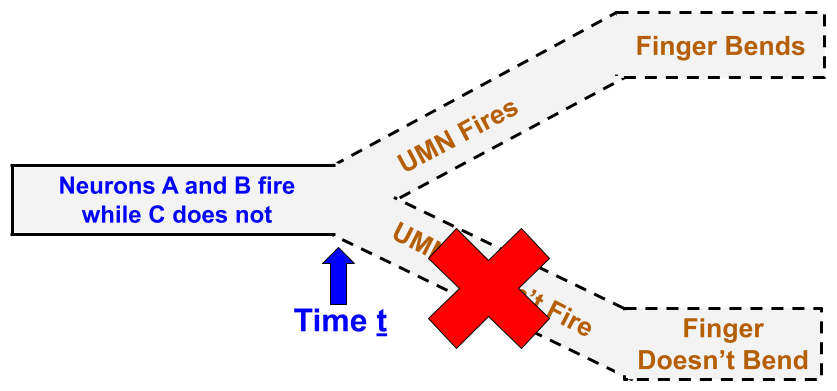
So the assassin could not have refrained from pulling the trigger. He did not have free will.
McBad bears no moral responsibility
How Could I have refrained from bending my finger?
- A person is morally responsible for something he does only if he could have avoided doing it.
- The assassin could not have avoided pulling the trigger, killing the Director.
- Therefore the assassin is not morally responsible for assassinating the Director, meaning that he doesn’t deserve to be punished.
- If I have free will, I control whether I bend my finger or not, which means I control whether the associated UMN fires. But a neuron fires because it reaches a certain threshold voltage due to changes in neurotransmitter receptors on its dendrites and axon.
What Free Will Looks Like
People believe they have free will, that they can decide among different possible courses of action. Free will seems to look like this:
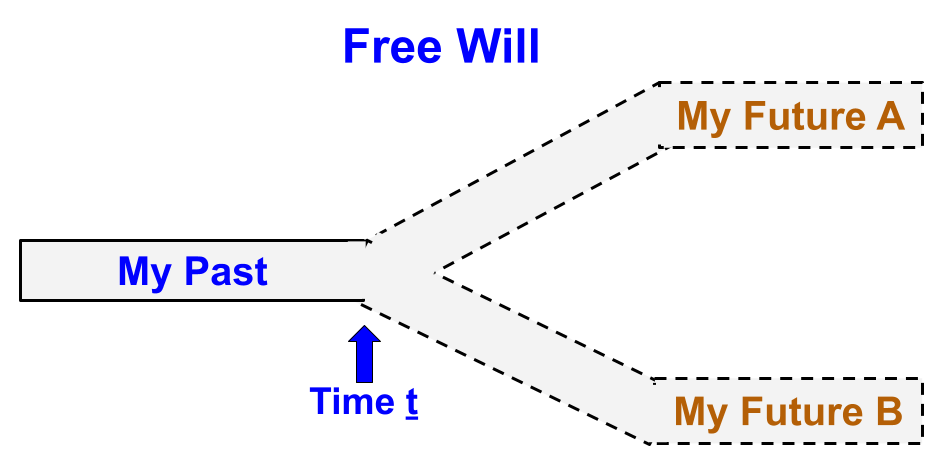
If I have free will at time t I can decide among multiple futures open to me. Thus, at time t I can choose future A and I can choose future B. Afterwards, if I freely chose future A, it’s true that I could have chosen B. Conversely, if I had freely chosen future B, it would have been true that I could have chosen A.
Assassination of the Director
An assassin kills the Director. Did he have free will?

Free will pulling the trigger
If the assassin has free will, then at some point before pulling the trigger at time t, he could have decided to refrain from bending his trigger finger.
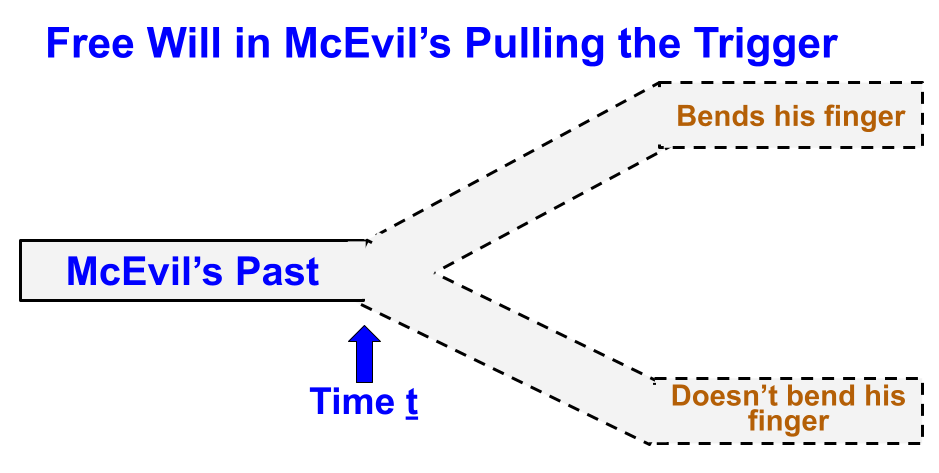
Motor neurons cause the assassin’s trigger finger to bend
Motor neurons bring about bodily movements.
Motor neurons caused the assassin’s finger to bend.
- An upper motor neuron runs from the primary motor cortex of the assassin’s brain to his spinal column, where it synapses on a lower motor neuron, which runs from his spinal column to his hand, where it synapses on the muscle controlling bending the finger.
- So in bending his trigger finger:
- The upper motor neuron fires
- Which causes the lower motor neuron to fire
- Which causes the lower motor neuron to release the neurotransmitter acetylcholine across the synapse with the muscle.
- Which causes the muscle to contract
- Which causes the finger to bend
- Which causes the gun to fire.
Free will to prevent neurons firing?
To have had free will to bend or not bend his trigger finger, the assassin must have been able to cause or prevent the upper motor neuron from firing.
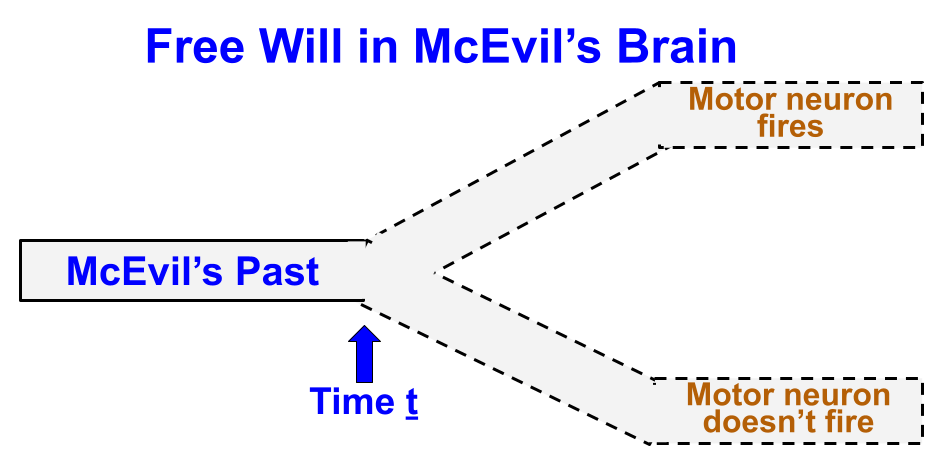
Neuroscience of Movement
- britannica.com/science/human-nervous-system
- “One important structure in the frontal lobe is the precentral gyrus, which constitutes the primary motor region of the brain. When parts of the gyrus are electrically stimulated in conscious patients (under local anesthesia), they produce localized movements on the opposite side of the body that are interpreted by the patients as voluntary.”
 A Philosopher's View