Contents
- Specifying Numeric Probabilities
- Probability Distributions
- Random Variables
- Three Common Distributions
- Mean of a Random Variable and Expectation
- Variance and Standard Deviation of a Random Variable
Specifying Numeric Probabilities
- Individual Probability
- In rolling a pair of dice the probability of rolling a seven = ⅙
- Probability Range
- In rolling a pair of dice the probability of rolling 5 through 9 = ⅔
- In rolling a pair of dice the probability of rolling at least 10 = ⅙
- Probability Distribution
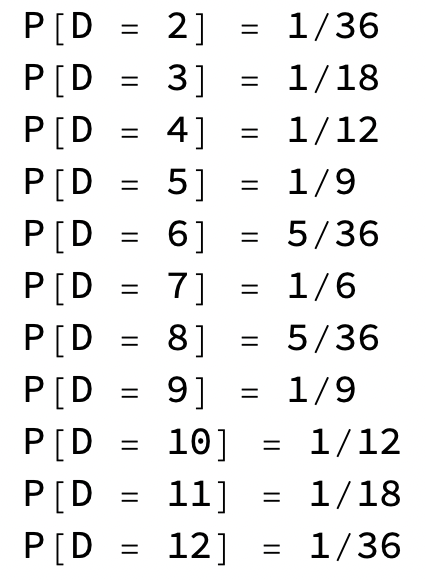
- In rolling a pair of dice the probabilities of rolling 2, 3, 4, 5, 6, 7, 8, 9, 10, 11, 12 are 1/36, 1/18, 1/12, 1/9, 5/36, 1/6, 5/36, 1/9, 1/12, 1/18, 1/36 respectively.

Probability Distributions
- A probability distribution is an assignment of probabilities to a set of numbers.
- The Rolling Dice distribution assigns probabilities to the possible outcomes of a roll, the integers 2 through 12.
- At the heart of a probability distribution are two functions:
- PDF, the probability density (or mass) function, returns the probability of the input value.
- CDF, the cumulative density (or mass) function returns the probability of values less than or equal to the input value.
- For example, for Rolling Dice:
- Probability of Boxcars:
- PDF(Rolling Dice, 12) = 1/36
- Probability of 7 or 11:
- PDF[Rolling Dice, 7] + PDF[Rolling Dice, 11] = 2/9
- Probability of x ≥ 10:
- 1 – CDF[Rolling Dice, 9] = ⅙
- Probability of x ≥ 7 & x ≤ 11:
- CDF[Rolling Dice, 11] – CDF[Rolling Dice, 6] = 5/9
- Probability of Boxcars:
- Probability distributions are discrete or continuous.
- A discrete distribution assigns probabilities only to a finite (or countable) set of numbers. For example, the Rolling Dice distribution assigns probabilities to the integers 2 through 12 but not to the real numbers between.
- A continuous distribution assigns probabilities to real numbers. The normal distribution, for instance, assigns probabilities to all real numbers from negative infinity to positive infinity.
- Every probability distribution is characterized by a set of numeric properties, the most important being mean, variance, standard deviation, and quintile. For Rolling Dice, for example:
- Mean = 7
- Variance = 35/6
- Standard deviation = √(35/6)
- Quartiles = {5, 7, 9)
- Quantile[0.1] = 4
- Quantile[0.9] = 10
- A probability distribution is not a frequency distribution. The latter is a calculation on the data. A probability distribution, on the other hand, is a self-contained abstract entity.

- The terms mean, variance, standard deviation, and quantile have dual senses. They have one meaning when applied to datasets. They have a different but analogous meaning when applied to probability distributions and random variables. For example, the mean of ten rolls of a pair of dice is the sum of the ten rolls divided by ten. But the mean of Rolling Dice is the probability-weighted average of the possible outcomes. The former is a calculation on a dataset, varying from one dataset to another. The latter is an a priori calculation on an abstract entity and is fixed at seven.
Random Variables
- Random variables provide the symbolism for stating and proving theorems about probability distributions.
- A random variable, typically a capital letter, is defined by a probability distribution, which assigns probabilities to its values. It can be thought of as the outcome of a probabilistic process.
- For example, let random variable D = the outcome of rolling a pair of dice. D’s values are the integers 2 through 12 with the probabilities:
- A tilde is used to specify a random variable’s probability distribution. Thus:
- D ~ Rolling Dice.
- A random variable is discrete or continuous, depending on its probability distribution. D is discrete.
- And a random variable has the numeric properties of its probability distribution. Thus the mean of D is 7, that of Rolling Dice.
- Statements with random variables have determinate probabilities but no truth-values. That’s because a random variable’s probability distribution determines probabilities, not truth and falsehood. Thus, the probability that D ≤ 12 is 1. But it’s a mistake think that D ≤ 12 is true.
- Two common definitions of a random variable:
- A random variable is the outcome of a repeatable event whose probability is determined by a probability distribution.
- A random variable is a real-valued function defined on a sample space.
- The former definition provides a better way of understanding random variables as they are used. Thus you might say, for example:
- Let H be the number of heads in 3 flips of a coin;
- Let D be the total number of spots in rolling two dice;
- Let R be the proportion of problems you get right.
- Then you ask:
- What’s the probability of H (or D or R)?
- The answer is a probability distribution.
Three Common Distributions
- Scientists have developed hundreds of parametric probability distributions, i.e. those that take parameters. Distributions such as:
- Discrete
- Bernoulli (probability of success)
- Binomial (number of trials, probability of success)
- Poisson (mean)
- Discrete Uniform (minimum integer, maximum integer)
- Geometric (probability of success)
- Hypergeometric(number of draws, number of successes, population size)
- Continuous
- Normal (mean, standard deviation)
- Student T (degrees of freedom)
- ChiSquare (degrees of freedom)
- Continuous Uniform (minimum real number, maximum real number)
- Exponential (parameter)
- Βeta (shape, shape)
- Gamma (shape, scale)
- Discrete
- See wikipedia.org/wiki/List_of_probability_distributions for a long list.
- I briefly discuss three: the binomial, Poisson, and normal distributions.
Binomial Distribution
- The binomial distribution gives the probabilities of the possible outcomes of a series of trials, where the outcome of each trial is:
- binary, e.g. success or failure, heads or tails, 1 or 0.
- determined by the same probability.
- The distribution takes two parameters:
- n = the number of trials.
- p = the probability of success on a given trial.
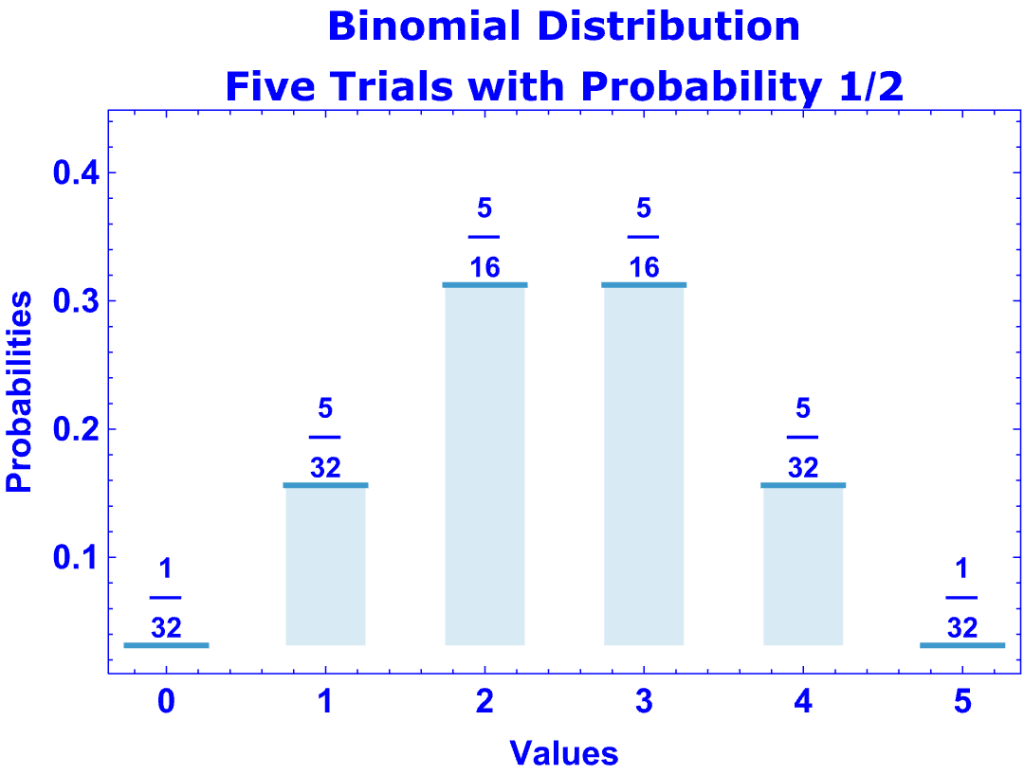
- The graph, for example, represents the binomial distribution for the number of heads in five tosses of an unbiased coin.
Poisson Distribution
- The Poisson distribution is a discrete probability distribution that’s been found to approximate very unlikely events occurring randomly within a given time or space.
- The distribution takes one parameter: the mean of the distribution. Its variance is the same as the mean.
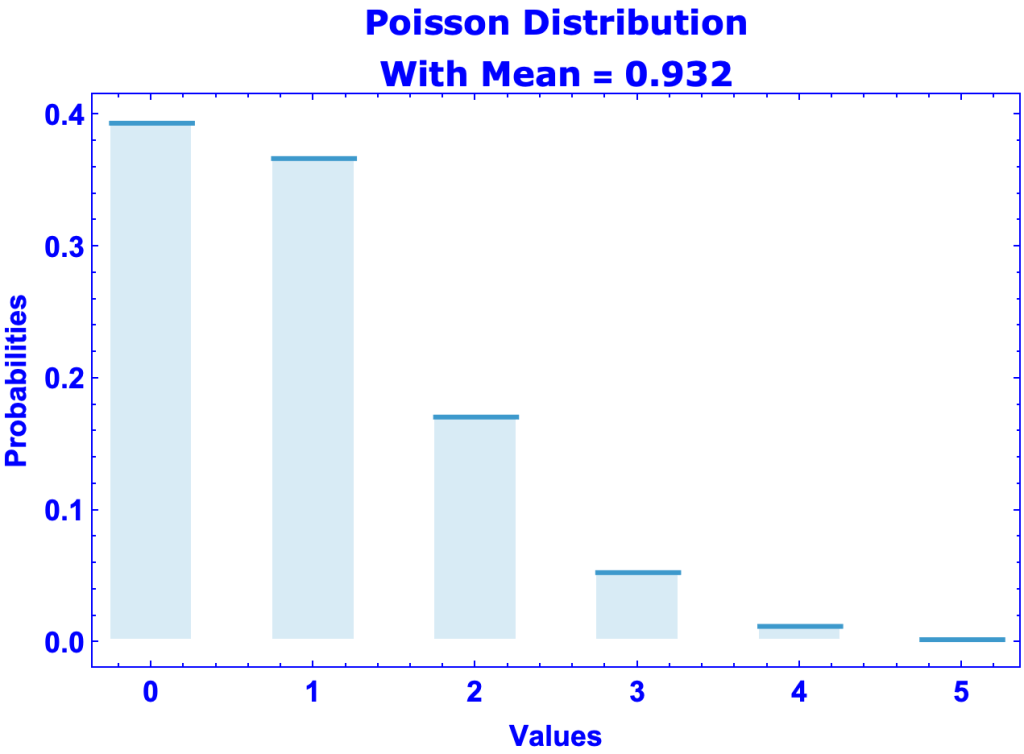
- The Britannica relates the story of R. D. Clark who, during WWII, was asked to determine whether the V-1 and V-2 rockets hitting London were targeted to hit certain locations or were hitting locations randomly. He divided London into small equally-sized plots and recorded the number hits in each. The Poisson distribution approximated the number of plots with 0, 1, 2, 3, 4, and 5 hits.
- Clark concluded that the rockets were hitting London randomly.
- Here’s a graph of my reconstruction of Clark’s Poisson distribution.

Normal Distribution
- The normal distribution is a continuous, bell-shaped, symmetric distribution that approximates natural quantities such as blood pressure, income, and measurement errors.
- The distribution takes two parameters:
- μ = the mean of the distribution
- σ = the standard deviation of the distribution
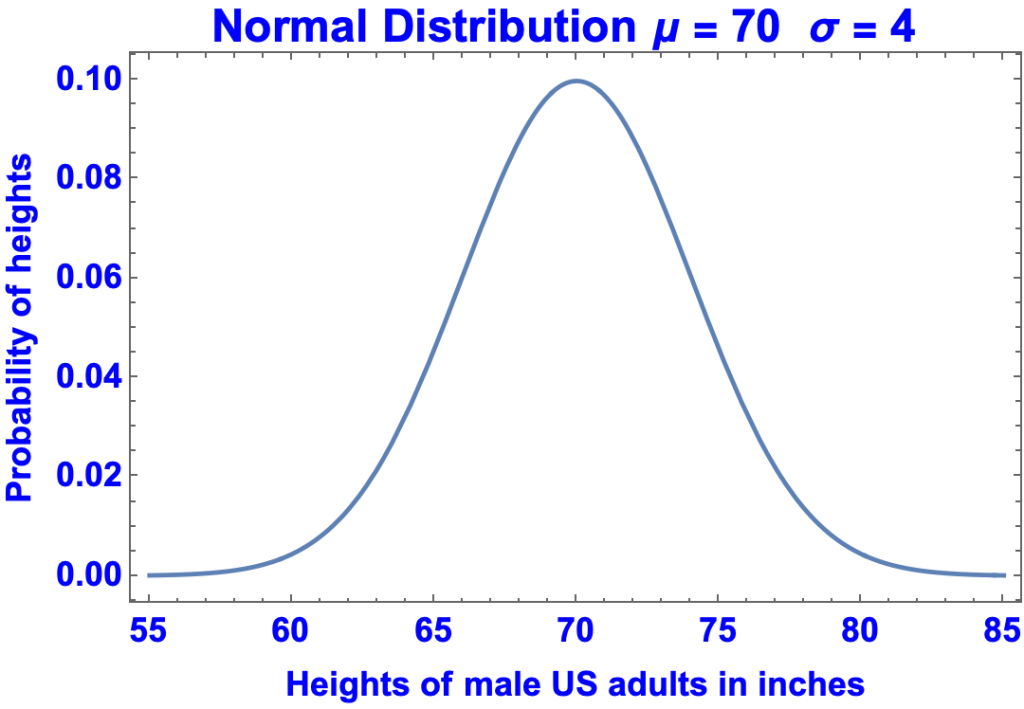
- The graph depicts the normal distribution that approximates adult male heights in inches.
Mean of a Random Variable and Expectation
- The mean of a random variable (or probability distribution) is the sum (or integral) of its probability-weighted values.
- For a discrete random variable X,
- the mean of X = the sum of (X · P(X)) for all values of X.
- For a continuous random variable X,
- the mean of X = the integral of (X · P(X)) for all values of X.
- For example, the means of Rolling Dice, the Binomial Distribution[5, 0.5], and the Normal Distribution[70,4] are:

- The mean of a random variable is also its expectation (or expected value). Expectation applies not just to random variables but to functions of random variables as well. Thus, not only is E(D) = 7, but E(2D) = 14, and E(D2) = 329 / 6.
Variance and Standard Deviation of a Random Variable
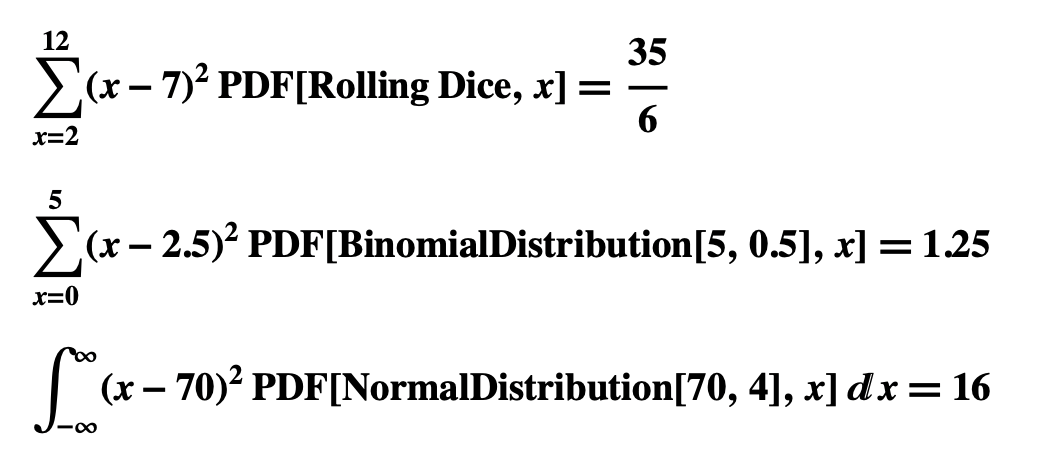
- The variance of a random variable (or probability distribution) is the sum (or integral) of the probability-weighted “square-distance” of its values from the mean.
- For a discrete random variable X,
- the variance of X = the sum of ((X – μ)2 · P(X)) for all values of X, where μ is the mean of X.
- For a continuous random variable X
- the variance of X = the integral of ((X – μ)2 · P(X)) for all values of X, where μ is the mean of X.
- Thus, for example, the variances of Rolling Dice, the Binomial Distribution[5, 0.5], and the Normal Distribution[70, 4] are:
- In the language of random variables, Var(X) = E[(X – μ)2].
- It’s easily shown, moreover, that Var(X) = E(X2) – (E(X))2. For example:

- Finally, the standard deviation of a random variable (or probability distribution) is the square root of its variance.
- Thus, the standard deviations of Rolling Dice, the Binomial Distribution[5, 0.5], and the Normal Distribution[70, 4] are: √(35/6), 1.118, and 4 respectively.
 A Philosopher's View