Back to Scientific Theories
Contents
- Big Picture
- Three Questions Raised by the Theory of Electromagnetism
- Postulates of Special Relativity
- Counterintuitive Consequences of the Postulates, an Example
- Predictions Derived from Postulates
- Minkowski’s Theory of Four-dimensional Spacetime
- Twin Paradox
- Modifications to Mechanics and E = mc2
- Historical Development
Big Picture
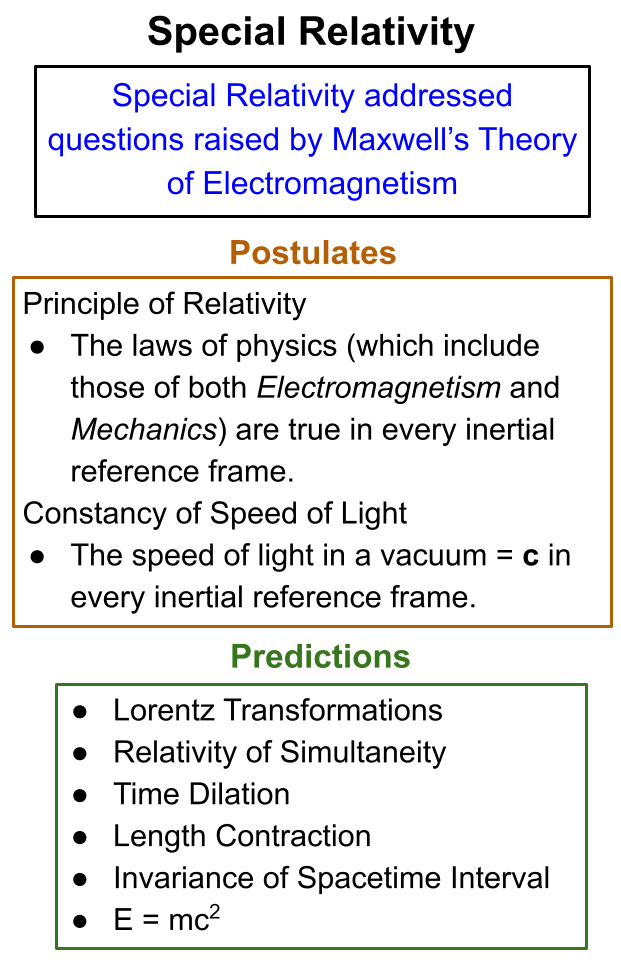
Three Questions Raised by the Theory of Electromagnetism
Theory of Electromagnetism
- In the 1860s James Clerk Maxwell set forth the theory of classical electromagnetism, which postulated the existence of an electromagnetic force that produced its effects, not instantaneously, but by way of fields traveling at the speed of light. “Maxwell’s Equations” describe how electric and magnetic fields are generated and how they exert a force on charged particles.
- According to one of Maxwell’s postulates, a changing magnetic field generates an electric field and, according to another, a changing electric field generates a magnetic field. Maxwell figured out that, by mutually generating each other, the fields produced a wave that travels at the speed of light. He concluded that light itself is an electromagnetic wave. As he put it,
- “We can scarcely avoid the conclusion that light consists in the transverse undulations of the same medium which is the cause of electric and magnetic phenomena.”
Questions
Maxwell’s conclusion that light is an electromagnetic wave raised three questions:
- Waves imply that something is waving. Sound waves, for example, propagate through air, water, or some other medium. What, then, is the medium through which electromagnetic waves travel?
- Velocity is relative. The ground speed of an aircraft, for example, is relative to the Earth’s surface below. Its airspeed is relative to the air surrounding it. What, then, is the speed of light relative to?
- Underlying Newtonian Mechanics is the Principle of Relativity, that the laws of physics are valid in all inertial frames of reference, i.e. reference frames that are not accelerating, decelerating, rotating, or changing direction. Since it’s logically implied by Maxwell’s Equations, it’s a law of physics that light travels at velocity c. Thus, if the Principle of Relativity is true, the speed of light is the same in every inertial frame. But that seems impossible. Suppose a reference frame moves at half the speed of light relative to a second frame. And a light beam passes by. Surely its speed can’t be the same in both frames. The question then is: in which inertial reference frames does the speed of light equal c?
Ether Hypothesis
The ether hypothesis, supported by many prominent 19th-century physicists, provided answers to the three questions:
- Electromagnetic waves propagate through the medium of the ether (or luminiferous ether), a weightless, transparent, elastic substance that pervades all space (including inside matter).
- The speed of light is relative to the ether.
- The Principle of Relativity is valid for Newtonian Mechanics. But the theory of Electromagnetism is true only in the reference frame of the ether.
Special Relativity
In his classic 1905 paper “On the Electrodynamics of Moving Bodies” Einstein gave very different answers.
- Electromagnetic waves require no medium.
- Einstein: “The introduction of a ‘luminiferous ether’ will prove to be superfluous inasmuch as the view here to be developed will not require an ‘absolutely stationary space’ provided with special properties.”
- The speed of light in a vacuum is the same in all inertial reference frames.
- Einstein: “Light is always propagated in empty space with a definite velocity c which is independent of the state of motion of the emitting body.”
- The Principle of Relativity is true unconditionally (and is thus true for both Electromagnetism and Mechanics).
- Einstein: “The same laws of electrodynamics and optics will be valid for all frames of reference for which the equations of mechanics hold good.”
Answers #2 and #3 are the postulates of Special Relativity.
Postulates of Special Relativity
Principle of Relativity
- Postulate
- The laws of physics (which include those of both Electromagnetism and Mechanics) are true in every inertial reference frame.
- From Einstein’s 1905 paper “On the Electrodynamics of Moving Bodies:”
- “The same laws of electrodynamics and optics will be valid for all frames of reference for which the equations of mechanics hold good”
- Thus the outcome of any physical experiment is the same in every inertial reference frame.
- Experiments with pendulums, electricity, and magnets yield the same results whether performed in a laboratory or inside a smooth-riding maglev train going 400 mph.
View Reference Frames
Constancy of the Speed of Light
- Postulate
- The speed of light in a vacuum = c in every inertial reference frame
- where c = 299,792,458 meters per second.
- The speed of light in a vacuum = c in every inertial reference frame
- From Einstein’s 1905 paper “On the Electrodynamics of Moving Bodies:”
- “Light is always propagated in empty space with a definite velocity c which is independent of the state of motion of the emitting body.”
- The postulate contradicts common sense.
- If a person runs six miles per hour on a moving walkway going at 2 mph, then they run at eight mph relative to the (stationary) floor. But a light ray traveling at the speed of light relative to a spaceship traveling at half the speed of light still travels at the speed of light relative to a stationary planet.
- The speed of light is thus different from the speed of everything else. Which is why only one physicist realized it was true.
- The second postulate is logically implied by the first.
- The laws of physics are true in every inertial reference frame, per the Principle of Relativity.
- The laws of physics include the postulates of Electromagnetism.
- The postulates of Electromagnetism logically imply that the speed of light in a vacuum = c, making it a law of physics.
- Therefore, the speed of light in a vacuum = c in every inertial reference frame.
View Reference Frames
Counterintuitive Consequences of the Postulates, an Example
The Spacecraft
- Two spacecraft, Spacecraft Orange and Spacecraft Red, are coasting in intergalactic space. Each has set up its own reference frame and determined that the frame is inertial by confirming that the Law of Inertia is true.
- The spacecraft move relative to each other.
- Red moves from right to left in Orange’s frame.
- Orange moves from left to right to Red’s frame.
The Light Beam
- Spacecraft Orange sets up a huge mirror, at rest in its frame, 300,000 km away.
- Orange then shoots a laser beam at the mirror, which is reflected back.
- Orange measures the interval between emission and reception of the beam at 2 seconds.
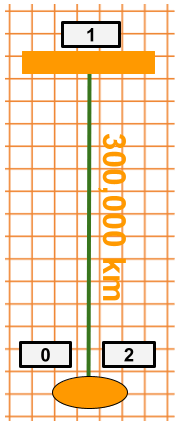
The Light Beam in Orange’s Frame
Animation of Light Beam in Orange’s Frame
- The elapsed time of the Light Beam is 2 seconds in Orange’s frame, which accords with its measurement of its distance to the mirror and the speed of light:
- 2 x 300,000 km / 300,000 km/s = 2 seconds
The Light Beam in Red’s Frame
Animation of Light Beam in Red’s Frame
- As the Light Beam is in transit, Spacecraft Orange travels from left to right in Red’s reference frame.
- Assume that the total distance Orange travels in Red’s frame, from emission of the laser beam to reception, is 800,000 km.
- The beam hits the mirror just as Orange passes by Red. At this point:
- Orange has traveled 400,000 km
- The distance from Red to the mirror is 300,000 km
- The laser beam has therefore traveled 500,000 km from Orange’s starting point to the mirror, per the Pythagorean Theorem.
- On the second half of the journey, Orange travels another 400,000 km and the light beam travels another 500,000 km, arriving at the point where Orange detects the light beam.
- So in Red’s frame the light beam travels 1,000,000 km at a speed of 300,000 km/s. The light beam was therefore en route 3 ⅓ seconds:
- 1,000,000 km / 300,000 km/s = 3 ⅓ seconds.

Same Light Beam, Different Distances and Times
- In the Orange Frame:
- Distance light beam traveled = 600,000 km
- Speed of light = 300,000 km/s
- Therefore, the elapsed time between transmission and reception = 2 seconds
- In the Red Frame:
- Distance light beam traveled = 1,000,000 km
- Speed of light = 300,000 km/s
- Therefore, the elapsed time between transmission and reception = 3 ⅓ seconds
Appearance vs Reality ≠ Relative vs Absolute
- Appearance vs Reality
- A stick half-submerged in water at an angle appears bent but is really straight.
- Absolute vs Relative
- The ground speed of an aircraft is relative to the ground. Its airspeed is relative to the air around it.
- The elapsed time of the light beam is relative to a reference frame.
- It’s false that the elapsed time of the light beam is really 2 seconds in the Orange Frame but only appears 3 ⅓ seconds in Red’s frame.
- It’s true that the elapsed time of the light beam is really 2 seconds in the Orange Frame and really 3 ⅓ seconds in the Red Frame.
- What makes it real in both cases is the authority of measurement.
- It’s also true that there’s something special about the elapsed time of the light beam in the Orange Frame.
- The proper time between events is the elapsed time in a reference frame in which the events occur at the same place. Transmission and reception of the light beam occur at the same place in the Orange Frame. Therefore, the proper elapsed time is 2 seconds.
Predictions Derived from Postulates
A scientific theory is supported by the verified predictions derived from its postulates. SR’s predictions are established facts.
Lorentz Transformations
- The Lorentz Transformations are a set of formulas for converting spatial and temporal coordinates of an event from one inertial reference frame to second reference frame in uniform motion relative to the first (along the x-axis). From (t, x, y, z) to (t′, x′, y′, z′).
- The transformations follow from Einstein’s postulates plus the homogeneity of space and time.
- Logical consequences of the transformations include the relativity of simultaneity, time dilation, length contraction, and the invariance of the spacetime interval.
- View Lorentz Transformations
Relativity of Simultaneity
- Suppose that two physically separated events are simultaneous in an inertial frame S. It’s a logical consequence of Einstein’s postulates that the events are not simultaneous in an inertial frame in motion relative to S.
- View Relativity of Simultaneity
Time Dilation
- Let Δt be the elapsed time between two events in an inertial reference frame S in which the events occur at the same location. It’s a logical consequence of Einstein’s postulates that the elapsed time between the events is greater than Δt in a reference frame in uniform motion relative to S.
- View Time Dilation
Length Contraction
- Let Δx be the length of an object in an inertial reference frame S in which it’s at rest. It’s a logical consequence of Einstein’s postulates that the length of the object is less than Δx in a reference frame S′ which is in uniform motion relative to S (and in which the length of the object is measured in S′ by measuring the locations of the ends of the object simultaneously).
- View Length Contraction
E = mc2
- E = mc2 says that the energy of a particle at rest equals its mass times the speed of light squared.
- The equation follows directly from the relativistic kinetic energy of particle, γmc2.
- γmc2 = mc2/√(1 – v2/c2)
- v = 0
- Therefore, γmc2 = mc2/√(1 – 0/c2) = mc2
- That is, mc2 is the “kinetic” energy of a particle at rest.
View Kinetic Energy and E = mc2
Minkowski’s Theory of Four-dimensional Spacetime
- In his 1905 paper setting forth Special Relativity, Einstein focused on reference frames: the Principle of Relativity, the Constancy of the Speed of Light, and the Lorentz Transformations are all about inertial frames of reference. Realizing that Einstein’s ideas undermined the concepts of space and time of Classical Mechanics, Hermann Minkowski developed the theory of four-dimensional spacetime. In his classic 1908 lecture on the subject, Raum und Zeit, Minkowski predicted:
- “The views of space and time which I wish to lay before you have sprung from the soil of experimental physics, and therein lies their strength. They are radical. Henceforth space by itself, and time by itself, are doomed to fade away into mere shadows, and only a kind of union of the two will preserve an independent reality.”
View Minkowski’s Theory of Four-dimensional Spacetime
Twin Paradox
- Time Dilation applies not only to clocks, spaceships, and subatomic particles; it also applies to living organisms.
- The Twin Paradox, which derives from a 1911 thought-experiment by French physicist Paul Langevin, raises three questions:
- Why does the traveling twin age less and not the twin who remains on Earth?
- Can Special Relativity resolve the paradox? Or is General Relativity required?
- To what degree does the Earthbound twin age less due to gravitational time dilation?
View Twin Paradox
Modifications to Mechanics and E = mc2
- Classical Mechanics and Quantum Mechanics presuppose that distances and intervals are the same across inertial reference frames. The theories thus had to be modified to make them consistent with Special Relativity.
View Modifications to Mechanics
Historical Development
- Highlights
- 1800s Ether Hypothesis
- 1865 Maxwell’s Electromagnetism
- 1887 Michelson-Morley Experiment
- 1889 Contraction Hypothesis
- 1904 Lorentz Transformations
- 1905 Annus Mirabilis
- 1905 Special Relativity
- 1908 Minkowski Spacetime
 A Philosopher's View