Contents
- Benedict de Spinoza: An Axiom System for God-Nature
- Monism
- Pantheism
- Spinoza’s Axiom System
- Spinoza’s Ontological Argument
- God’s Nature is to Exist
- From the Entry on Spinoza in the Stanford Encyclopedia of Philosophy
- Spinoza’s Axiom System of Ethics Part I (Of God)
Benedict de Spinoza:
An Axiom System for God-Nature
- Masterwork
- Ethics, Proved in Geometrical Order (1677)
- Themes
- Monism
- Pantheism
- Axiom System
- Ontological Argument
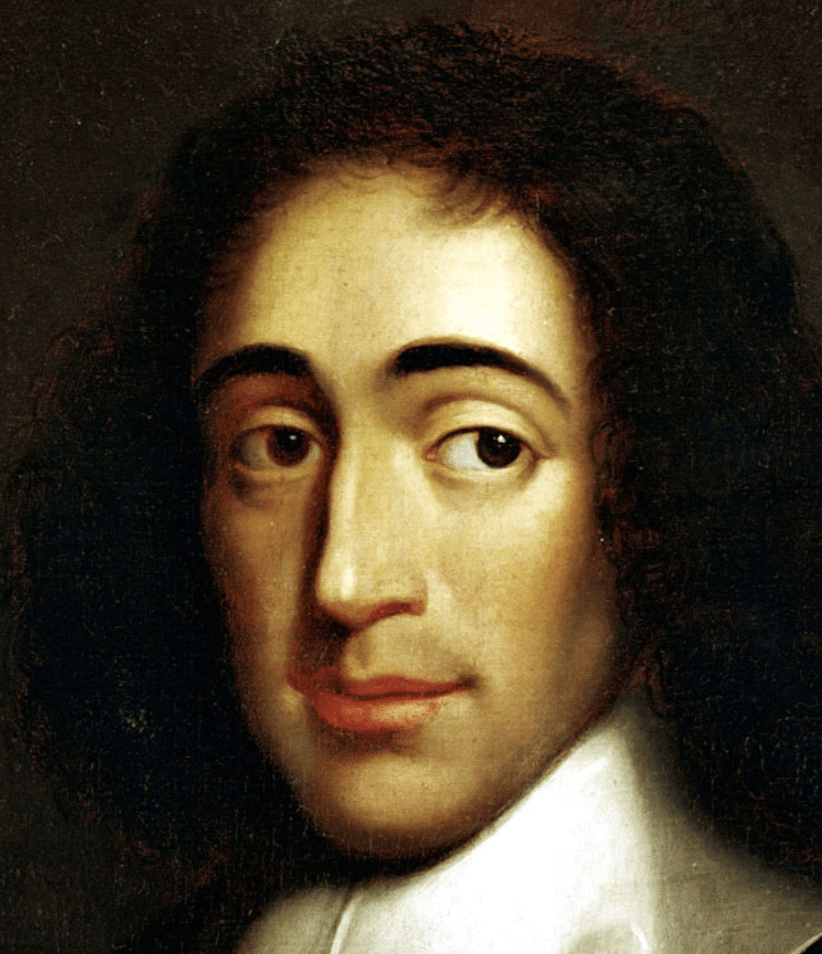
Monism
Spinoza was a monist, believing in one substance: God-Nature. Where Descartes regarded mind and matter as distinct substances, Spinoza viewed them as different aspects of the same underlying substance.
Pantheism
- According to Judeo-Christian tradition, God is the transcendent creator of the universe. For Spinoza, God and Nature were the same.
- “That eternal and infinite being we call God, or Nature, acts from the same necessity from which he exists.”
Spinoza’s Axiom System
- Spinoza is unique among major philosophers in presenting his system axiomatically, like Euclidean geometry.
- Spinoza actually presents five axiom systems, one in each part of the Ethics.
- Part I: Of God
- Part II: Of the Nature and Origin of the Mind
- Part III: Of the Origin and Nature of Emotions
- Part IV: Of Human Servitude, or Of the Strength of the Emotions
- Part V: Of the Power of the Intellect, or Of Human Freedom
- In each he lays out
- Definitions
- Axioms
- Propositions with supporting proofs
- View Spinoza’s Axiom System for Ethics Part I
Spinoza’s Ontological Argument
- Proposition 11.
- God, or a substance consisting of infinite attributes each one of which expresses eternal and infinite essence, necessarily exists.
- Proof
- If you deny this, conceive, if you can, that God does not exist. It would follow (by Axiom 7) that his essence does not involve existence. But (by Proposition 7) this is absurd. Therefore God necessarily exists. Q. E. D.
- Axiom 7
- The essence of anything that can be conceived as not existing does not involve existence.
- Proposition 7
- It belongs to the nature of substance to exist.
God’s Nature is to Exist
- The argument in a nutshell:
- The nature of God includes His existence. So the idea that God doesn’t exist is self-contradictory. God must therefore exist.
- The argument is subject to Kant’s criticism that “existence is not a predicate,” discussed later.
From the Entry on Spinoza in the Stanford Encyclopedia of Philosophy
- “Nature is an indivisible, uncaused, substantial whole—the only substantial whole. Outside of Nature, there is nothing, and everything that exists is a part of Nature and is brought into being by Nature with a deterministic necessity. This unified, unique, productive, necessary being is just what is meant by ‘God’. Because of the necessity inherent in Nature, there is no teleology in the universe. God or Nature does not act for any ends, and things do not exist for any set purposes. God does not “do” things for the sake of anything else. The order of things just follows from God’s essence with an inviolable determinism. All talk of God’s purposes, intentions, goals, preferences or aims is just an anthropomorphizing fiction.”
- “God is not some goal-oriented planner who then judges things by how well they conform to his purposes. Things happen only because of Nature and its laws. “Nature has no end set before it … All things proceed by a certain eternal necessity of nature.” To believe otherwise is to fall prey to the same superstitions that lie at the heart of the organized religions.”
- “Nor does God perform miracles, since there cannot be departures from the necessary course of nature. This would be for God or Nature to act against itself, which is absurd. The belief in miracles is due only to ignorance of the true causes of phenomena.”
Spinoza’s Axiom System of Ethics Part I (Of God)
From Ethics Proved in Geometrical Order (Cambridge Texts in the History of Philosophy)
- Definitions
- 1. By cause of itself I mean that whose essence involves existence or that whose nature cannot be conceived except as existing.
- 2. A thing is said to be finite in its kind if it can be limited by another thing of the same nature. For example, a body is said to be finite because we always conceive bodies that are greater. Similarly a thought is limited by another thought. But a body is not limited by a thought nor a thought by a body.
- 3. By substance I mean that which is in itself and is conceived through itself, i.e. no concept of any other thing is needed for forming a concept of it.
- 4. By attribute I mean that which an intellect perceives of a substance as constituting its essence.
- 5. By mode I mean affections of a substance or that which is in another thing through which it is also conceived.
- 6. By God I mean absolutely infinite being, i.e. substance consisting of infinite attributes, each one of which expresses eternal and infinite essence.
- Axioms
- 1. All things that are, are either in themselves or in another thing.
- 2. Anything that cannot be conceived through another thing must be conceived through itself.
- 3. If there is a determinate cause, an effect necessarily follows, and conversely if there is no determinate cause, it is impossible for an effect to follow.
- 4. Cognition of an effect depends upon cognition of its cause and involves it.
- 5. Things which have nothing in common with each other cannot be understood through each other, or the concept of the one does not involve the concept of the other.
- 6. A true idea must agree with its object.
- 7. The essence of anything that can be conceived as not existing does not involve existence.
- Propositions 1-11 of the 36 Propositions of Part I
- 1. A substance is prior by nature to its affections.
- Proof
- This is clear from Definitions 3 and 5
- Proof
- 2. Two substances with different attributes have nothing in common with each other.
- Proof
- This is clear from Definition 3. For each substance must be in itself and be conceived through itself, or the concept of the one does not involve the concept of the other.
- Proof
- 3. If things have nothing in common with each other, one cannot be the cause of the other.
- Proof
- If they have nothing in common with each other, it follows (by Axiom 5) that they cannot be understood through each other, and therefore (by Axiom 4) one cannot be the cause of the other. Q. E. D.
- Proof
- 4. Two or more different things are distinguished from each other either by differences of the attributes of their substances or by differences of the affections of their substances.
- Proof
- All things that are, are either in themselves or in another thing (by Axiom 1), i.e. (by Definitions 3 and 5) outside the intellect there is nothing besides substances and their affections. Therefore outside the intellect,
- Proof
- 5. There cannot be two or more substances in the universe with the same nature or attribute.
- Proof
- If there were several distinct substances, they would have to be distinguished from each other either by a difference of attributes or by a difference of affections (by the previous proposition). If they are distinguished only by a difference of attributes, it will be admitted that there is only one substance with the same attribute. But if they are distinguished by a difference of affections, it follows, since a substance is prior in nature to its affections (by Proposition 1), that if we strip it of its affections and consider it in itself – i.e. if (by Definitions 3 and 6) we consider it truly – it will not be possible to conceive it as distinguished from any other substance. That is (by the previous proposition), it will not be possible for there to be several substances but only one.
- Proof
- 6. One substance cannot be produced by another substance.
- Proof
- There cannot be two substances in the universe with the same attribute (by the previous proposition), i.e. (by Proposition 2) two substances that have anything in common with each other. Therefore (by Proposition 3) one cannot be the cause of the other or be produced by the other. Q. E. D.
- Corollary
- Hence it follows that a substance cannot be produced by anything external to itself. For in the universe nothing is granted, save substances and their modifications (as appears from Axiom 1. and Definitions 3 and 5.). Now (by the last Proposition) substance cannot be produced by another substance, therefore it cannot be produced by anything external to itself. Q.E.D. This is shown still more readily by the absurdity of the contradictory. For, if substance be produced by an external cause, the knowledge of it would depend on the knowledge of its cause (Axiom 4), and (by Definition 3.) it would itself not be substance.
- Proof
- 7. It belongs to the nature of substance to exist.
- Proof.
- A substance cannot be produced by something else (by the corollary of the previous proposition); it will therefore be the cause of itself, i.e. (Definition 1) its essence necessarily involves its existence, or it belongs to its nature to exist. Q. E. D.
- Proof.
- 8. Every substance is necessarily infinite.
- Proof.
- There can only be one substance with an identical attribute, and existence follows from its nature (Proposition 7.); its nature, therefore, involves existence, either as finite or infinite. It does not exist as finite, for (by Definition 2) it would then be limited by something else of the same kind, which would also necessarily exist (Proposition 7.); and there would be two substances with an identical attribute, which is absurd (Proposition 5). It therefore exists as infinite. Q.E.D.
- Proof.
- 9. The more reality or being each thing has, the more attributes belong to it.
- This is evident from Definition 4
- 10. Each attribute of a single substance must be conceived through itself.
- Proof:
- An attribute is what the intellect perceives as constituting the essence of a substance (by def4), and therefore (by Definition 3) it must be conceived through itself. Q. E. D.
- Proof:
- 11. God, or a substance consisting of infinite attributes each one of which expresses eternal and infinite essence, necessarily exists.
- Proof:
- If you deny this, conceive, if you can, that God does not exist. It would follow (by Axiom 7) that his essence does not involve existence. But (by Proposition 7) this is absurd. Therefore God necessarily exists. Q. E. D.
- Proof:
- 1. A substance is prior by nature to its affections.
 A Philosopher's View