Contents
- Trump’s Big Lie
- Three Key Facts About the Big Lie
- A Big Lie
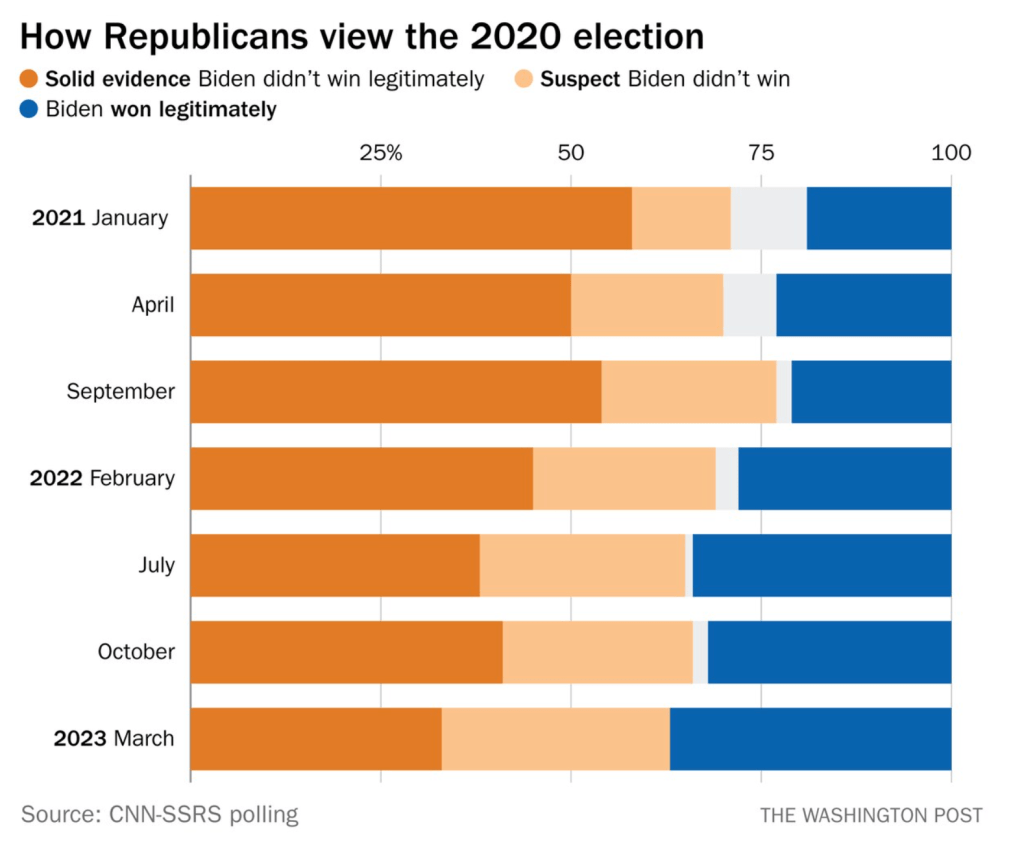
- Most Republicans still believe the Big Lie
- Legitimacy of Biden’s Victory
- People Explain Why They Believe the Big Lie
- Demographics of True Believers
- What Republican Politicians say about the Big Lie
- Trump’s Earlier Claims of Election Fraud
- Disinformation
- Hitler’s Big Lie The Stab-in-the-back Conspiracy
- Legitimacy of Biden’s Win: the Arguments, Evidence, and Claims
Trump’s Big Lie
That Biden was not legitimately elected president
Three Key Facts About the Big Lie
- It’s beyond a reasonable doubt, based on the evidence, that Biden was legitimately elected president.
- The Big Lie makes a serious accusation: that the Democratic Party undermined a bedrock of democracy to win an election — the institution of free and fair elections.
- Millions of Americans, including most Republicans, still believe the Big Lie.
A Big Lie
- A Big Lie is a falsehood so outrageous that people believe it’s got to be true because it’s hard to believe anyone would tell a lie of such magnitude.
- Adolf Hitler in Mein Kampf
- “in the big lie there is always a certain force of credibility; because the broad masses of a nation are always more easily corrupted in the deeper strata of their emotional nature than consciously or voluntarily; and thus in the primitive simplicity of their minds they more readily fall victims to the big lie than the small lie, since they themselves often tell small lies in little matters but would be ashamed to resort to large-scale falsehoods. It would never come into their heads to fabricate colossal untruths, and they would not believe that others could have the impudence to distort the truth so infamously.”
Most Republicans still believe the Big Lie
- Cross-Tabs: Late October 2024 Times/Siena Poll of the Likely Electorate NY Times
- Which candidate do you think was the legitimate winner of the 2020 presidential election?
- Donald Trump
- Democrat 3%
- Republican 58%
- Independent 17%
- Joe Biden
- Democrat 96%
- Republican 30%
- Independent 75%
- Donald Trump
- Which candidate do you think was the legitimate winner of the 2020 presidential election?
- The head of the GOP is still elevating 2020 election skepticism Philip Bump WaPo July 2023
Legitimacy of Biden’s Victory
Beyond a Reasonable Doubt
- The evidence is overwhelming that Biden was legitimately elected president, making it beyond a reasonable doubt that his victory was legitimate.
- The legitimacy of Biden’s win is not an open question. It’s not a matter of opinion. It’s a fact established by overwhelming evidence.
- A logical consequence of the legitimacy of Biden’s win is that anyone who says or believes otherwise is wrong.
- 58 percent of Republicans say Biden won the 2020 election due to fraud, as of October 2024.
- Late October 2024 Times/Siena Poll of the Likely Electorate NY Times
- Therefore 58 percent of Republicans are wrong about Biden’s victory.
- 58 percent of Republicans say Biden won the 2020 election due to fraud, as of October 2024.
Assessing the Arguments, Evidence, and Claims
- Assessing whether Biden was legitimately elected president means evaluating the arguments, evidence, and claims for and against two hypotheses:
- that Biden won the election legitimately
- that Biden won the election only through fraud

View The Arguments, Evidence, and Claims in Detail
People Explain Why They Believe the Big Lie
- Understanding Election Fraud Beliefs: Interviews with People Who Think Trump Likely Won the 2020 Election
- Why They Believe
- Kyle
- I guess the actual amount of votes that he got at the end of the night, there was no way. I was listening there thinking, ‘How in the hell did Joe Biden get 81 million votes and never even held a rally with more than 20 or 30 people there?’ Didn’t really speak to anybody. Didn’t go out in public. Here’s Donald Trump going to these rallies and tens of thousands of people there and all of the enthusiasm was there, but I just couldn’t figure out how in the world that happened.
- Candace
- You see the graph, the line, it’s a line graph, they go up, Trump’s ahead, Biden’s staying whatever, 50,000 votes below him. Steady, steady, steady, steady, steady all the way up, and then three o’clock in the morning when they stopped counting right after they started again, I can’t remember how many hours it was, they – Oh, there’s a big jump in the Biden numbers. And now all of a sudden, the graph, it just went up on the Biden line. So all of a sudden, the Biden numbers, ‘Oh my God, Biden’s ahead 15,000 now.’ In that one moment.
- Frank
- It just seemed like there was just tons of examples of just irregularities that took place and just unlike any other election I’ve seen. There just seemed to be a lot of examples that you can point to where it’s just like, ‘Wow, yeah. That doesn’t seem right. That’s odd.’ Everything from the water main break that happened in Atlanta to the counting stopping in Pennsylvania and then they restarted it, and all of a sudden they picked up enough to win. And then also it seemed like there were a lot of people that were willing to come forward and give sworn affidavits, ‘Hey, trucks were coming in and I’d never seen this before and going out.’ And I mean, it just seemed like there were a lot of people that were willing to come forward and report some of the irregularities that they saw.
- Paris
- It just seems like there were so many things with this election. Thousands of ballots found in the garbage or ballots being burned or poll workers not being able to enter polling stations for whatever reason, those kind of things. And listen, I mean, if there were a hundred stories, which there was probably more, it just seemed like to me that anytime something like that came out about the election in regard to it being rigged or being fraudulent, they always had an answer for something and they always had an answer for it. And I think to myself, what’s the probability of say, and I know I’m just using a number, what’s the probability of a hundred instances of voter fraud, or a rigged election in any way? A hundred instances and you’re telling me that every single one checked out? You have an explanation for every single one? I find that very, very hard to believe.
- Kyle
- Trump Supporters Explain Why They Believe the Big Lie Sarah Longwell Atlantic
- [Sarah Longwell is the executive director of the Republican Accountability Project, publisher of The Bulwark, and host of the Focus Group podcast.]
- I regularly host focus groups to better understand how voters are thinking about key political topics. Recently, I decided to find out why Trump 2020 voters hold so strongly to the Big Lie.
- As a woman from Wisconsin told me, “I can’t really put my finger on it, but something just doesn’t feel right.” A man from Pennsylvania said, “Something about it just didn’t seem right.” A man from Arizona said, “It didn’t smell right.”
- A man from North Carolina, when asked why he thought the election was stolen, said, “There was 10 million more votes for Trump in this last election than he got in 2016. You’re telling me that [Joe] Biden got that many?”
- Another man from North Carolina said, “I personally went to Trump rallies that were filling stadiums, and then Biden can’t even fill a freaking library. Like, no, it’s not true. I don’t believe it. Don’t buy it.”
- A woman from Georgia told me, “When I went to bed, Trump was so in the lead and then [I got] up and he’s not in the lead. I mean, that’s crazy.”
- A woman from Arizona told me, “I think what convinced me more that the election was fixed was how vehemently they have said it wasn’t.”
- These voters aren’t bad or unintelligent people. The problem is that the Big Lie is embedded in their daily life. They hear from Trump-aligned politicians, their like-minded peers, and MAGA-friendly media outlets—and from these sources they hear the same false claims repeated ad infinitum.
- If I’ve learned anything from my focus groups, it’s that something doesn’t have to make sense for voters to believe it’s true.
Demographics of True Believers
- Trump True Believers Have Their Reasons, Thomas Edsall NY Times Oct 2021
- Just who believes the claim that Donald Trump won in 2020 and that the election was stolen from him?
- Three sources provided The Times with survey data:
- the University of Massachusetts-Amherst Poll,
- P.R.R.I. (the Public Religion Research Institute) and
- Reuters-Ipsos.
- With minor exceptions, the data from all three polls is similar.
- Alexander Theodoridis, a political scientist at the University of Massachusetts, summed it up:
- About 35 percent of Americans believed in April that Biden’s victory was illegitimate, with another 6 percent saying they are not sure. What can we say about the Americans who do not think Biden’s victory was legitimate? Compared to the overall voting-age population, they are disproportionately
- white
- Republican
- older
- less educated
- more conservative
- more religious (particularly more Protestant and more likely to describe themselves as born again).
- About 35 percent of Americans believed in April that Biden’s victory was illegitimate, with another 6 percent saying they are not sure. What can we say about the Americans who do not think Biden’s victory was legitimate? Compared to the overall voting-age population, they are disproportionately
- P.R.R.I. also tested agreement or disagreement with a view that drives replacement theory, that:
- “Immigrants are invading our country and replacing our cultural and ethnic background”
- They found that 60 percent of Republicans agreed, as do 55 percent of conservatives.
- The Reuters/Ipsos data showed that
- 69 percent of white Republicans without college degrees agreed “that the 2020 election was stolen from Donald Trump,”
- 51 percent of white Republicans with college degrees agreed, and
- the level of this belief remained consistently strong (over 60 percent) among Republicans of all ages living in rural, suburban or urban areas.
What Republican Politicians say about the Big Lie
- Some Republican politicians, like Marjorie Taylor Greene, say outright that the election was stolen.
- Others hedge their remarks, saying things like:
- There were many election irregularities and questions that need to be addressed
- People have a lot of doubts about the integrity of the election and those doubts need to be allayed.
- Yeah, Biden’s president.
- Crickets
- From the Vice Presidential Debate:
- Walz: Did [Trump] lose the 2020 election?
- Vance: Tim, I’m focused on the future. Did Kamala Harris censor Americans from speaking their mind in the wake of the 2020 COVID situation?
- Walz: That is a damning. That is a damning non answer.
- This Week with George Stephanopoulos, aired Sunday, October 5, 2024 ABC News
- Interview with Mike Johnson, Speaker of the House
- STEPHANOPOULOS: “Can you say unequivocally that Joe Biden won the 2020 election and Donald Trump lost?”
- JOHNSON: “See, this is the game that is always played by mainstream media with leading Republicans. It’s — it’s a gotcha game. You want us to litigate things that happened four years ago when we’re talking about the future. We’re not going to talk about what happened in 2020. We’re going to talk about 2024 and how we’re going to solve the problems for the American people.”
- Interview with Mike Johnson, Speaker of the House
- Only a few Republican politicians have spoken the truth as bluntly as Liz Cheney:
- “The 2020 presidential election was not stolen. Anyone who claims it was is spreading THE BIG LIE, turning their back on the rule of law, and poisoning our democratic system,” USA Today
- Republicans’ conflicting message: Embracing Trump election lie is key to prominence, just stop asking us about it WaPo
- Geoff Kabaservice, who chronicled the transformation of the GOP in his 2012 book, “Rule and Ruin: The Downfall of Moderation and the Destruction of the Republican Party,” said of Republican party members that:
- “These people are afraid of their base. They know that if they actually come out and forthrightly tell these 70 percent of Republicans who believe Joe Biden did not legitimately win the election, that the base will turn against them, that they’ll end up with a primary challenge, Trump himself will get involved and they’ll lose and they’ll be out of politics.”
- Geoff Kabaservice, who chronicled the transformation of the GOP in his 2012 book, “Rule and Ruin: The Downfall of Moderation and the Destruction of the Republican Party,” said of Republican party members that:
Trump’s Earlier Claims of Election Fraud
- 2016 Primary
- Ted Cruz in Iowa
- “Ted Cruz didn’t win Iowa, he stole it. That is why all of the polls were so wrong and why he got far more votes than anticipated. Bad!” WaPo
- Ted Cruz in Iowa
- 2016 General Election
- New Hampshire
- The president claimed that he would have been victorious in the Granite State if not for the “thousands” of people who were “brought in on buses” from neighboring Massachusetts to “illegally” vote in New Hampshire. Politico
- Popular Vote
- New Hampshire
- 2020 Before the Election
- From Trump’s nomination-acceptance speech at the Republican National Convention (August 2020).
- “The only way they can take this election away from us is if this is a rigged election.”
- From Trump’s nomination-acceptance speech at the Republican National Convention (August 2020).
Disinformation
- Disinformation is dangerous
- “Those who can make you believe absurdities can make you commit atrocities” — Voltaire
- Disinformation works
- It can lead people to do what they otherwise would not do, attack the US Capitol.
- View Disinformation
- A Threat to Our Democracy: Election Subversion in the 2021 Legislative Session, September 29, 2021 Voting Rights Lab (The Voting Rights Lab is a nonpartisan organization that brings state advocacy, policy, and legislative expertise to the fight for voting rights.)
- Election subversion bills have either been enacted or seen significant momentum in key battleground states, including Arizona, Florida, Georgia, Nevada, Ohio, Pennsylvania, Texas, Wisconsin, and others. Taken together, these actions – legislative and otherwise – threaten to inject partisanship where it never belongs: into our election systems themselves. This dangerous crop of legislation has driven toward several alarming outcomes:
- Increased Partisanship in Election Administration
- Partisan Election Reviews
- Criminalization of Election Officials & Civil Causes of Action
- Election subversion bills have either been enacted or seen significant momentum in key battleground states, including Arizona, Florida, Georgia, Nevada, Ohio, Pennsylvania, Texas, Wisconsin, and others. Taken together, these actions – legislative and otherwise – threaten to inject partisanship where it never belongs: into our election systems themselves. This dangerous crop of legislation has driven toward several alarming outcomes:
Hitler’s Big Lie
The Stab-in-the-back Conspiracy
- From How Hitler’s Enablers Undid Democracy in Germany, Christopher R. Browning Atlantic:
- “The short-lived Weimar Republic—which spanned the years after Germany’s defeat in World War I until 1933, when Hitler came to power—has become a paradigmatic example of democratic collapse.
- During its first four years, Weimar was under constant attack—above all, from the Big Lie that the republic was a totally illegitimate government because it owed its genesis to a “stab in the back” delivered on the home front. According to this Big Lie, the German army had not been defeated on the battlefield in 1918—when in fact General Erich Ludendorff’s spring offensive was a gamble that ended in military disaster. Instead, the myth went, a cabal of “November criminals”—Jews, Marxists, democrats, and internationalists—had betrayed the country, subverted the war effort, driven out the kaiser, signed the shameful Treaty of Versailles, and imposed an un-German democracy.
- Two factors distinguished Hitler from the rest of the German right. First was his self-awareness and cool calculation in deploying the Big Lie. In Mein Kampf, published in 1925–26, he explained that “the masses … more easily fall victim to a big lie than to a little one,” and that even a propaganda claim “so impudent that people thought it insane” could ultimately prevail. Essential to the “stab in the back” conspiracy theory’s effectiveness were a simple appeal to the emotions, not the intellect, and its endless repetition without concession to contrary evidence. Commitment to the Big Lie, he realized, had to be total and uncompromising.
- The second factor was Hitler’s decision to make the conspiracy theory the justification for violent action, moving rapidly from merely denigrating Weimar democracy to staging an outright insurrection. In November 1923, he instigated the Beer Hall Putsch, an attempted local coup d’état in the Bavarian capital of Munich.”
 A Philosopher's View