Outline of Tyranny of the Minority: Why American Democracy Reached the Breaking Point
by Daniel Ziblatt and Steven Levitsky
Contents
- The Book
- My Top-Level Outline
- Chapter Summary
- Introduction
- Chapter 1 Fear of Losing
- Chapter 2: The Banality Of Authoritarianism
- Chapter 3 It Has Happened Here
- Chapter 4 Why the Republican Party Abandoned Democracy
- Chapter 5 Fettered Majorities
- Chapter 6 Minority Rule
- Chapter 7 America the Outlier
- Chapter 8 Democratizing Our Democracy
- Addendum
- Detailed Table of Contents
The Book
- Tyranny of the Minority: Why American Democracy Reached the Breaking Point
- Published in 2023
- Available in
- Hardcover
- Paperback
- Kindle
- Kindle App
- Audible Book
- By Daniel Ziblatt and Steven Levitsky
- Photo
- Daniel Ziblatt is Eaton Professor of the Science of Government at Harvard University
- Steven Levitsky is the David Rockefeller Professor of Latin American Studies and Professor of Government at Harvard University
- They wrote How Democracies Die, published in 2018
- The concept that runs through the book is the democratic norm, an established and respected unwritten rule that reinforces the Constitution.
- View Outline of How Democracies Die
- Reviews and Commentary
- GoodReads
- How Do We Survive the Constitution? New Yorker
- Why is American democracy on the brink? Blame the Constitution WaPo
- Is America uniquely vulnerable to tyranny? Zack Beauchamp Vox
- Can an Unpopular Populist Still Damage Democracy? Edsall nyt
My Top-Level Outline
A. The Constitution has flaws that enable partisan minorities to impede or block majorities.
Flaws
- A severely malapportioned Senate, in which all states are given the same representation regardless of population.
- The Electoral College, an indirect system of electing presidents that privileges smaller states and allows losers of the popular vote to win the presidency.
- In four elections so far, a candidate was elected president although more people voted for someone else.
- The presidents: Rutherford B. Hayes (1876), Benjamin Harrison (1888), George W. Bush (2000), Donald Trump (2016).
- Why Framers Chose the Electoral College
- Extreme supermajority rules for amending the Constitution, requiring a two-thirds vote of each house of Congress plus approval by three-quarters of U.S. states.
- The Supreme Court, with power of judicial review and lifetime appointments for justices.
- A bicameral Congress, which means that two legislative majorities are required to pass laws.
- The filibuster, a supermajority rule in the Senate (not in the Constitution) that allows a partisan minority to permanently block legislation backed by the majority.
- An electoral system of “manufactured majorities” that enables parties that win fewer votes to control legislatures.
- In elections for the House of Representatives, the proportion of seats a party wins depends not only on the proportion of votes it receives but also on how “efficiently” its votes are distributed across electoral districts. Thus, the proportion of seats a party wins may be different from the proportion of votes it receives.
- View Bar Chart Depicting Relative Efficiency of Votes in 2018 Election for the Pennsylvania State Legislature
Chapters
- Chapter 5 Fettered Majorities
- Principles of Democratic Rule
- In elections, those with more votes should prevail over those with fewer votes.
- Legislative majorities should be able to pass laws
- Democracies must
- protect individuals against the “tyranny of the majority”
- prevent the majority from installing authoritarian rule.
- Thus the need for counter-majoritarian institutions. But those institutions must be prevented from impeding and obstructing the majority from governing.
- merriam-webster.com/dictionary/majoritarianism
- the philosophy or practice according to which decisions of an organized group should be made by a numerical majority of its members
- Principles of Democratic Rule
- Chapter 7 America the Outlier
- US lags behind other democracies in making democratic reforms
- Chapter 8 Democratizing Our Democracy
- Democracy in the US should be changed to:
- Uphold the right to vote
- Ensure that election outcomes reflect majority preferences
- Empower governing majorities
- Democracy in the US should be changed to:
B. The Republican Party evolved from the Party of Lincoln and Reconstruction into the Party of Racial Conservatism
Chapters
- Chapter 3 It Has Happened Here
- Republicans attempted to establish a multiracial democracy after the Civil War.
- The result was a white backlash that took the form of terrorism, Jim Crow Laws, and 90 years of Democratic Party control of the Solid South.
- Chapter 4 Why the Republican Party Abandoned Democracy
- As Democrats fought for civil rights beginning in the mid 20th century, the Republican Party pursued a “Southern Strategy,” resulting in its takeover of the “Solid South.”
- And then “the Republican Party was captured by its racially conservative base.”
C. The flaws in the Constitution now give the Republican Party an electoral advantage
Small-State bias has become a Partisan Bias
- Republicans are predominantly the party of sparsely populated regions, while Democrats are the party of the cities. As a result, the Constitution’s small-state bias, which became a rural bias in the twentieth century, has become a partisan bias in the twenty-first century.
The Senate, for Example


- States with 1 Rep Senator and 1 Dem Senator: MT, WV, WI, OH
- States with 1 Dem Senator and 1 Indy Senator VT, AZ
- States with 1 Rep Senator and 1 Indy Senator: ME
Chapter
- Chapter 6 Minority Rule
- Flaws in the Constitution, together with the partisan urban-rural divide, have given the Republican Party an electoral advantage in:
- the Senate, since states have equal representation, no matter the size of their populations
- the Electoral College, since a state has at least 3 electoral votes, no matter its population.
- the Supreme Court, because presidents nominate Supreme Court justices and the Senate confirms them
- the House and State Legislatures, since the proportion of seats a party wins depends not just on its proportion of the vote but also on how those votes are distributed across districts
- “Flaws in our Constitution now imperil our democracy.”
- Flaws in the Constitution, together with the partisan urban-rural divide, have given the Republican Party an electoral advantage in:
Chapter Summary
- Introduction
- Demographic changes in the U.S have transformed what had been a predominantly white Christian society into a diverse and multiethnic one.
- The changes resulted in an authoritarian backlash: a surge in politically motivated violence; threats against election workers; efforts to make it harder for people to vote; a campaign by the president to overturn the results of an election.
- Part of the problem we face today lies in the US Constitution, which allows partisan minorities to routinely thwart majorities, and sometimes even govern them. Institutions that empower partisan minorities can become instruments of minority rule. And they are especially dangerous when they are in the hands of extremist or antidemocratic partisan minorities.
- Chapter 1 Fear of Losing
- The norm of accepting defeat and peacefully relinquishing power is the foundation of modern democracy.
- But accepting defeat gets harder when parties are fearful they will lose not just elections but their place in society and way of life.
- Chapter 2 The Banality Of Authoritarianism
- Most twenty-first-century autocracies are built via “constitutional hardball”: using the law to eliminate the opposition and undermine democracy.
- Constitutional hardball includes
- exploiting gaps in constitutions
- excessive or undue use of the law
- selective enforcement
- lawfare.
- Constitutional hardball includes
- Many of the politicians who preside over a democracy’s collapse are just ambitious careerists trying to stay in office. Rather than oppose democracy out of principle, they tolerate antidemocratic extremism because it is the path of least resistance.
- Most twenty-first-century autocracies are built via “constitutional hardball”: using the law to eliminate the opposition and undermine democracy.
- Chapter 3 It Has Happened Here
- The Republican Party attempted to establish multiracial democracy after the Civil War. The result was a white backlash that took the form of terrorism, Jim Crow Laws, and 90 years of Democratic Party control of the Solid South.
- Chapter 4 Why the Republican Party Abandoned Democracy
- As Democrats began championing civil rights in the 20th century, Republicans pursued their southern strategy, eventually capturing the Democrat’s Solid South. By the Obama era, racially conservative whites, who feared the country’s demographic shift toward more diversity, had become a solid majority in the party. Thus “the Republican Party was captured by its racially conservative base.”
- Chapter 5 Fettered Majorities
- Democracies must
- protect individual liberty against the “tyranny of the majority”
- prevent the majority from installing authoritarian rule.
- Thus the need for counter-majoritarian institutions. But the danger such institutions pose is that they can enable partisan minorities that prevent the majority from governing.
- Democracies must
- Chapter 6 Minority Rule
- Because of the counter-majoritarian features of the Constitution and the partisan urban-rural divide, the Constitution now gives the Republican Party an electoral advantage.
- Chapter 7 America the Outlier
- Though the US took important steps toward majority rule in the twentieth century, the reforms did not go as far as other democracies.
- Chapter 8 Democratizing Our Democracy
- Democracy in the US should be changed to:
- Uphold the right to vote
- Ensure that election outcomes reflect majority preferences
- Empower governing majorities
- Democracy in the US should be changed to:
- Notes
- Lots of references
Introduction
- Demographic changes in the U.S have transformed what had been a predominantly white Christian society into a diverse and multiethnic one.
- britannica.com/topic/demographics
- The characteristics of a large population over a specific time interval, characteristics such as age, race, gender, ethnicity, religion, income, education, home ownership, sexual orientation, marital status, family size, health and disability status, and psychiatric diagnosis.
- britannica.com/topic/demographics
- The changes resulted in an authoritarian backlash: a surge in politically motivated violence; threats against election workers; efforts to make it harder for people to vote; a campaign by the president to overturn the results of an election.
- The republic became less democratic between 2016 and 2021.
- Freedom House’s Global Freedom Index for the US went from 90 in 2015 (in line with countries like Canada, Italy, France, Germany, Japan, Spain, and the U.K) to 83 in 2021 (lower than democracies like Argentina, the Czech Republic, Lithuania, and Taiwan)

- Part of the problem we face today lies in something many of us venerate: our Constitution. For more than two centuries it has succeeded in checking the power of ambitious and overreaching presidents. But flaws in our Constitution now imperil our democracy.
- Designed in a pre-democratic era, the U.S. Constitution allows partisan minorities to routinely thwart majorities, and sometimes even govern them. Institutions that empower partisan minorities can become instruments of minority rule. And they are especially dangerous when they are in the hands of extremist or antidemocratic partisan minorities.
- Prominent eighteenth- and nineteenth-century thinkers worried that democracy risked becoming a “tyranny of the majority”—that such a system would allow the will of the many to trample on the rights of the few. But the American political system has always reliably checked the power of majorities. What ails American democracy today is closer to the opposite problem: Electoral majorities often cannot win power, and when they win, they often cannot govern. The more imminent threat facing us today, then, is minority rule.
Chapter 1 Fear of Losing
- The norm of accepting defeat and peacefully relinquishing power is the foundation of modern democracy.
- The Peronists accepted defeat in Argentina’s 1983 election, Page 12
- The Federalists accepted defeat in their 1800 loss to the Democratic-Republicans, Page 15
- On March 4, 1801, the United States became the first republic in history to experience an electoral transfer of power from one political party to another.
- But accepting defeat gets harder when parties are fearful they will lose not just an election but their place in society and way of life.
- Research in political psychology teaches us that social status—where one stands in relation to others—can powerfully shape political attitudes. We often gauge our social status in terms of the status of the groups we identify with. Those groups may be based on social class, religion, geographic region, or race or ethnicity, and where they sit in the larger societal pecking order greatly affects our own individual sense of self-worth. Economic, demographic, cultural, and political change may challenge existing social hierarchies, raising the status of some groups and, inevitably, lowering the relative status of others. What the writer Barbara Ehrenreich called the “fear of falling” can be a powerful force. When a political party represents a group that perceives itself to be losing ground, it often radicalizes. With their constituents’ way of life seemingly at stake, party leaders feel pressure to win at any cost. Losing is no longer acceptable.
- The Democrat Party in Thailand, which once supported democracy and opposed coups and absolutist royal power, supported the 2014 coup, Page 25
- When democracy gave rise to a movement that challenged the social, cultural, and political dominance of the Bangkok elite, the Democrats turned against democracy.
- Existential fear thwarted the emergence of democracy in early twentieth-century Germany, Page 24
- Parties are more likely to accept defeat when they believe that
- they stand a reasonable chance of winning again in the future.
- losing power will not bring catastrophe—that a change of government will not threaten the lives, livelihoods, or most cherished principles of the outgoing party and its constituents.
Chapter 2: The Banality Of Authoritarianism
Banality of Authoritarianism
- Many politicians who preside over a democracy’s collapse are just ambitious careerists trying to stay in office. Rather than opposing democracy out of principle, they tolerate antidemocratic extremism because it is the path of least resistance.
- britannica.com/biography/Hannah-Arendt
- In a highly controversial work, Eichmann in Jerusalem (1963), based on her reportage of the trial of the Nazi war criminal Adolf Eichmann in 1961, Arendt argued that Eichmann’s crimes resulted not from a wicked or depraved character but from sheer “thoughtlessness”: he was simply an ambitious bureaucrat who failed to reflect on the enormity of what he was doing.
Constitutional Hardball
- Most twenty-first-century autocracies are built via “constitutional hardball”: using the law to eliminate opposition and undermine democracy. Such democratic backsliding occurs gradually, through a series of reasonable-looking measures:
- new laws that are ostensibly designed to clean up elections, combat corruption, or create a more efficient judiciary;
- court rulings that reinterpret existing laws;
- long-dormant laws that are conveniently rediscovered.
- Because the measures are couched in legality, it may appear as if little has changed. No blood has been shed. No one has been arrested or sent into exile. Parliament remains open. So criticism of the government’s measures is dismissed as alarmism or partisan bellyaching. But gradually, and sometimes almost imperceptibly, the playing field tilts. The cumulative effect of these seemingly innocuous measures is to make it harder for opponents of the government to compete—and thereby entrench the incumbents in power.
Kinds of Constitutional Hardball
- Kinds
- Exploiting Gaps
- Excessive or Undue Use of the Law
- Selective Enforcement
- Lawfare
- Exploiting Gaps, Page 51
- No rule or set of rules covers all contingencies. There are always circumstances that are not explicitly covered by existing laws and procedures.
- Societies often develop norms—or unwritten rules—to fill in the gaps in the rules. But norms can’t be legally enforced.
- Example, Page 52
- In 2016 the Senate refused to let President Barack Obama appoint a new Supreme Court justice in the wake of Justice Antonin Scalia’s death.
- According to the Constitution, presidential nominees to the Supreme Court must have the consent of the Senate. But because the Constitution does not specify when the Senate must take up presidential court nominees, the theft was entirely legal.
- Norm
- Historically, the Senate used its power of “advice and consent” with forbearance. Most qualified nominees were promptly approved, even when the president’s party did not control the Senate. Indeed, in the 150-year span between 1866 and 2016, the Senate never once prevented an elected president from filling a Supreme Court vacancy. Every president who attempted to fill a court vacancy before the election of his successor was eventually able to do so (though not always on the first try)
- Denying the president’s ability to fill a Supreme Court vacancy clearly violated the spirit of the Constitution.
- Excessive or Undue Use of the Law, Page 52
- Some rules are designed to be used sparingly, or only under exceptional circumstances.
- Example: Presidential Pardons
- If U.S. presidents used their constitutional pardon authority to the full extent, they could not only systematically pardon friends, relatives, and donors but also legally pardon political aides and allies who commit crimes on their behalf, in the knowledge that if caught, they will be pardoned
- Example: Impeaching a President
- Impeaching a president involves overturning the will of voters, which is a momentous event for any democracy. So impeachment should be rare—used only when presidents egregiously or dangerously abuse their power.
- Peru: Congress “vacated” three presidents in a span of four years.
- Example: Abuse of State of Emergency
- In 1975 Indira Gandhi persuaded India’s ceremonial president to sign a declaration of emergency, suspending constitutional rights. Within 24 hours 676 politicians—including the leaders of all major opposition parties—were in jail. The government arrested more than 110,000 critics in 1975 and 1976. Page 55
- Example: Presidential Pardons
- Some rules are designed to be used sparingly, or only under exceptional circumstances.
- Selective Enforcement, Page 57
- Wherever nonenforcement of the law is the norm—where people routinely cheat on their taxes, businesses routinely flout health, safety, or environmental regulations, and well-placed public officials routinely use their influence to do favors for friends and family members—enforcement can be a form of constitutional hardball. Governments may enforce the law selectively, targeting their rivals.
- Lawfare, Page 58
- Politicians may design new laws that, while seemingly impartial, are crafted to target opponents.
- Example: Zambia 1991, Page 58
A model for Building an Autocracy by Constitutional Hardball
- The model for building an autocracy via constitutional hardball is Viktor Orban, Page 60
- Orbán used his party’s parliamentary supermajority to build an unfair advantage over his opponents.
- One of his first moves was to purge and pack the courts.
- Orbán also used “legal” means to capture the media.
- Under Orbán, public television became the government’s propaganda arm.
- The government banned the use of campaign advertisements in commercial media
- Orbán also legally captured the private media. In 2016, the newspaper Népszabadság, Hungary’s largest opposition newspaper, was suddenly closed, not by the government, but by its own corporate owners.
- The Orbán government used constitutional hardball to tilt the electoral playing field.
- It packed the Electoral Commission, which prior to 2010 was appointed via multiparty consensus.
- The politicized Electoral Commission then egregiously gerrymandered parliamentary election districts to overrepresent Fidesz’s rural strongholds and underrepresent the opposition’s urban strongholds.
- All these efforts paid off.
- In the 2014 election, Fidesz lost 600,000 votes relative to 2010; its share of the popular vote fell from 53 percent to 45 percent. And yet it captured the same number of seats as in 2010, retaining control of two-thirds of parliament despite failing to win a majority of the vote.
- Fidesz repeated the trick in 2018, winning two-thirds of parliament with less than half the popular vote.
- In 2022, the ruling party defeated a broad opposition coalition, reinforcing the emerging conventional wisdom that Orbán “cannot be defeated under ‘normal’ circumstances.”
Chapter 3 It Has Happened Here
Wilmington Coup and Massacre, 1898
- The largest city in North Carolina, Wilmington was majority Black. And as its post–Civil War economy expanded, numerous Black-owned businesses had sprung up—barbershops, grocery stores, restaurants, butcher shops, and soon doctor’s offices and a law firm. Black Wilmington became wealthier, which gave rise to a vibrant civic life of literary societies, public libraries, baseball leagues, and a Black-owned newspaper. At the center of the community were several churches, including St. Stephen A.M.E. Church, with its large congregation, and St. Mark’s Episcopal Church, which was attended by the most affluent Black families.
- The Fusion ticket won a sweeping majority in the North Carolina state legislature in 1894, and in 1896 it captured the governorship and elected to the House of Representatives George Henry White, who at the time was America’s only African American congressman.
- In Wilmington, three Black aldermen were elected to the city council. Ten of twenty-one city policemen and four deputy sheriffs were Black. Black magistrates sat in the courthouses. The county treasurer, the county jailer, and the county coroner were Black. There were Black health inspectors, Black registrars of deeds, and a Black superintendent of streets. Black postal workers delivered mail to Black and white homes alike.
- On November 10, in one of the most brutal domestic terrorist attacks in American history, a mob of at least five hundred white supremacists, armed and dressed in their paramilitary red shirts, marched through the streets of Wilmington, shooting bystanders, attacking Black churches, and burning the city’s only Black-owned newspaper to the ground.
- After reclaiming statewide power in North Carolina, the Democrats quickly amended the state constitution to impose a series of suffrage restrictions, including a poll tax, literacy tests, and property requirements.
- britannica.com/event/Wilmington-coup-and-massacre
- wikipedia.org/wiki/Wilmington_massacre
Reconstruction, 1865 -1877
- The historian Eric Foner describes the Reconstruction era as America’s “Second Founding,” a moment when the constitutional order was broken and then remade, leading to a “stunning and unprecedented experiment in interracial democracy.”
- Eric Foner
- britannica.com/event/Reconstruction-United-States-history
- The Second Founding: How the Civil War and Reconstruction Remade the Constitution
- Reconstruction: America’s Unfinished Revolution, 1863–1877
- Eric Foner
Reconstruction Amendments and Acts, 1865-1875
- Reconstruction Amendments
- The Thirteenth Amendment (1865) abolished slavery.
- The Fourteenth Amendment (1868) established birthright citizenship and formal equality before the law, giving rise to contemporary rights of due process and equal protection.
- And the Fifteenth Amendment (1870) prohibited restrictions on the right to vote on the basis of race.
- Reconstruction Acts
- The Reconstruction Acts of 1867 placed former Confederate states under federal military rule and made readmission to the Union conditional on passage of the Fourteenth Amendment and the writing of a new state constitution guaranteeing Black suffrage.
- Federal authorities launched a massive campaign to register newly enfranchised Black voters.
- The 1875 Civil Rights Act extended the Fourteenth Amendment’s guarantee of equal treatment to everyday “public” places, such as streetcars, restaurants, theaters, and hotels. The act’s preamble recognized “the equality of all men before the law” and declared it “the duty of government in all its dealings with the people to mete out equal and exact justice to all, of whatever nativity, race, color, or persuasion.”
- The Reconstruction Acts of 1867 placed former Confederate states under federal military rule and made readmission to the Union conditional on passage of the Fourteenth Amendment and the writing of a new state constitution guaranteeing Black suffrage.
Reconstruction, the Work of One Party Alone
- The Reconstruction reforms were the work of one party alone: the Republican Party. In the U.S. Congress, no Democrat—from the North or South—voted for the Fourteenth or Fifteenth Amendments or any of the subsequent voting and civil rights bills of the Reconstruction era.
Black Participation in Democracy
- Within one year, the percentage of Black men in America who were eligible to vote rose from 0.5 percent to 80.5 percent, with the entire increase coming from the former Confederacy. By 1867, at least 85 percent of African American men were registered to vote in Alabama, Florida, Georgia, Louisiana, Mississippi, and North and South Carolina.
- By 1867, registered Black voters outnumbered registered whites across much of the Deep South.
- African Americans began to ascend to public office across the entire South, in some places in large numbers.
- African Americans won a majority of seats in the South Carolina legislature and a near majority in Louisiana; state legislatures in Mississippi and South Carolina elected Black speakers in 1872. There were Black lieutenant governors in Louisiana, Mississippi, and South Carolina and Black secretaries of state in Florida, Mississippi, and South Carolina. Across the Deep South, African Americans filled important local offices, including justices of the peace, county supervisors, school commissioners, election commissioners, and even sheriffs.
- More than thirteen hundred Black Americans held public office during the Reconstruction era. Sixteen Black Americans were elected to the U.S. House and Senate during Reconstruction, and more than six hundred were elected to state legislatures.
White Backlash
- The prospect of multiracial democracy threatened southern whites in three ways:
- The former slaveholding elite feared losing its unfettered control over Black labor.
- Black suffrage jeopardized the political power of the Democratic Party, especially in states where African Americans were now a majority or near majority of the electorate.
- Democracy promised to upend long-established social and racial hierarchies.
Wave of Terrorism
- Since Black citizens were either majorities or near majorities in most southern states, white supremacists’ return to power would require, in W.E.B. Du Bois’s words, “brute force.” Backed by the Democratic Party, white supremacists organized paramilitary groups with names like the Whitecaps, the White Brotherhood, Jayhawkers, Pale Faces, and the Knights of the White Camellia.
- The largest of these, the Ku Klux Klan, emerged in Tennessee in early 1866 and quickly spread throughout the South.
- Klan terror crippled Republican organizations and kept Black voters from the polls, making a mockery of elections and allowing the Democrats to unconstitutionally seize power across the South—a process they euphemistically called “Redemption.”
- In Louisiana, a “civil war of secret assassination and open intimidation and murder” left at least five hundred African Americans dead.
- In Georgia, Klan terror so decimated Black turnout in the 1868 presidential election that eleven counties with Black majorities registered no Republican votes.
- In 1871, Klan pressure allowed Democrats to retake the state legislature and force the Republican governor, Rufus Bullock, to resign and flee the state.
- In North Carolina, Klan violence weakened the Republicans and enabled the Democrats to win a veto-proof majority in the state legislature, which they used to impeach and remove the Republican governor.
- In response, President Ulysses S. Grant and the Republican-dominated Congress passed a series of Enforcement Acts that empowered the federal government to oversee local elections and combat political violence.
- These included an 1870 law authorizing the president to appoint federal election supervisors with the power to press federal charges against anyone who engaged in electoral fraud, intimidation, or race-based voter suppression, as well as the 1871 Ku Klux Klan Act, which allowed for federal prosecution and even military intervention to combat efforts to deprive citizens of basic rights. These laws were unprecedented in that they gave the federal government the authority to intervene in states to protect basic civil and voting rights—an essential component of multiracial democracy.
- Initially, these enforcement mechanisms worked. With the help of federal troops, hundreds of Klan members were arrested and prosecuted in 1871 and 1872, especially in Florida, Mississippi, and South Carolina. By 1872, federal authorities had “broken the Klan’s back and produced a dramatic decline in violence throughout the South.” According to the historian James McPherson, the 1872 election was “the fairest and most democratic election in the South until 1968.”
Waning of Reconstruction
- Eventually, the Republican Party divided. A faction known as the Liberal Republicans grew critical of the costs of enforcement. Prioritizing issues such as free trade and civil service reform, and skeptical of Black suffrage, the liberals began to question the wisdom of the Reconstruction project, preferring a more politically expedient “let alone” policy in the South.
- The multiracial democratic coalition was further undermined by the 1873 depression, which led to a sweeping Democratic takeover of the House of Representatives in 1874.
- Public opinion turned against federal intervention in the South, and civil rights activism faded to such a degree that The New York Times declared the “era of moral politics” to be over. In this new political climate, federal troops began to be withdrawn.
Second Wave of “Redemption”
- The turn away from federal protection permitted a second wave of Redemption.
- In 1875 the Mississippi Democrats launched a violent campaign—known as the Mississippi Plan—aimed at regaining the state legislature. As Foner notes, terrorist acts were “committed in broad daylight by undisguised men,” severely depressing the Black vote in the 1875 elections and giving Democrats control of the state legislature. They then impeached the African American lieutenant governor and forced the Republican governor, Adelbert Ames, to resign and flee the state. In South Carolina, the 1876 election was marred by Red Shirt terror and outright fraud. In what one observer described as “one of the grandest farces ever seen,” the Democrat Wade Hampton, a former Confederate officer, claimed the governorship.
End of Reconstruction, 1877
- By the time Grant’s successor, Rutherford B. Hayes, withdrew most of the remaining federal troops overseeing the South in 1877 (as part of a negotiated settlement of the disputed 1876 presidential election), Reconstruction had effectively ended.
- Democrats had seized power in every southern state except Florida and Louisiana.
- Overall, nearly two thousand Black Americans had been murdered in acts of terror during the ten years that followed the end of the Civil War, a rate of killing roughly equivalent to that of Pinochet’s Chile in the 1970s.
Biracial Coalitions Defy Rule by the Democratic Party in the South, 1880s
- A biracial Readjusters ticket won the Virginia governorship in 1881.
- Populist or Fusion tickets—backed by many Black voters—nearly won the governorship in Alabama in 1892, Virginia in 1893, Georgia in 1894, and Louisiana and Tennessee in 1896.
- A populist-Republican Fusion ticket won the governorship of North Carolina in 1896.
Jim Crow Laws, 1877-1954
- Concerned that acts of flagrant violence would attract national attention and trigger renewed federal oversight and enforcement, Democratic leaders across the South began the campaign to undermine democracy through legal channels. Between 1888 and 1908, they rewrote state constitutions and voting laws to disenfranchise African Americans using:
- Poll taxes
- Literacy tests
- Property and proof of residency requirements
- Secret ballots, which required citizens to vote on government-produced ballots—and alone in a voting booth where they could not be assisted by a (literate) friend
- To avoid also disenfranchising poor, illiterate whites, additional laws were passed:
- “Understanding clauses,” under which registrars would determine whether illiterate prospective voters demonstrated an “understanding” of the Constitution based on sections of the Constitution they read aloud. The laws were designed to give registrars the discretion to apply a higher bar for “understanding” to Black citizens than to white ones.
- “Grandfather clauses,” which allowed (white) illiterate or propertyless voters to register if they had voted before 1867 or were the descendants of pre-1867 voters.
- britannica.com/event/Jim-Crow-law
- wikipedia.org/wiki/Jim_Crow_laws
Giles v. Harris, 1903
- In the 1890s, civil rights groups began filing lawsuits against state and county governments to protest the multitude of new laws targeting Blacks. Between 1895 and 1905, the Supreme Court heard six challenges to disenfranchisement efforts. The most decisive case was Giles v. Harris (1903).
- The lawsuit argued that Alabama’s 1901 constitution made registering to vote nearly impossible for Blacks.
- After passage of the constitution, only 3,000 of the more than 180,000 adult Black men in Alabama were eligible.
- Oliver Wendell Holmes, who wrote the opinion of the court, argued that since the complaint alleged that Alabama’s voter registration system was fraudulent, if the court were to grant relief to Giles and add another voter to the rolls, it would be complicit in Alabama’s fraud. Furthermore, Holmes argued, the court ought not to intervene because anything the court might mandate was unenforceable given the absence of federal troops or election supervisors to enforce it.
- supreme.justia.com/cases/federal/us/189/475/
- wikipedia.org/wiki/Giles_v._Harris
- The lawsuit argued that Alabama’s 1901 constitution made registering to vote nearly impossible for Blacks.
A Last Attempt to Pass Voting Rights Legislation, 1890
- The 1903 Giles v. Harris decision delivered the deathblow to America’s first experiment with multiracial democracy. It didn’t have to be this way. A brief political opening in the late 1880s had presented an alternative path—one that, if taken, might have set the country on a different course.
- In 1888, Benjamin Harrison, the Republican former senator from Indiana and a vocal supporter of more robust voting rights protections, was elected president, and the Republicans regained control of both houses of Congress. Moreover, Black suffrage and federal enforcement of voting laws remained in the Republican Party platform, which called for “effective legislation to secure the integrity and purity of elections.”
- Two influential Republican leaders, Senator George Frisbie Hoar and Congressman Henry Cabot Lodge (later U.S. senator), began work on a national plan to protect voting rights. It was the most ambitious voting rights bill in U.S. history, surpassing even the 1965 Voting Rights Act in its geographic scope, and it would have fundamentally altered the way elections were conducted in America.
- In the summer of 1890, solid Republican majorities in both houses of Congress seemed poised to pass the Lodge bill. President Harrison was ready to sign it. The bill passed the House of Representatives in July 1890 with the support of all but two Republicans.
- But then things began to unravel…..
- When the Lodge bill finally came up for debate in the Senate in January 1891, the minority Democrats turned to their last tool of obstructionism, the Senate’s filibuster—delivering speeches late into the night, issuing impossible amendment proposals, extending debate, and wandering the halls outside the main chamber to prevent a quorum. In a final desperate attempt to pass the bill, Republican leaders proposed a change to Senate rules to allow for the filibuster to be ended with a simple majority vote, thereby allowing the Senate majority to vote in favor of the Lodge bill. But the measure was blocked by a coalition of Democrats and western “silver” Republicans who had voted for currency reform. And so the Lodge bill, which might have preserved fair elections across the country, died by filibuster.
Chapter 4 Why the Republican Party Abandoned Democracy
V-Dem Illiberal Index
- The V-Dem (Varieties of Democracy) Institute, which tracks global democracy, assigns the world’s major political parties an annual “illiberalism” score, which measures their deviation from democratic norms such as pluralism and civil rights, tolerance of the opposition, and the rejection of political violence. Most western European conservative parties receive a very low score, suggesting a strong commitment to democracy. So did the U.S. Republican Party—through the late 1990s. But the GOP’s illiberalism score soared in the twenty-first century. In 2020, V-Dem concluded that in terms of its commitment to democracy the Republican Party was now “more similar to autocratic ruling parties such as the Turkish AKP and Fidesz in Hungary than to typical center-right governing parties.”
- v-dem.net/documents/8/vparty_briefing.pdf
- Main Findings: V-Party’s 2020 Illiberalism Index shows that the Republican party in the US has retreated from upholding democratic norms in recent years. Its rhetoric is closer to authoritarian parties, such as AKP in Turkey and Fidesz in Hungary. Conversely, the Democratic party has retained a commitment to longstanding democratic standards.
- v-dem.net/documents/8/vparty_briefing.pdf
Southern Strategy
- GOP was in power from 1890 to 1930
- In the first half of the twentieth century, Republicans were a party of business and the well-to-do, with factions that included northeastern manufacturing interests, midwestern farmers, small-town conservatives, and white Protestant voters outside the South. This coalition allowed the Republicans to dominate national politics in the late nineteenth and early twentieth centuries: between 1890 and 1930, the GOP controlled the presidency for thirty of forty years and the Senate for thirty-two of those years.
- GOP was out power from 1930 to 1953
- Things changed in the 1930s as the Great Depression and the New Deal reshaped American politics. Millions of urban working-class voters—Black and white—rejected the Republicans, establishing the New Deal Democrats as the new majority party. The Democrats won five consecutive presidential elections between 1932 and 1948.
- The civil rights revolution shook up America’s party system.
- As the party of Reconstruction, the GOP had almost no presence at mid-century in the Democratic “Solid South.” But in the late 1930s the Democratic Party began its gradual, tumultuous transformation from the party of Jim Crow into the party of cvil rights. Truman became the first Democratic president to openly embrace civil rights; and LBJ signed the Voting Rights Act into law in 1964. Southerners weren’t happy, providing the opening that would drive the “Long Southern Strategy”—a decades-long Republican effort to attract “white southerners who felt alienated from, angry at, and resentful of the policies that granted equality and sought to level the playing field for [minority] groups.” (See note on Long Southern Strategy.) Thus, the Republicans gradually repositioned themselves as the party of racial conservatism, appealing to voters who resisted the dismantling of traditional racial hierarchies.
- Goldwater actively pursued the southern white vote.
- He voted against the Civil Rights Act, championed “states’ rights,” and campaigned across the South, enthusiastically supported by segregationist Strom Thurmond.
- The GOP won the largest share of the white vote in every presidential election after 1964
- Richard Nixon’s “southern strategy” got results.
- Four-fifths of southern whites voted for either Nixon or the third-party candidate George Wallace in 1968.
- Four years later, Nixon won three-quarters of the Wallace vote en route to a landslide reelection.
- Ronald Reagan continued the southern strategy.
- He had opposed the Civil Rights Act and the Voting Rights Act in the 1960s and continued to embrace “states’ rights” into the 1980s.
- He launched his 1980 presidential campaign at the Neshoba County Fair in Philadelphia, Mississippi, where three civil rights activists had been brutally murdered in 1964.
- Reagan added a new prong—a white Christian strategy.
- Multiple issues triggered evangelical leaders’ entry into politics, including opposition to gay rights, the Equal Rights Amendment, and the 1973 Roe v. Wade decision. A major catalyst was the Carter administration’s efforts to desegregate private Christian schools by denying IRS tax exemption status to those that remained segregated. Under Falwell’s leadership, the Moral Majority embraced the Republican Party and campaigned hard for Reagan in 1980.
- Reagan was reelected in 1984 with 72 percent of the southern white vote and 80 percent of white evangelicals.
- Goldwater actively pursued the southern white vote.
- As the party of Reconstruction, the GOP had almost no presence at mid-century in the Democratic “Solid South.” But in the late 1930s the Democratic Party began its gradual, tumultuous transformation from the party of Jim Crow into the party of cvil rights. Truman became the first Democratic president to openly embrace civil rights; and LBJ signed the Voting Rights Act into law in 1964. Southerners weren’t happy, providing the opening that would drive the “Long Southern Strategy”—a decades-long Republican effort to attract “white southerners who felt alienated from, angry at, and resentful of the policies that granted equality and sought to level the playing field for [minority] groups.” (See note on Long Southern Strategy.) Thus, the Republicans gradually repositioned themselves as the party of racial conservatism, appealing to voters who resisted the dismantling of traditional racial hierarchies.
- The Republicans became America’s leading party, winning every presidential election between 1968 and 1988 except the 1976 post-Watergate election. In 1994, the Republicans captured the House of Representatives for the first time since 1955. By 1995, they controlled the House, the Senate, and thirty governorships.
Republican Party Captured by its Racially Conservative Base
- But if the Great White Switch created a new Republican majority, it also created a monster. By the turn of the century, surveys showed that a majority of white Republicans scored high on what political scientists call “racial resentment.” This mattered because, although the Republicans remained overwhelmingly white and Christian into the twenty-first century, America did not.
- Having spent four decades recruiting southern, conservative, and evangelical whites into a single tent, Republican politicians established the GOP as the undisputed home for white Christians who feared cultural and demographic change. According to the political scientist Alan Abramowitz, the proportion of white Republicans who scored high on survey-based “racial resentment” scores increased from 44 percent in the 1980s to 64 percent during the Obama era.
- The Republican Party was not, of course, a monolithic entity. Not all Republican voters were racial conservatives. But by the Obama era, racially conservative whites had become a solid majority in the party. This mattered a lot: the Republicans’ radicalizing voters exerted influence through primaries, where extremist challengers—many of them backed by the Tea Party—either defeated mainstream Republicans or pulled them to the right. The process of radicalization was facilitated by the evisceration of the Republican Party leadership. The rise of well-funded outside groups and influential right-wing media such as Fox News left the party especially vulnerable to capture.
Growing Diversity in America
- American society grew far more diverse in the late 20th and early 21st centuries.
- The 1965 Immigration and Nationality Act, which was passed with strong bipartisan support, opened the door to a long wave of immigration, particularly from Latin America and Asia.
- The percentage of Americans who were non-Hispanic white fell from 88 percent in 1950 to 69 percent in 2000 to just 58 percent in 2020.
- African Americans, Hispanic Americans, Asian Americans, and Native Americans now constituted 40 percent of the country.
- Whereas more than 80 percent of Americans identified as white and Christian (Protestant or Catholic) in 1976, only 43 percent did so in 2016.
- The number of African Americans in Congress (House and Senate) increased from seventeen in 1980 to sixty-one in 2021.
- Young Americans are less white and less Christian than their elders. In a 2014 PRRI survey, only 29 percent of respondents between the ages of eighteen and twenty-nine identified as white and Christian, compared with 67 percent of respondents over the age of sixty-five.
Change in Racial Hierarchy
- For nearly two hundred years, a white-dominated racial hierarchy was taken for granted. This changed dramatically in the twenty-first century. Not only was America no longer overwhelmingly white, but once-entrenched racial hierarchies were weakening. Challenges to white Americans’ long-standing social dominance left many of them with feelings of alienation, displacement, and deprivation.
- Whereas a large majority of African Americans, Hispanic Americans, and religiously unaffiliated Americans said things had changed for the better since the 1950s, 57 percent of whites and 72 percent of white evangelical Christians said things had changed for the worse.
- Surveys showed that whites’ perception of “anti-white bias” rose steadily beginning in the 1960s; by the early twenty-first century, a majority of white Americans believed that discrimination against whites had become at least as big a problem as discrimination against Blacks.
White Christian Nationalism
- Much of the resistance to multiracial democracy took the form of white Christian nationalism, or what the sociologist Philip Gorski describes as the belief that “the United States was founded by (white) Christians, and that (white) Christians are in danger of becoming a persecuted (national) minority.” “White Christians” were now less a religious group than an ethnic and political one.
- White Christian nationalism helped fuel the Tea Party movement, which emerged in February 2009—barely a month after Obama took office.
- Not only did the Republicans’ white Christian base radicalize in the face of a perceived existential threat, but it effectively captured the party.
Racial Resentment Score
- Racial resentment scores are based on individuals’ level of agreement or disagreement with four statements included in the American National Election Study:
- 1. Irish, Italian, Jewish, and many other minorities overcame prejudice and worked their way up. Blacks should do the same without any special favors.
- 2. Generations of slavery and discrimination have created conditions that make it difficult for blacks to work their way out of the lower class.
- 3. Over the past few years, blacks have gotten less than they deserve.
- 4. It’s really a matter of some people not trying hard enough; if blacks would only try harder they could be just as well off as whites.
- wikipedia.org/wiki/Racial_resentment_scale
Electoral Threat to the Republican Party
- The southern strategy created a new GOP majority. But that majority posed an electoral threat to the Republican Party
- The GOP remained an overwhelmingly white Christian party.
- In 2012, four out of five Republican voters were white and Christian (that is, Protestant or Catholic).
- But white Christians were a rapidly diminishing share of the American electorate
- White Christians declined from three-quarters of the electorate in the 1990s to barely half the electorate in the 2010s.
- As Republican Lindsey Graham put it in 2012, “We’re not generating enough angry white guys to stay in business for the long term.”
- The GOP remained an overwhelmingly white Christian party.
- An Omen: the Fate of the California Republican Party, Page 104
- In the early 1990s, with the economy in recession, the Republican governor, Pete Wilson, who aspired to reelection in 1994, found himself trailing badly in the polls. To regain his standing, Wilson appealed to growing resentment among California’s declining white majority. Because whites still constituted 80 percent of the state’s electorate at the time, dwarfing the Latino vote (8 percent of the electorate), an anti-immigrant stance seemed like a good political bet. So Wilson turned hard to the right and embraced Proposition 187, a ballot initiative that would restrict undocumented immigrants’ access to education and health care and require teachers, doctors, and nurses to report anyone suspected of being undocumented to the authorities.
- By 2000, a majority of Californians were nonwhite, and by 2021 about 60 percent of California voters were nonwhite. Having alienated this emerging majority for short-term electoral gain, Republicans suffered a political collapse of historic proportions.
Obama’s Presidency and Since
- Obama elected president in 2008
- Obama’s presidency made the transition to multiracial democracy plain for all Americans to see.
- On election night in 2012, the Fox News host Bill O’Reilly declared that “the white establishment is now the minority…. It’s not traditional America anymore.” The following day, Rush Limbaugh told his listeners, “I went to bed last night thinking we’re outnumbered…. I went to bed… thinking we’ve lost the country.”
- Beginning of the Tea Party Movement, 2009, Page 114
- Surveys showed Tea Party members to be overwhelmingly anti-immigrant, anti-Muslim, and resistant to ethnic and cultural diversity. According to the political scientists Christopher Parker and Matt Barreto, Tea Partiers perceived themselves to be “losing their country to groups they fail to recognize as ‘real’ Americans.”
- Voter ID Laws, Page 108
- Prior to 2005, no U.S. state required photo identification to vote, and prior to 2011 only Georgia and Indiana did so. But between 2011 and 2016, thirteen states—all Republican led—passed strict photo ID laws. The laws were adopted on seemingly reasonable grounds: combating voter impersonation fraud. But there were two problems.
- Election fraud—especially voter impersonation fraud—is virtually nonexistent in the United States.
- Voter ID laws are biased against poor and minorities
- Prior to 2005, no U.S. state required photo identification to vote, and prior to 2011 only Georgia and Indiana did so. But between 2011 and 2016, thirteen states—all Republican led—passed strict photo ID laws. The laws were adopted on seemingly reasonable grounds: combating voter impersonation fraud. But there were two problems.
- In 2012, Black turnout exceeded white turnout for the first time in U.S. history.
- GOP Attempt to Broaden the Republican Electorate, Page 107
- In the wake of Barack Obama’s 2012 reelection RNC chair, Reince Priebus, launched what he proclaimed to be “the most comprehensive election review” ever undertaken after a party’s defeat. The review’s final report, known as the RNC “autopsy,” sharply critiqued the GOP’s focus on white voters, warning that the party was “marginalizing itself” by “not working beyond its core constituencies.”
- wikipedia.org/wiki/Growth_%26_Opportunity_Project
- Trump tapped into white fear and resentment
- A 2021 survey found that 84 percent of Trump voters said they “worry that discrimination against whites will increase significantly in the next few years.” Many Trump supporters also embraced the “great replacement theory,” which claimed that a cabal of elites was using immigration to replace America’s “native” white population.
- The most influential peddler of the “great replacement theory” was Tucker Carlson
- A 2021 survey sponsored by the American Enterprise Institute found that 56 percent of Republicans agreed with the statement that “the traditional American way of life is disappearing so fast that we may have to use force to save it.”
- A 2021 survey found that 84 percent of Trump voters said they “worry that discrimination against whites will increase significantly in the next few years.” Many Trump supporters also embraced the “great replacement theory,” which claimed that a cabal of elites was using immigration to replace America’s “native” white population.
Chapter 5 Fettered Majorities
Tyranny of the Majority
- In a democracy two domains must be protected from majorities.
- Civil Liberties
- This includes the basic individual rights that are necessary for any democracy, such as freedom of speech, press, association, and assembly.
- But it also includes a range of other domains in which our individual life choices should be free from the interference of elected governments or legislative majorities. Elected governments, for example, should not have the power to determine whether or how we worship; they should not decide what books we may read, what movies we may watch, or what may be taught in universities; and they shouldn’t decide the race or gender of the people we marry.
- Example: Minersville School District v. Gobitis (1940) Page 138
- In an 8-to-1 decision, the Court upheld a Board of Education rule that required school children to salute the flag as part of their daily routine.
- But in West Virginia State Board of Education v. Barnette (1943) the Court reversed its decision, ruling that national symbols like the flag do not trump the right to free speech.
- Rules of Democracy Itself
- Elected governments must not be able to use their temporary majorities to entrench themselves in power by changing the rules of the game in ways that weaken their opponents or undermine fair competition. This is the specter of “majority tyranny”: the possibility that a government will use its popular or parliamentary majority to vote the opposition—and democracy—out of existence.
- Example: Viktor Orbán in Hungary, Page 60
- Example: Tanzania 1962, Page 140
Tyranny of the Minority
- Most democrats agree that individual liberties and the opposition’s right to fair competition must be placed beyond the reach of majorities. All democracies must therefore be tempered by a degree of counter-majoritarianism. But democracies must also empower majorities. Indeed, a political system that does not grant majorities considerable say cannot be called a democracy. This is the danger of counter-majoritarianism: rules designed to fetter majorities may allow partisan minorities to consistently thwart and even rule over majorities. As the eminent democratic theorist Robert Dahl warned, fear of “tyranny of the majority” may obscure an equally dangerous phenomenon: tyranny of the minority. So just as it is essential that some domains be placed beyond the reach of majorities, so too is it essential that other domains remain within the reach of majorities. Democracy is more than majority rule, but without majority rule there is no democracy.
- merriam-webster.com/dictionary/majoritarianism
- the philosophy or practice according to which decisions of an organized group should be made by a numerical majority of its members
- An institution is counter-majoritarian if it can impede or block a majority of voters from electing officials that enact legislation they want.
Principles of Democratic Rule
- Those with more votes should prevail over those with fewer votes in determining who holds political office.
- There is no theory of liberal democracy that justifies any other outcome. When candidates or parties can win power against the wishes of the majority, democracy loses its meaning.
- Those who win elections should govern
- Legislative majorities should be able to pass regular laws—provided, of course, that such laws do not violate civil liberties or undermine the democratic process. From a democratic standpoint, supermajority rules that allow a parliamentary minority to permanently block regular, lawful legislation backed by the majority are difficult to defend.
Counter-Majoritarian Institutions in the U.S.
- Bill of Rights, which protect certain actions against the majority making them a crime.
- The Supreme Court, with power of judicial review and lifetime appointments for justices.
- Federalism, which devolves considerable lawmaking power to state and local governments beyond the reach of national majorities.
- A bicameral Congress, which means that two legislative majorities are required to pass laws.
- A severely malapportioned Senate, in which all states are given the same representation regardless of population.
- The filibuster, a supermajority rule in the Senate (not in the Constitution) that allows a partisan minority to permanently block legislation backed by the majority.
- The Electoral College, an indirect system of electing presidents that privileges smaller states and allows losers of the popular vote to win the presidency.
- Extreme supermajority rules for constitutional change, requiring a two-thirds vote of each house of Congress plus approval by three-quarters of U.S. states.
A Constitution Extremely Difficult to Amend, Page 145-146
- Since constitutions may endure for decades and even centuries, one generation inevitably ties the hands of majorities generations into the future. Legal theorists have called this the problem of the dead hand. The more difficult a constitution is to change, the firmer the grip of the dead hand.
- “The dead,” Jefferson wrote to Madison, “should not govern the living.”
- On the other hand, as Madison argued, it’s important that constitutions not be too easy to change.
- For example, Bolivia and Ecuador have changed constitutions at a rate of about once a decade since independence in the 1820s. They have never sustained stable democracies, showing us the cost of not having a set of widely accepted rules that transcend politics.
Malapportioned Senate, Page 154-156
- At the Constitutional Convention, larger states wanted congressional representation based on population while states with smaller populations wanted every state to have equal representation.
- The solution was the Connecticut Compromise: the House of Representatives would be elected via a majoritarian principle, with representation proportional to the population of the state, but the Senate would be composed of two senators per state, no matter the size.
- Many of the founders, including Hamilton and Madison, strongly opposed the idea of equal representation of states.
- As Hamilton argued at the convention, people, not territories, deserved representation in Congress:
- “As states are a collection of individual men, which ought we to respect most: the rights of the people composing them, or the artificial beings resulting from the composition? Nothing could be more preposterous or absurd than to sacrifice the former to the latter.”
- avalon.law.yale.edu/18th_century/debates_629.asp (CC: Friday June 29, 1787)
- “As states are a collection of individual men, which ought we to respect most: the rights of the people composing them, or the artificial beings resulting from the composition? Nothing could be more preposterous or absurd than to sacrifice the former to the latter.”
- Criticizing the Articles of Confederation, Hamilton also argued that the equal representation of states “contradicts that fundamental maxim of republican government, which requires that the sense of the majority should prevail.” “It may happen,” he wrote in Federalist No. 22, that a “majority of states is a small minority of the people of America.”
- avalon.law.yale.edu/18th_century/fed22.asp (Federalist Paper 22)
- ” It may happen that this majority of States is a small minority of the people of America”
- constitutioncenter.org/the-constitution/historic-document-library/detail/articles-of-confederation
- The Articles created a national government centered on the legislative branch, which was comprised of a single house. There was no separate executive branch or judicial branch. The delegates in Congress voted by state—with each state receiving one vote, regardless of its population.
- avalon.law.yale.edu/18th_century/fed22.asp (Federalist Paper 22)
- Madison described equal representation in the Senate as “evidently unjust” and warned that it would allow small states to “extort measures [from the House] repugnant to the wishes and interests of the majority.”
- avalon.law.yale.edu/18th_century/debates_630.asp (CC: Saturday June 30, 1787)
- James Wilson of Pennsylvania also rejected equal state representation, asking, like Hamilton, “Can we forget for whom we are forming a government? Is it for men, or for the imaginary beings called states?”
- avalon.law.yale.edu/18th_century/debates_630.asp (CC: Saturday June 30, 1787)
- As Hamilton argued at the convention, people, not territories, deserved representation in Congress:
Electoral College, Pages 156 -158
- The delegates debated how the president should be chosen for twenty-one days and held thirty separate votes—more than for any other issue.
- The initial draft proposal, backed by Madison, called for Congress to choose the president. But many delegates feared the president would be overly beholden to Congress, so the system was rejected.
- britannica.com/topic/parliamentary-system
- a democratic form of government in which the party (or a coalition of parties) with the greatest representation in the parliament (legislature) forms the government, its leader becoming prime minister or chancellor. Executive functions are exercised by members of the parliament appointed by the prime minister to the cabinet.
- britannica.com/topic/parliamentary-system
- James Wilson argued for popular election of the president. But most delegates were still too distrustful of the “people” to accept direct elections, and the proposal was twice voted down by the convention.
- Southern delegates were particularly opposed to direct presidential elections. As Madison recognized, the South’s heavy suffrage restrictions, including the disenfranchisement of the enslaved population, left it with many fewer eligible voters than the North.
- The Committee on Unfinished Parts proposed a model that had been used to “elect” monarchs and emperors under the Holy Roman Empire. When the emperor died, local princes and archbishops gathered in a Council of Electors to vote on a new emperor. Even today, with the passing of a pope, the Sacred College of Cardinals convenes in Rome to “elect a successor.”
- Madison personally viewed direct elections as the “fittest” method to choose a president, but he ultimately recognized that the Electoral College generated the “fewest objections,” largely because it provided additional advantages to both the southern slave states and the small states. The number of electoral votes assigned to each state would be equal to that state’s House delegation plus its two senators.
- This arrangement satisfied the southern states because House representatives would be elected under the three-fifths clause.
- It satisfied the small states because the Senate was based on equal state representation
- In this way, both sets of states had a greater say in the selection of the president than they would have had in a system of direct popular election.
- The Electoral College never did what it was designed to do. Hamilton expected it to be composed of highly qualified notables, or prominent elites, chosen by state legislatures, who would act independently. This proved illusory. The Electoral College immediately became an arena of party competition. As early as 1796, electors acted as strictly partisan representatives.
Supreme Court, Pages 158-160
- The Constitution (Article III) required that Congress create a Supreme Court, which it did in the First Congress in 1789. The Constitution also explicitly stated that federal judges could enjoy lifetime tenure (conditional on “good behavior”).
- The framers were not concerned about long tenures on the court.
- Life expectancy was shorter at the time of the founding
- The position of Supreme Court justice lacked the status and appeal that it has today.
- The powers of the Supreme Court were left rather vague.
- The framers clearly aimed to establish the supremacy of federal law over state law (something that was lacking in the ill-fated Articles of Confederation),
- But the idea of judicial review of federal legislation was never resolved in the convention or explicitly incorporated into the Constitution.
- britannica.com/topic/judicial-review
- the power of the courts of a country to examine the actions of the legislative, executive, and administrative arms of the government and to determine whether such actions are consistent with the constitution. Actions judged inconsistent are declared unconstitutional and, therefore, null and void.
- britannica.com/topic/judicial-review
- Judicial review emerged gradually, not by design but in judicial practice during the 1790s and early years of the nineteenth century.
- In Marbury v. Madison (1803), the Supreme Court for the first time ruled an act of Congress inconsistent with the Constitution and therefore null and void.
- Specifically Section 13 of the Judiciary Act of 1789
- Chief Justice John Marshall wrote the the court’s opinion.
- britannica.com/event/Marbury-v-Madison
Senate Filibuster, Pages 160-163
- The original Senate had no filibuster. Rather, it adopted the so-called previous question motion, which allowed a simple majority of senators to vote to end debate. The rule was little used, however, and in 1806, following recommendations by the former vice president Aaron Burr, the Senate eliminated it.
- There were no organized filibusters until the 1830s (or by some accounts, 1841), and the practice was so rare that it didn’t even have a name until the 1850s.
- Filibuster use picked up in the late nineteenth century.
- So in 1917, the Senate passed Rule 22, under which a vote of two-thirds of senators could end debate (a practice known as cloture) and force a vote on legislation.
- In 1975, the Senate reduced the number of votes required for cloture from 67 to 60.
- Still, filibusters remained relatively rare for much of the twentieth century—in part because they were hard work. Senators had to physically hold the floor—by speaking continuously—to sustain a filibuster.
- After reforms in the 1970s, senators only needed to signal their intent to filibuster to party leaders—via a phone call or, today, an email—to put the supermajority rule in effect. As filibustering became costless, what had once been rare became a routine practice. In other words, the filibuster evolved into what was effectively a supermajority rule for all Senate legislation.
- Many of the framers of the Constitution, including Hamilton and Madison, strongly opposed supermajority rules in Congress.
- In Federalist No 58, Madison explicitly rejected the use of supermajority rules in Congress on the grounds that “the fundamental principle of free government would be reversed. It would no longer be the majority that would rule; the power would be transferred to the minority.”
- avalon.law.yale.edu/18th_century/fed58.asp (Federalist Paper 58)
- Hamilton argued (in Federalist No. 22) that a supermajority rule would “subject the sense of the greater number to that of the lesser number.” Under such rules, he observed,
- “We are apt to rest satisfied that all is safe, because nothing improper will likely to be done; but we forget how much good may be prevented, and how much ill may be produced, by the power of hindering that which is necessary from being done, and of keeping affairs in the same unfavorable posture in which they may happen to stand at particular periods.”
- avalon.law.yale.edu/18th_century/fed22.asp (Federalist Paper 22)
- “We are apt to rest satisfied that all is safe, because nothing improper will likely to be done; but we forget how much good may be prevented, and how much ill may be produced, by the power of hindering that which is necessary from being done, and of keeping affairs in the same unfavorable posture in which they may happen to stand at particular periods.”
- In Federalist No 58, Madison explicitly rejected the use of supermajority rules in Congress on the grounds that “the fundamental principle of free government would be reversed. It would no longer be the majority that would rule; the power would be transferred to the minority.”
- With the exception of treaty ratification and the removal of impeached officials, the Philadelphia Convention rejected all proposals for supermajority rules in regular congressional legislation.
Chapter 6 Minority Rule
How the Constitution Developed a Partisan Bias
- The U.S. system has always contained institutions that empower minorities at the expense of majorities. But only in the twenty-first century has counter-majoritarianism taken on a partisan cast—that is, regularly benefiting one party over another in national politics.
- Two things changed over time.
- First, as the country expanded and America’s population grew, the asymmetry between low- and high-population states increased dramatically.
- In 1790, a voter in Delaware (the least populous state) had about thirteen times more influence in the U.S. Senate than a voter in the most populous state, Virginia. In 2000, by contrast, a voter in Wyoming has nearly seventy times more influence in the U.S. Senate than a voter in California.
- But there was another change: America urbanized.
- At the time of the founding, the United States was overwhelmingly a country of small towns and vast expanses of sparsely populated farmlands and forests. All states—large and small—were rural. As America industrialized during the nineteenth century, however, people flocked to urban areas in search of work. In 1920, the U.S. Census Bureau announced, to great public fanfare, that for the first time in U.S. history more Americans lived in cities than in the countryside.
- First, as the country expanded and America’s population grew, the asymmetry between low- and high-population states increased dramatically.
- What began as a strictly small-state bias had become a rural-state bias.
- This meant that rural jurisdictions were now overrepresented in three of America’s most important national political institutions: the U.S. Senate, the Electoral College, and—because presidents nominate Supreme Court justices and the Senate confirms them—the Supreme Court.
- Even though America’s constitutional system favored rural interests for much of the twentieth century, however, it had no clear-cut partisan bias. This is because for most of the twentieth century both parties had urban and rural bases.
- The Constitution’s small-state bias, which became a rural bias in the twentieth century, has become a partisan bias in the twenty-first century.
- Left-of-center parties—the Labour Party in Great Britain, the Social Democrats and Greens in Germany, the Democrats in the United States—have increasingly become the home of urban voters, who tend to be more secular, cosmopolitan, and tolerant of ethnic diversity, whereas right-leaning—and often far-right-wing—parties increasingly represent small-town and rural voters, who tend to be more socially conservative and less supportive of immigration and ethnic diversity.
- In the United States, this shift was exacerbated by the race-driven transformation of the party system. Before the civil rights movement rural voters in the South were overwhelmingly Democratic. Elsewhere, they leaned Republican. After the civil rights revolution, the (white) rural South gradually moved into the Republican camp.
- Today, then, Republicans are predominantly the party of sparsely populated regions, while Democrats are the party of the cities. As a result, the Constitution’s small-state bias, which became a rural bias in the twentieth century, has become a partisan bias in the twenty-first century.
- Analogy
- In U.S. professional basketball, teams score one point for a free throw, two points for a regular shot, and three points for a shot from beyond the three-point line. But imagine a game in which those rules apply only to one team (call it Team Normal), and the other team (Team Extra) is given four points for each shot it makes beyond the three-point line.
- America risks descending into minority rule—an unusual and undemocratic situation in which a party that wins fewer votes than its rivals nevertheless maintains control over key levers of political power.
Republican Advantages
- House
- Efficiency of Distribution of Votes across Congressional Districts favors GOP
- In House elections, the proportion of seats a party wins depends not only on the proportion of votes it receives but also on how “efficiently” its votes are distributed across electoral districts. The GOP’s vote distribution has been more efficient than the Democrats’.
- For example, in the 2012 House election, Democrats received more votes than Republicans but won only 201 seats, versus 234 for the GOP. (Wikipedia)
- View House Elections from 2000 to 2022
- Efficiency of Distribution of Votes across Congressional Districts favors GOP
- Senate
- Senate’s small-state bias favors GOP
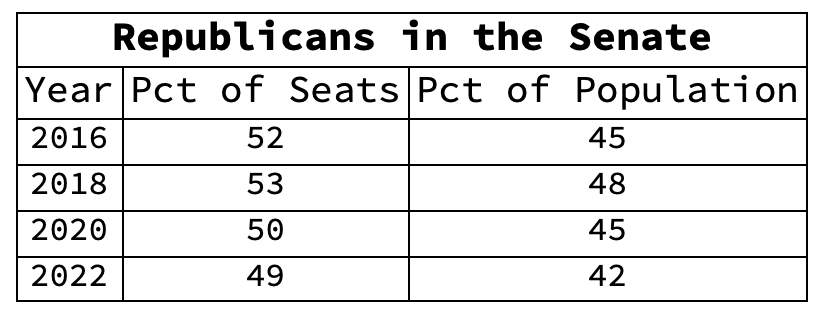
- At no time during the twenty-first century have Senate Republicans represented a majority of the U.S. population. Based on states’ populations, Senate Democrats have continuously represented more Americans since 1999.
- For example:
- Electoral College
- Efficiency of Vote Distribution favors GOP
- Winner-take-all electoral votes amplifies the effect of GOP’s more efficient distribution.
- Slight GOP small-state bias
- GOP lost the popular vote in every presidential election between 1992 and 2020 except 2004.
- Supreme Court
- Given the nature of the Electoral College and the Senate, Supreme Court justices may be nominated by presidents who lost the popular vote and confirmed by Senate majorities that represent only a minority of Americans. And given the Republican advantage in the Electoral College and the Senate, such justices are more likely to be Republican appointees.
- Four of nine current Supreme Court justices—Clarence Thomas, Neil Gorsuch, Brett Kavanaugh, and Amy Coney Barrett—were confirmed by a Senate majority that collectively won a minority of the popular vote in Senate elections and represented less than half of the American population. And three of them—Gorsuch, Kavanaugh, and Coney Barrett—were also nominated by a president who lost the popular vote
Republican Advantage in the Senate
- Sparsely populated states representing less than 20 percent of the U.S. population can produce a Senate majority. And states representing 11 percent of the population can produce enough votes to block legislation via a filibuster. The problem is now compounded by partisan bias. The GOP’s dominance in low-population states allows it to control the U.S. Senate without winning national popular majorities.
- At no time during the twenty-first century have Senate Republicans represented a majority of the U.S. population. Based on states’ populations, Senate Democrats have continuously represented more Americans since 1999.
- For example:
- For example:
- Tipping Point Argument
- How big is the Senate’s pro-Republican bias? Consider the 2020 election. Drawing on the tipping state logic below concerning the Electoral College, there is a five-point gap between the 2020 presidential election results in the median state—the one that yields a Senate majority—and the 2020 national presidential vote. This means that the Senate’s partisan bias was such that Democrats had to win the nationwide popular vote for Senate by about five points to gain control of the Senate. Over the past few decades, the size of the pro-Republican bias has varied from election to election, ranging from a low of two points to a high of nearly six points. But one thing has been constant: the GOP has enjoyed an advantage in the Senate for decades.
Republican Advantage in the Electoral College
- The Electoral College distorts the popular vote in two ways
- Winner-take-all
- Small-state bias
- First, nearly all states (with the exception of Maine and Nebraska) allocate Electoral College votes in a winner-take-all manner.
- Consider, for example, how the 2016 election played out in the states of
- Wisconsin (10 electoral votes),
- Michigan (16 electoral votes),
- Pennsylvania (20 electoral votes), and
- New York (29 electoral votes).
- Donald Trump won Wisconsin, Michigan, and Pennsylvania by narrow margins
- Wisconsin by 23,000 votes,
- Michigan by 11,000 votes,
- Pennsylvania by 44,000 votes.
- Which gave him 46 electoral votes.
- Hillary Clinton won New York by 1.7 million votes, giving her 29 electoral votes
- Summing up the votes in those four states:
- Clinton won the popular vote by 1.6 million votes
- 1,700,000 – (23,000 + 11,000 + 44,000) = 1,622,000
- Trump won the Electoral College vote among those states 46 to 29.
- 10 + 16 + 20 = 46
- The loser won.
- Clinton won the popular vote by 1.6 million votes
- The Electoral College’s winner-take-all system may benefit losing candidates of either party.
Bar Chart Depicting How a Party’s Distribution of Votes Can Affect the Number of Electoral Votes it Gets

- The second distortion in the Electoral College, the small-state bias, clearly favors the Republicans.
- Because the U.S. Senate heavily overrepresents sparsely populated states, the Electoral College has a modest rural bias of about twenty votes in the 538-seat college, which gives the Republicans a small but potentially decisive advantage. In 2000, for example, the small-state bias added an estimated eighteen votes to George W. Bush’s overall electoral vote. Since Bush defeated Al Gore by only five electoral votes, those eighteen votes were pivotal, turning the popular-vote loser into the president-elect.
- Tipping Point Argument
- One way in which analysts measure the Republican Party’s current advantage in the Electoral College is by identifying the state that serves as the tipping point in a national election—in other words, the state that delivers the decisive 270th electoral vote to the winning candidate. If we rank states from the largest pro-Democratic margin (Vermont) to the largest pro-Republican margin (Wyoming) in the 2020 presidential election, Wisconsin was the tipping point state. As such, we’d expect it to track the national popular vote, which Biden won by 4.4 percentage points. But he won Wisconsin by only 0.6 points, a nearly 4-point gap. This is the Electoral College bias: Biden needed to win the popular vote by around 4 points to be elected president. Like in the basketball game described above, a 3-point Biden advantage would have led to a Trump victory.
- View Advantage GOP: Electoral College
- View Tipping Point Math and Argument
- U.S. presidential elections have not been very democratic in the twenty-first century.
- Between 1992 and 2020, the Republican Party lost the popular vote in every presidential election except 2004. In other words, the GOP won the most votes only once during a span of nearly three decades. And yet Republican Party candidates have won the presidency three times during that period, allowing the party to occupy the presidency for twelve of those twenty-eight years.
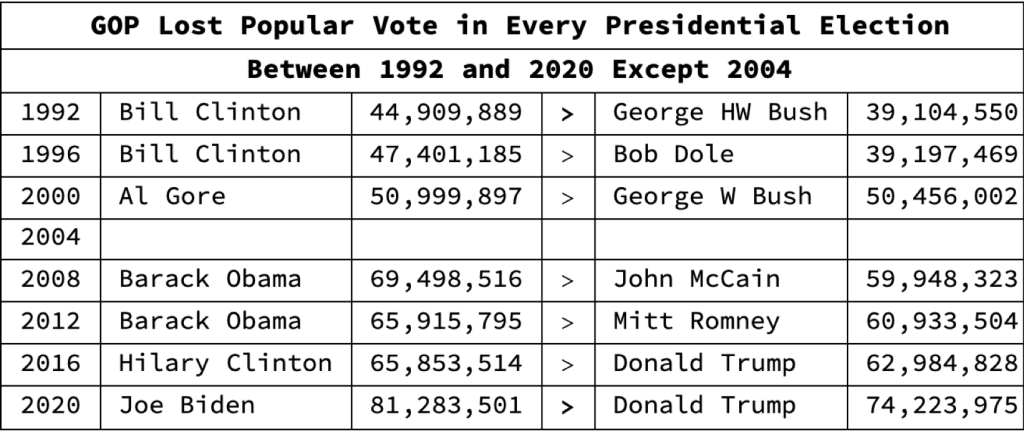
Republican Advantage on the Supreme Court
- Given the nature of the Electoral College and the Senate, Supreme Court justices may be nominated by presidents who lost the popular vote and confirmed by Senate majorities that represent only a minority of Americans. And given the Republican advantage in the Electoral College and the Senate, such justices are more likely to be Republican appointees.
- Four of nine current Supreme Court justices—Clarence Thomas, Neil Gorsuch, Brett Kavanaugh, and Amy Coney Barrett—were confirmed by a Senate majority that collectively won a minority of the popular vote in Senate elections and represented less than half of the American population. And three of them—Gorsuch, Kavanaugh, and Coney Barrett—were also nominated by a president who lost the popular vote.
Republican Advantage in the US House and State Legislatures
- Nearly all U.S. congressional and state legislative elections employ a first-past-the-post (or winner-take-all) system. States are carved up into districts with one legislator elected per district. The first-place candidate in each election wins the seat, and all rival candidates lose. The outcome is the same whether the election is a 50.1 percent to 49.9 percent nail-biter or an 80 percent to 20 percent landslide.
- Recall that in the twenty-first century, the Democratic Party’s voters are concentrated in metropolitan centers, whereas Republican voters, based in small towns and suburbs, tend to be more evenly distributed. As a result, Democrats are more likely to “waste” votes by racking up large majorities in urban districts while losing in most non-urban ones. This “inefficient” distribution of voters, combined with single-member districts, can allow the party with fewer votes to win legislative majorities. The problem is most visible in state legislatures.
- To see how this works, we can look at Pennsylvania, a major battleground state where Democrats have routinely won statewide popular majorities in the twenty-first century but Republicans have typically dominated the legislature. In 2018, for example, Democrats won 55 percent of the vote in the state’s legislative elections, but the Republicans retained a 110–93 seat majority in the state house. If we compare three typical state legislative districts we can see how this unfolds. In 2018:
- Republicans won the 71st District 11,615 to 10,661
- Republicans won the 144th District 15,457 to 14,867
- Democrats won the 70th District 16,055 to 7,112
- Adding up the total votes across the three districts:
- the Democrats won more votes by a margin of 41,583 to 34,184.
- But the Republicans captured 2 of the 3 seats.
- This pattern occurred across Pennsylvania in 2018, and it regularly occurs across many U.S. states today.
- Although geographic sorting clearly plays a role here, many state legislatures also intentionally sort voters by drawing the lines in ways that favor the party in power. After each decennial U.S. census, states are required to redraw election boundaries to keep institutions up-to-date with population changes. Since the Supreme Court decisions in Baker v. Carr (1962) and Reynolds v. Sims (1964), legislative districts must also be equally sized in terms of population. But they don’t have to be similarly shaped. State legislatures may carve up districts in highly irregular ways, redrawing district lines to place rival party voters into a small number of districts and spreading out the remainder across other districts, thereby diluting the rival party’s vote. Rival parties will thus win a few districts with big majorities but lose many more districts as a result.This is gerrymandering, and it’s as old as the republic itself. Both major parties have long engaged in it.
Bar Chart Depicting How Distribution of Votes Across Districts Can Affect Results

Majority Opinion Thwarted
- The more that political institutions overrepresent partisan minorities, the more likely it is that majority opinion will be thwarted or ignored.
- Examples:
- Abortion, page 183
- Gun Control, page 185
- Minimum Wage, page 187
Chapter 7 America the Outlier
Norway’s Constitution
- Norway’s 1814 constitution, like America’s in 1789, included a range of undemocratic features.
- But Norway improved its constitution over the years. In total, Norway’s constitution was amended 316 times between 1814 and 2014.
- On Freedom House’s Global Freedom Index for 2022 only three countries received a perfect score of 100: Finland, Sweden, and Norway.
Dismantling Counter-Majoritarian Institutions
- Over the course of the twentieth century, most established democracies dismantled their most egregiously counter-majoritarian institutions and took steps to empower majorities.
- Extended Suffrage
- They did away with suffrage restrictions.
- Eliminated Indirect Elections
- Indirect elections also disappeared.
- By the late nineteenth century, France and the Netherlands had eliminated the local councils that had previously selected members of parliament. Norway, Prussia, and Sweden did the same in the early twentieth century.
- Electoral colleges gradually disappeared across Latin America.
- Transitioned to Proportional Representation
- Most European democracies also reformed their electoral systems—the rules that govern how votes are translated into representation. They transitioned to proportional voting systems. By World War II, nearly all continental European democracies used some variant of proportional representation, and today 80 percent of democracies with populations above one million do so.
- Trended Toward Unicameral Legislatures
- By the early twenty-first century, two-thirds of the world’s parliaments were unicameral.
Adopted Judicial Review
- Many democracies moved in one counter-majoritarian direction in the twentieth century: judicial review.
- Prior to World War II, judicial review existed in only a few countries outside the United States. But since 1945, most democracies have adopted some form of it.
- But democracies outside the United States have replaced life tenure with either term limits or a mandatory retirement age for high court justices.
- For example, Canada adopted a mandatory retirement age of seventy-five for its Supreme Court justices in 1927.
- Similarly, Australia established a retirement age of seventy for High Court justices in 1977
US Reforms
- The US, too, took important steps toward majority rule in the twentieth century.
- In 1913 the Seventeenth Amendment mandated the direct popular election of senators.
- Before that, per the Constitution, state legislatures selected their U.S. senators.
- The Nineteenth Amendment (ratified in 1920) extended voting rights to women.
- The 1924 Snyder Act extended citizenship and voting rights to Native Americans.
- The Twenty-third Amendment (ratified in 1961) gave Washington, D.C. residents the right to vote in presidential elections.
- Legislative elections became much fairer in the 1960s
- Prior to this, rural election districts across America contained far fewer people than urban and suburban ones. For example, Alabama’s Lowndes County, with just over 15,000 people, had the same number of state senators as Jefferson County, which had more than 600,000 residents.
- Between 1962 and 1964, a series of Supreme Court rulings established the principle of “one person, one vote” for the US House and state legislatures, requiring that legislative districts be roughly equal in population. In the words of the political scientists Stephen Ansolabehere and James Snyder, the consequences of the rulings were “immediate, complete, and stunning.” Almost overnight, artificial rural majorities were wiped out in seventeen states.
- In Wesberry v Sanders the Supreme Court ruled that “one person, one vote” applied to the House of Representatives
- In Reynolds v Sims the Supreme Court ruled that “one person, one vote” applied to state houses and senates.
- The Twenty-fourth Amendment (1964) prohibited poll taxes.
- The 1965 Voting Rights Act met minimal standards for universal suffrage.
- The Twenty-sixth Amendment (1971) lowered the age to vote from twenty-one to eighteen.
US Reforms Lagged Behind
- But the reforms in the US did not go as far as other democracies
- Indirect Elections
- Whereas every other presidential democracy in the world did away with indirect elections during the twentieth century, in America the Electoral College remained intact.
- District Representation
- America also retained its first-past-the-post electoral system, even though it created situations of minority rule, especially in state legislatures. The United States thus joined Canada and the U.K. as the only rich Western democracies to not adopt more proportional election rules in the twentieth century.
- Malapportioned Senate
- America’s heavily malapportioned Senate also remained intact. The 1962–64 Supreme Court rulings establishing the principle of “one person, one vote” in the House of Representatives did not apply to the U.S. Senate.
- In Wesberry v Sanders the Supreme Court ruled that “one person, one vote” applied to the House of Representatives
- In Reynolds v Sims the Supreme Court ruled that “one person, one vote” applied to state houses and senates.
- America’s heavily malapportioned Senate also remained intact. The 1962–64 Supreme Court rulings establishing the principle of “one person, one vote” in the House of Representatives did not apply to the U.S. Senate.
- SuperMajoritarian Rule
- America also maintained a minority veto within the Senate.
- But Canada, like France and Britain, put in place a majoritarian 50 percent cloture rule, while the U.S. Senate adopted a nearly insurmountable supermajoritarian sixty-seven-vote cloture rule. The rule was modified from two-thirds to three-fifths in 1975, but it remained counter-majoritarian. America thus entered the twenty-first century with a “sixty-vote Senate.”
- Lifetime Tenure
- Unlike every other established democracy, America did not introduce term limits or mandatory retirement ages for Supreme Court justices.
- Of the fifty U.S. states, forty-six imposed term limits on state supreme court justices during the nineteenth or twentieth century. Three others adopted mandatory retirement ages. Only Rhode Island maintains lifetime tenure for its supreme court justices. But among national democracies, America, like Rhode Island, stands alone.
The US, a Democratic Laggard
- The United States, once a democratic pioneer and model for other nations, has now become a democratic laggard. Consider the following:
Indirect Elections
- America is the only presidential democracy in the world in which the president is elected via an Electoral College, rather than directly by voters. Only in America can a president be “elected against the majority expressed at the polls.”
Bicameral Legislature + Unequal Representation + Super Majoritarian Rule
- America is one of the few remaining democracies that retains a bicameral legislature with a powerful upper chamber, and it is one of an even smaller number of democracies in which a powerful upper chamber is severely malapportioned due to the “equal representation of unequal states” (only Argentina and Brazil are worse). Most important, it is the world’s only democracy with both a strong, malapportioned Senate and a legislative minority veto (the filibuster). In no other democracy do legislative minorities routinely and permanently thwart legislative majorities.
District Representation
- America is one of the few established democracies (along with Canada, India, Jamaica, and the U.K.) with first-past-the-post electoral rules that permit electoral pluralities to be manufactured into legislative majorities and, in some cases, allow parties that win fewer votes to win legislative majorities.
Lifetime Tenure
- America is the only democracy in the world with lifetime tenure for Supreme Court justices. All other established democracies have either term limits, a mandatory retirement age, or both.
Difficulty Amending the Constitution
- Among democracies, the U.S. Constitution is the hardest in the world to change, for it requires supermajorities in two legislative chambers plus the approval of three-quarters of the states.
US Constitution, the Hardest to Amend
- The US Constitution is the hardest to amend in the democratic world.
- Among the thirty-one democracies examined by Donald Lutz in his comparative study of constitutional amendment processes, the United States stands at the top of the Index of Difficulty, exceeding the next-highest-scoring countries (Australia and Switzerland) by a wide margin. Not only do constitutional amendments require the approval of two-thirds majorities in both the House and the Senate, but they must be ratified by three-quarters of the states. For this reason, the United States has one of the lowest rates of constitutional change in the world. According to the U.S. Senate, there have been 11,848 attempts to amend the U.S. Constitution. But only twenty-seven of them have been successful.
- Failed Attempts to Amend the Constitution
- Senator Birch Bayh’s attempt to abolish the Electoral College
- Bayh was initially skeptical about Electoral College reform, but as democratic changes swept the country in the mid-1960s, he reconsidered, and in 1966 he proposed a constitutional amendment to replace the Electoral College with direct presidential elections.
- Americans were on board.
- In September 1969, the House of Representatives passed the proposal to abolish the Electoral College 338–70—far more than the two-thirds necessary to amend the Constitution. As the proposal moved to the Senate, a Gallup poll showed that 81 percent of Americans supported the reform.
- But like so many times in the past, the Senate killed the reform. And like so many past reform efforts, opposition came from the South.
- Bayh didn’t give up. He reintroduced his Electoral College reform bill in 1971, 1973, 1975, and 1977.
- Equal Rights Amendment (ERA)
- Another serious but ultimately unsuccessful effort to reform the Constitution came in the 1970s, with the Equal Rights Amendment (ERA), which, like recent reforms in Norway, would have enshrined equal rights for women.
- In October 1971, the House approved the ERA 354–23. It went to the Senate, where in March 1972 it was approved 84–8.
- By early 1973, thirty of the required thirty-eight states had ratified the ERA.
- And yet the process stalled. Five more states approved the ERA after 1973, bringing the total to thirty-five—just three states shy of ratification—in 1977. But even though Congress extended the deadline for ratification to 1982, no additional states signed on.
- Senator Birch Bayh’s attempt to abolish the Electoral College
Chapter 8 Democratizing Our Democracy
Three Strategies for protecting democracy against authoritarianism
Containment
- One strategy, born in the darkest days of 1930s Europe, is to corral all democratic-minded forces into a broad coalition to isolate and defeat antidemocratic extremists.
- In Finland in the early 1930s, the leftist Social Democrats joined center and center-right parties in a broad-based Legality Front to face down the fascist Lapua Movement.
- In Belgium, the center-left Labor Party joined forces with the conservative Catholic Party and the centrist Liberals in a right-leaning unity government to defeat the fascist Rexist Party.
- In the US
- The lifelong conservatives who founded “Never Trump” organizations like Republicans for the Rule of Law, Republican Voters Against Trump, and the Lincoln Project cooperated with the Democrats—a party they had spent their careers opposing—to defeat the Trump-led GOP in elections.
- Likewise, Representatives Liz Cheney and Adam Kinzinger, two conservative Republicans, risked their political careers by working closely with Democrats on the House Select Committee to Investigate the January 6th Attack on the United States Capitol.
- Containment strategies were also employed in America’s state legislatures.
- In Ohio and Pennsylvania after the 2022 midterm elections, Democrats aligned with more moderate Republicans to defeat extremist Republicans for the statehouse speakership.
- In Pennsylvania, an alliance of Democrats and Republicans elected a moderate Democrat; in Ohio, they elected a mainstream Republican, keeping election-deniers out of power.
- Although containment can help keep antidemocratic forces out of power, it doesn’t necessarily weaken them.
Militant / Defensive Democracy
- A second strategy for confronting authoritarians—known as militant or defensive democracy—also emerged out of the trauma of 1930s Europe. The idea is that government authority and the law can be used to exclude and aggressively prosecute antidemocratic forces. The strategy was first implemented in post–World War II West Germany.
- America had never prosecuted a former president before 2023, but numerous other established democracies—from Japan and South Korea to France, Israel, and Italy—have done so, and their political systems were no worse off for it.
- A 2021 Pew survey found that 87 percent of Americans believed it was important to prosecute the January 6, 2021, Capitol rioters, and 69 percent believed it was “very important to do so.”
- But Defensive Democracy is easily abused. American history is replete with instances of such abuse:
- the 1798 Alien and Sedition Acts;
- the imprisonment of the socialist leader Eugene Debs;
- the 1919–20 Palmer Raids;
- the notorious House Un-American Activities Committee and Senator Joseph McCarthy’s political witch hunts;
- and the surveillance, prosecution, and even killing of African American leaders and activists.
Electoral Competition
- Madison believed that the need to win popular majorities would likely tame the most “sinister” political tendencies. But his formula requires that popular majorities actually prevail in elections. For that to happen, America must reform its institutions. The early twentieth century American reformer Jane Addams once wrote, “The cure for the ills of Democracy is more Democracy.”
- This means dismantling spheres of undue minority protection and empowering majorities at all levels of government; it means ending constitutional protectionism and unleashing real political competition; it means bringing the balance of political power more closely in line with the balance of voter preferences; and it means forcing our politicians to be more responsive and accountable to majorities of Americans. In short, we must democratize our democracy, undertaking long overdue constitutional and electoral reforms that would, at minimum, bring America in line with other established democracies.
Broad Areas of Reform
Uphold the Right to Vote
Right to Vote Amendment
- Pass a constitutional amendment establishing a right to vote for all citizens, which would provide a solid basis to litigate voting restrictions.
- In the United States, to the surprise of many, there is no constitutional or even statutory “right to vote.”
- Later amendments specified that suffrage may not be denied on the basis of race (Fifteenth Amendment) or sex (Nineteenth Amendment), but never has the Constitution positively affirmed Americans’ right to vote. Likewise, although there are many federal laws protecting voting, no single federal statute grants all adult citizens the right to cast a ballot.
- Nineteenth Amendment
- The right of citizens of the United States to vote shall not be denied or abridged by the United States or by any State on account of sex.
- Twenty-Sixth Amendment
- The right of citizens of the United States, who are eighteen years of age or older, to vote shall not be denied or abridged by the United States or by any State on account of age.
- Nineteenth Amendment
Making Voting Easy
- Establish automatic registration in which all citizens are registered to vote when they turn eighteen. This could be accompanied by the automatic distribution of national voting ID cards to all citizens. The burdens of the registration process should not deter anyone from voting.
- Expand early voting and easy mail-in voting options for citizens of all states. It should be easy for all Americans to cast ballots.
- Make Election Day a Sunday or a national holiday, so that work responsibilities do not discourage Americans from voting.
Voting Rights
- Restore voting rights (without additional fines or fees) to all ex-felons who have served their time.
- Restore national-level voting rights protections. In the spirit of the 1965 Voting Rights Act, parts of which the Supreme Court struck down in 2013, we should reinstate federal oversight of election rules and administration.
Nonpartisan Election Administration
- Replace the current system of partisan electoral administration with one in which state and local electoral administration is in the hands of professional, nonpartisan officials.
- Nearly every other established democracy, from France and Germany to Brazil, Costa Rica, Japan, and South Africa, has nonpartisan referees to oversee elections.
Ensure That Election Outcomes Reflect Majority Preferences
Abolish Electoral College
- Abolish the Electoral College and replace it with a national popular vote. No other presidential democracy permits the loser of the popular vote to win the presidency. Such a constitutional amendment very nearly passed as recently as 1970.
Number of a State’s Senators should be proportional to its population
- Reform the Senate so that the number of senators elected per state is more proportional to the population of each state (as in Germany). California and Texas should elect more senators than Vermont and Wyoming. Because Article V of the U.S. Constitution stipulates that “no state, without its Consent, may be deprived of its equal suffrage in the Senate” we understand the barriers to such a reform are enormous. But because the structure of the Senate so subverts basic democratic principles, and with such great consequence, any list of important democratizing reforms must include it.
Replace District Representation for the House with Modified Proportional Representation
- Replace “first-past-the-post” electoral rules and single-member districts for the House of Representatives and state legislatures with a form of proportional representation in which voters elect multiple representatives from larger electoral districts and parties win seats in proportion to the share of the vote they win. This would require repeal of the 1967 Uniform Congressional District Act, which mandates single-member districts for House elections. By ensuring that the distribution of seats in Congress more accurately reflects the way Americans vote, a proportional representation system would prevent the problem of “manufactured majorities,” in which parties that win fewer votes in an election capture a majority of seats in the legislature. As the political scientist Lee Drutman writes, a proportional representation system “treats all voters equally, regardless of where they live. And it treats all parties the same, regardless of where their voters live.”
- Such systems are typically referred to as Single Transferable Vote.
- See Fairvote on what it calls Proportional Ranked Choice Voting
Create Independent Redistricting Commissions
- Eliminate partisan gerrymandering via the creation of independent redistricting commissions such as those used in California, Colorado, and Michigan.
Expand the size of the House to keep it line with population growth
- Update the Apportionment Act of 1929, which fixed the House of Representatives at 435, and return to the original design of a House that expands in line with population growth. At present, the ratio of voters to representatives in the House is nearly five times higher than that of any European democracy. Expanding the size of Congress would bring representatives closer to the people, and, if the Electoral College and the current Senate structure remain in place, mitigate the small-state bias of the Electoral College.
Empower Governing Majorities
Abolish Senate Filibuster
- Abolish the Senate filibuster (a reform that requires neither statutory nor constitutional change), thereby eliminating the ability of partisan minorities to repeatedly and permanently thwart legislative majorities. In no other established democracy is such a minority veto routinely employed.
Term Limit for Supreme Court justices and regularize Supreme Court appointment process
- Establish term limits (perhaps twelve or eighteen years) for Supreme Court justices and regularize the Supreme Court appointment process so that every president has the same number of appointments per term. Such a reform would place the United States in the mainstream of all other major democracies in the world. This would also limit the court’s intergenerational counter-majoritarianism.
Make Constitution Easier to Amend
- Make it easier to amend the Constitution by eliminating the requirement that three-quarters of state legislatures ratify any proposed amendment. Requiring two-thirds supermajorities in both the House of Representatives and the Senate for a constitutional amendment would bring America in line with most other established democracies, including federal democracies like Germany and India, as well as many U.S. states.
Selected Notes
- A multiracial democracy A more accurate term might be “multiethnic democracy,” because the concept encompasses not only different races but also ethnic groups (such as Latinos or Jews) that are not based on race. Given the historical centrality of race in the United States, however, and given that the term “multiracial democracy” is more commonly employed in U.S. public debates, we will use the term “multiracial democracy.”
- But the assault on American democracy Over the last five years, several important books have been written on the challenges of American democracy, including
- Theda Skocpol and Caroline Tervo, eds., Upending American Politics: Polarizing Parties, Ideological Elites, and Citizen Activists from the Tea Party to the Anti-Trump Resistance (New York: Oxford University Press, 2020);
- Suzanne Mettler and Robert C. Lieberman, Four Threats: The Recurring Crises of American Democracy (New York: St. Martin’s Press, 2020);
- Robert C. Lieberman, Suzanne Mettler, and Kenneth M. Roberts, eds., Democratic Resilience: Can the United States Withstand Rising Polarization? (Cambridge, UK: Cambridge University Press, 2022).
- But flaws in our Constitution For an excellent discussion of some of these flaws, see Sanford Levinson, Our Undemocratic Constitution: Where the Constitution Goes Wrong (and How We the People Can Correct It) (Oxford: Oxford University Press, 2008).
- On March 4, 1801 Sean Wilentz, The Rise of American Democracy: Jefferson to Lincoln (New York: W. W. Norton, 2005), 94.
- constitutional hardball The term “constitutional hardball” was coined by the constitutional scholar Mark Tushnet. See Mark Tushnet, “Constitutional Hardball,” John Marshall Law Review 37 (2004): 523–54. See also Steven Levitsky and Daniel Ziblatt, How Democracies Die (New York: Crown, 2018).
- “Second Founding” Eric Foner, The Second Founding: How the Civil War and Reconstruction Remade the Constitution (New York: Norton, 2019), 7; Foner, Reconstruction, 278.
- The V-Dem (Varieties of Democracy) Institute Anna Luhrmann et al., “New Global Data on Political Parties: V-Party,” V-Dem Institute Briefing Paper No. 9, Oct. 26, 2020, 1–2.
- Why has the Republican Party Some important works on this question include
- Daniel Schlozman, When Movements Anchor Parties: Electoral Alignments in American History (Princeton, N.J.: Princeton University Press, 2015);
- E. J. Dionne, Why the Right Went Wrong: Conservatism—from Goldwater to Trump and Beyond (New York: Simon & Schuster, 2016);
- Theda Skocpol and Vanessa Williamson, The Tea Party and the Remaking of Republican Conservativism (New York: Oxford University Press, 2016);
- Sam Rosenfeld, The Polarizers: Postwar Architects of Our Partisan Era (Princeton, N.J.: Princeton University Press, 2017);
- Jacob Hacker and Paul Pierson, Let Them Eat Tweets: How the Right Rules in an Age of Extreme Inequality (New York: W. W. Norton, 2020).
- In the first half See
- Lewis L. Gould, The Republicans: A History of the Grand Old Party (Oxford: Oxford University Press, 2014);
- Heather Cox Richardson, To Make Men Free: A History of the Republican Party (New York: Basic Books, 2014).
- “Long Southern Strategy” Angie Maxwell and Todd G. Shields, The Long Southern Strategy: How Chasing White Voters in the South Changed American Politics (New York: Oxford University Press, 2019), 8.
- “racial resentment” Alan Abramowitz, The Great Alignment: Race, Party Transformation, and the Rise of Donald Trump (New Haven, Conn.: Yale University Press, 2018), 130–31.
- First, election fraud
- Lorraine C. Minnite, The Myth of Voter Fraud (Ithaca, N.Y.: Cornell University Press, 2011);
- Richard L. Hasen, The Voting Wars: From Florida 2020 to the Next Election Meltdown (New Haven, Conn.: Yale University Press, 2012), 52–62;
- Justin Levitt, “The Truth About Voter Fraud,” Brennan Center for Justice, 2007.
- Studies have found See
- Jason D. Mycoff, Michael W. Wager, and David C. Wilson, “The Empirical Effects of Voter ID Laws: Present or Absent?,” PS: Political Science and Politics 42, no. 1 (Jan. 2009): 121–26;
- Highton, “Voter Identification Laws and Turnout in the United States,” 149–67;
- Nicholas A. Valentino and Fabian G. Neuner, “Why the Sky Didn’t Fall: Mobilizing Anger in Reaction to Voter ID Laws,” Political Psychology 38, no. 2 (2017): 331–50;
- Justin Grimmer et al., “Obstacles to Estimating Voter ID Laws’ Effects on Turnout,” Journal of Politics 80, no. 3 (2018), 1045–51;
- Justin Grimmer and Jesse Yoder, “The Durable Differential Deterrent Effects of Strict Photo Identification Laws,” Political Science Research and Methods 10, no. 3 (2022): 453–69.
- The Tea Party
- Skocpol and Williamson, Tea Party and the Remaking of American Conservatism, 76–82;
- Parker and Barreto, Change They Can’t Believe In; Rachel M. Blum, How the Tea Party Captured the GOP: Insurgent Factions in American Politics (Chicago: University of Chicago Press, 2020), 95–97.
- “Trump didn’t hijack the Republican Party”
- Matthew Continetti on The Ezra Klein Show, “Donald Trump Didn’t Hijack the G.O.P. He Understood It,” New York Times, May 6, 2022.
- “The Big Lie”
- Zack Beauchamp, “The Big Lie Is the GOP’s One and Only Truth,” Vox, May 21, 2021;
- Ashley Parker and Marianna Sotomayor, “For Republicans, Fealty to Trump’s Election Falsehood Becomes Defining Loyalty Test,” Washington Post, May 2, 2021.
- All democracies must therefore One of the most prominent analysts of how different democracies balance majority and minority rights is Arend Lijphart, Patterns of Democracy: Government Forms and Performance in Thirty-six Countries (New Haven, Conn.: Yale University Press, 1999).
- This is the danger of counter-majoritarianism See Robert A. Dahl, Democracy and Its Critics (New Haven, Conn.: Yale University Press, 1989), 155–56.
- First, those with more votes In presidential systems, this means that candidates who win electoral pluralities or majorities should win; in parliamentary democracies, governments should have the (explicit or implicit) support of parties that represent an electoral majority.
- Many of the founders See Hamilton, “Federalist No. 22,” in Alexander Hamilton, James Madison, and John Jay, The Federalist, with Letters of “Brutus,” ed. Terence Ball (Cambridge, U.K.: Cambridge University Press, 2003), 100–1; Greg Weiner, Madison’s Metronome: The Constitution, Majority Rule, and the Tempo of American Politics (Lawrence: University Press of Kansas, 2012), 13–14.
Addendum
- Tyranny of Minority, By Topic
- Tipping Point Math and Argument
- Outline of How Democracies Die
- Advantage GOP, by Bronner and Rakich
Tyranny of Minority, By Topic
House
- Minority Rule
- America the Outlier
- Broad Areas of Reform
Senate
- Fettered Majorities
- Minority Rule
- America the Outlier
- Broad Areas of Reform
Electoral College
- Fettered Majorities
- Minority Rule
- America the Outlier
- Broad Areas of Reform
Supreme Court
- Fettered Majorities
- Minority Rule
- America the Outlier
- Broad Areas of Reform
Filibuster
- Fettered Majorities
- Broad Areas of Reform
Partisan Bias
- Minority Rule
Amending the Constitution
- Fettered Majorities
- America the Outlier
- Broad Areas of Reform
Right to Vote
- Broad Areas of Reform
Tipping Point Math and Argument
- Dataset pres2020 for 2020 presidential election
- Fields: state, Dem EC, Rep EC, Dem vote, Rep vote, Other vote, Total Vote
- Sample records:
- {“AL”, 0, 9, 849624, 1441170, 32488, 2323282}
- {“CA”, 55, 0, 11110639, 6006518, 384223, 17501380}
- Sort by Democratic winning margin percent
- tippoint = ReverseSortBy[MapApply[{#1, #2, #3, N[100((#4/#7)- (#5/#7))]}&, pres2020], Last]
- {{DC, 3, 0, 86.7524}, {VT, 3, 0, 35.4127}, {MA, 11, 0, 33.4582}, {MD, 10, 0, 33.2104}, {HI, 4, 0, 29.4648}, {CA, 55, 0, 29.1641}, {NY, 29, 0, 23.1278}, {RI, 4, 0, 20.775}, {CT, 7, 0, 20.0736}, {WA, 12, 0, 19.2033}, {DE, 3, 0, 18.9681}, {IL, 20, 0, 16.9882}, {OR, 7, 0, 16.0861}, {NJ, 14, 0, 15.9379}, {CO, 9, 0, 13.5016}, {NM, 5, 0, 10.7926}, {VA, 13, 0, 10.114}, {ME, 0, 1, 9.07134}, {ME, 3, 0, 9.07116}, {NH, 4, 0, 7.3526}, {MN, 10, 0, 7.11016}, {MI, 16, 0, 2.78353}, {NV, 6, 0, 2.39053}, {PA, 20, 0, 1.16124}, {WI, 10, 0, 0.6271}, {AZ, 11, 0, 0.30871}, {GA, 16, 0, 0.235582}, {NC, 0, 15, -1.34816}, {FL, 0, 29, -3.35837}, {TX, 0, 38, -5.57859}, {OH, 0, 18, -8.03196}, {IA, 0, 6, -8.19761}, {AK, 0, 3, -10.0612}, {SC, 0, 9, -11.6802}, {KS, 0, 6, -14.635}, {MO, 0, 10, -15.3909}, {IN, 0, 11, -16.0674}, {MT, 0, 3, -16.3691}, {MS, 0, 6, -16.5453}, {LA, 0, 8, -18.6094}, {NE, 1, 0, -19.0572}, {NE, 0, 4, -19.0576}, {UT, 0, 6, -20.4838}, {TN, 0, 11, -23.2089}, {AL, 0, 9, -25.4617}, {KY, 0, 8, -25.9351}, {SD, 0, 3, -26.1641}, {AR, 0, 6, -27.6207}, {ID, 0, 4, -30.774}, {OK, 0, 7, -33.0871}, {ND, 0, 3, -33.3428}, {WV, 0, 5, -38.9312}, {WY, 0, 3, -43.3827}}
- tippoint = ReverseSortBy[MapApply[{#1, #2, #3, N[100((#4/#7)- (#5/#7))]}&, pres2020], Last]
- Dems have 268 ECs through the first 24 records
- Total[Take[tippoint,24][[All,{2}]]]
- = 268
- Total[Take[tippoint,24][[All,{2}]]]
- So record 25 is the tipping point state
- Take[tippoint, {25}]
- {“WI”, 10, 0, 1630866, 1610184, 56991, 3298041}
- Take[tippoint, {25}]
- Biden’s winning margin percent in WI is 0.626766
- N[((1630855/3298041) – (1610184/3298041)) 100]
- = 0.626766
- N[((1630855/3298041) – (1610184/3298041)) 100]
- Biden’s winning margin percent overall is 4.45594
- N[((81283501 / 158429631) – (74223975 / 158429631)) 100]
- = 4.45594
- N[((81283501 / 158429631) – (74223975 / 158429631)) 100]
- So the gap between Biden’s winning margin percent overall and his winning margin percent in the tipping point state is 3.82917
- 4.45594 – 0.626766 = 3.82917
- Tipping Point Argument
- The math establishes that there’s a gap of 3.8 percentage points between Biden’s winning margin percent overall and his winning margin percent in the tipping point state of Wisconsin.
- Ziblatt and Levinsky then draw the following conclusion from the gap:
- “Wisconsin was the tipping point state. As such, we’d expect it to track the national popular vote, which Biden won by 4.4 percentage points. But he won Wisconsin by only 0.6 points, a nearly 4-point gap. This is the Electoral College bias: Biden needed to win the popular vote by around 4 points to be elected president.”
- Reconstructed, their argument is something like this:
- If the Electoral College were unbiased, Biden would have won the tipping point state popular vote by the same percent margin as he won the overall popular vote.
- Biden won the tipping point state popular vote by 3.8 percentage points less than he won the overall popular vote.
- Therefore the Electoral College was biased against Biden by 3.8 percentage points.
- Therefore Biden needed to win the popular vote by around 3.8 points to be elected president.
- The first premise may well be true, but Ziblatt and Levinsky offer no argument in support of it.
Outline of How Democracies Die
- Introduction
- Since the end of the Cold War, most democratic breakdowns have been caused not by generals and soldiers but by elected governments themselves. Some of these leaders dismantle democracy quickly, as Hitler did in the wake of the 1933 Reichstag fire in Germany. More often, though, democracies erode slowly, in barely visible steps.
- How vulnerable is American democracy to this form of backsliding?
- Extremist demagogues emerge from time to time in all societies, even in healthy democracies. The United States has had its share of them, including Henry Ford, Huey Long, Joseph McCarthy, and George Wallace.
- An essential test for democracies is not whether such figures emerge but whether political leaders, and especially political parties, work to prevent them from gaining power in the first place—by keeping them off mainstream party tickets, refusing to endorse or align with them, and when necessary, making common cause with rivals in support of democratic candidates.
- Once a would-be authoritarian makes it to power, democracies face a second critical test: Will the autocratic leader subvert democratic institutions or be constrained by them? Institutions alone are not enough to rein in elected autocrats. Constitutions must be defended—by political parties and organized citizens, but also by democratic norms.
- Democracies work best—and survive longer—where constitutions are reinforced by unwritten democratic norms. Two basic norms have preserved America’s checks and balances in ways we have come to take for granted:
- mutual toleration, or the understanding that competing parties accept one another as legitimate rivals, and
- forbearance, or the idea that politicians should exercise restraint in deploying their institutional prerogatives.
- The erosion of our democratic norms began in the 1980s and 1990s and accelerated in the 2000s. By the time Barack Obama became president, many Republicans, in particular, questioned the legitimacy of their Democratic rivals and had abandoned forbearance for a strategy of winning by any means necessary. Donald Trump may have accelerated this process, but he didn’t cause it. The challenges facing American democracy run deeper. The weakening of our democratic norms is rooted in extreme partisan polarization—one that extends beyond policy differences into an existential conflict over race and culture. America’s efforts to achieve racial equality as our society grows increasingly diverse have fueled an insidious reaction and intensifying polarization.
- Fateful Alliances
- We’ve developed a set of four behavioral warning signs that can help us know an authoritarian when we see one. We should worry when a politician
- 1) rejects, in words or action, the democratic rules of the game,
- 2) denies the legitimacy of opponents,
- 3) tolerates or encourages violence,
- 4) indicates a willingness to curtail the civil liberties of opponents, including the media.
- What kinds of candidates tend to test positive on a litmus test for authoritarianism? Very often, populist outsiders do. Populists are antiestablishment politicians—figures who, claiming to represent the voice of “the people,” wage war on what they depict as a corrupt and conspiratorial elite. Populists tend to deny the legitimacy of established parties, attacking them as undemocratic and even unpatriotic. They tell voters that the existing system is not really a democracy but instead has been hijacked, corrupted, or rigged by the elite. And they promise to bury that elite and return power to “the people.”
- We’ve developed a set of four behavioral warning signs that can help us know an authoritarian when we see one. We should worry when a politician
- Gatekeeping in America
- Gatekeepers in a democracy are the institutions responsible for preventing would-be authoritarians from coming into power.
- Alexander Hamilton worried that a popularly elected presidency could be too easily captured by those who would play on fear and ignorance to win elections and then rule as tyrants.
- “History will teach us,” Hamilton wrote in the Federalist Papers, that “of those men who have overturned the liberties of republics, the great number have begun their career by paying an obsequious court to the people; commencing demagogues, and ending tyrants.”
- For Hamilton and his colleagues, elections required some kind of built-in screening device.
- The device they chose was the Electoral College, made up of locally prominent men in each state who would be responsible for choosing the president. Under this arrangement, Hamilton reasoned, “the office of president will seldom fall to the lot of any man who is not in an eminent degree endowed with the requisite qualifications.” The Electoral College thus became our original gatekeeper.
- The rise of parties in the early 1800s changed the way our electoral system worked. Instead of electing local notables as delegates to the Electoral College, as the founders had envisioned, each state began to elect party loyalists. Electors became party agents, which meant that the Electoral College surrendered its gatekeeping authority to the parties.
- Political parties thus became the gatekeepers of American democracy.
- The Great Republican Abdication
- In the twenty-three years between 1945 and 1968, under the old convention system, only a single outsider (Dwight Eisenhower) publicly sought the nomination of either party.
- But the primary system had opened up the presidential nomination process more than ever before in American history.
- The post-1972 primary system was especially vulnerable to a particular kind of outsider: individuals with enough fame or money to skip the “invisible primary.” In other words, celebrities.
- Party gatekeepers were shells of what they once were, for two main reasons.
- One was a dramatic increase in the availability of outside money, accelerated (though hardly caused) by the Supreme Court’s 2010 Citizens United ruling.
- The other major factor diminishing the power of traditional gatekeepers was the explosion of alternative media, particularly cable news and social media.
- Subverting Democracy
- Three strategies by which elected authoritarians seek to consolidate power:
- capturing the referees,
- sidelining the key players, and
- rewriting the rules to tilt the playing field against opponents.
- Three strategies by which elected authoritarians seek to consolidate power:
- The Guardrails of Democracy
- All successful democracies rely on informal rules (or norms) that, though not found in the constitution or any laws, are widely known and respected. In the case of American democracy, this has been vital.
- Two norms stand out as fundamental to a functioning democracy: mutual toleration and institutional forbearance.
- Mutual toleration is the idea that as long as our rivals play by constitutional rules, we accept that they have an equal right to exist, compete for power, and govern.
- Institutional forbearance is avoiding actions that, while respecting the letter of the law, violate its spirit.
- The Unwritten Rules of American Politics
- Unwritten rules are everywhere in American politics, ranging from the operations of the Senate and the Electoral College to the format of presidential press conferences.
- By the turn of the twentieth century norms of mutual toleration and institutional forbearance were well-established. Indeed, they became the foundation of our much-admired system of checks and balances.
- In the absence of these norms, this balance becomes harder to sustain. When partisan hatred trumps politicians’ commitment to the spirit of the Constitution, a system of checks and balances risks being subverted in two ways.
- Under divided government, where legislative or judicial institutions are in the hands of the opposition, the risk is constitutional hardball, in which the opposition deploys its institutional prerogatives as far as it can extend them—defunding the government, blocking all presidential judicial appointments, and perhaps even voting to remove the president. In this scenario, legislative and judicial watchdogs become partisan attack dogs.
- Under unified government, where legislative and judicial institutions are in the hands of the president’s party, the risk is not confrontation but abdication. If partisan animosity prevails over mutual toleration, those in control of congress may prioritize defense of the president over the performance of their constitutional duties. In an effort to stave off opposition victory, they may abandon their oversight role, enabling the president to get away with abusive, illegal, and even authoritarian acts.
- U.S. presidents, congressional leaders, and Supreme Court justices enjoy a range of powers that, if deployed without restraint, could undermine the system.
- Consider six of these powers.
- Three are available to the president: executive orders, the presidential pardon, and court packing. Another three lie with the Congress: the filibuster, the Senate’s power of advice and consent, and impeachment.
- The Unraveling
- Behind the unraveling of basic norms of mutual tolerance and forbearance lies a syndrome of intense partisan polarization.
- But the polarization has been asymmetric, moving the Republican Party more sharply to the right than it has moved the Democrats to the left. Ideologically sorted parties don’t necessarily generate the “fear and loathing” that erodes norms of mutual toleration, leading politicians to begin to question the legitimacy of their rivals.
- The social, ethnic, and cultural bases of partisanship have also changed dramatically, giving rise to parties that represent not just different policy approaches but different communities, cultures, and values. We have already mentioned one major driver of this: the civil rights movement. But America’s ethnic diversification was not limited to black enfranchisement. Beginning in the 1960s, the United States experienced a massive wave of immigration, first from Latin America and later from Asia, which has dramatically altered the country’s demographic map. In 1950, nonwhites constituted barely 10 percent of the U.S. population. By 2014, they constituted 38 percent, and the U.S. Census Bureau projects that a majority of the population will be nonwhite by 2044. Together with black enfranchisement, immigration has transformed American political parties.
- The Republican Party has also become the party of evangelical Christians. Evangelicals entered politics en masse in the late 1970s, motivated, in large part, by the Supreme Court’s 1973 Roe v. Wade decision legalizing abortion. Beginning with Ronald Reagan in 1980, the GOP embraced the Christian Right and adopted increasingly pro-evangelical positions, including opposition to abortion, support for school prayer, and, later, opposition to gay marriage.
- Democratic voters, in turn, grew increasingly secular.
- In other words, the two parties are now divided over race and religion—two deeply polarizing issues that tend to generate greater intolerance and hostility than traditional policy issues such as taxes and government spending.
- But why was most of the norm breaking being done by the Republican Party?
- It is not only media and outside interests that have pushed the Republican Party toward extremism. Social and cultural changes have also played a major role. Unlike the Democratic Party, which has grown increasingly diverse in recent decades, the GOP has remained culturally homogeneous. This is significant because the party’s core white Protestant voters are not just any constituency—for nearly two centuries, they comprised the majority of the U.S. electorate and were politically, economically, and culturally dominant in American society. Now, again, white Protestants are a minority of the electorate—and declining. And they have hunkered down in the Republican Party.
- Trump Against the Guardrails
- In Chapter 4, we presented three strategies by which elected authoritarians seek to consolidate power: capturing the referees, sidelining the key players, and rewriting the rules to tilt the playing field against opponents. Trump and other Republicans attempted all three of these strategies.
- President Trump demonstrated striking hostility toward the referees—law enforcement, intelligence, ethics agencies, and the courts.
- The Trump administration also mounted efforts to sideline key players in the political system. President Trump’s rhetorical attacks on critics in the media are an example. His repeated accusations that outlets such as the New York Times and CNN were dispensing “fake news” and conspiring against him look familiar to any student of authoritarianism.
- Republican state legislatures tried to tilt the playing field by enacting strict voter ID laws.
- Perhaps the most antidemocratic initiative yet undertaken by the Trump administration is the creation of the Presidential Advisory Commission on Election Integrity, chaired by Vice President Mike Pence but run by Vice Chair Kris Kobach.
- Perhaps President Trump’s most notorious norm-breaking behavior has been lying.
- In Chapter 4, we presented three strategies by which elected authoritarians seek to consolidate power: capturing the referees, sidelining the key players, and rewriting the rules to tilt the playing field against opponents. Trump and other Republicans attempted all three of these strategies.
- Saving Democracy
- America’s democratic norms, at their core, have always been sound. But for much of our history, they were accompanied—indeed, sustained—by racial exclusion. Now those norms must be made to work in an age of racial equality and unprecedented ethnic diversity. Few societies in history have managed to be both multiracial and genuinely democratic. That is our challenge. It is also our opportunity. If we meet it, America will truly be exceptional.
Advantage GOP, by Bronner and Rakich
- Advantage, GOP
- fivethirtyeight.com/features/advantage-gop/?curator=MediaREDEF
- By Laura Bronner and Nathaniel Rakich
- Published Apr. 29, 2021
Advantage GOP: Electoral College
- By now, Democrats’ disadvantage in the Electoral College is well-documented. President Joe Biden won the national popular vote by 4.5 percentage points, yet he won Wisconsin — the state that gave him his decisive 270th electoral vote1 — by only 0.6 points. In other words, Biden needed to beat former President Donald Trump nationally by more than 3.8 points2 in order to win the White House outright. (However, Trump wouldn’t have won outright unless Biden had won the popular vote by fewer than 3.2 points, thus losing Pennsylvania as well.3 The Electoral College’s Republican bias in 2020 thus averaged out to 3.5 points — but either way, it’s the most out of sync the Electoral College has been with the popular vote since 1948.)
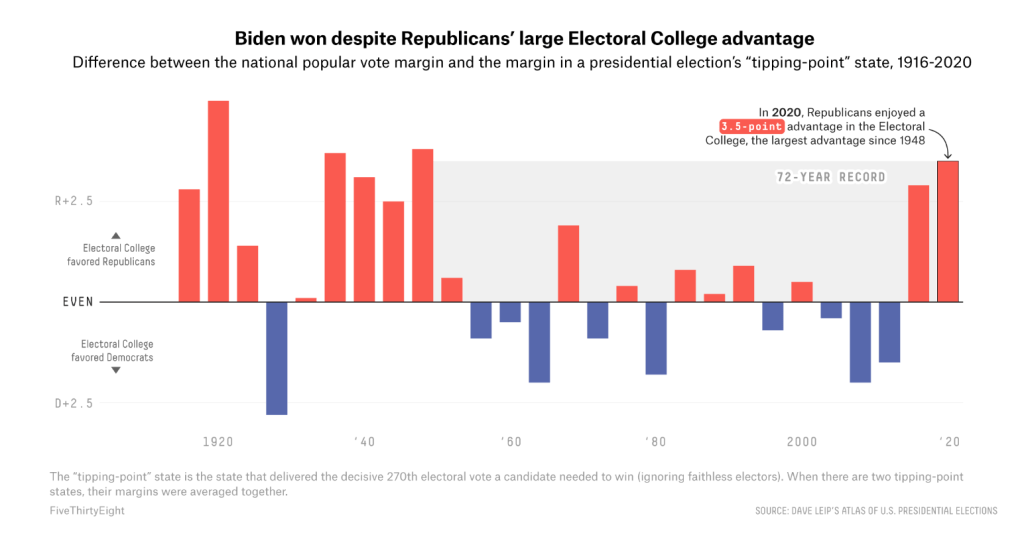
- But in many ways, this is Republicans’ least concerning advantage, because the bias of the Electoral College is not consistent. Though it favored Republicans in 2016 and 2020, Democrats were actually the beneficiary from 2004 to 2012. Contrary to popular belief, the Electoral College’s bias doesn’t stem from its privileging of small states, but rather from its winner-take-all nature and which states happen to be battlegrounds.
Advantage GOP: Senate
- Another of our counter-majoritarian institutions, the U.S. Senate, was designed to amplify the political voice of less populous states. For decades, this had no partisan effect: Democrats and Republicans were equally competitive in big and small states alike. But in the last half century, the two parties have gradually undergone a dramatic urban-rural sorting that has made most small states reliably Republican and most big states bastions of blue. So now, the Senate’s small-state bias has become a Republican bias — both more consistent and more severe than the Electoral College’s.
- Last year, despite Biden winning the national popular vote by 4.5 points, Trump won the median Senate seat4 by 0.5 points. That 5.0-point Republican lean makes the Senate the most biased institution in the federal government.
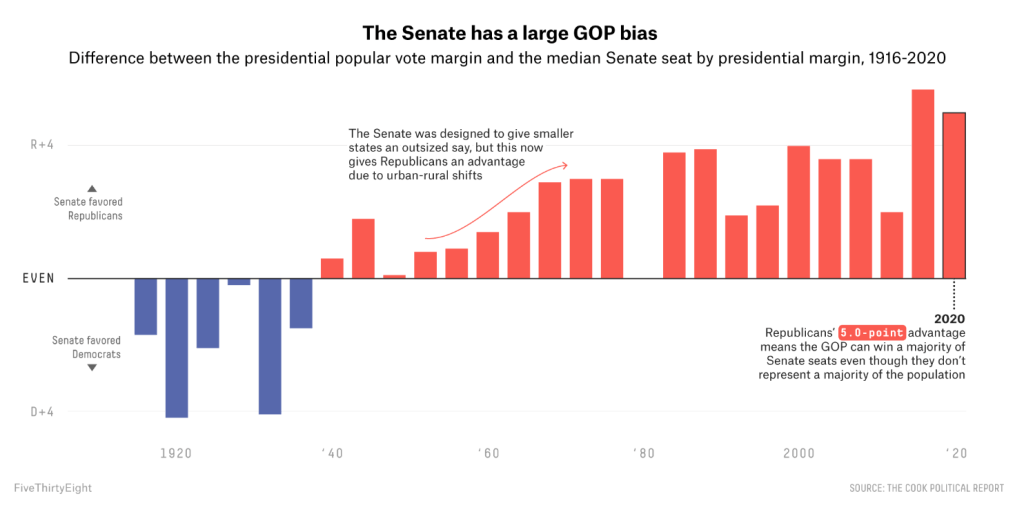
- In fact, Republican senators have not represented a majority of the population since 1999 — yet, from 2003 to 2007 and again from 2015 to 2021,5 Republicans had a majority of members of the Senate itself. That means that, for 10 years, Republican senators were passing bills — and not passing others — on behalf of a minority of Americans.
- This has implications for policy as well as democracy. “You have a Senate that empowers small states,” Jake Grumbach, a political scientist at the University of Washington, said. “Plus [with] the filibuster, you have to get compromises to get to 60 votes.” For example, Grumbach pointed out, fossil-fuel-producing states such as Kentucky, Louisiana and West Virginia don’t have very many people, yet their six senators are capable of blocking legislation to address climate change even though most Americans say the federal government is not doing enough on the issue.
- The Senate not only passes legislation that affects every American, but it also confirms the president’s judicial nominees, including Supreme Court justices. That brings us to the first way in which counter-majoritarian institutions reinforce each other. If the Senate and the Electoral College are biased in the same direction, as they are now, it gives a minority party broad power over the entire federal judicial branch. And the current minority party, Republicans, has so far been incredibly successful at appointing judges to the federal courts: From 2017 to 2021, more than 220 judges, including three Supreme Court justices, were appointed by a president who lost the popular vote and confirmed by a Senate that a majority of voters didn’t choose.
- These judges are the umpires who uphold the rules of our tennis game, but when a system of minority rule brought them to power, those decisions may not be impartial. Rather, their rulings on cases involving redistricting and voting rights can deepen the minority’s institutional advantages. Indeed, under Chief Justice John Roberts, the Supreme Court has done just that with rulings such as Shelby County v. Holder, which weakened the Voting Rights Act, and Rucho v. Common Cause, which said federal courts should not review partisan gerrymanders. And because federal judgeships are lifetime appointments, these judges will shape our democracy not just in the short term, but for decades to come.
Advantage GOP: House
- The House of Representatives completes the federal trifecta of imbalance: According to Daily Kos Elections, Biden won the median House seat (Illinois’s 14th District) by 2.4 percentage points, meaning it was still 2.1 points redder than the country as a whole.
- This is not a new phenomenon: The House map has had a Republican bias since at least 1968, based on presidential election results. And in 1996 and 2012, Republicans even won House majorities despite Democrats winning the House popular vote.

- Unlike the Electoral College and Senate, the founders actually did intend for the House to represent the majority of people — yet the chamber now shares the others’ Republican bias. One reason for this is, again, urban-rural sorting; the clustering of Democratic votes in urban areas has made it harder to draw maps that benefit Democrats rather than Republicans. But another reason is engineered by Republicans themselves. The GOP has taken full advantage of its many opportunities to draw boundaries that give them an unfair advantage. For instance, after the red wave election of 2010, Republicans drew more than five times as many congressional districts as Democrats, and they used it to push their structural advantage in the House to record levels.
- The House’s Republican bias in the 2020 election, however, wasn’t as severe as earlier in the decade, as some Republican-drawn maps were invalidated by courts and shifts in electoral coalitions also caused some gerrymanders to backfire (e.g., suburban seats that had been assumed to be safely Republican in 2011 have become more Democratic). That said, Republicans had a strong down-ballot performance in the 2020 elections, so they will once again get to redraw a plurality of congressional districts as they see fit, which could again pad the House’s Republican bias.
- In this way, a chamber that was intended to counteract the skew of the Senate ends up reinforcing our structural imbalance even more.
Advantage GOP: State Legislatures
- State legislatures are the last piece in the institutional jenga. Here, too, urban-rural sorting and gerrymandering have handed Republicans an advantage: Republicans currently control at least four state-legislative chambers (the Michigan Senate, Michigan House, Minnesota Senate and Pennsylvania Senate) for which Democrats won the statewide popular vote in the last election.6 Democrats also won the 2018 popular vote in the Michigan House, North Carolina House and Pennsylvania House yet failed to take control of those chambers. In fact, Republicans have controlled the Michigan House without interruption since the 2012 elections despite winning the popular vote in just one of the five elections to take place in that time, according to Daily Kos Elections.
- This is important not only because state governments enact the types of policies that are most consequential for people’s lives, but also because they can reinforce minority rule. In most states, legislatures draw the districts in which both state lawmakers and U.S. representatives are elected. This raises the possibility that minority rule can self-perpetuate: A minority-elected legislature can theoretically set up future legislatures and congressional delegations to be elected with a minority too.
- Additionally, legislatures are the ones with the power to change election law since elections are administered at the state and local levels. That means, as we’re seeing now in states like Georgia and Iowa, that they can make the competition less fair by changing the rules of the game.
- It’s always been possible for state legislators to write partisan laws and draw self-serving maps, and to some degree it has always happened. But if legislatures’ recent actions have felt especially antidemocratic, it’s not your imagination. In our highly polarized era of politics, Democrats and Republicans view each other with increased suspicion and hatred, meaning they’re willing to go to greater lengths to keep the other side out of power. And as the parallel trend of political nationalization has made state and national politicians more like-minded, they’ve been able to more efficiently coordinate their efforts to exploit minority rule for political gain.
- Republicans, in particular, have been more willing than Democrats to violate norms — and even subvert democracy — in order to retain power. Indeed, recent research from Grumbach on state-level democratic backsliding has found that the most important predictor of how undemocratic state-level institutions are is whether the GOP is in power.
Advantage GOP: Democracy, GOP, and Minority Rule
- “You have a party that believes at a high level in democracy, and you’ve got a party filled with a number of people who wield power who don’t,” Hakeem Jefferson, a FiveThirtyEight contributor and a professor of political science at Stanford University, told us. “I think it’s uncomfortable for scholars to say outwardly, because it doesn’t seem like the objective thing to say, but it is empirically the truth.”
- Jefferson is one of many scholars who believe that Republicans are embracing minority rule because of demographic changes. Having made the fateful decision to appeal primarily to white voters decades ago, Republicans now face an existential threat in a country where people of color are becoming a greater and greater share of the population. “They’re so fearful of the imagined harm that comes to their hold on power when a more diverse constituency becomes a part of the electoral process,” Jefferson said.
- Simply put, America’s counter-majoritarian institutions have never been stacked so high against one party. Because of this cumulative tilt, Democrats have to win increasingly large majorities in order to govern — and Republicans increasingly don’t have to win majorities at all. In recent years, they have controlled the White House, the Senate, the House and several state legislatures despite most voters preferring the other party. And in the words of Daniel Ziblatt, a political scientist at Harvard University and author of “How Democracies Die,” a “political system without any majority rule at all — it’s not really very democratic.”
- Minority rule is not just a fact of life for the GOP — it is a strategy, encouraged by Republican politicians who fear ceding power to a more and more diverse majority. And because political institutions interact to shape the rules of our democracy, they have created a vicious cycle where minority rule can perpetuate itself.
- “Essentially, what this means is the Republican Party can go off the rails without really suffering any immediate electoral costs,” Ziblatt told us. “They can win the presidency without winning the popular vote; they can control the Senate without representing the majority of voters. And so the self-correcting mechanism of American democracy” — elections — “is not working, because they’re not getting the signal that what they’re doing isn’t a winning strategy — because it is a winning strategy.”
- In other words, if American democracy were a tennis game, the Republican player would be set up perfectly. His opponent would be hitting every ball into the wind, and every call from the umpire’s chair would go his way.
Detailed Table of Contents
- The Book
- My Top-Level Outline
- Chapter Summary
- Introduction
- Chapter 1 Fear of Losing
- Chapter 2: The Banality Of Authoritarianism
- Chapter 3 It Has Happened Here
- Wilmington Coup and Massacre, 1898
- Reconstruction, 1865 -1877
- Reconstruction Amendments and Acts, 1865-1875
- Reconstruction, the Work of One Party Alone
- Black Participation in Democracy
- White Backlash
- Wave of Terrorism
- Waning of Reconstruction
- Second Wave of “Redemption”
- End of Reconstruction, 1877
- Biracial Coalitions Defy Rule by the Democratic Party in the South, 1880s
- Jim Crow Laws, 1877-1954
- Giles v. Harris, 1903
- A Last Attempt to Pass Voting Rights Legislation, 1890
- Chapter 4 Why the Republican Party Abandoned Democracy
- Chapter 5 Fettered Majorities
- Chapter 6 Minority Rule
- Chapter 7 America the Outlier
- Chapter 8 Democratizing Our Democracy
- Selected Notes
- Addendum
- Detailed Table of Contents
 A Philosopher's View