- A Shortcoming of Propositional Logic
- Paradoxes of Material Implication
- Indicative Conditional of Natural Language
- Probability Logic Overview
- Language of Probability Logic
- Probability Logic, by Example
- Formal P-validity
- Natural Deduction
- Computer Decision Procedure for P-validity
- Embedded Conditionals
- Links
- Adams’ Bibliography
- Conditional Logic, an extension of Propositional Logic, sets forth the logic of the indicative conditional, sentences such as:
- If you strike the match, it will light.
- If Anna rode her bike to school yesterday she wore a helmet.
- If it doesn’t rain tomorrow, he’ll play golf in the afternoon.
A Shortcoming of Propositional Logic
The truth-value of a conditional in Propositional Logic is true if and only if its antecedent (the if clause) is false or its consequent (the then clause) is true or both. It makes sense that a conditional is true when antecedent and consequent are both true. And it makes sense that a conditional is false when the antecedent is true and the consequent false. But the idea that a conditional is true when its antecedent is false is not only counterintuitive but leads to the paradoxes of material implication.
Paradoxes of Material Implication
For each of following arguments, valid in Propositional Logic, there’s a scenario in which its premises are true and conclusion false.
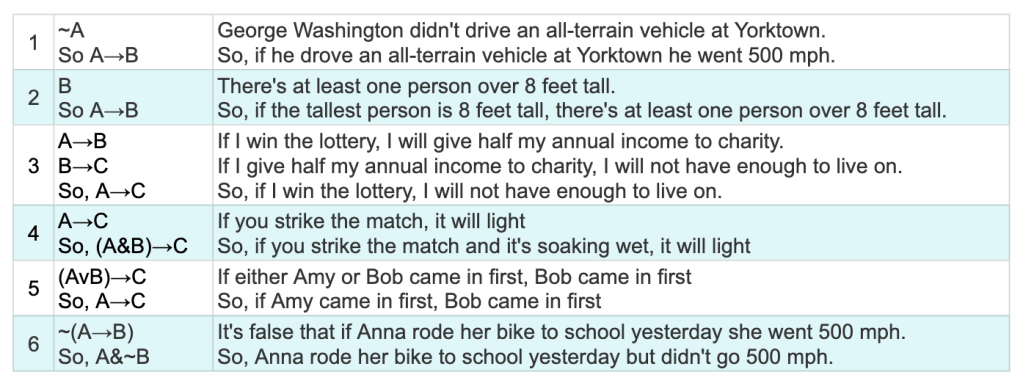
The arguments are invalid in Conditional Logic.
Indicative Conditional of Natural Language
- John is asked whether Anna wore a helmet riding her bike to school yesterday. John doesn’t know if Anna rode her bike yesterday. But he knows that Anna is very good about wearing a helmet. So, he replies:
- If Anna rode her bike to school yesterday she wore a helmet.
- Three scenarios:
- Anna rode her bike to school yesterday and wore a helmet:
- John is right and the conditional is true.
- Anna rode her bike to school yesterday but didn’t wear a helmet:
- John is wrong and the conditional is false.
- Anna didn’t ride her bike to school yesterday:
- John is neither right or wrong and the conditional is neither true or false.
- The fact that Anna is very good about wearing a helmet is evidence either that if Anna rode her bike to school yesterday she wore a helmet or that if Anna had ridden her bike to school yesterday she would have worn a helmet. That is, it’s evidence either for an indicative conditional or for a counterfactual subjunctive conditional.
- Anna rode her bike to school yesterday and wore a helmet:
- Upshot:
- If the antecedent of an indicative conditional is true:
- the truth-value of the conditional is the same as the truth-value of the consequent.
- If the antecedent of an indicative conditional is false:
- the conditional is neither true or false;
- the conditional (or its counterfactual counterpart) can nevertheless be likely (certain, reasonable to believe, doubtful, etc.) based on the evidence.
- View Epistemic Probability.
- If the antecedent of an indicative conditional is true:
Probability Logic Overview
In the 1960s and 70s Ernest W. Adams developed a system of Conditional Logic, which he called Probability Logic, that in a sense replaces the truth-values of Propositional Logic with the real numbers of Probability Theory. Here’s an overview of his system, contrasted with Propositional Logic.
- Propositional Logic
- The core notion of Propositional Logic is truth-functionality, the idea that the truth-value of a compound sentence is a function of the truth-values of its component clauses.
- The truth-values of conjunctions, disjunctions, negations, and material conditionals are determined by the truth-values of their sentence letters.
- An argument is valid if there’s no assignment of truth-values to its sentence letters under which the premises are true and the conclusion is false.
- The material conditional is defined as true when its antecedent is false, its consequent true, or both; and false otherwise. That the material conditional is true when its antecedent is false leads to the paradoxes of material implication.
- Probability Logic
- The core notion of Probability Logic is epistemic probability, the kind of probability relative to evidence and expressed by terms such as:
- it is certain that, it is beyond a reasonable doubt that, it’s likely that, it is doubtful that, there’s a remote possibility that, it is impossible that.
- View Epistemic Probability.
- The probabilities of conjunctions, disjunctions, negations, material conditionals and indicative conditionals are determined by the probabilities of the state-descriptions of their sentence letters.
- A state-description is a conjunction of sentence letters and negations of sentence letters.
- An argument is p-valid, loosely speaking, if there’s no probability distribution to the state-descriptions of its sentence letters under which the premises are very likely and the conclusion very unlikely.
- The probability of the indicative conditional is defined as the conditional probability of its consequent given its antecedent. That is, the probability of the conditional if A then B = P(A ⇒ B) = P(B|A) = P(A&B) / P(A).
- The core notion of Probability Logic is epistemic probability, the kind of probability relative to evidence and expressed by terms such as:
Language of Probability Logic
- The language of Adams’ Probability Logic is an extension of the language of Propositional Logic. So it includes sentence letters (A, B, C, ..), parentheses, and the connectives: &, v, ~, and ➞.
- Thus the following are sentences of Probability Logic:
- ~(AvB) ➞ C
- ~(A ➞ B)
- (A ➞ B) & (B ➞ A)
- It also includes the connective ⇒, symbolizing the indicative conditional, what Adams calls a probability conditional.
- Thus the sentences of Probability Logic also include:
- A ⇒ B
- A ⇒ (B &C)
- (A v B) ⇒ C
- A ⇒ ~(A ➞B )
- There’s a special restriction on probability conditionals: unlike other connectives, “⇒” has to be the main connective in a sentence; so a probability conditional can’t be within the scope of a another connective. The following are thus not sentences of Probability Logic:
- ~(A ⇒ B)
- (A ⇒ B) & (B ⇒ A)
- (A ⇒ B) v (A ⇒ C)
- A ⇒ (B ⇒ C)
Probability Logic, by Example
To get a feel for Adams’ system we’ll look at a number of arguments and compare why they’re valid or invalid in Propositional Logic versus why they’re p-valid or p-invalid in Probability Logic.
- An argument is valid in Propositional Logic if and only if there’s no assignment of truth-values to its sentence letters under which the premises are true and the conclusion is false.
- An argument is p-valid, loosely speaking, if and only if there’s no probability distribution for the state-descriptions of its sentence letters under which the premises are very likely and the conclusion very unlikely.
- A state-description is a conjunction of sentence letters and negations of sentence letters.
- An argument is p-valid, strictly speaking, if and only if there’s no probability distribution to the state-descriptions of its sentence letters under which the probability of the conclusion is less than the sum of the probabilities of the premises (minus one less than the number of premises).
- View Formal P-validity
Reverse Disjunctive Syllogism
- The argument
- A v B
- A
- So, ~B
- is invalid in both Propositional Logic and Probability Logic:
Invalidity
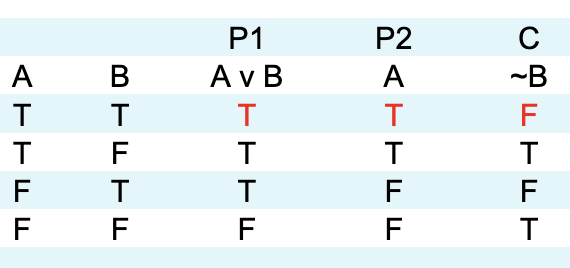
- The argument is invalid since the premises are true and the conclusion false when A and B are both true:
-
P-Invalidity
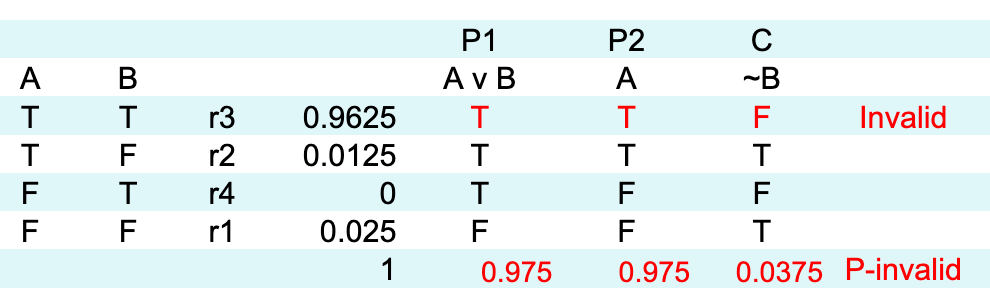
- The argument is p-invalid because there’s a probability distribution for the state-descriptions of A and B under which the premises are very likely and the conclusion very unlikely. That is, there’s a probability distribution for the state-descriptions
- P(A&B)
- P(A&~B)
- P(~A&B)
- P(~A&~B)
- under which AvB and A are very likely and ~B very unlikely.
- For example:
- the probability distribution
- P(A&B) = 0.9625
- P(A&~B) = 0.0125
- P(~A&B) = 0
- P(~A&~B) = 0.025.
- under which
- P(AvB) = P(A&B) + P(A&~B) + P(~A&B) = 0.975
- P(A) = P(A&B) + P(A&~B) = 0.975
- P(~B) = P(A&~B) + P(~A&~B) = 0.0375.
- the probability distribution
- It is helpful to think about probability visually.
- State-descriptions correspond to regions of a Venn diagram.
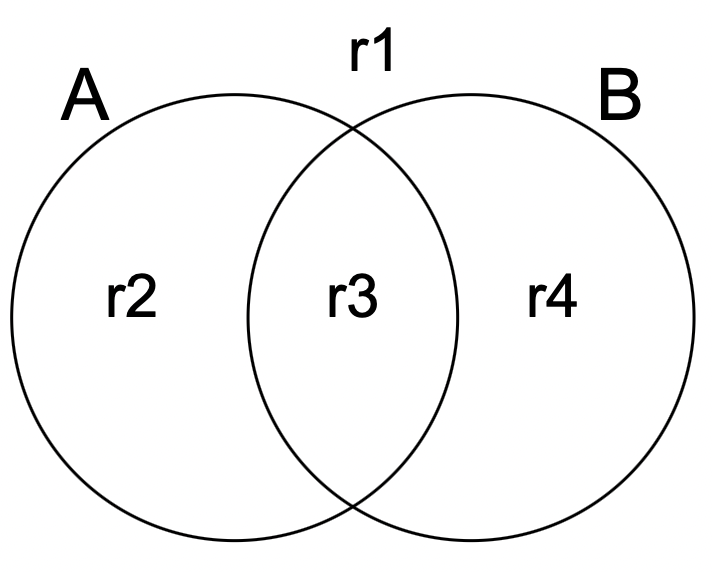
- Thus the state-descriptions of A and B correspond to the regions of
- where the regions are:
- r1 = ~A&~B
- r2 = A&~B
- r3 = A&B
- r4 = B&~A.
- Which makes it clear that the probabilities of the premises and conclusion are:
- P(AvB) = r2 + r3 + r4
- P(A) = r2 + r3
- P(~B) = r1 + r2.
- I used Mathematica to find the counterexample above — by telling it to find probabilities for r1, r2, r3, and r4 that make the premises > 0.95 and the conclusion < 0.05.
- FindInstance[
- (r2 + r3 + r4) > 0.95 &&
- (r2 + r3) > 0.95 &&
- (r1 + r2) < 0.05 &&
- r1 + r2 + r3 + r4 = 1.0 &&
- r1 ≥ 0 && r2 ≥ 0 && r3 ≥ 0 && r4 ≥ 0,
- {r1, r2, r3, r4}]
- FindInstance[
- Which returns {r1 = 0.025, r2 = 0.0125, r3 = 0.9625, r4 = 0.}. A null return, {}, would have meant that no such probability distribution exists.
Summary:
Disjunctive Syllogism
- Disjunctive Syllogism (DS) is valid in Propositional Logic and p-valid:
- AvB
- ~A
- So, B
Validity
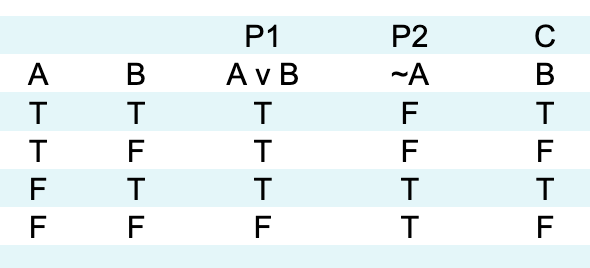
- There’s no assignment of truth-values to A and B under which the premises are true and the conclusion is false, there being only four:
- The argument is thus valid.
P-validity
- There are two ways of proving that DS is p-valid:
- Derive the conclusion from the premises using rules of inference that guarantee p-validity.
- Use a decision procedure for p-validity that finds that DS is p-valid.
Derivation
- Adams’ rules of inference are sound and complete. That is:
- If the conclusion is derivable from the premises, the argument is p-valid.
- If an argument is p-valid, the conclusion is derivable from the premises.
- Since there’s a derivation of B from AvB and ~A, the argument is p-valid.
Decision Procedure
- The other way of proving p-validity is by using a decision procedure, an algorithm that determines, after a finite number of steps, whether the argument is p-valid or p-invalid.
- I’ll use the strict definition of p-validity:
- An argument is p-valid if and only if there’s no probability distribution to the state-descriptions of its sentence letters under which the probability of the conclusion is less than the sum of the probabilities of the premises (minus one less than the number of premises).
- Thus, for example, if a p-valid argument has two premises each with probability 0.9, the probability of the conclusion can’t be less than 0.9 + 0.9 − 1 = 0.8. And if the probability of the two premises is 0.8, the probability of the conclusion can’t be less than 0.8 + 0.8 −1 = 0.6.
- In other words, if the premises of a p-valid argument are reasonable to believe, the conclusion can’t be reasonable to disbelieve.
- The decision procedure is some Mathematica code that determines whether there’s a probability distribution under which the probability of B is less than the probability of AvB + the probability of ~A − 1.
- Disjunctive Syllogism
- AvB = r2 + r3 + r4
- ~A = (r1 + r4)
- B = (r3 + r4)
- FindInstance[
- r2 + r3 + r4 = p1 &&
- (r1 + r4) = p2 &&
- (r3 + r4) = c &&
- c < (p1 + p2 −1) &&
- 1 + r2 + r3 + r4 = 1.0 &&
- r1 ≥ 0 && r2 ≥ 0 && r3 ≥ 0 && r4 ≥ 0,
- {r1, r2, r3, r4, p1, p2, c}]
- Output = {}.
- The code returns {}, meaning that no such probability distribution exists.
- So if AvB and ~A are reasonable to believe, it can’t be reasonable to believe that B is false.
Fallacy of Affirming the Consequent
- Fallacy of Affirming the Consequent is the argument form:
- Material implication
- A ➞ B
- B
- So, A
- Indicative conditional
- A ⇒ B
- B
- So, A
- Material implication
- The argument is invalid and p-invalid.
Invalidity
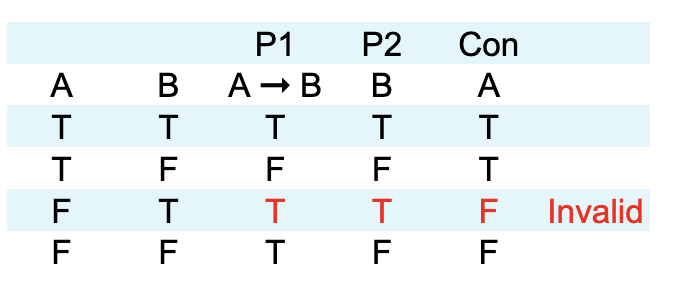
- The argument is invalid because A ➞ B and B are true and A false when A = F and B = T.
P-invalidity
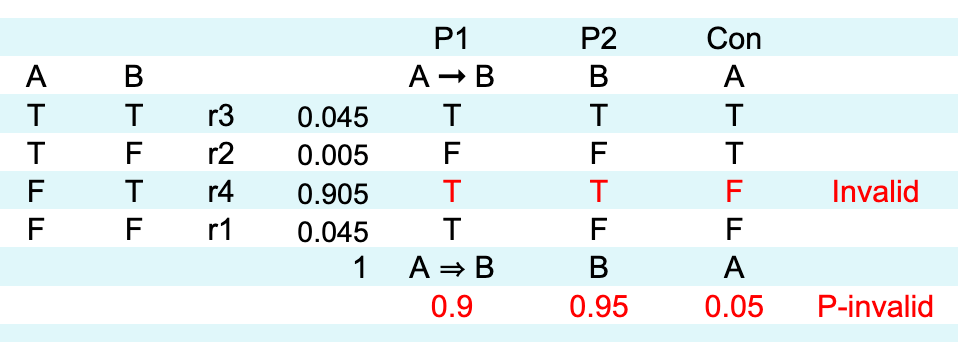
- Lets find a probability distribution for state-description probabilities r1, r2, r3, and r4 that makes A ⇒ B and B likely and A unlikely.
- It’s clear that P(A) = r2 + r3 and P(B) = r3 + r4.
- But what’s P(A ⇒ B)?
- Consider the question:
- What’s the probability, if you randomly draw a face card from a standard deck, that it’s a king?
- A reasonable way to answer the question is to assume you’ve drawn a face card and then calculate the probability it’s a king based on that assumption. There are 12 face cards and 4 kings. So, assuming you’ve drawn a face card, the probability of a king is 4/12.
- Let A = “You draw a face card” and B = “You draw a king.”
- The probability of A ⇒ B = P(A&B) / P(A) = (4/52)/(12/52) = 4/12. Which is r3 / (r2 + r3) on the Venn diagram.
- The argument is thus:
- P(A ⇒ B) = r3 / (r2 + r3),
- P(B) = r3 + r4,
- P(A) = r2 + r3.
- The counterexample is:
- r1 = 0.045, r2 = 0.005, r3 = 0.045, r4 = 0.905.
- Which yields the probabilities:
- P(A ⇒ B) = r3 / (r2 + r3) + 0.045 / (0.005 + 0.045) = 0.9
- P(B) = r3 + r4 = 0.045 + 0.905 = 0.95
- P(A) = r2 + r3 = 0.005 + 0.045 = 0.05.
Summary:
Modus Ponens
- Modus ponens is valid and p-valid.
- Valid
- A ➞ B
- A
- So, B
- P-valid
- A ⇒ B
- A
- So B.
- Valid
Validity
Obvious.
P-validity
Derivation for P-validity
- A derivation of B from A and A ⇒ B using Adams’ rules of inference:
- 1. A G.
- 2. A ⇒ B G.
- 3. T ⇒ A From 1 by CF.
- 4. (T&A) ⇒ B From 2 by EA.
- 5. T ⇒ B From 3 and 4 by RT.
- 6. B From 5 by CF
Decision Procedure
- The probabilities of premises and conclusion in terms of state-description probabilities:
- P(A ⇒ B) = p1 = r3 / (r2 + r3),
- P(A) = p2 = r2 + r3.
- P(B) = c = r3 + r4.
- The FindInstance command:
- FindInstance[
- r3/(r2 + r3) = p1 &&
- (r2 + r3) = p2 &&
- (r3 + r4) = c &&
- c < (p1 + p2 − 1) &&
- r1 + r2 + r3 + r4 = 1.0 &&
- r1 ≥ 0 && r2 ≥ 0 && r3 ≥ 0 && r4 ≥ 0,
- {r1, r2, r3, r4, p1, p2, c}]
- FindInstance[
- Which returns {}, so the argument is p-valid.
- Therefore:
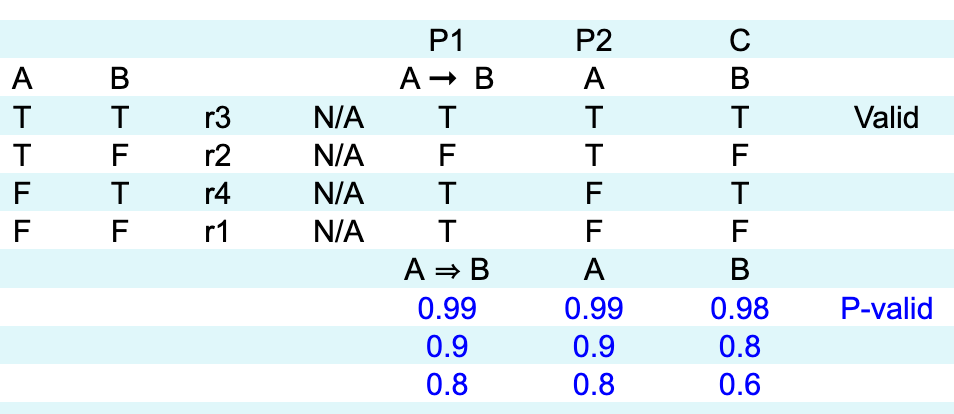
- If P(A ⇒ B) = 0.99 and P(A) = 0.99, P(B) can’t be less than 0.98.
- If P(A ⇒ B) = 0.9 and P(A) = 0.9, P(B) can’t be less than 0.8.
- If P(A ⇒ B) = 0.8 and P(A) = 0.8, P(B) can’t be less than 0.6.
Summary:
Transitivity
- Transitivity is valid in Propositional Logic and, indeed, seems valid. But it’s p-invalid and subject to counterexample.
- Valid
- A ➞ B
- B ➞ C
- So, A ➞ C
- P-invalid
- A ⇒ B
- B ⇒ C
- So, A ⇒ C
- Counterexample:
- If I win the lottery I will give half my annual income to charity.
- If I give half my annual income to charity I will not have enough to live on.
- So, If I win the lottery I will not have enough to live on.
Validity
- The validity of transitivity is confirmed by the Mathematica.
- The argument is valid if and only if it’s logically true that
- ((A ➞ B) & (B ➞ C)) ➞ (A ➞ C).
- ((A ➞ B) & (B ➞ C)) ➞ (A ➞ C) translates into Mathematica as:
- Implies[And[Implies[a, b], Implies[b, c]], Implies[a, c]]
- The TautologyQ command returns True:
- TautologyQ[Implies[And[Implies[a, b], Implies[b, c]], Implies[a, c]]].
- The argument is valid if and only if it’s logically true that
P-invalidity
- We want to find a probability distribution for the regions of a Venn diagram that makes A ⇒ B and B ⇒ C likely and A ⇒ C unlikely. Since there are three sentence letters there are eight regions.
- The probabilities of the premises and conclusion in terms of regions:
- P(A ⇒ B) = p1 = (r3 + r8) / (r2 + r3 + r7 + r8)
- P(B ⇒ C) = p2 = (r5 + r8)/(r3 + r5 + r6 + r8)
- P(A ⇒ C) = c = (r7 + r8)/( r2 + r3 + r7 + r8).
- I use Mathematica to find a probability distribution that makes the probabilities of the premises greater than 0.9 and the probability of the conclusion less than 0.1.
- FindInstance[
- (r3 + r8) / (r2 + r3 + r7 + r8) ≥ 0.9 &&
- (r5 + r8) / (r3 + r5 + r6 + r8) ≥ 0.9 &&
- (r7 + r8) / ( r2 + r3 + r7 + r8) < 0.1 &&
- r1 + r2 + r3 + r4 + r5 + r6 + r7 + r8 = 1.0 &&
- r1 ≥ 0 && r2 ≥ 0 && r3 ≥ 0 && r4 ≥ 0 && r5 ≥ 0 && r6 ≥ 0 && r7 ≥ 0 && r8 ≥ 0,
- {r1, r2, r3, r4, r5, r6, r7, r8}]
- FindInstance[
- The probability distribution:
- {r1 = 0., r2 = 0.00617284, r3 = 0.0524691, r4 = 0., r5 = 0.891358, r6 = 0.0469136, r7 = 0., r8 = 0.00308642}.
- Which renders the probabilities of the premises 0.9 and the probability of the conclusion 0.05.
- P(A ⇒ B) = (r3 + r8) / (r2 + r3 + r7 + r8) = 0.9
- P(B ⇒ C) = (r5 + r8)/(r3 + r5 + r6 + r8) = 0.9
- P(A ⇒ C) = (r7 + r8)/( r2 + r3 + r7 + r8) = 0.05.
Restricted Transitivity
- A slight modification of Transitivity results in the p-valid argument form:
- A ⇒ B
- (A&B) ⇒ C
- So, A ⇒ C
- The argument is not subject to the lottery-income counterexample.
- If I win the lottery I will give half my annual income to charity.
- If I win the lottery and give half my annual income to charity I will not have enough to live on.
- So, If I win the lottery I will not have enough to live on.
- The second premise is false.
- Restricted Transitivity is p-valid per Mathematica.
- The probabilities of premises and conclusion in terms of state-description probabilities;
- P(A ⇒ B) = p1 = (r3+r8)/(r2+r3+r7+r8),
- P((A&B) ⇒ C) = p2 = r 8/(r3+r8),
- P(A ⇒ C) = c = (r7+r8)/(r2+r3+r7+r8).
- Mathematica code:
- FindInstance[
- (r3 + r8)/(r2 + r3 + r7 + r8) = p1 &&
- r8/(r3 + r8) = p2 &&
- (r7 + r8)/(r2 + r3 + r7 + r8) = c &&
- 1 − c > ((1 − p1) + (1 -−p2)) &&
- r1 + r2 + r3 + r4 + r5 + r6 + r7 + r8 = 1.0 &&
- r1 ≥ 0 && r2 ≥ 0 && r3 ≥ 0 && r4 ≥ 0 && r5 ≥ 0 && r6 ≥ 0 && r7 ≥ 0 && r8 ≥ 0,
- {r1, r2, r3, r4, r5, r6, r7, r8, p1, p2, c}]
- FindInstance[
- The command returns the null {}. So the argument is p-valid.
Formal P-validity
- Strict definition of p-validity (Adams’ formulation):
- An argument is p-valid if and only if there’s no probability distribution to the state-descriptions of its sentence letters under which the improbability of the conclusion is greater than the sum of the improbabilities of its premises.
- The improbability of a sentence is one minus its probability.
- A state-description is a conjunction of sentences letters and negations of sentence letters.
- Adams uses the word “uncertainty” rather than “improbability.”
- An argument is p-valid if and only if there’s no probability distribution to the state-descriptions of its sentence letters under which the improbability of the conclusion is greater than the sum of the improbabilities of its premises.
- An equivalent definition of p-validity:
- An argument is p-valid if and only if there’s no probability distribution to the state-descriptions of its sentence letters under which the probability of the conclusion is less than the sum of the probabilities of the premises (minus one less than the number of premises).
- Equivalence:
- Suppose that an argument with, say, two premises is p-valid per the improbability definition. Then there is no probability distribution such that (1 − c) > ( (1 − p1) + (1 − p2), where p1 and p2 are the probabilities of the premises and c is the probability of the conclusion. It follows that there is no probability distribution such that c < (p1 + p2 − 1).
- If the probability of the premises = p, the probability of the conclusion can’t be less than c.
- For a p-valid argument with one premise:
- If the probability of the premise = 0.99, the probability of the conclusion can’t be less than 0.99 – 0 = 0.99
- For premise = 0.9, the conclusion can’t be less than 0.9.
- For premise = 0.8, the conclusion can’t be less than 0.8.
- For a p-valid argument with two premises:
- If the probability of each premise = 0.99, the probability of the conclusion can’t be less than 0.99 + 0.99 – 1 = 0.98
- For premises = 0.9, the conclusion can’t be less than 0.8.
- For premises = 0.8, the conclusion can’t be less than 0.6.
- And for a p-valid argument with three premises:
- If the probability of each premise = 0.99, the probability of the conclusion can’t be less than 0.99 + 0.99 + 0.99 – 2 = 0.97
- For premises = 0.9, the conclusion can’t be less than 0.7.
- For premises = 0.8, the conclusion can’t be less than 0.4.
- For a p-valid argument with one premise:
Natural Deduction
Constants T and F
- The sentential constants T and F stand for generic tautology and contradiction.
- T is sort of tautology at large
- T is logically equivalent to any tautology.
- A sentence P is logically equivalent to P&T and T ⇒ P.
- F is sort of contradiction at large
- F is logically equivalent to any contradiction
- A sentence P is logically equivalent to PvF.
- T is sort of tautology at large
Basic Rules of Inference
Let φ, ψ, and η be any sentences in which “⇒” does not appear.
- Rule G (Premise Introduction)
- Any sentence may be entered on a line as a premise.
- Example
- 1. (A&B) ⇒ C G
- Rule LC (Logical Consequence)
- φ ⇒ ψ may be entered on a line if ψ is a logical consequence of φ
- Example
- 1. (A&B) ⇒ A LC
- Rule CF (T-Equivalence)
- T⇒ φ may be derived from φ
- φ may be derived from T⇒ φ
- Example
- 1. A
- 2. T ⇒ A From 1 by CF
- 3. A From 2 by CF
- Rule EA (Equivalent Antecedents)
- ψ ⇒ η may be derived from φ ⇒ η if φ and ψ are logically equivalent
- Example
- 1. ~(A&B) ⇒ C
- 2. (~Av~B) ⇒ C From 1 by EA
- Rule DA (Disjunctive Antecedents)
- (φ ∨ ψ) ⇒ η may be derived from φ ⇒ η and ψ ⇒ η
- Example
- 1. A ⇒ C
- 2. B ⇒ C
- 3. (AvB) ⇒ C From 1 and 2 by DA
- RT (Restricted Transitivity)
- φ ⇒ η may be derived from φ ⇒ ψ and (φ&ψ) ⇒ η
- Example
- 1. A ⇒ B
- 2. (A&B) ⇒ C
- 3. A ⇒ C From lines 1 and 2 by RT
- Ordinary Transitivity is p-invalid
- A ⇒ B, B ⇒ C, So A ⇒ C
- Rule AR (Antecedent Restriction)
- (φ&ψ) ⇒ η may be derived from φ ⇒ ψ and φ ⇒ η
- Example
- 1. A ⇒ B,
- 2. A ⇒ C
- 3. (A&B) ⇒ C From 1 and 2 by AR
- Inference without A ⇒ B is p-invalid
- A ⇒ C, So (A&B) ⇒ C
Typical Format
- Enter premises by G
- Add prefix “T ⇒” by CF
- Infer indicative conditionals from indicative conditionals
- EA (Equivalent Antecedents): ~(A&B) ⇒ C, So, (~Av~B) ⇒ C
- DA (Disjunctive Antecedents): A ⇒ C, B ⇒ C, So (A v B) ⇒ C
- RT (Restricted Transitivity): A ⇒ B, (A&B) ⇒ C, So, A ⇒ C
- Unrestricted Transitivity: A ⇒ B, B ⇒ C, So, A ⇒ C
- AR (Antecedent Restriction): A ⇒ B, A ⇒ C, So A&B ⇒ C
- Antecedent Unrestricted: A ⇒ C, So A&B ⇒ C
- Enter logical indicative conditionals by LC
- Remove prefix “T ⇒” by CF
Modus Ponens, for example
- A G.
- A ⇒ B G.
- T ⇒ A From 1 by CF.
- (T&A) ⇒ B From 2 by EA.
- T ⇒ B From 3 and 4 by RT.
- B From 5 by CF
Use of T
- CF
- 1. A&B G.
- 2. T ⇒ (A&B) From 1 by CF.
- CF
- 1. T ⇒ (B&A)
- 2. B&A From 1 by CF
- EA
- 1. (A ∨ ∼A) ⇒ (A → B)
- 2. T ⇒ (A → B) From 1 by EA
- AR
- 1. T ⇒ A
- 2. T ⇒ B
- 3. (T&A) ⇒ B From 1 and 2 by AR
- RT
- 1. T ⇒ (A&B)
- 2. (T&(A&B)) ⇒ (B&A)
- 3. T ⇒ (B&A) From 1 and 2 by RT.
- LC
- 1. (T&(A&B)) ⇒ (B&A) LC
No Conditional Proof
- Adams’ derivation system does not use the commonly used rule of Conditional Proof, for good reason. The derivation below, which uses Conditional Proof (CP), would prove the p-invalid argument:
- A ⇒ C
- So, A&B ⇒ C.
- A ⇒ C G
- A&B G
- A From 2
- C From 1 and 3
- A&B ⇒ C From 2 and 4 by CP
Selected Derived Rules
Let φ, ψ, and η be any sentences in which “⇒” does not appear.
- Rule MP (Modus Ponens)
- ψ may be derived from φ and φ ⇒ ψ
- Example
- 1. A ⇒ B
- 2. A
- 3. B, From 1 and 2 by MP
- Rule CC (Consequent Consequence)
- φ ⇒ η may be derived from φ ⇒ ψ if η is a logical consequence of ψ
- Example
- 1. A ⇒ (B&C)
- 2. A ⇒ B From 1 by CC
- 3. A ⇒ (BvC) From 2 by CC
- Rule CE (Conjunction Elimination)
- ψ may be derived from φ&ψ
- Example
- 1. A&B
- 2. B From 1 by CE
- Rule DI (Double Implication)
- η may be derived from φ and ψ if η is a logical consequence of φ and ψ.
- Example
- 1. A
- 2. B
- 3. (A&B) v C From lines 1 and 2 by DI
- Rule SWC (Strong to Weak Conditional)
- φ ➞ ψ may be be derived from φ ⇒ ψ.
- Example
- 1. A ⇒ B
- 2. A ➞ B From 1 by SWC
- Rule CC (Consequent Conjunction)
- φ ⇒ (ψ&η) may be derived from φ ⇒ ψ and φ ⇒ η.
- Example
- 1. A ⇒ B
- 2. A ⇒ C
- 3. A ⇒ (B&C) From lines 1 and 2 by CC
Derivation of Disjunctive Syllogism
- AvB G
- ~A G
- T ⇒ AvB From 1 by CF
- T ⇒ ~A From 2 by CF
- (T&(AvB)) ⇒ ~A From 3 and 4 by AR
- (T&(AvB)&~A) ⇒ B By LC
- B is a logical consequence of T&(AvB)&~A
- (T&(AvB)) ⇒ B From 5 and 6 by RT
- (AvB) ⇒ B From 7 by EA
- T&(AvB) and AvB are logically equivalent
- (T&(AvB)) ⇒ B From 8 by EA
- T ⇒ B From 3 and 8 by RT.
- B From 10 by CF QED
Computer Decision Procedure for P-validity
The FindInstance function of the symbolic/numeric programming language Mathematica can be applied so that it is a decision procedure for p-validity.
- To evaluate an argument for p-validity:
- Translate the premises and conclusion into arithmetic expressions using variables r1, r2, r3,… for the regions of a Venn Diagram.
- Embed the expressions in the appropriate FindInstance command.
- Run the command. If the return is null, {}, the argument is p-valid; otherwise p-invalid.
Arguments with Two Sentence Letters and Two Premises
- Modus ponens, for example:
- A ⇒ B = r3/(r2 + r3)
- A = (r2 + r3)
- So B = (r3 + r4)
- FindInstance[
- (r3/(r2 + r3)) = p1 &&
- (r2 + r3) = p2 &&
- (r3 + r4) = c &&
- r1 + r2 + r3 + r4 = 1.0 &&
- 1 − c > ((1 − p1) + (1 − p2)) &&
- r1 ≥ 0 && r2 ≥ 0 && r3 ≥ 0 && r4 ≥ 0,
- {r1, r2, r3, r4, p1, p2, c}]
- Return: {}.
Arguments with Three Sentence Letters and One Premise
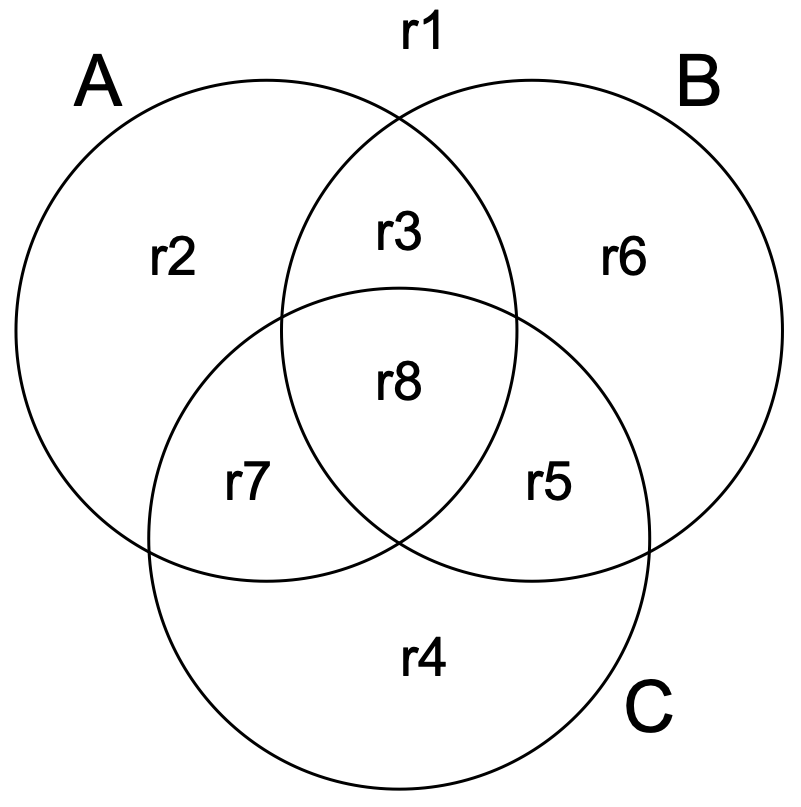
- Monotonicity, for example:
- A ⇒ C = (r7 + r8)/(r2 + r3 + r7 + r8)
- A&B ⇒ C = r8/(r3 + r8)
- FindInstance[
- (r7 + r8)/(r2 + r3 + r7 + r8) = p1 &&
- r8 / (r3 + r8) = c &&
- c < (p1 − 0) &&
- r1 + r2 + r3 + r4 + r5 + r6 + r7 + r8 = 1.0 &&
- r1 ≥ 0 && r2 ≥ 0 && r3 ≥ 0 && r4 ≥ 0 && r5 ≥ 0 && r6 ≥ 0 && r7 ≥ 0 && r8 ≥ 0,
- {r1, r2, r3, r4, r5, r6, r7, r8, p1, c}]
- Return: {r1 = 0.5, r2 = 0., r3 = 0.5, r4 = 0., r5 = 0., r6 = 0., r7 = 1., r8 = 0}
- A ⇒ C = (1 + 0)/(0 + 0.5 + 1 + 0) = 1/1.5 = 0.666667
- A&B ⇒ C = 0/(0.5 + 0) = 0/0.5 = 0
Arguments with Three Sentence Letters and Two Premises
- Restricted Transitivity, for example:
- A ⇒ B = (r3 + r8)/(r2 + r3 + r7 + r8)
- A&B ⇒ C = r8/(r3 + r8)
- So, A ⇒ C = (r7 + r8)/(r2 + r3 + r7 + r8)
- FindInstance[
- (r3 + r8)/(r2 + r3 + r7 + r8) = p1 &&
- r8/(r3 + r8) = p2 &&
- (r7 + r8)/(r2 + r3 + r7 + r8) = c &&
- 1 − c > ((1 − p1) + (1 − p2)) &&
- r1 + r2 + r3 + r4 + r5 + r6 + r7 + r8 = 1.0 &&
- r1 ≥ 0 && r2 ≥ 0 && r3 ≥ 0 && r4 ≥ 0 && r5 ≥ 0 && r6 ≥ 0 && r7 ≥ 0 && r8 ≥ 0,
- {r1, r2, r3, r4, r5, r6, r7, r8, p1, p2, c}]
- Return: {}.
Embedded Conditionals
- The connective ⇒ is not allowed within the scope of &, v, ~ or another ⇒. Yet indicative conditionals in English occur within the scope of and, or, false or another if. For example:
- Your’e damned if you do and damned if you don’t.
- It’s false that if you turn the key the door will open.
- He’s eligible to be president if and only if he’s at least 35 and a natural-born citizen.
- If you’re a natural-born citizen then, if you’re at least 35, you’re eligible to be president.
- It’s true either that if you cut the red wire an alarm goes off or if you cut the blue wire the alarm is disabled.
- But such sentences can often be translated into Probability Logic nonetheless.
- Your’e damned if you do and damned if you don’t.
- You do ⇒ your’e damned
- You don’t ⇒ your’e damned.
- It’s false that if you turn the key the door will open.
- You turn the key ⇒ the door won’t open.
- He’s eligible to be president if and only if he’s at least 35 and a natural-born citizen.
- He’s at least 35 and a natural-born citizen ⇒ he’s eligible to be president.
- He’s eligible to be president ⇒ he’s at least 35 and a natural-born citizen.
- If you’re a natural-born citizen then, if you’re at least 35, you’re eligible to be president.
- You’re a natural-born citizen & you’re at least 35 ⇒ you’re eligible to be president.
- Your’e damned if you do and damned if you don’t.
- But not always, apparently:
- It’s true either that if you cut the red wire an alarm goes off or if you cut the blue wire the alarm is disabled.
- (R ⇒ A) or (B ⇒ D)?
- It’s true either that if you cut the red wire an alarm goes off or if you cut the blue wire the alarm is disabled.
Links
- Indicative Conditionals, Dorothy Edgington
- The Logic of Conditionals, Paul Egré and Hans Rott
- Probability Logic, Lorenz Demey, Barteld Kooi and Joshua Sack
- Counterfactuals, Willow Starr and Alex Kocurek
Adams’ Bibliography
- 1965. “A Logic of Conditionals”, Inquiry, 8: 166–97.
- 1966. “Probability and the Logic of Conditionals”, in J. Hintikka and P. Suppes (eds.), Aspects of Inductive Logic, Amsterdam: North Holland, pp. 256–316.
- 1970. “Subjunctive and Indicative Conditionals”, Foundations of Language, 6: 89–94.
- 1975. The Logic of Conditionals, Dordrecht: Reidel.
- 1998. A Primer of Probability Logic, Stanford: CSLI Publications.
- Available in Kindle.

