Outline
- Probability Theory
- Seven Problems
- Conditional Probability
- Probability Rules
- Probability Tools
- Bayes Theorem
- Random Variables and Probability Distributions
- Law of Large Numbers
- Central Limit Theorem
- Mendel’s Theory of Heredity
- Epistemic Probability
- Evidential Arguments
- Axioms, Definitions, Theorems
- Theorems for Venn Diagrams
Probability Theory
- Probability Theory is the formal theory of probability, applicable to both objective and epistemic probability.
- Objective (or physical) probability is the kind of probability supported or refuted by relative frequencies. The kind used in statements such as:
- The probability of rolling a seven with two dice is 1/6.
- If both parent pea plants have yellow-green alleles for seed color, the probability that a child plant has yellow peas is 3/4.
- The probability that a free neutron decays within 611 seconds is 1/2.
- Epistemic (or evidential) probability is the kind of probability relative to evidence. The kind used in statements such as:
- The Tunguska Event of 1908 was most likely caused by a meteor.
- The probability of rain tomorrow is 90 percent.
- It’s very likely the defendant is guilty based on the evidence presented at trial.
- In Statistics, Bayesians use probability theory to calculate epistemic probabilities; Classical Statisticians (Frequentists) use probability theory to calculate objective probabilities.
- Objective (or physical) probability is the kind of probability supported or refuted by relative frequencies. The kind used in statements such as:
- Developed in 1654 by French mathematicians Pierre de Fermat and Blaise Pascal, Probability Theory is used in physics, genetics, statistics, the social sciences, decision theory, investment analysis, actuarial forecasting, risk assessment, and blocking spam.
- These pages set forth basic probability theory by solving seven problems of increasing difficulty. The last is the infamous Monty Hall problem, gotten wrong by hundreds of PhDs.
Seven Problems
- Aces and Hearts
- What’s the probability of randomly picking the ace of hearts from a standard deck of 52 cards?
- Also, what are the probabilities of selecting an ace, a heart, an ace or a heart, neither ace nor heart, a red or black card, a black heart?
- View Aces and Hearts
- Flipping Coins
- A normal coin is randomly flipped three times in a row; what’s the probability of three heads?
- Three coins are tossed simultaneously; what’s the probability of three heads?
- View Flipping Coins
- With and Without Replacement
- Three cards are randomly selected from a standard deck. What’s the probability they’re all hearts given that the cards are selected:
- Consecutively with replacement
- Consecutively without replacement
- Simultaneously
- View With and Without Replacement
- Three cards are randomly selected from a standard deck. What’s the probability they’re all hearts given that the cards are selected:
- Sixes
- Three dice are tossed. What’s the probability of rolling:
- Three sixes
- At least one six
- Exactly one six
- View Sixes
- Three dice are tossed. What’s the probability of rolling:
- Cell Phones and Day Packs
- Among 1,000 students 400 have cell phones (C), 300 daypacks (D), and 350 neither. What are the following probabilities for a randomly selected student: P(C&D), P(~C&~D), P(C), P(D), P(CvD), P(~C), P(D|C), P(C|D).
- View Cell Phones and Day Packs
- Random Drug Test
- You’re given a random drug test that’s 95 percent reliable, meaning 95 percent of drug users test positive and 95 percent of non-drug users test negative. Assume five percent of the population takes drugs. You test positive. What’s the probability you use drugs?
- View Random Drug Test
- Monty Hall
- You’re a contestant on a game show and asked to choose one of three closed doors. Behind one door is the car of your dreams; behind the others, goats. You pick a door, Door 1, say, and the host, knowing what’s behind each door, opens one of the other doors, Door 3 for example, revealing a goat. (He always opens a door with a goat.) He then gives you the option of changing your selection to Door 2. Do you have a better chance of winning if you switch; or are the odds the same?
- View Monty Hall
Conditional Probability
- Conditional probability is the probability of something given that something else is the case.
- Notation
- “P(….. | —–) = n” means that the probability that ….. given that —– equals n.
- The probability of randomly drawing a King from a standard deck of 52 cards is 4/52 = 1/13
- That is, P(King) = 1/13
- But the probability of drawing a King given that the card is a Face Card is 1/3, since there are 4 Kings and 12 Face Cards.
- That is, P(King | Face Card) = 1/3, where “|” means “given that.”
- The formal definition of conditional probability is
- P(A|B) = P(A&B) / P(B), where P(B) > 0
- Thus, P(King | Face Card) = P(King & Face Card) / P(Face Card) = (4/52) / (12/52) = 4/12 = 1/3.
- P(A|B) is not P(B|A)
- P(King | Face Card) = 1/3
- But P(Face Card | King) = 1
Probability Rules
Probability Tools
- Calculators
- Natural Frequencies
- Possibility Trees
- Possibility Tables
- Probability Rules
- All Problems
- Probability Trees
- Probability Tables
- Venn Diagrams
Bayes Theorem
- The core idea of Bayes Theorem is that the probability of a hypothesis given the evidence is, in part, a function of the probability of the evidence given the hypothesis.
- View Bayes Theorem
Random Variables and Probability Distributions
View Random Variables and Probability Distributions
Law of Large Numbers
- The Law of Large Numbers says that, in the long run, the probability of an event equals the frequency of its occurrence.
- View Law of Large Numbers
Central Limit Theorem
- The Central Limit Theorem says that probabilities for the sum or average of a decent number of repeated events form a normal, bell-shaped curve.
- View Central Limit Theorem
Mendel’s Theory of Heredity
- Mendel’s Theory uses probability theory to make predictions.
- View Mendel’s Theory of Heredity
Epistemic Probability
- The epistemic probability of a proposition is how much it’s supported by the evidence and arguments.
- View Epistemic Probability
Evidential Arguments
- An evidential argument is an argument whose premises are evidence making its conclusion probable.
- View Evidential Arguments
Axioms, Definitions, Theorems
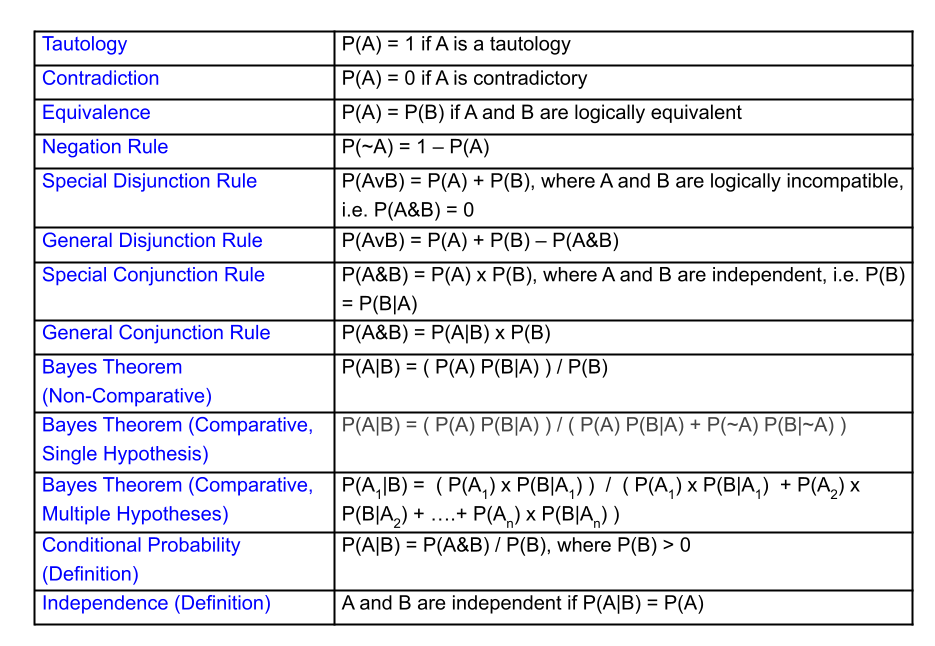
- Tautology
- If A is a tautology, P(A) = 1
- Status: Axiom
- Equivalence
- If A and B are logically equivalent, P(A) = P(B)
- Status: Axiom
- Special Disjunctive Rule
- P(A∨B) = P(A) + P(B), where A and B are logically incompatible
- Status: Axiom
- Contradiction
- If A is a contradiction, P(A) = 0
- Status: Theorem
- Derivation
- Let B be a tautology and A any contradiction. Then:
- P(B) = 1
- Tautology
- Since A v B follows from B, A v B is also a tautology. Therefore:
- P(A v B) = 1
- Tautology
- P(A) + P(B) = 1
- Special Disjunctive Rule
- P(A) + 1 = 1
- Since P(B) = 1
- P(A) = 0
- Subtract 1 from both sides
- Derivation
- Negation Rule
- P(~A) = 1 – P(A)
- Status: Theorem
- Derivation
- P(A v ~A) = 1
- Tautology
- P(A) + P(~A) = 1
- Special Disjunctive Rule
- P(~A) = 1 – P(A)
- Subtract P(~A) from both sides
- P(A v ~A) = 1
- Derivation
- General Disjunctive Rule
- P(A v B) = P(A) + P(B) – P(A&B)
- Status: Theorem
- Derivation
- P(A) = P(A&B) + P(A&~B)
- Equivalence
- P(B) = P(A&B) + P(~A&B)
- Equivalence
- P(A) + P(B) = 2 P(A&B) + P(A&~B) + P(~A&B)
- Add the two equations
- P(A) + P(B) – P(A&B) = P(A&B) + P(A&~B) + P(~A&B)
- Subtract P(A&B) from both sides
- P(A) + P(B) – P(A&B) = P(A v B)
- Equivalence
- A v B is equivalent to A&B v A&~B v ~A&B
- Equivalence
- P(A) = P(A&B) + P(A&~B)
- Derivation
- Conditional Probability
- P(A|B) =df P(A&B) / P(B), where P(B) > 0
- Status: Definition
- Independence
- A and B are independent =df P(A|B) = P(A)
- Status: Definition
- General Conjunction Rule
- P(A&B) = P(A|B) x P(B)
- Status: Theorem
- Derivation
- P(A|B) = P(A&B) / P(B)
- Conditional Probability
- P(A&B) = P(A|B) x P(B)
- Multiply both sides by P(B)
- P(A|B) = P(A&B) / P(B)
- Derivation
- Special Conjunction Rule
- P(A&B) = P(A) x P(B), if A and B are independent
- Status: Theorem
- Derivation
- P(A&B) = P(A|B) x P(B)
- General Conjunction Rule
- P(A&B) = P(A) x P(B)
- Independence
- P(A&B) = P(A|B) x P(B)
- Derivation
- Bayes Theorem (Non-Comparative Form)
- P(A|B) = P(A) P(B|A) / P(B)
- Status: Theorem
- Derivation
- P(A|B) = P(A&B) / P(B)
- Conditional Probability
- P(A|B) = P(A) P(B|A) / P(B)
- General Conjunction Rule
- P(A|B) = P(A&B) / P(B)
- Derivation
- Bayes Theorem (Comparative Form, Single Hypothesis)
- P(A|B) = P(A) P(B|A) /( P(A) P(B|A) + P(~A) P(B|~A) )
- Status: Theorem
- Derivation
- P(A|B) = P(A&B) / P(B)
- Conditional Probability
- P(A|B) = P(A&B) / P((B&A) v (B&~A))
- Equivalence
- B is logically equivalent to B&A v B&~A
- Equivalence
- P(A|B) = P(A&B) /( P(B&A) + P(B&~A) )
- Special Disjunction Rule
- P(A|B) = P(A) P(B|A) /( P(A) P(B|A) + P(~A) P(B|~A) )
- General Conjunction Rule
- P(A|B) = P(A&B) / P(B)
- Derivation
Theorems for Venn Diagrams
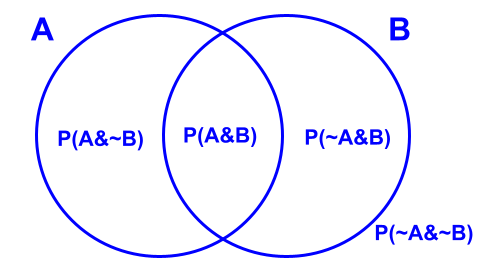
- Theorem for P(A)
- P(A) = P(A&B) + P(A&~B)
- Derivation
- P(A) = P(A&B v A&~B)
- Equivalence
- A is logically equivalent to A&B v A&~B
- Equivalence
- P(A) = P(A&B) + P(A&~B)
- Special Disjunction Rule
- P(A) = P(A&B v A&~B)
- Theorem for P(B)
- P(B) = P(A&B) + P(~A&B)
- Derivation
- P(B) = P(A&B v ~A&B)
- Equivalence
- B is logically equivalent to A&B v ~A&B
- Equivalence
- P(B) = P(A&B) + P(~A&B)
- Special Disjunction Rule
- P(B) = P(A&B v ~A&B)
- Theorem for Venn Diagram Partition of Sample Space
- P(A&B) + P(A&~B) + P(~A&B) + P(~A&~B) = 1
- Derivation
- P(A&B v A&~B v ~A&B v ~A&~B) = 1
- Tautology
- P(A&B) + P(A&~B) + P(~A&B) + P(~A&~B) = 1
- Special Disjunction Rule
- P(A&B v A&~B v ~A&B v ~A&~B) = 1
- Theorem for P(A|B)
- P(A|B) = P(A&B) / (P(A&B) + P(~A&B))
- Derivation
- P(A|B) = P(A&B) / P(B)
- Conditional Probability
- P(B) = P(A&B) + P(~A&B)
- Theorem for P(B)
- P(A|B) = P(A&B) / (P(A&B) + P(~A&B))
- Replace P(B) with P(A&B) + P(~A&B)
- P(A|B) = P(A&B) / P(B)
 A Philosopher's View