Back to Quantum Mechanics
Contents
Classical Physics
- Classical Physics — which comprises Classical Mechanics, Electromagnetism, Thermodynamics, and Statistical Mechanics — has been remarkably successful at explaining and predicting things such as the orbits of the planets, the tides, the existence of Neptune, the diffraction and interference of light, and the existence of electromagnetic waves. But around the beginning of the 20th century Classical Physics was confronted with phenomena for which its predictions were false.
Blackbody Radiation
- A piece of steel heated in a forge becomes red-hot, then orange, then, yellow, and finally white-hot. Classical physics predicts that very hot substances emit a lot ultraviolet radiation. In fact, though, the hotter a substance gets, the less UV radiation it emits. In 1900 Max Planck set forth a hypothesis that correctly predicted the range of radiation emitted by hot bodies: that energy is radiated in discrete packets of energy called quanta. But quantized energy is incompatible with the continuous variables of Classical Physics.
Photoelectric Effect
- Light hitting a metal surface dislodges electrons which then shoot off. According to the wave theory of light of Classical Physics the kinetic energy of the dislodged electrons should be proportional to the intensity of light: the brighter the light, the more energetic the electrons. In fact, though, an electron’s kinetic energy is proportional to the color of the light (i.e. its frequency). In 1905 Einstein explained the photoelectric effect by the radical hypothesis that light consists of packets of energy — photons — whose energy is proportional to the color of its light. Thus higher-frequency bluish photons impart more energy to electrons than lower -frequency reddish photons. The kinetic energy of the dislodged electrons is thus a function of the color (frequency) of the photons hitting them. The intensity of the light affects the number of electrons hit by photons. Like Planck’s hypothesis, Einstein’s hypothesis is incompatible with Classical Physics.
Atomic Model
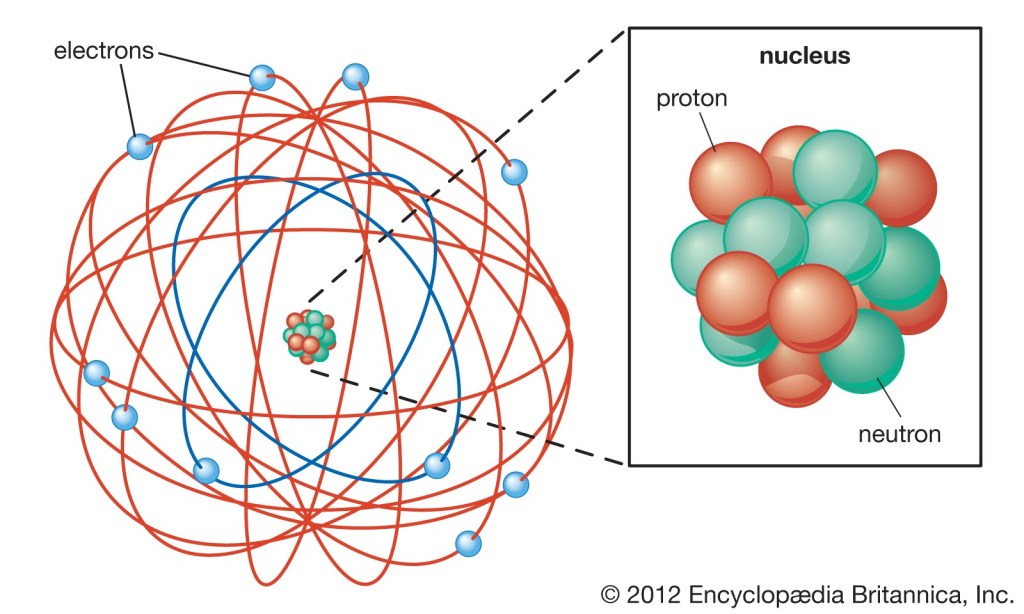
- In 1911 Ernest Rutherford set forth the classic planetary model of the atom in which negatively-charged electrons orbit a heavier positively-charged nucleus, like planets around the Sun.
- But an orbiting electron differs from an orbiting planet in a significant way: the electron has an electric charge. Thus, as the Britannica puts it,
- “The motion of the electrons in the Rutherford model was unstable because, according to classical mechanics and electromagnetic theory, any charged particle moving on a curved path emits electromagnetic radiation; thus, the electrons would lose energy and spiral into the nucleus.”
- Classical Physics thus incorrectly predicts that orbiting electrons spiral into the nucleus.
- Two years later Neils Bohr set forth a non-classical fix to the problem: that electrons move in orbits with different energy levels and emit radiation only when they drop to a lower-energy orbit. Electrons in the lowest-energy orbit, therefore, don’t radiate energy and don’t spiral into the nucleus.
Quantum Mechanics
- So you might think that Classical Physics could be fixed by somehow “quantizing” it. As it turned out, the solution was much more radical.
 A Philosopher's View