An argument is an instance of reasoning, from premises
to a conclusion
Outline
- Arguments
- Examples
- Argument Reconstruction
- Kinds of Arguments / Support
- Evaluating Arguments
- Addendum
Arguments
- People infer things. They investigate matters and draw conclusions. They deliberate and make decisions. They give reasons for their opinions. They justify their decisions. They establish claims. They refute claims. They explain why things are true. They persuade people. They engage in argumentation.
- All these activities involve arguments.
- An argument is an instance of reasoning, from premises to a conclusion.
- Arguments are typically set forth to establish their conclusions.

Examples
- The core of the Declaration of Independence is the following argument:
- The people have the right to alter or abolish a government if it violates basic human rights such as the rights to life, liberty and the pursuit of happiness.
- The British government of the colonies has violated those rights.
- Therefore the American people have a right to alter or abolish the British government of the colonies.
- Before he flew a kite in a thunderstorm, Benjamin Franklin presented an argument that lightning was electrical in nature.
- Lightning and sparks are alike in the following respects:
- 1. Giving light, 2. Color of the light, 3. Crooked direction, 4. Swift motion, 5. Being conducted by metals, 6. Crack or noise in exploding, 7. Subsisting in water or ice, 8. Rending bodies it passes through, 9. Destroying animals, 10. Melting metals, 11. Firing inflammable substances, 12. Sulphureous smell
- A spark is electrical in nature.
- Therefore, lightning is likely electrical in nature.
- “Let the experiment be made.”
- Lightning and sparks are alike in the following respects:
- The New York Times presented this argument against capital punishment:
- Fallible governments should refrain from inflicting irreversible punishments
- Capital punishment is irreversible.
- Governments are fallible.
- Therefore, governments should refrain from inflicting capital punishment.
- Hypothesis testing is one kind of statistical inference.
- In a blind taste test, a wine connoisseur, who claims she can taste the difference between French and California Cabernets, correctly identified 15 out of 20 glasses of the wines.
- The probability she correctly identified at least 15 out of 20 glasses by chance is 1/50. (In statistical jargon, the p-value = 1/50.)
- Therefore, she can probably taste the difference between French and California Cabernets.
- The Britannica is an authoritative source.
- In its article on swans the Britannica says there are black swans in Australia.
- The Britannica is a reliable source of information.
- Therefore, black swans exist.
Argument Reconstruction
Real-life Arguments and Arguments in Premise-conclusion Form
- Compare the statements:
- John Oliver is not eligible to be president.
- John Oliver is not eligible to be president because only natural-born U.S. citizens are eligible.
- The first makes the claim that John Oliver isn’t eligible to be president.
- The second puts forth an argument for that claim:
- Only natural-born U.S. citizens are eligible to be president.
- John Oliver isn’t a natural-born U.S. citizen.
- Therefore, he’s not eligible to be president.
- Statements 1 and 2 are the premises of the argument.
- Statement 3 is the conclusion.
- The argument so stated is in premise-conclusion (or canonical) form.
- The five examples of arguments above are in premise-conclusion form.
- Nowhere in the Declaration of Independence, for example, will you find the words:
- The people have the right to alter or abolish a government if it violates basic human rights such as the rights to life, liberty and the pursuit of happiness.
- The British government of the colonies has violated those rights.
- Therefore the American people have a right to alter or abolish the British government of the colonies.
- Rather, the argument in premise-conclusion was “reconstructed” from the text of the Declaration.
- Nowhere in the Declaration of Independence, for example, will you find the words:
- Argument Reconstruction is the process of restating a real-life (naturally-occurring) argument so its premises, conclusion, and reasoning are clear.
View page on Argument Reconstruction
Kinds of Arguments
- Arguments consist of premises, a conclusion, and some kind of reasoning that gets you from one to the other.
- Arguments use different kinds of reasoning, different ways that premises support conclusions.
- There are three main kinds of argument:
- Deductive
- Evidential (Inductive)
- Normative
- And two secondary kinds of argument:
- Analogical
- Defeasible
Deductive Arguments
- A deductive argument is an argument whose conclusion (purportedly) follows necessarily from its premises.
- The word purportedly allows for invalid deductive arguments.

- Examples of deductive arguments are the Declaration of Independence and John Oliver arguments above.
View page on Deductive Arguments
Evidential (Inductive) Arguments
- An evidential argument is an argument whose premises are evidence (purportedly) making its conclusion probable.
- Purportedly allows for bad evidential arguments.

- Examples are the Blind Taste Test and Black Swan arguments above.
View page on Evidential Arguments
Normative Arguments
- A normative argument is an argument whose premises (purportedly) constitute a reason why a particular action should (or shouldn’t) be done.

- An example is the New York Times argument against capital punishment above.
View page on Normative Arguments
Analogical Arguments
- An analogical argument is an argument that, because things are alike in certain respects, they are therefore (purportedly) alike in a further respect.

- An example is Benjamin Franklin’s argument that lightning is an electrical discharge.
View page on Analogical Arguments
Defeasible Arguments
- A defeasible argument is an argument whose premises (purportedly) support its conclusion other things being equal (and which support can therefore be “defeated” by additional information).

- An example is the Black Swan argument above:
- It’s reasonable to believe there are black swans because the Britannica is reliable. But reliability is not infallibility. The argument would be nullified if, for example, it were discovered that black swans are not really swans but a different species.
View page on Defeasible Arguments
Evaluating Arguments
- Evaluating an argument means determining whether the argument establishes its conclusion, other things being equal.
- “Establish” typically means to prove beyond a reasonable beyond.
- The reason for keeping other things equal is that there may be arguments on both sides of an issue and, before making a final judgment, all the arguments need to be considered. The NY Times argument against capital punishment, for example, may be a good argument in its own right. But before making a final determination on whether “governments should refrain from inflicting capital punishment,” arguments for capital punishment need to be looked at, e.g. arguments based on retributive justice, deterrence, and incapacitation.
- Evaluating an argument involves three steps:
- Reconstructing the argument so its premises, conclusion, and logic (reasoning) are clear.
- Determining whether the premises are true.
- Determining whether the argument’s logic is any good.
Addendum
- Argument Pages
- Awareness of Arguments
- Facts don’t speak for themselves
- When it’s not clear what a person’s argument is
- Ubiquity of Arguments
- Pitfalls of Reasoning
- Obsolete Classification of Arguments
- Exercises: Do these arguments establish their conclusions?
Argument Pages
- Analogical Arguments
- Argument Reconstruction
- Deductive Arguments
- Defeasible Arguments
- Evidential Arguments
- Epistemic Probability
- Logic
- Logical Equivalences among Why, Because, Reason, Therefore, Explain
- Logical Modailities
- Normative Arguments
- Pitfalls of Reasoning
Awareness of Arguments
- Though everyone uses arguments, awareness of arguments varies.
- Philosophers, judges, lawyers, mathematicians, and scientists are especially aware of arguments.
- Philosophers investigate issues by means of rational argument.
- Judges set forth arguments in judicial opinions.
- Lawyers present arguments in lawsuits, briefs, and arguments at trial.
- Mathematicians construct proofs — very, very long arguments.
- Scientific theories are supported or refuted by predictions derived from their postulates.
- Thinkers during the Enlightenment were keenly aware of arguments. It’s not surprising that the Declaration of Independence is framed as one long argument, having been written by one of the leaders of the Enlightenment in America.
Facts don’t speak for themselves
- Facts sometimes speak. But when they do, they speak, not for themselves, but as premises of an argument. For example, the argument that John Oliver can’t be president (above) can be put forth by stating two facts:
- Only natural-born U.S. citizens are eligible to be president.
- John Oliver isn’t a natural-born U.S. citizen.
- The obvious inference is that John Oliver isn’t eligible to be president.
- But merely listing sundry facts can result in either a bad argument or puzzlement about what the point is.
- Example:
- Here are the facts: When Biden was inaugurated on January 20, 2021 inflation was increasing at the rate of 1.7%. In June 2022 that figure was 9%.
- What conclusion is supposed to be drawn? That inflation has increased? That Biden’s policies are responsible for the increase?. If the latter, the argument is fallacious, an instance of Post Hoc Ergo Propter Hoc.
- The takeaway:
- When facts speak they do so, not for themselves, but as premises of an argument. When someone merely lists facts, the question should be:
- And what conclusion should we draw from these facts of yours?
- When facts speak they do so, not for themselves, but as premises of an argument. When someone merely lists facts, the question should be:
When it’s not clear what a person’s argument is
- Sometimes in a discussion it’s not clear what a person’s argument is. Clarence Thomas has an interesting method for eliciting arguments.
- The Supreme Court was hearing oral arguments in the case of CFPB v. Community Financial Services.
- Noel Francisco, arguing for the plaintiffs, maintained that how the CFPB is funded violates the Appropriations Clause of the Constitution.
- The justices had a hard time understanding his argument.
- Justice Sonia Sotomayor said, “I’m trying to understand your argument, and I’m at a total loss.”
- Finally, Clarence Thomas asked Francisco to “complete this sentence: Funding of the CFPB violates the Appropriations Clause because …?”
- Francisco replied “Because Congress has not determined the amount that this agency should be spending.”
Ubiquity of Arguments
- People infer things. They investigate matters and draw conclusions. They deliberate and make decisions. They give reasons for their opinions. They justify their decisions. They establish claims. They refute claims. They explain why things are true. They persuade people. They engage in argumentation.
- All these activities involve arguments.
Inferring Things
- A person infers there are black swans after reading in the Britannica that there are black swans in Australia.
- Argument
- The Britannica says there are black swans.
- The Britannica is a reliable source of information.
- Therefore, there are black swans.
Investigating Matters and Drawing Conclusions
- Special Counsel Robert Mueller investigated Russian interference in the 2016 presidential election. In the process he found evidence of ten alleged instances of obstruction of justice by Donald Trump. One of these is that he directed Don McGahn to tell the Acting Attorney General to remove the Special Counsel.
- Mueller’s argument that Trump obstructed justice from the Mueller Report:
- A person obstructs justice if he/she does something with the specific intent to influence, obstruct, or impede a judicial proceeding.
- On June 17, 2017 Trump directed Don McGahn to inform the acting Attorney General that the Special Counsel had conflicts of interest and must be removed.
- Trump’s intent in directing McGahn was to influence, obstruct, or impede Mueller’s investigation.
- Therefore, Trump obstructed justice
Deliberating and Deciding Things
- In Dobbs v. Jackson Women’s Health Organization the Supreme Court held that there is no constitutional right to abortion and thus overturned Roe and Casey
- Argument there is no constitutional right to abortion.
- There is a constitutional right to abortion only if at least one of the following conditions is true:
- the Constitution explicitly states that there is a right to abortion.
- the right can be inferred from certain constitutional provisions, e.g. the Due Process Clause of the Fourteenth Amendment.
- the right is included in a broader constitutional right, e.g. the right to privacy.
- None of these conditions is satisfied.
- Therefore, there is no constitutional right to abortion
- There is a constitutional right to abortion only if at least one of the following conditions is true:
- Argument that Roe v. Wade should be overturned.
- A Supreme Court decision that’s wrongly decided should be overturned.
- Roe and Casey were wrongly decided.
- Therefore they should be overturned,
Justifying a Decision
- The Bush administration justified its invasion of Iraq on the grounds that Iraq’s WMD’s posed a threat to the United State.
- Argument
- The US had clear and convincing evidence that Iraq possessed chemical and biological WMDs that might be used against it.
- A country is justified in launching a war against another country if it has clear and convincing evidence that the other country possesses WMDs that might be used against it.
- Therefore the US was justified in launching war against Iraq
Giving Reasons for an Opinion
- The last paragraph of a New York Times editorial.
- “Death is the only final and irreversible criminal punishment. As the Richardson and Adams cases vividly show, humans and their governments are fallible and corruptible. Prudent humility dictates that fallible people refrain from inflicting irreversible punishments.”
- Argument
- Fallible governments should refrain from inflicting irreversible punishments
- Capital punishment is irreversible.
- Governments are fallible.
- Therefore, governments should refrain from inflicting capital punishment.
Establishing that something is true
- Conversation between Lucas and Mia:
- Lucas: Did you know that John Oliver is eligible to be president, since he’s an American citizen?
- Mia: As a matter of fact he’s not eligible. He’s not a natural-born U.S. citizen
- Mia’s Argument
- Only natural-born U.S. citizens are eligible to be president.
- John Oliver isn’t a natural-born U.S. citizen.
- Therefore, he’s not eligible to be president.
Explaining why something is true
- Second conversation between Lucas and Mia:
- Lucas: I understand John Oliver is not eligible to be president. Do you know why?
- Mia: Yes. Only natural-born U.S. citizens are eligible to be president.
- In this case the premises of the argument explain the conclusion.
- That John Oliver isn’t a natural-born U.S. citizen and that only natural-born U.S. citizens are eligible to be president are why he’s not eligible to be president.
- They explain his ineligibility.
- They are the reason he’s ineligible.
- He’s not eligible because he’s not a natural-born U.S. citizen and only natural-born U.S. citizens are eligible.
- That John Oliver isn’t a natural-born U.S. citizen and that only natural-born U.S. citizens are eligible to be president are why he’s not eligible to be president.
- View Logical Equivalences among Why, Because, Reason, Therefore, Explain
Pitfalls of Reasoning
- Anomalies of Language
- Artifices of Deception and Distraction
- Bias
- Conspiracy Theories
- Disinformation
- Fallacies
- Fooled by Statistics
- Why People Believe Irrational Things
Obsolete Classification of Arguments
- 1911 Encyclopedia Britannica
- Analogical Inference, from particular to particular: e.g. border-war between Thebes and Phocis is evil; border-war between Thebes and Athens is similar to that between Thebes and Phocis; therefore, border-war between Thebes and Athens is evil.
- Inductive Inference, from particular to universal: e.g. border-war between Thebes and Phocis is evil; all border-war is like that between Thebes and Phocis; therefore, all border-war is evil.
- Deductive or Syllogistic Inference, from universal to particular, e.g. all border-war is evil; border-war between Thebes and Athens is border-war; therefore border-war between Thebes and Athens is evil.
- Deductive inference is today understood to be inference to a conclusion that purports to be a necessary consequence of the premises.
- Analogical inference is not simply an inference from particular to particular. There have to be resemblances among the particulars.
- In an older but still used sense of the word, “induction” means inference from the particular to the general. But today it is also used to mean inference to a probable conclusion.
Exercises: Do these arguments establish their conclusions?
- False Statements to FBI (Answer)
- On July 2, 2016 Hillary Clinton was interviewed for over three hours at the FBI headquarters regarding her private email server.
- In a congressional hearing on July 7, 2016 James Comey said that Clinton made six false statements during the interview.
- According to 18 U.S. Code § 1001:
- Whoever, in any matter within the jurisdiction of the executive, legislative, or judicial branch of the Government of the United States, knowingly and willfully makes any materially false, fictitious, or fraudulent statement or representation shall be fined under this title or imprisoned not more than 5 years.
- Therefore Hillary Clinton violated 18 U.S. Code § 1001.
- John Oliver (Answer)
- John Oliver isn’t eligible to be president because he’s not a natural-born U.S. citizen.
- Invasion of Iraq was not Justified (Answer)
- Had Saddam Hussein been responsible for the 9/11 attacks, the U.S. invasion of Iraq would have been morally justified.
- But Hussein was not responsible for the 9/11 attacks.
- Therefore, the U.S. invasion of Iraq was not justified.
- Abortion (Answer)
- Abortion should be legal because abortions will be performed whether legal or not.
- Random Drug Test (Answer)
- You’re given a random drug test that’s 95 percent reliable, meaning 95 percent of drug users test positive and 95 percent of non-drug users test negative.
- You test positive.
- Therefore, there’s a 95 percent probability you’re a drug user.
- Bible not Word of God (Answer)
- The Bible says that Jesus of Nazareth was crucified about 9:00 AM the day after Passover (Mark 14:12; 15:25).
- The Bible also says that Jesus was crucified about noon the day before Passover (John 19:14).
- Both statements can’t be true.
- If the Bible is the inerrant word of God, everything the Bible says is true.
- Therefore the Bible is not the inerrant word of God.
- Smoking Pot (Answer)
- Most heroin addicts first smoked pot.
- So, if you smoke pot you’re more likely to become addicted to heroin than if you don’t
- Active and Passive Euthanasia (Answer)
- There is no morally relevant difference between killing a person and letting them die.
- It is morally wrong to kill a terminally ill person.
- Therefore, it is morally wrong to let a terminally ill person die.
- Overweight (Answer)
- Most Americans are overweight.
- Therefore, most American children are overweight.
- Kalam Cosmological Argument (Answer)
- Whatever begins to exist has a cause
- The universe began to exist.
- Therefore, the universe has a cause
- If the universe has a cause, an uncaused, personal creator of the universe exists
- Therefore, an uncaused, personal creator of the universe exists.
- Justification for Iraq War (Answer)
- A country is justified in launching a war against another country if it has clear and convincing evidence that the other country possesses weapons of mass destruction that might be used against it.
- The US had clear and convincing evidence that Iraq possessed chemical and biological weapons of mass destruction that might be used against it.
- Therefore the US was justified in launching a war against Iraq.
- Venus (Answer)
- The Morning Star is the planet Venus. The Evening Star is also the planet Venus. So the Morning Star is the Evening Star.
- General Relativity (Answer)
- If Einstein’s general theory is true, then clocks at 30,000 feet run faster than clocks at sea level. Clocks at 30,000 feet do in fact run faster than clocks at sea level. Therefore, Einstein’s general theory is true.
- War on Drugs (Answer)
- If Prohibition had succeeded in the 1920s, the War on Drugs will succeed. But Prohibition failed. Therefore, so will the War on Drugs.
- Hume’s Argument against Miracles (Answer)
- Testimony establishes a miracle only if the falsehood of the testimony would be more unlikely than the miracle itself.
- The falsehood of the testimony of a miracle is always more likely than the miracle itself.
- Therefore testimony never establishes that a miracle has occurred.
- Capital Punishment (Answer)
- “Death is the only final and irreversible criminal punishment. As DNA exonerations vividly show, humans and their governments are fallible and corruptible. Fallible governments should refrain from inflicting irreversible punishments.” (NY Times)
- Fetal Homicide (Answer)
- After her pregnancy ended in the stillbirth of an 8 1/2 month old fetus, Chelsea Becker was charged with murder because toxic levels of methamphetamine were found in the fetus’s system and she admitted using methamphetamines during her pregnancy. California defines murder as “the unlawful killing of a human being, or a fetus, with malice aforethought.” But the statute does not apply if “the act was solicited, aided, abetted, or consented to by the mother of the fetus.” As California’s attorney general observed, “a woman necessarily consents to an act that she herself voluntarily undertakes, free of fraud, duress, or mistake.”
- Most US citizens were not born in the US (Answer)
- Most US citizens speak English.
- Most people who speak English were not born in the US.
- Britannica: As of 2020 there are 1.27 billion English speakers around the world
- Therefore, most US citizens were not born in the US.
- Argument that 1 = 0.9999999…(ad infinitum) (Answer)
- ⅓ = 0.3333333…(ad infinitum)
- self-evident
- Therefore, 3 x ⅓ = 3 x 0.3333333…
- multiplying both sides of line #1 by 3
- 1 = 3 x ⅓
- self-evident
- 3 x 0.3333333… = 0.9999999…
- self-evident
- Therefore, 1 = 0.9999999…
- from lines #2, #3, and #4
- ⅓ = 0.3333333…(ad infinitum)
- Arguments against Impeachment Article I (Answers)
- Article I, paraphrased
- Trump tried to extort Ukraine into announcing investigations into:
- the Bidens,
- an unsubstantiated theory involving a DNC server
- by withholding military aid and promising a White House visit.
- Trump tried to extort Ukraine into announcing investigations into:
- Arguments against Article I from the White House Trial Brief
- The military aid flowed on September 11, 2019, and a presidential meeting was scheduled for September 1 and then took place on September 25, 2019, all without the Ukrainian government having done anything about investigations. (WH Brief, page 9)
- Asking another country to examine potential interference in a past U.S. election is always permissible. (WH Brief, page 81)
- An impeachable act must violate the law. Trump violated no law. (WH Brief, page 1)
- Article I, paraphrased
- Ted Cruz (Answer)
- Ted Cruz is not eligible to president. Born in Canada, he’s not a natural-born US citizen.
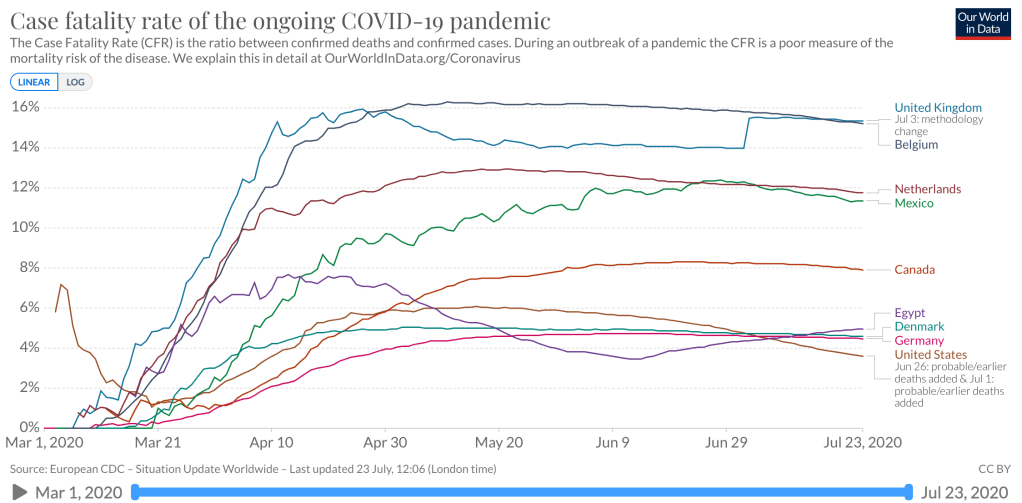
- Case Fatality Rate (Answer)
- The US has the lowest case fatality rate in the world. Here’s the proof:
 A Philosopher's View