An inductive argument is an argument whose conclusion is probable based on its premises
Outline
Inductive Arguments
- An inductive argument is an argument whose conclusion is (purportedly) probable to a certain degree based on its premises.
- “Probable” is used in the sense of epistemic probability, the kind of probability relative to evidence and expressed by locutions such as:
- it is certain that, it is beyond a reasonable doubt that, it is likely that, it is doubtful that, it is impossible that.
- View Epistemic Probability
- “Purportedly” allows for bad inductive arguments.
- “Probable” is used in the sense of epistemic probability, the kind of probability relative to evidence and expressed by locutions such as:

- (The word “induction” has two senses. In its older sense, which goes back to Aristotle, induction means inference from the particular to the general. As used by contemporary logicians, however, induction means probable reasoning. View Two Senses of Induction.)
Common Kinds of Inductive Arguments
- Reliability Arguments
- A reliability argument is an argument whose conclusion is probable because it’s the output of a reliable process process.
- Explanatory Arguments
- An explanatory argument is an argument whose conclusion is probable because it explains and predicts the evidence.
- Analogical Inductive Arguments
- An analogical inductive argument is an argument whose conclusion is probable because the subject of its conclusion is analogous to the subject of its premises.
Reliability Arguments
A reliability argument is an argument whose conclusion is probable because it’s the output of a reliable process process.
A process can be a mechanism, procedure, practice, device, or naturally occurring regularity.
- Testimony
- The Britannica says black swans exist. So black swans exist
- The Britannica says black swans exist.
- The Britannica is a reliable source of information.
- Therefore, black swans exist
- The Britannica says black swans exist. So black swans exist
- Perception
- The napkin appeared green to Matty. Therefore Matty saw a green napkin.
- The napkin appeared green to Matty
- Visual perception is reliable.
- Therefore Matty saw a green napkin.
- The napkin appeared green to Matty. Therefore Matty saw a green napkin.
- Memory
- Allen talked to Evan at the party because he remembers talking to him.
- Allen remembers talking to Evan at the party
- Remembering P is reliable evidence that P is true.
- So, Allen talked to Evan at the party
- Allen talked to Evan at the party because he remembers talking to him.
- Natural Phenomena
- Luke is exhibiting pain behavior. So he’s in pain
- Luke is exhibiting pain behavior.
- Pain behavior is reliable evidence of being in pain.
- So he’s in pain
- Luke is exhibiting pain behavior. So he’s in pain
- Mechanism
- It’s 3:00.
- My watch says 3:00.
- My watch is reliable.
- Therefore, it’s 3:00.
- It’s 3:00.
- Economic Forecast
- The Congressional Budget Office forecasts that real GDP growth will be under 2% next year. So, real GDP growth will be under 2% next year.
- The CBO forecasts that real GDP growth will be under 2% next year.
- The CBO’s forecasts of GDP are reliable.
- Therefore, real GDP growth will be under 2% next year.
- The Congressional Budget Office forecasts that real GDP growth will be under 2% next year. So, real GDP growth will be under 2% next year.
- Forensic Method
- The crime lab matched the left index fingerprint on the murder weapon to the suspect’s. So the suspect’s left index finger came in contact with the murder weapon.
- The crime lab matched the left index fingerprint on the murder weapon to the suspect’s.
- A fingerprint match is reliable evidence that the fingerprints are of the same person.
- Therefore the suspect’s left index finger came in contact with the murder weapon.
- The crime lab matched the left index fingerprint on the murder weapon to the suspect’s. So the suspect’s left index finger came in contact with the murder weapon.
Hume’s Argument on Miracles
- In his essay on miracles, David Hume argues that the improbability of a miracle always outweighs the reliability of a report of the miracle’s occurrence.
- View Hume’s Argument on Miracles
Explanatory Arguments
An explanatory argument is an argument whose conclusion is probable because it explains and predicts the evidence.
The principle underlying explanatory arguments is Bayes’ Theorem.
- The simplest example of Bayes’ Theorem:
- Two coins are on a table, both heads up. One is a regular coin, the other is double-headed. You don’t know which is which. You randomly select one of the coins and, without looking, flip it. It lands heads.
- Before flipping, the probability you selected the double-headed coin was 1/2.
- But the coin’s landing heads makes it more likely the coin you selected is double-headed. According to Bayes’ Theorem, the probability is now 2/3. The reason it’s 2/3 rather than 1/2 is that the double-headed hypothesis predicts heads better than the single-sided hypothesis:
- The double-headed hypothesis predicts heads with probability 1.
- The single-headed hypothesis predicts head with probability 1/2.
- View the calculations.
- The idea is simple but profound: the better a theory predicts (or explains) the evidence, the more likely it is.
- Common kinds of explanatory argument:
- Evidence for scientific theories,
- Inference to the best explanation,
- Statistical inference.
Evidence for Scientific Theories
The evidence for a scientific theory consists of the confirmed predictions derived from its postulates.
- For example
- Newton’s Theory of Gravitation (1687)
- Kepler’s Laws of Planetary Motion
- Galileo’s Laws of Motion
- More on the predictions of Newtons’s theory.
- Einstein’s Special Theory of Relativity (1905)
- Relativity of Simultaneity
- Time Dilation
- Length Contraction
- More on the predictions of STR.
- Einstein’s General Theory of Relativity (1915)
- Gravitational Deflection of Light (1919)
- Gravitational Redshift (1959)
- Gravitational Time Delay of Light (1964, 1976)
- Gravitational Time Dilation (1971)
- Gravitational Lensing (1979),
- Frame Dragging and Geodetic Effect (2005),
- Gravity Waves (2015)
- More on predictions of GTR.
- Newton’s Theory of Gravitation (1687)
- What makes these predictions such overwhelming evidence is:
- That the predictions are mathematically precise:
- The prediction of falling bodies is not merely that things pick up speed as they fall but that at sea level on Earth they accelerate at the rate 9.8 meters per second, per second.
- The variety of predicted phenomena:
- Newton’s theory predicts both the orbits of the planets and falling bodies on Earth.
- Einstein’s GTR predicts a wide range of phenomena.
- That what’s sometimes predicted is hitherto unknown phenomena, such as time dilation and gravity waves.
- That the predictions are mathematically precise:
Inference to the Best Explanation (IBE, Abduction)
Inference to the best explanation is inference from the facts to the hypothesis that explains the facts better than competing hypotheses.
- Criminal Investigation
- That McX burgled the Jones residence is the best explanation why his fingerprints were found inside, why a person of his weight and height was seen leaving the house, and why some of stolen property was found in his car.
- Competing hypothesis: someone else burgled the Jones residence.
- Medical Diagnosis
- Measles is the best explanation why the patient has a fever, cough, conjunctivitis, congestion, a blotchy rash, and Koplik spots.
- Competing hypotheses:
- Patient has Covid-19
- Patient has the flu.
- Discovery of Neptune
- The existence of an unobserved planet (Neptune) is the best explanation why the orbit of Uranus diverges from the orbit predicted by Newton’s theory of gravitation.
- Competing hypothesis: Newton’s theory of gravitation is wrong.
- Dead battery
- That the auto battery died of old age is the best explanation why the battery, with an expected lifetime of 5 years, died after five years of use.
- Competing hypotheses:
- Something drained the battery after the car was last driven.
- Bad alternator failed to charge the battery.
- Last 12 verses of Mark
- That the last twelve verses of the Gospel of Mark were not in the original autograph but added later is the best explanation why:
- the verses do not appear in the Codex Vatinicus and Codex Sinaiticus
- the writing style of the last twelve verses doesn’t match the style of the rest of Mark
- there’s an awkward transition from the previous passage.
- Competing hypothesis: The last twelve verses were in the original autograph.
- View more detail.
- That the last twelve verses of the Gospel of Mark were not in the original autograph but added later is the best explanation why:
Statistical Inference
The results of a random poll is evidence that a population parameter P has value V because the hypothesis that P is V predicts the results of the poll (by making the results likely).
- In a random poll of 1,000 Americans 600 approved of X. From which it’s inferred that 60 percent of Americans approve of X.
- The argument:
- P: In a randomly selected sample of 1,000 Americans 600 approved of X.
- C: Therefore, 60 percent of Americans approve of X.
- Conclusion C predicts premise P by predicting that:
- For a random sample of 1,000 Americans, the probability that the proportion of people who approve of X in the sample is given by the normal distribution with mean μ = 0.6 and standard deviation σ = 0.01549.
- This follows from P by virtue of the Central Limit Theorem and the Bernoulli Probability Distribution.
- For a random sample of 1,000 Americans, the probability that the proportion of people who approve of X in the sample is given by the normal distribution with mean μ = 0.6 and standard deviation σ = 0.01549.
- Which in turn predicts that:
- For a random sample of 1,000 Americans, there’s a 95 percent probability that the number of people who approve of X in the sample is between 570 and 630.
- The current sample is in that range.
- Thus, conclusion C predicts premise P.
- Therefore P supports C.
- Competing hypotheses include:
- 57 percent of Americans approve of X, which predicts between 539 and 601 in the sample approve of X
- 59 percent of Americans approve of X, which predicts between 560 and 620 in the sample approve of X
- 61 percent of Americans approve of X, which predicts between 580 and 640 in the sample approve of X
- 63 percent of Americans approve of X, which predicts between 600 and 660 in the sample approve of X.
Analogical Inductive Arguments
An analogical inductive argument is an argument that things are probably alike in a certain respect because they’re are alike in other respects.
- Benjamin Franklin’s Argument that Lightning is Electricity
- Lightning and sparks are alike in the following respects:
- 1. Giving light, 2. Color of the light, 3. Crooked direction, 4. Swift motion, 5. Being conducted by metals, 6. Crack or noise in exploding, 7. Subsisting in water or ice, 8. Rending bodies it passes through, 9. Destroying animals, 10. Melting metals, 11. Firing inflammable substances, 12. Sulphureous smell
- A spark is electrical in nature
- Therefore, it’s likely that lightning is electrical in nature.
- Lightning and sparks are alike in the following respects:
- Comparative Market Analysis
- Your house is similar to nearby, recently sold homes in regard to square footage, age, number of bedrooms, and number of baths.
- The average sales price of those houses is $250,000.
- Therefore the sales price of your house will be about $250,000.
View page on Analogical Arguments
Evaluating Inductive Arguments
- Argument evaluation is the three step process of argument reconstruction, determining whether the premises are true, and assessing how strongly the premises support the conclusion.
- Considerations in assessing evidential support:
- Reliability arguments:
- Reliability of the process
- Whether the argument is defeated
- For example, Defeated CNN Argument.
- Explanatory arguments:
- Likelihood of hypotheses, i.e. how well the inferred hypothesis explains and predicts the evidence vis-a-vis the competing hypotheses.
- For example, Measles is better than Covid-19 in explaining why the patient has a fever, cough, conjunctivitis, congestion, a blotchy rash, and Koplik spots because Covid-19 doesn’t explain Koplik spots.
- Prior probability of hypotheses, i.e. how likely the inferred hypothesis is, apart from explaining and predicting evidence, vis-a-vis the competing hypotheses.
- For example, Fake Moon Landing.
- Likelihood of hypotheses, i.e. how well the inferred hypothesis explains and predicts the evidence vis-a-vis the competing hypotheses.
- Reliability arguments:
Addendum
- Inductive Arguments are Defeasible
- Solving a Brain Teaser with Bayes’ Theorem
- Two Senses of “Induction”
- Evidence
- Hypothesis Testing
- Last Twelve Verses of Mark
- Defeated CNN Argument
- Fake Moon Landing
Inductive Arguments are Defeasible
- An argument is defeasible if the premises’ support of its conclusion can be defeated by additional premises.
- Unlike deductive arguments, inductive arguments are defeasible.
- Suppose, looking at your watch, you infer it’s 3:00.
- The underlying argument:
- My watch reads 3:00.
- My watch is reliable.
- Therefore, it’s 3:00.
- But the support of the conclusion is nullified if you discover, for example, that your watch has stopped. That is, this argument is no good:
- My watch reads 3:00.
- My watch is reliable.
- My watch has stopped.
- Therefore, it’s 3:00.
- View Defeasibility
Solving a Brain Teaser with Bayes’ Theorem
- Ernie, a Manhattanite, has two girlfriends, one in Brooklyn, the other in the Bronx. He visits one or the other every Saturday, taking the subway. Liking them equally, he lets chance (or fate) decide whom he visits, by showing up at the subway station at a random time on Saturday. The trains on one side of the platform arrive every ten minutes going to the Bronx; those on the other side arrive every ten minutes going to Brooklyn. He takes the first train to arrive, no matter its direction. Curiously, Ernie visits his Brooklyn girlfriend nine times out of ten. How can this be?
Ernie’s Hypothesis
- Ernie’s hypothesis is that the Bronx train arrives one minute after the Brooklyn train.
- The competing hypothesis is that there’s no correlation between the arrival times of the trains.
- The observed fact is that Ernie visits his Brooklyn girlfriend nine times out of ten.
- The argument
- Ernie visits his Brooklyn girlfriend nine times out of ten.
- Ernie’s hypothesis explains and predicts the observed fact far better than the competing hypothesis.
- Ernie’s hypothesis predicts the observed fact:
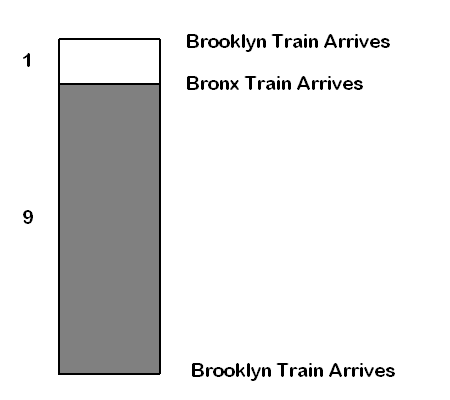
- Since Ernie arrives at the station at random times, the Bronx train arrives first 1/10 of the time and the Brooklyn train 9 times of 10.
- The diagram shows the ten-minute period between arrivals of the Brooklyn train.
- The probability Ernie arrives at the station in the gray time zone is 9/10, for which the Brooklyn train is next to arrive.
- The competing hypothesis predicts that Ernie takes the Brooklyn train half the time.
- Ernie’s hypothesis predicts the observed fact:
- Thus Ernie’s hypothesis is far more likely than the competing hypothesis.
Bayesian Calculation of the Subway Brain Teaser
- In the Subway Brain Teaser:
- The likelihood of the evidence E given Ernie’s hypothesis = 1.0
- The likelihood of the evidence E given the competing hypothesis = 0.5
- where E is the fact that Ernie visits his Brooklyn girlfriend nine out of ten times.
- So, Ernie’s hypothesis is more probable, other things being equal.
- To determine the probabilities of the two hypotheses all things considered we have to factor in their probabilities apart from their predictions of E.
- Bayes Theorem can then be used to calculate what we want to know: the probabilities of the two hypotheses based on
- their predictions of evidence E, and
- the probabilities of the hypotheses apart from their prediction of E.
- To do the calculation we need figures for:
- The likelihood of the evidence E given Ernie’s hypothesis
- The likelihood of the evidence E given the competing hypothesis
- The probability of Ernie’s hypothesis apart from predicting evidence E
- The probability of the competing hypothesis apart from predicting evidence E
- Let’s suppose that the hypotheses are equally likely apart from their prediction of E.
- Then:
- The likelihood of the evidence E given Ernie’s hypothesis = 1.0
- The likelihood of the evidence E given the competing hypothesis = 0.5
- The probability of Ernie’s hypothesis apart from predicting evidence E = 0.5
- The probability of the competing hypothesis apart from predicting evidence E = 0.5
- The result of the calculation is:
- The probability of Ernie’s hypothesis all things considered = 2/3.
- The probability of the competing hypothesis all things considered = 1/3.
- View Bayes Theorem Calculator
- View Bayes Theorem
Two Senses of “Induction”
- Two senses of “Induction:”
- Reasoning from the particular to the general.
- Reasoning from evidence to a probable conclusion.
- The first sense has a long history (going back to Aristotle) and is still widely used.
- merriam-webster.com/dictionary/induction
- inference of a generalized conclusion from particular instances
- ahdictionary.com/word/search.html?q=induction
- The process of deriving general principles from particular facts or instances.
- Prior Analytics (350 BC), Aristotle
- “Induction, however, is a proceeding from particulars to a universal.”
- The Port-Royal Logic (1662), Antoine Arnauld and Pierre Nicole
- When, from the examination of many particular things, we rise to the knowledge of a general truth —this is called induction.
- System of Logic (1882) John Stuart Mill
- “Induction, then, is that operation of the mind, by which we infer that what we know to be true in a particular case or cases, will be true in all cases which resemble the former in certain assignable respects. In other words, Induction is the process by which we conclude that what is true of certain individuals of a class is true of the whole class, or that what is true at certain times will be true in similar circumstances at all times.”
- merriam-webster.com/dictionary/induction
- The second sense is used by contemporary texts on informal logic.
- iep.utm.edu/deductive-inductive-arguments
- Govier (1987) observes that “Most logic texts state that deductive arguments are those that ‘involve the claim’ that the truth of the premises renders the falsity of the conclusion impossible, whereas inductive arguments ‘involve’ the lesser claim that the truth of the premises renders the falsity of the conclusion unlikely, or improbable.”
- Libretexts on Inductive Reasoning
- Inductive arguments are arguments intended to be judged by the inductive standard of, “Do the premises make the conclusion probable?”
- iep.utm.edu/deductive-inductive-arguments
Evidence
- The premises of a good inductive argument are evidence that its conclusion is true.
- Evidence is an established fact that supports or casts doubt on a claim or hypothesis.
- Evidence makes a claim or hypothesis more (or less) likely than it would have been otherwise.
- Federal Rule of Evidence (FRE-401)
- Relevant evidence means evidence having any tendency to make the existence of any fact that is of consequence to the determination of the action more probable or less probable than it would be without the evidence.
- Federal Rule of Evidence (FRE-401)
Hypothesis Testing
- Anna claims she can taste the difference between regular coke and caffeine-free coke. Skeptical, you arrange a taste test with 12 unmarked glasses of regular and caffeine-free coke. Anna identifies 10 of the 12 cokes.
- The argument that Anna can taste the difference:
- The result of the test is that Anna identified 10 of the 12 cokes.
- The hypothesis that Anna can taste the difference explains and predicts the result of the test better than the competing hypothesis that she is randomly guessing.
- If Anna is randomly guessing, the probability of her getting 10, 11, or 12 right is 1/50.
- If Anna can taste the difference, getting 10, 11, or 12 right is expected.
- It’s therefore likely that Anna can taste the difference between cokes.
Last Twelve Verses of Mark
- Biblical scholars have put forth the hypothesis that the last twelve verses of the Gospel of Mark were not in the original autograph, but added later. The verses relate post-mortem appearances of Jesus of Nazareth and his ascension into Heaven. It’s important to recognize that scholars agree that none of the manuscripts of the Bible, Old Testament and New, are autographs, i.e. handwritten by the author him or herself; rather, the manuscripts are copies of copies of copies of copies. So the hypothesis is that the writer of the original manuscript of the Gospel of Mark did not write the last twelve verses included in most versions of the gospel; rather, the verses were added later by copyists.
- Bart Ehrman lays out the evidence:
- “The verses are absent from our two oldest and best manuscripts of Mark’s Gospel [Codex Sinaiticus and Codex Vatanicus], along with other important witnesses; the writing style varies from what we find elsewhere in Mark; the transition between this passage and the one preceding is hard to understand (e.g. Mary Magdalene is introduced in verse 9 as if she hadn’t been mentioned yet, even though she is discussed in the preceding verses; there is another problem with the Greek that makes the transition even more awkward); and there are a large number of words and phases in the passage that are not found elsewhere in Mark.” (Bart D Ehrman, Misquoting Jesus, page 67)
- Ehrman’s argument, reconstructed:
- The evidence is that:
- The verses do not appear in the Codex Vatinicus and Codex Sinaiticus;
- The writing style of the last twelve verses doesn’t match the style of the rest of Mark;
- There’s an awkward transition from the previous passage.
- The hypothesis that the verses were added later explains the evidence better than the hypothesis they were in the original autograph.
- That the last 12 verses were not in the original autograph explains why
- The verses do not appear in the Codex Vatinicus and Codex Sinaiticus;
- The writing style of the last twelve verses doesn’t match the style of the rest of Mark;
- There’s an awkward transition from the previous passage.
- By contrast, if the verses were part of the original text, the opposite would be expected:
- The verses would appear in the Codex Vatinicus and Codex Sinaiticus;
- The writing style of the last twelve verses would match the style of the rest of Mark;
- There would be a smooth transition from the previous passage.
- That the last 12 verses were not in the original autograph explains why
- Therefore it’s more likely that the last twelve verses of Mark were added afterwards than they were part of the original autograph.
- The evidence is that:
Defeated CNN Argument
- Argument:
- In 1998 CNN reported that the U.S. had used sarin nerve gas in Laos in 1970 as part of Operation Tailwind during the Vietnam War.
- CNN is a reliable source of news.
- Therefore, the US used sarin gas in Laos in 1970.
- Which is defeated by CNN’s later retraction of the story.
Fake Moon Landing
- Consider the conspiracy theory that the moon-landing was a hoax.
- The evidence consists of news reports, TV transmissions, photos, interviews with astronauts, moon rocks, takeoffs and landings
- The straightforward hypothesis is that the astronauts walked on the Moon
- The hoax hypothesis is that NASA made fake photos, telemetry records, radio and TV transmissions, moon rocks, etc.
- Both hypotheses perhaps explain the evidence equally well. But due to its complexity, the hoax hypothesis is inherently more improbable than the straightforward hypothesis. Per Ockham’s Razor, the simpler of two hypotheses is more likely, other things equal.
Evaluating Inductive Arguments
- Procedure:
- Formulate the argument so its premises, conclusion, and logic are clear
- The basic form of an explanatory argument:
- H explains and predicts the evidence better than competing hypotheses.
- Therefore H is more likely than the competing hypotheses, other things being equal.
- View Argument Reconstruction
- The basic form of an explanatory argument:
- Determine whether the premises are beyond a reasonable doubt.
- The key premise is that hypothesis H explains and predicts the evidence better than the competing hypothesis.
- A Numerical Example:
- In the Subway Brain Teaser example:
- The evidence is that Ernie visits his Brooklyn girlfriend nine out of ten times
- Ernie’s hypothesis is that the Bronx train arrives one minute after the Brooklyn train.
- The competing hypothesis is that there’s no correlation between the arrival times of the trains.
- The likelihood of the evidence given Ernie’s hypothesis = 1.0
- The likelihood of the evidence given the competing hypothesis = 0.5
- So Ernie’s hypothesis predicts the evidence better than the competing hypothesis.
- In the Subway Brain Teaser example:
- A Qualitative Example:
- In the Last Twelve Verses of Mark example, the evidence is that:
- The verses do not appear in the Codex Vatinicus and Codex Sinaiticus;
- The writing style of the last twelve verses doesn’t match the style of the rest of Mark;
- There’s an awkward transition from the previous passage.
- The hypothesis that the verses were added later explains the evidence
- The hypothesis that the verses were part of the original text not only fails to account for the evidence but also predicts the opposite of the evidence:
- that the verses would appear in the Codex Vatinicus and Codex Sinaiticus;
- that the writing style of the last twelve verses would match the style of the rest of Mark;
- that there would be a smooth transition from the previous passage.
- Thus the added-later hypothesis explains and predicts the evidence better than the part-of-autograph hypothesis.
- In the Last Twelve Verses of Mark example, the evidence is that:
- Determine whether the premises, if true, adequately support the conclusion
- As with reliability arguments, additional facts can affect abductive support (AFAS).
- Suppose a doctor is trying to diagnose the cause of a strange set of symptoms. Disease D explains the symptoms better than disease E. So, D is likelier than E, other things being equal. However, D is so rare that only five cases are diagnosed annually, whereas E is common. Its rarity thus offsets D’s explanatory success.
- To determine whether the premises of an abductive argument, if true, support its conclusion, we need to find out whether additional facts affect the abductive support.
- A Numerical Example:
- In the Subway Brain Teaser case we determined that
- The likelihood of the evidence E given Ernie’s hypothesis = 1.0
- The likelihood of the evidence E given the competing hypothesis = 0.5
- where E is the fact that Ernie visits his Brooklyn girlfriend nine out of ten times.
- So, Ernie’s hypothesis is more probable, other things being equal.
- The question is: are there other facts that affect the probabilities of the two hypotheses. Let’s assume not. Bayes Theorem can then be used to calculate the probabilities of Ernie’s hypothesis and the competing hypothesis given these facts:
- The likelihood of the evidence E given Ernie’s hypothesis = 1.0
- The likelihood of the evidence E given the competing hypothesis = 0.5
- The probability of Ernie’s hypothesis apart from evidence E = 0.5
- The probability of the competing hypothesis apart from evidence E = 0.5
- The result:
- The probability of Ernie’s hypothesis = 2/3.
- The probability of the competing hypothesis = 1/3.
- If the probabilities apart from evidence E had been different, for example:
- The probability of Ernie’s hypothesis apart from evidence E = 0.1
- The probability of the competing hypothesis apart from evidence E = 0.9
- The result would have been:
- The probability of Ernie’s hypothesis = 1/5
- The probability of the competing hypothesis = 4/5
- View Bayes Theorem Calculator
- View Bayes Theorem
- In the Subway Brain Teaser case we determined that
- A Quantitative Example
- In the Last Twelve Verses of Mark example, the evidence consisted of three facts:
- The verses do not appear in the Codex Vatinicus and Codex Sinaiticus;
- The writing style of the last twelve verses doesn’t match the style of the rest of Mark;
- There’s an awkward transition from the previous passage.
- We concluded that the hypothesis that the verses were added later explains and predicts the evidence better than the hypothesis that the verses were part of the original text. Thus, the added-later hypothesis is more probable than the part-of-autograph hypothesis, other things being equal.
- But are other things equal? Are there additional facts affecting the probabilities of the two hypotheses? The burden of proof seems to be on anyone who thinks the argument wrong.
- In the Last Twelve Verses of Mark example, the evidence consisted of three facts:
- As with reliability arguments, additional facts can affect abductive support (AFAS).
- Formulate the argument so its premises, conclusion, and logic are clear
Evaluating Reliability Arguments
- Factors in evaluating a reliability argument:
- The process’s track record, buttressed by an explanation why the process is reliable
- The probability or improbability of the conclusion apart from the support by the reliable process.
- Whether additional facts nullify the argument’s reliability
- Track record, buttressed by an explanation why the process is reliable
- For example:
- DNA and fingerprinting have impressive track records. Other methods have been proven unreliable, e.g. Bitemark Analysis.
- For DNA, scientists understand why and how it’s reliable.
- For example:
- Probability or improbability of the conclusion apart from the support by the reliable process
- Suppose the police charge your friend Evan with burglary. But Evan and his wife were at your home playing bridge when the crime occurred. The reliability of the police is irrelevant because you know Evan could not have committed the crime. The probability that Evan is guilty, independent of the police accusation, is zero.
- Bottom line:
- In evaluating a reliability argument, the reliability of the process must be weighed against the independent improbability of the conclusion.
- Whether additional facts nullify the argument’s reliability
- Additional facts can nullify the reliability of a reliability argument.Consider:
- In 1998 CNN reported that the U.S. had used sarin nerve gas in Laos in 1970 as part of Operation Tailwind during the Vietnam War.CNN is a reliable source of news.Therefore, the US used sarin gas in Laos in 1970.
- The argument’s reliability was later undercut by CNN’s 54-page retraction.
- Additional facts can nullify the reliability of a reliability argument.Consider:
Evaluating Abductive Arguments
- Factors in evaluating abductive arguments.
- How the hypotheses compare in explaining and predicting evidence E
- How likely the hypothesis are, apart from explaining and predicting evidence E
- How the hypotheses compare in explaining and predicting evidence E
- A Numerical Example:
- In the Subway Brain Teaser example:
- The evidence E is that Ernie visits his Brooklyn girlfriend nine out of ten times
- Ernie’s hypothesis is that the Bronx train arrives one minute after the Brooklyn train.
- The competing hypothesis is that there’s no correlation between the arrival times of the trains.
- The likelihood of the evidence E given Ernie’s hypothesis = 1.0
- The likelihood of the evidence E given the competing hypothesis = 0.5
- So Ernie’s hypothesis predicts evidence E better than the competing hypothesis.
- In the Subway Brain Teaser example:
- A Qualitative Example:
- In the Last Twelve Verses of Mark example, the evidence E was that:
- The verses do not appear in the Codex Vatinicus and Codex Sinaiticus;
- The writing style of the last twelve verses doesn’t match the style of the rest of Mark;
- There’s an awkward transition from the previous passage.
- The hypothesis that the verses were added later explains why each piece of evidence is true.
- The hypothesis that the verses were part of the original text not only fails to account for the evidence E but also predicts the opposite of the evidence:
- that the verses would appear in the Codex Vatinicus and Codex Sinaiticus;
- that the writing style of the last twelve verses would match the style of the rest of Mark;
- that there would be a smooth transition from the previous passage.
- Thus the added-later hypothesis explains and predicts the evidence better than the part-of-autograph hypothesis.
- In the Last Twelve Verses of Mark example, the evidence E was that:
- A Numerical Example:
Single-Hypothesis Abduction
- Single-Hypothesis Abduction
- We’ve considered only comparative abductive arguments, where a hypothesis is compared to competing hypotheses.
- Abductive arguments can also be non-comparative:
- E, the evidence, is true
- Hypothesis H explains and predicts E.
- Therefore H is probable.
- The problem is that single-hypothesis arguments provide only one side of the story.
- Consider this explanation for high inflation:
- Biden’s American Rescue Plan poured $1.9 trillion into the economy. “Flush with government money, millions of Americans decided they could afford to stay on the sidelines and not to return to work — producing a historic labor shortage. Demand for goods and services soared as people emerged from pandemic lockdowns and started spending again, but supply could not keep up — in large part because businesses could not find workers. The result is inflation the likes of which we have not seen since the 1970s.” (Marc A. Thiessen, WaPo)
- Argument Reconstructed:
- Inflation is high
- Let H = the hypothesis that Biden’s American Rescue Plan added $1.9 trillion into the economy, which resulted in a labor shortage while demand for goods and services soured, which caused prices to increase dramatically.
- H explains why inflation is high.
- Therefore H is likely.
- Inflation is high
- The obvious question: how does this theory stack up against the competitors.
- However, a version of single-hypothesis abduction can provide strong evidence for a theory.
- The form:
- E, the evidence, is true
- Hypothesis H explains and predicts E.
- Except for H, E is completely unexpected.
- Therefore H is probable.
- For example, Einstein’s theory of gravitation, General Relativity, predicted phenomena no one had even conceived: Gravitational Redshift, Gravitational Time Dilation, Gravity Waves.
- The form:

