- Fall 2023
- Spring 2023
- Bruce
- Jim
- What makes a joke funny?
- How one senator can put 300 military promotions on hold
- Fact Checks of McCarthy’s Impeachment Inquiry Claims
- What I know about the government shutdown
- Cockatoos and Cashews
- NY State Indictment of Trump for Falsifying Business Records (Stormy Daniels)
- Checks and Balances in US and Israel
- FDIC’s Systemic Risk Exception
- What will Biden do if there are only minutes before the US defaults?
- Political Realignment of College and Non-college Whites since 1980
- AR6 Synthesis Report (2023)
- Racial Resentment Score
- Four Quadrants of American Politics
- Fall 2022
Fall 2023
Jim
- Introduction
Bruce
Spring 2023
Bruce
Jim
- Caitlin Clark, University of Iowa Women’s Basketball #22
- Meet the Queen Kong of Hoops, Iowa’s Caitlin Clark, Rick Reilly WaPo
- This 21-year-old, 6-foot junior plays for Iowa
- In Iowa’s Sunday win over Louisville in the Elite Eight, she became the first player in NCAA tournament history — man or woman — to record a 40-point triple double.
- Of Iowa’s 97 points that night, she either scored or assisted on 70
- Meet the Queen Kong of Hoops, Iowa’s Caitlin Clark, Rick Reilly WaPo
What makes a joke funny?
- A joke first sets up a narrative. Then the punchline puts a different, unexpected, but perfectly logical slant on the narrative. But to be funny there’s got to be something more. What?
- Favorites
- Rodney Dangerfield
- I went to the psychiatrist, and he says “You’re crazy.” I tell him I want a second opinion. He says, “Okay, you’re ugly too!”
- This is a play on “second opinion”
- “Second opinion” means advice from a second expert (such as a doctor) to make sure advice from the first such expert is correct. Merriam-Webster
- Dangerfield takes it literally.
- This is a play on “second opinion”
- I went to the psychiatrist, and he says “You’re crazy.” I tell him I want a second opinion. He says, “Okay, you’re ugly too!”
- Henny Youngman
- When I read about the evils of drinking, I gave up reading.
- Demetri Martin
- There’s a saying that goes: People who live in glass houses shouldn’t throw stones. How about: Nobody should throw stones?
- The reason for not throwing stones, implied by the saying, is that your house may be destroyed if stones are thrown back at you. Martin’s reason is that throwing stones is wrong.
- There’s a saying that goes: People who live in glass houses shouldn’t throw stones. How about: Nobody should throw stones?
- Woody Allen
- I don’t want to achieve immortality through my work. . . . I want to achieve it through not dying.
- Yogi Berra
- Baseball is 90 percent mental, the other half is physical
- If people don’t want to come out to the ballpark, nobody’s gonna stop ’em
- You expect Yogi to say “nobody’s going to make them go.” Instead he uses the silly circumlocution: “nobody’s going to stop them from not going”
- Will Rogers
- I am not a member of any organized political party. I am a Democrat.
- You think Will Rogers is talking about his own political leanings. Then you realize he’s making a statement about the Democratic party.
- A fool and his money are soon elected.
- I am not a member of any organized political party. I am a Democrat.
- Stephen Colbert
- Whatever you do, do your best. Yes, I realize I just said dodo.
- Rodney Dangerfield
- Groaners and Bad Puns
- Two cannibals are eating a clown. One turns to the other and asks with a puzzled look: does this guy taste funny to you?
- Did you know deer can jump higher than the average house? It’s because of their strong hind legs and the fact that the average house can’t jump.
- Two muffins are baking in an oven. The first muffin says, “wow, it’s really getting hot in here.” The second muffin says, “Wow… a talking muffin!”
- A rabbi, a priest, and a minister walk into a bar. The bartender looks up and asks “Is this some kind of joke?”
- David Sedaris
- It’s late at night and a guy’s getting ready for bed when the doorbell rings. He goes to the door, opens it, but no one’s there. Then a little voice says: “down here”. He looks down and there’s a snail. The snail looks up at him and says: “I’d like to talk to you about buying some magazine subscriptions?” The guy, totally pissed, kicks the snail as hard as he can and slams the door.
- Two years later there’s another knock at the door. The guy goes to the door and there’s the snail again. The snail says “What the [bleep] was that about?”
- youtube.com/watch?v=U_uZjgG3F0c
How one senator can put 300 military promotions on hold
- Senate Confirms Army and Marine Chiefs, but Tuberville’s Blockade Drags On NYT
- The Senate on Thursday overwhelmingly confirmed Gen. Randy George of the Army and Gen. Eric Smith of the Marines as the chiefs of staff of their respective services, circumventing a single senator’s blockade against senior military promotions but leaving hundreds more still in limbo.
- The action followed the confirmation on Wednesday night of Gen. Charles Q. Brown Jr. to serve as the next chairman of the Joint Chiefs of Staff.
- How Tuberville’s hold works.
- The Senate typically approves military promotions through a unanimous consent agreement between Democrats and Republicans that enables approval of promotions in large batches and avoids silly amendments and time-consuming debate. As Senate.gov says, “unanimous consent agreements bring order and structure to floor business and expedite the course of legislation.” The catch is that they must be approved by every Senator. Tuberville refused to approve a UC for military promotions, so the Senate would need to spend months approving each promotion individually.
- This is an example of what Ziblatt and Levitsky call the “tyranny of the minority.”
- The Legislative Process on the Senate Floor: An Introduction crsreports.congress.gov
- unanimous consent agreements versus standing rules.
Fact Checks of McCarthy’s Impeachment Inquiry Claims
- In announcing an impeachment inquiry into President Biden, Kevin McCarthy made sundry claims about Biden’s activities that “warrant further investigation by the House of Representatives.”
- Below are factchecks of eight.
- Fact Checkers
- FactChecking McCarthy’s Impeachment Inquiry Claims Factcheck.org
- Fact-checking McCarthy’s claims while launching Biden impeachment inquiry CNN Facts First
- What We Know About the Impeachment Case Against Biden NY Times
- Claim: “Bank records show that nearly $20 million in payments were directed to the Biden family members and associates through various shell companies.”
- Facts First: This is true about Joe Biden’s family and associates, but there is no public evidence to date that the president personally received any money.
- Factcheck.org: Most important, however, as it relates to an impeachment inquiry, there has been no evidence uncovered to date that proves Joe Biden received any money from these foreign business deals, or that he took any actions with the intent to aid these businesses.
- Claim: “Even a trusted FBI informant has alleged a bribe to the Biden family.”
- Facts First: It’s true that an informant gave a tip of this nature to the FBI in 2020, and that the bureau had viewed him as a credible informant. But the underlying allegation that the Biden family was given a bribe is totally unproven; the informant was merely reporting something he said he had been told by a Ukrainian businessman.
- Factcheck.org: The report is unverified and no evidence has yet been discovered of such a payment to Joe Biden.
- The bribery claim was also contradicted by Zlochevsky himself, in a document initially obtained by Rudy Giuliani during his investigation of the Bidens in 2019 and 2020.
- “NO ONE FROM BURISMA EVER HAD ANY CONTACTS WITH VP BIDEN OR PEOPLE WORKING FOR HIM DURING HUNTER BIDEN’S ENGAGEMENT,” Zlochevsky allegedly wrote.
- Claim: “Eyewitnesses have testified that the president joined on multiple phone calls and had multiple interactions – dinners resulted in cars and millions of dollars into his son’s and his son’s business partners,”
- Facts First: McCarthy’s claim omits key context about what was – and wasn’t – reportedly discussed in the calls and dinners. A Hunter Biden associate testified that even though Joe Biden was on these calls and at these dinners, he didn’t discuss business. And Republicans have not presented any evidence that Joe Biden himself benefited financially from his appearances at the dinners or on the calls.
- Factcheck.org: But Archer also said the conversations were always limited to benign pleasantries, such as asking about the weather, and never included “specific business deal or business dealings or, you know, specifics about any kind of financial stuff.”
- Archer said Joe Biden never participated in any of their business deals.
- NY Times: Beyond Mr. Biden exchanging niceties with associates of his son, Republicans have provided no evidence that the elder Mr. Biden was involved in landing that business or participated in it in any way.
- Claim: “The Treasury Department alone has more than 150 transactions involving the Biden family and other business associates that were flagged as suspicious activity by US banks.”
- Facts First: The existence of these suspicious activity reports don’t prove wrongdoing on their own.
- Factcheck.org: McCarthy is referring to Suspicious Activity Reports, or SARs, that the House oversight committee obtained from U.S. financial institutions. The committee in a report last year said, “Between Hunter Biden and James Biden, President Biden’s brother, American banks have generated at least 150 SARs.”
- So, the bank reports were about the business dealings of the president’s son and brother — but not the president. Also, the fact that a bank filed such a report isn’t necessarily evidence of a crime.
- NY Times: House Republicans have reviewed so-called suspicious activity report records pertaining to Biden family business transactions. Those reports are described as “preliminary and unverified tip-and-lead information” that banks are required to file for any transaction that could potentially be a red flag for money laundering, including any cash transaction of more than $10,000.
- Senate investigators and the Justice Department also reviewed such reports, but they did not result in any criminal charges.
- Claim: “Biden used his official office to coordinate with Hunter Biden’s business partners about Hunter’s role in Burisma, the Ukrainian energy company,” McCarthy said, apparently referring to Biden’s time as vice president.
- Facts First:There is no public evidence that Joe Biden abused his government powers to help his family.
- Claim: “The President did lie to the American people about his own knowledge of his family’s foreign business dealings.”
- Facts First: Joe Biden’s unequivocal denials of any business-related contact with his son have been undercut over time. But so far there is no public evidence that his occasional interactions with Hunter Biden’s business partners led to him getting substantively involved in his son’s financial arrangements.
- Factcheck.org: In August, Joe Biden did deny that bank records obtained by the oversight committee showed $1 million in transfers to Biden family members through a third-party paid by a Shanghai-based energy company. He also falsely claimed during a presidential debate in October 2020 that Hunter Biden “has not made money” from China. According to a transcript of court testimony in July, Hunter Biden acknowledged that he did receive hundreds of thousands of dollars via Chinese business deals in 2017 and 2018.
- But that does not mean that Joe Biden had prior knowledge of the payments and therefore “lied” about them.
- Claim: “Finally, despite these serious allegations, it appears that the president’s family has been offered special treatment by Biden’s own administration, treatment that not otherwise would have been received if they were not related to the president.“
- Factcheck.org: But there is no evidence that the president was involved in any decisions made by the IRS and DOJ involving his son.
- Two common fallacies:
- An Unsupported Claim is a claim made with no supporting evidence.
- Non Sequitur (or Jumping to a Conclusion) is drawing a conclusion that doesn’t follow from the evidence.
- Six of the seven claims are unsupported, offering no evidence that Biden did anything wrong.
- The argument that Biden lied is a non sequitur, since making a false statement does not logically imply lying.
- Comparison to the impeachment inquiries of Trump:
- Trump’s two impeachment inquires were about events known to the public:
- Trump’s phone call to Zelenskyy
- The Jan 6 attack on the Capitol
- Launching Impeachment Inquiries: Reviewing What Happened in 2019 and 2023 factcheck.org
- As we have written, McCarthy originally told the conservative Breitbart News website that he would require the House to vote on opening an impeachment inquiry into Biden.
- Less than two weeks later, on Sept. 12, McCarthy went back on his promise and unilaterally announced an impeachment inquiry.
- But Pelosi, who was the House speaker in 2019, also proceeded with an impeachment inquiry without holding a vote first.
- But it was not until about five weeks later, on Oct. 31, that the House voted on a resolution establishing procedures for those committees to “continue their ongoing investigations as part of the existing House of Representatives inquiry into whether sufficient grounds exist” to impeach Trump.
- But neither the Constitution nor House rules require a vote before an impeachment inquiry can begin, as Pelosi explained in an Oct. 3 letter responding to McCarthy’s request that she suspend the inquiry into Trump.
- Also, in a 2019 report, the Congressional Research Service noted examples of impeachment investigations that were conducted without an authorization vote, as well as examples when the investigation began before an authorization vote was held later.
- It remains to be seen if McCarthy, like Pelosi, will eventually call for a vote authorizing Biden’s impeachment inquiry.
- Trump’s two impeachment inquires were about events known to the public:
- Claim debunked in 2019: Joe Biden, while Vice President, sought the ouster of Ukraine’s prosecutor general, Viktor Shokin, to prevent a corruption investigation of the Ukrainian gas company Burisma, where Hunter Biden was on the board.
What I know about the government shutdown
- The Senate passed a bipartisan CR
- McCarthy said he will not bring the Senate CR to the House floor. If he did, it would probably pass with bipartisan votes, preventing a government shutdown Sunday. But McCarthy would lose his job.
- Since 10 hard-right House Republicans have said they will vote against any CR, Republicans will have a hard time passing a CR with only GOP votes.
- Nonetheless McCarthy said he is working on a CR that would cut spending, enact strict border-security measures, and omit money for Ukraine. If the House passes it, the Senate won’t.
Cockatoos and Cashews
- In this video a Cockatoo remembers it needs two different sticks to get a cashew, walks up a ramp, and first uses the short stick to puncture a seal and the long stick to reach the cashew. NYT February 2023
- The short pointy stick is used to puncture the seal protecting the cashew
- The long stick is used to knock the cashew off its platform.
- Video
NY State Indictment of Trump for Falsifying Business Records (Stormy Daniels)
The Indictment
- The indictment is for 34 felony counts of falsifying business records, in violation of NY State Penal Code § 175-10
- New York § 175-10 Falsifying business records in the first degree
- A person is guilty of falsifying business records in the first degree when he commits the crime of falsifying business records in the second degree, and when his intent to defraud includes an intent to commit another crime or to aid or conceal the commission thereof.
- Falsifying business records in the first degree is a class E felony
- New York § 175-10 Falsifying business records in the first degree
- Each count has the form:
- AND THE GRAND JURY AFORESAID, by this indictment, further accuses the defendant of the crime of FALSIFYING BUSINESS RECORDS IN THE FIRST DEGREE, in violation of Penal Law §175.10, committed as follows: The defendant, in the County of New York and elsewhere, on or about [date] with intent to defraud and intent to commit another crime and aid and conceal the commission thereof, made and caused a false entry in the business records of an enterprise, to wit,
- [an invoice….]
- [an entry in the Detail General Ledger….]
- [a Donald J. Trump account check and check stub …]
- AND THE GRAND JURY AFORESAID, by this indictment, further accuses the defendant of the crime of FALSIFYING BUSINESS RECORDS IN THE FIRST DEGREE, in violation of Penal Law §175.10, committed as follows: The defendant, in the County of New York and elsewhere, on or about [date] with intent to defraud and intent to commit another crime and aid and conceal the commission thereof, made and caused a false entry in the business records of an enterprise, to wit,
- The 34 counts of falsifying business records pertain to 11 checks to Michal Cohen
- How an Accounts Payable Department pays an invoice:
- An invoice is received from a vendor, approved, and coded.
- A check request is entered into the AP system.
- A check with stub is printed and mailed to the vendor
- A General Ledger entry is made for the payment
- Credit cash
- Debit the appropriate expense account.
- The 34 counts
- Cohen received ten checks for $35,000 and one check for $70,000, totaling $420,000.
- For each of the 10 checks for $35,000, there are 3 counts of falsifying business records
- Invoice from Cohen
- Check to Cohen and check stub
- Nine of these were paid by Trump personally.
- General Ledger Entry
- For the single check for $70,000, there are 4 counts of falsifying business records
- Invoice from Cohen
- Check to Cohen and check stub
- First General Ledger Entry
- Second General Ledger Entry
- Example: Counts 32, 33, and 34 for the last $35,000 payment to Cohen
- 32. An invoice from Michael Cohen dated December 1, 2017
- The Accounts Payable Supervisor printed the invoice and marked it with an accounts payable stamp and the general ledger code “51505” for legal expenses.
- The invoice falsely stated that it was being submitted “pursuant to the retainer agreement,” and falsely requested “payment for services rendered” for a month of 2017. In fact, there was no such retainer agreement and Cohen was not being paid for services rendered in any month of 2017.
- 33. GL Entry bearing voucher number 877785
- Credit cash $35,000
- Debit account “51505” for legal expenses
- 34. Check and check stub dated December 5, 2017 bearing check number 003006
- The Accounts Payable Supervisor prepared the check with attached check stub for approval and signature. The check stub falsely recorded the payment as “Retainer for 12/1-12/31/17.”
- The check and stub bearing the false statement were stapled to the invoice also bearing the false statement. The Defendant signed the check personally and had it sent back to the Trump Organization in New York County. There, the check, the stub, and the invoice were scanned and maintained in the Trump Organization’s data system before the check was mailed to Cohen.
- 32. An invoice from Michael Cohen dated December 1, 2017
- Second Crimes
- New York § 175-10 Falsifying business records in the first degree (a felony)
- A person is guilty of falsifying business records in the first degree when he commits the crime of falsifying business records in the second degree, and when his intent to defraud includes an intent to commit another crime or to aid or conceal the commission thereof.
- The indictment does not specify a second crime, nor does it have to.
- About second crimes from Bragg’s news conference:
- “The first is New York state election law, which makes it a crime to conspire to promote a candidacy by unlawful means. I further indicated a number of unlawful means, including additional false statements, including statements that were planned to be made to tax authorities. I also noted the federal election-law cap on contribution limits.”
- First Second Crime
- Trump and Cohen conspired to promote the election of Trump to a public office by unlawful means: not reporting a contribution to Trump’s campaign (the hush money paid to Daniels)
- New York election law defines a campaign contribution, in part, as “any thing of value, made in connection” with an election.
- New York § 17-152. Conspiracy to promote or prevent election.
- Any two or more persons who conspire to promote or prevent the election of any person to a public office by unlawful means and which conspiracy is acted upon by one or more of the parties thereto, shall be guilty of a misdemeanor.
- Types of contributions FEC
- A contribution is anything of value given, loaned or advanced to influence a federal election.
- Goods or services offered free or at less than the usual charge result in an in-kind contribution. Similarly, when a person pays for goods or services on the committee’s behalf, the payment is an in-kind contribution. An expenditure made by any person in cooperation, consultation or concert with, or at the request or suggestion of, a candidate’s campaign is also considered an in-kind contribution to the candidate.
- Second Second Crime
- Violation of federal limit on individual campaign contribution
- fec.gov/updates/contribution-limits-for-2015-2016/
- The limits on contributions made by persons to candidates (increased to $2,700 per election, per candidate)(52 U.S.C. § 30116(a)(1)(A));
- fec.gov/updates/contribution-limits-for-2015-2016/
- Violation of federal limit on individual campaign contribution
- Possible Third Second Crime
- Plan to submit false information to the state government.
- Breakdown of $420,000 paid to Cohen
- $35,000 for 10 months + $70,000 for 1 month = $420,000
- $130,000 Reimbursement for payment to Stormy Daniels
- $50,000 Another Reimbursement
- $180,000 Subtotal
- $180,000 Doubling the $180,000 subtotal so Cohen could declare $360,000 as income, paying half in income taxes, rather than report $180,000 as a reimbursement
- $60,000 year-end bonus
- $420,000 Total
- Plan to submit false information to the state government.
- New York § 175-10 Falsifying business records in the first degree (a felony)
From Statement of Facts WaPo Document
- 1. The defendant DONALD J. TRUMP repeatedly and fraudulently falsified New York business records to conceal criminal conduct that hid damaging information from the voting public during the 2016 presidential election.
- This is the heart of the matter.
- 3. One component of this scheme was that, at the Defendant’s request, Cohen covertly paid $130,000 to an adult film actress shortly before the election to prevent her from publicizing a sexual encounter with the Defendant. This payment was illegal, and Cohen has since pleaded guilty to making an illegal campaign contribution and served time in prison.
- This is evidence that Trump and Cohen violated New York § 17-152: Conspiracy to promote or prevent election.
- 11. When AMI later concluded that the [doorman] story was not true, the AMI CEO wanted to release the Doorman from the agreement. However, Cohen instructed the AMI CEO not to release the Doorman until after the presidential election, and the AMI CEO complied with that instruction because of his agreement with the Defendant and Cohen
- This helps rebut the defense that the payoffs were made only to prevent embarrassment to Trump’s wife and family.
- 19. The Defendant directed Cohen to delay making a payment to Stormy Daniels as long as possible. He instructed Cohen that if they could delay the payment until after the election, they could avoid paying altogether, because at that point it would not matter if the story became public. As reflected in emails and text messages between and among Cohen, Daniels’ lawyer, and the AMI Editor-in-Chief, Cohen attempted to delay making payment as long as possible.
- This helps rebut the defense that the payoffs were made only to prevent embarrassment to Trump’s wife and family.
- 20. With pressure mounting and the election approaching, the Defendant agreed to the payoff and directed Cohen to proceed. Cohen discussed the deal with the Defendant and Weisselberg. The Defendant did not want to make the $130,000 payment himself, and asked Cohen and Weisselberg to find a way to make the payment. After discussing various payment options, Cohen agreed he would make the payment. Before making the payment, he confirmed with the Defendant that Defendant would pay him back.
- 22. On November 8, 2016, the Defendant won the presidential election and became the President-Elect. Thereafter, AMI released both the doorman and Karen McDougal from their nondisclosure agreements
- This helps rebut the defense that the payoffs were made only to prevent embarrassment to Trump’s wife and family.
- 26. The Defendant, Weisselberg, and Cohen agreed that Cohen would be paid $420,000 through twelve monthly payments of $35,000 over the course of 2017. Each month, Cohen was to send an invoice to the Defendant through Trump Organization employees, falsely requesting payment of $35,000 for legal services rendered in a given month of 2017 pursuant to a retainer agreement. At no point did Cohen have a retainer agreement with the Defendant or the Trump Organization.
From We Finally Know the Case Against Trump, and It Is Strong, Karen Friedman Agnifilo and Norman Eisen NYT Opinon
- The jurisdiction of the Manhattan D.A.’s office is the financial capital of the world. That means the office routinely prosecutes complex white-collar cases.
- The books and records counts laid out in the charging papers against Mr. Trump are the bread and butter of the D.A.’s office. Mr. Trump, who pleaded not guilty to all charges on Tuesday, is the 30th defendant to be indicted on false records charges by Mr. Bragg since he took office just over a year ago.
- New York prosecutors regularly charge felony violations of the books and records statute — and win convictions — when the crimes covered up were campaign finance violations, resulting in false entries in business records to conceal criminal activity. For example:
- The Rockland County D.A. convicted the executive Richard Brega for falsifying business records by misrepresenting the source of funds that he funneled into a campaign.
- The Oneida County D.A. charged a county political party chair, John Dote, with pilfering campaign funds and failing to properly account for them, resulting in conviction for felony falsification of business records (and second-degree grand larceny).
- The Brooklyn D.A. convicted Assemblyman Clarence Norman for soliciting illegal campaign contributions and for felony falsification of business records.
- And on and on, in New York and federally.
- It’s worth noting that Mr. Trump was a federal candidate, whereas the other New York cases involved state ones. But court after court across the country has recognized that state authorities can enforce state law in cases relating to federal candidates.
- So Mr. Bragg’s bringing a state case concerning a federal campaign is hardly novel. In an abundance of caution, he not only alleges violations of state campaign finance law but also alleges federal violations. We believe that is permitted, given that the fraudulent books and records and other relevant statutes refer simply to covering up “another crime” or using “unlawful means” and do not specify whether they need be federal or state.
- This approach is wise because to throw out the case, a judge would have to rule that Mr. Trump is covered by neither state nor federal campaign finance law. We think it is unlikely that the courts will embrace that Catch-22.
More Opinions
- Bragg doesn’t show all his cards in his case against Trump, Jennifer Rubin WaPo Opinion
- Bragg did not cite specific statutes he will rely upon to pursue felonies. But there is nothing sneaky or underhanded about that. Bragg presented what he thought he needed to — no more and no less. (New York legal experts point out to me that even in the jury instructions, the prosecutor need not specify the precise crime that bumps up a charge to a felony.)
- As a criminal defendant Trump cannot say everything he wants; like other defendants, if he threatens court personnel or incites violence, he’ll find himself back before the judge. (He certainly went right up to the line during remarks at Mar-a-Lago, with references to the judge and his family.)
- The Broad Scope of “Intent to Defraud” in the New York Crime of Falsifying Business Records Just Security
- An important question is whether maintaining false business records to conceal hush money payments in a political campaign meets the “intent to defraud” element of the Falsifying Business Records statute, New York Penal Law § 175.05 and 175.10.
- As we explain in this essay, the law is firmly on the side of the DA, and we do not think this question will give the DA’s office or Justice Juan Merchan much pause. Indeed, the jurisdiction in which this case will be brought – the First Department of New York – has settled law on the issue that defines “intent to defraud” in broad terms that cover the allegations in the Trump case.
- Trump’s Hush Money is News Again. Here’s Why We Should Care Just Security
- So six years and counting have passed, whereas charges in a case of this kind must usually be brought within five years
- But there are exceptions that allow Bragg to overcome this hurdle. For example, under New York law, the statute of limitations is “tolled” (that is, stops running) when a defendant is “continuously” outside of the state.
Checks and Balances in US and Israel
- Israeli parliament advances bill that may override top court AP News February 2023
- Israel’s parliament advanced a bill Wednesday that would enable lawmakers to overturn a Supreme Court decision with a simple majority, a law that critics say would severely erode the country’s democratic checks and balances.
- Kind of Democracy
- US is a Representative, Constitutional, Presidential, Federal, Liberal Democracy with a Bicameral Legislature
- Israel is a Representative, Non-Constitutional, Parliamentary, Unitary, Liberal Democracy with a Unicameral Legislature
- US Checks
- Check on Congress by Judiciary — Supreme Court has power of judicial review per Marbury v Madison (1803)
- View Judicial Review
- Check on Congress by President — veto power, per US Constitution
- Check on Congress by itself — since Senate and House can check each other
- Check on federal government by the states
- Check on Congress by Judiciary — Supreme Court has power of judicial review per Marbury v Madison (1803)
- Israel Checks
- Check on Knesset by Judiciary — Supreme Court has power of judicial review, per United Mizrahi Bank v. Migdal Cooperative Village (1995)
- Instead of a written constitution Israel has a set of Basic Laws
- No check on Knesset by Prime Minster — since Israel is a parliamentary democracy
- No check on Knesset by itself — since the Knesset is unicameral.
- No check on federal government by the states — since Israel is a unitary democracy
- Check on Knesset by Judiciary — Supreme Court has power of judicial review, per United Mizrahi Bank v. Migdal Cooperative Village (1995)
- A Proposal to Overhaul the Judiciary Is Roiling Israel. What Is the Plan? Isabel Kershner, NYT February 2023
- What does the government want to change?
- Committee that selects Supreme Court judges
- One of the government’s main demands is to change the makeup of a nine-member committee that selects judges. Under current law, the committee includes three Supreme Court judges, two representatives of the Bar Association, two government ministers and two members of the Parliament, one of whom is often from the opposition.
- To select Supreme Court judges with the required majority of seven, consensus must generally be reached among the five legal professionals and four politicians.
- The new proposal would give representatives and appointees of the government an automatic majority on the committee, effectively allowing the government to choose the judges.
- Ability of Supreme Court to strike down laws passed by Parliament
- The government also wants to curb what it calls the Supreme Court’s overreach by drastically restricting its ability to strike down laws passed by Parliament that it deems unconstitutional.
- Bills under consideration would allow the 120-seat Parliament to override such court decisions with a bare majority of 61, and abolish the Supreme Court’s use of the grounds of “unreasonability” — a term the court uses to base decisions on vaguely defined ethical standards — to disqualify government decisions or appointments, as in the recent case of a minister convicted of crimes.
- Power of Attorney General
- Another proposal would weaken the authority of the attorney general, who is independent of the government, and give ministers authority over the appointment and oversight of legal advisers within their ministries. Those advisers are currently under the authority of the attorney general.
- Who opposes the plan and why?
- Opponents say the proposed overhaul would deal a mortal blow to the independence of the judiciary and would change the Israeli system from a liberal democracy with protections for minorities to a tyranny of majority rule.
- Unlike many other democracies, the critics note, Israel has no formal written constitution, only one house of Parliament, a mainly ceremonial president and no federal or geographic constituency-based system. That means the judiciary is the only check on government power, they say.
FDIC’s Systemic Risk Exception
- FDIC Acts to Protect All Depositors of the former Silicon Valley Bank FDIC
- The transfer of all the deposits [to an FDIC-operated ‘bridge bank’] was completed under the systemic risk exception approved yesterday. All depositors of the institution will be made whole.
- brookings.edu/2023/03/21/how-does-deposit-insurance-work/
- At times of acute financial stress, the law allows the government to lift the $250,000 ceiling. This is known as a “systemic risk exception.” If federal officials believe that normal procedures would have “serious adverse effects on economic conditions or financial stability,” a systemic risk exception can be declared by the Treasury Secretary, in consultation with the President, provided at least two-thirds of the members of the FDIC’s Board of Directors and two-thirds of the members of the Federal Reserve’s Board of Governors approve. The systemic risk exception was written into law in 1991 but wasn’t used until the Global Financial Crisis of 2008. In March 2023, Treasury Secretary Janet Yellen invoked the systemic risk exception to cover all deposits of Silicon Valley Bank and Signature Bank.
- Distinct Questions:
- Should the Treasury Secretary, the Fed’s Board of Governors, and the FDIC’s Board of Directors not have invoked the Systemic Risk Exception?
- Should there not be a Systemic Risk Exception?
What will Biden do if there are only minutes before the US defaults?
- Chat with Jennifer Rubin March 24, 2023
- We don’t know yet whether a small group of sober Republicans will peal off to support a debt ceiling increase. If they don’t, the president will likely take unilateral action.
- Could Republicans sue Biden if he did?
- It is far from clear that anyone, let alone a member of Congress, would have standing to challenge this. It is also possible the courts would decline to get involved in the dispute, citing the political question doctrine.
Political Realignment of College and Non-college Whites since 1980
- The Transformation of the American Electorate: Race, education, and partisanship from Reagan to Biden, March 23, 2023
- centerforpolitics.org/crystalball/articles/the-transformation-of-the-american-electorate/
- By Alan I. Abramowitz
- Alan I. Abramowitz is the Alben W. Barkley Professor of Political Science at Emory University and a senior columnist with Sabato’s Crystal Ball. His latest book, The Great Alignment: Race, Party Transformation, and the Rise of Donald Trump, was released in 2018 by Yale University Press.
- University of Virginia Center for Politics
- Sebato’s Crystal Ball
- Sabato’s Crystal Ball is a comprehensive, nonpartisan political analysis and handicapping newsletter run by the University of Virginia Center for Politics.
- centerforpolitics.org/crystalball/
- American National Election Studies (ANES)
- ANES is a collaboration of Stanford University and the University of Michigan, with funding by the National Science Foundation.
- Database: electionstudies.org/data-center/anes-time-series-cumulative-data-file/
- Key Points
- “Over the past 40 years the electorate has become more diverse and more highly educated. Democrats rely heavily on nonwhite voters and have improved with white college-educated voters, while Republicans have cut deeply into Democratic support with non-college whites.”
- “Racial and cultural issues, rather than economic ones, have fueled Republican gains with the non-college white electorate.”
- Larger Percentage of College Grads among the Electorate
- “According to the ANES data, the proportion of eligible voters with a college degree more than doubled between 1980 and 2020, going from 16% to 37%.”
- Realignment of White College and Non-college Grads
- “Over this 40-year period, there was a very dramatic realignment along educational lines among white Americans. Between the Reagan-H.W. Bush era and the Trump-Biden era, Democratic identification collapsed among non-college whites. At the same time, Democratic identification increased substantially among white college graduates.”
- Net Party Identification = the percentage of the electorate, or a subgroup, identifying as Democratic – the percentage identifying as Republican.
- So a group that’s 52% Democratic and 48% Republican has an NPI of +4. And a group that’s 60% Republican and 40% Democratic has an NPI of -20.
- (The idea is to have a single number representing the party makeup of a group.)
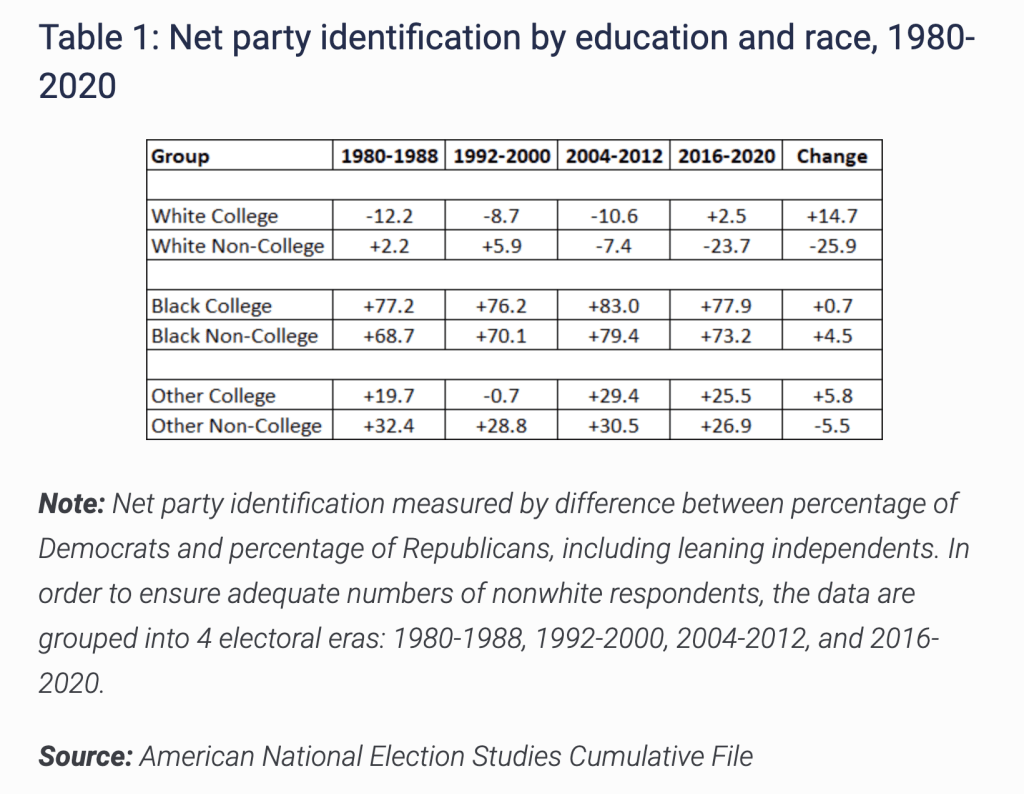
My graph of the first two rows:

- Two theories why non-college whites have become more Republican
- Economic Stress and Insecurity
- “One explanation for this realignment emphasizes economic stress and insecurity caused by changes in the structure of the American economy that have disproportionately affected those without a college degree.”
- Racial and Cultural Resentment
- “The other explanation emphasizes racial and cultural resentment caused by changes in American society that disproportionately affect those without college degrees because they tend to hold more conservative attitudes on racial and cultural issues.”
- Economic Stress and Insecurity
- Refutation of the Economic Stress and Insecurity Theory
- If economic stress and insecurity were causing non-college whites to become more Republican, we would expect that in general lower income whites would be more Republican than higher income whites, i.e. the blue and green lines would go from southwest to northeast. But they don’t.
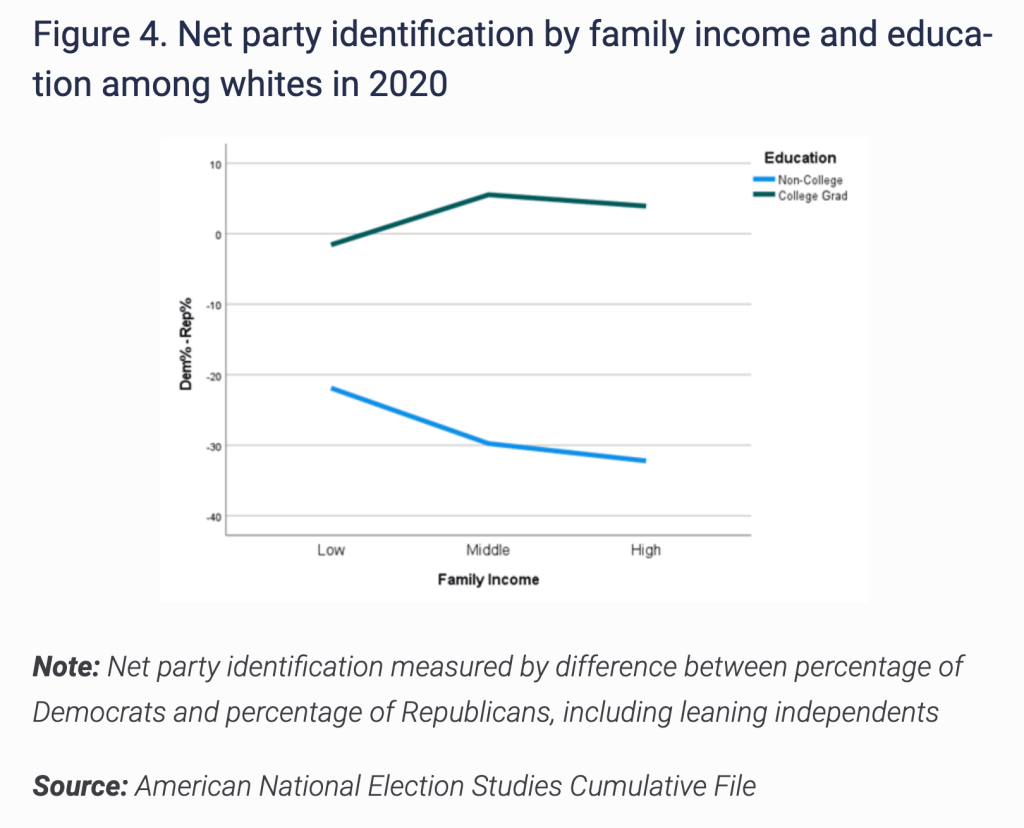
- Confirmation of Racial and Cultural Resentment Theory
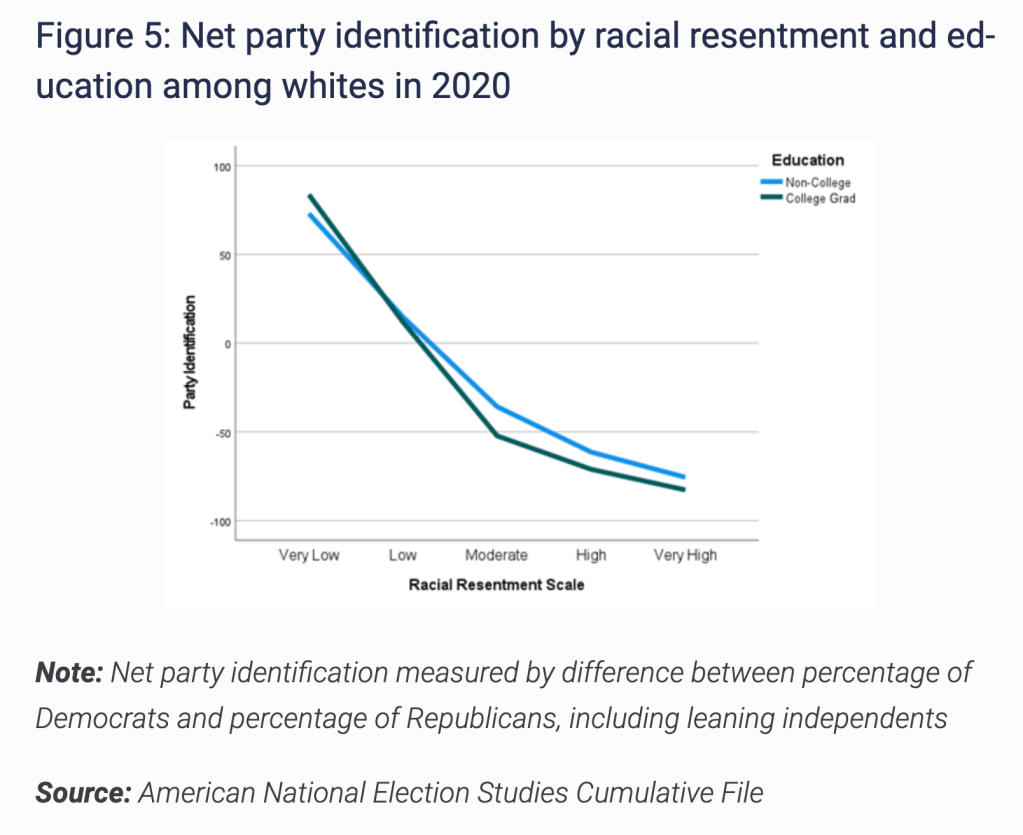
- If racial and cultural resentment were causing non-college whites to become more Republican, we would expect a high correlation among all whites between racial resentment and Republican identification. Such is the case: for both college and non-college whites, as resentment increases, net party identification becomes more Republican.
AR6 Synthesis Report (2023)
- AR6 Synthesis Report (2023)
- ipcc.ch/report/ar6/syr/
- AR6 = IPCC Sixth Assessment Report (2021)
- IPCC = The UN’s Intergovernmental Panel on Climate Change
- Five things we’ve learned from UN climate report BBC March 20, 2023
- 1 – Overshoot is the key word
- The sober tones of this study by the Intergovernmental Panel on Climate Change (IPCC) make clear that there is very little chance of keeping the world from warming by more than 1.5C. Governments had previously agreed to act to avoid that. But the world has already warmed by 1.1C and now experts say that it is likely to breach 1.5C in the 2030s, despite all the political speechmaking.
- 2 – Keep it in the ground
- While the report doesn’t definitively say it, there’s some clear indications that there’s no future for coal, oil and gas on a livable planet.
- 3 – The power is in our hands
- While it is easy to think that scientific reports on climate change are all about governments and energy policy, the IPCC has been moving to highlight the fact that the actions that people can take make by themselves make massive difference to the overall picture.
- 4 – Our actions now will resonate for thousands of years
- It’s amazing to think that the decisions we make around the world over the next seven years will echo down the centuries.
- 5 – It’s now about the politics not just the science
- The real strength of the IPCC is that their reports are agreed to by governments – and as such the reports are approved by their representatives in the presence of the scientists who research and write them.
- But the future of fossil fuels is becoming more and more a political question.
- 1 – Overshoot is the key word
Racial Resentment Score
- Racial Resentment Scale (Wikipedia)
- The standard racial resentment scale is based on how strongly respondents agree or disagree with four statements:
- Irish, Italian, and Jewish ethnicities overcame prejudice and worked their way up. Blacks should do the same without any special favors.
- Generations of slavery and discrimination have created conditions that make it difficult for blacks to work their way out of the lower class.
- Over the past few years, blacks have gotten less than they deserve.
- It’s really a matter of some people just not trying hard enough: if blacks would only try harder they could be just as well off as whites.
- Two statements are added in the expanded version:
- Government officials usually pay less attention to a request or complaint from a black person than from a white person
- Most blacks who receive money from welfare programs could get along without it if they tried
- The standard racial resentment scale is based on how strongly respondents agree or disagree with four statements:
Four Quadrants of American Politics
- In a recent article in The Atlantic Ronald Brownstein reported on an analysis of the demographic and economic characteristics of all 435 congressional districts, conducted by the Equity Research Institute at the University of Southern California in conjunction with The Atlantic.
- The Four Quadrants of American Politics, Ronald Brownstein Atlantic March 17, 2023
- Here’s a graph I made based on the results:

- Roughly speaking:
- NW↓WAC↓ are white, blue-collar districts
- NW↑WAC↑ are districts with above average populations of both racial minorities and college-educated whites
- NW↓WAC↑ are white-collar suburban districts
- NW↑WAC↓ are minority districts
- Definitions:
- NW↑ means a district whose percentage of its nonwhite population exceeds the national level of 40 percent
- NW↓means a district whose percentage of its nonwhite population is less than the national level of 40 percent
- WAC↑ means a district whose percentage of white adults with a college degree exceeds the national level of 36 percent.
- WAC↓ means a district whose percentage of white adults with a college degree is less than the national level of 36 percent.
- A notable difference between the parties is the percentage of white adults with a college degree in their districts:
- Percent of Republican districts with below-average percentages of white adults with a college degree = 77.5 percent
- (142 + 30)/222 x 100
- Percent of Democratic districts with above-average percentages of white adults with a college degree = 72.8 percent
- (98 + 57)/213 x 100
- Percent of Republican districts with below-average percentages of white adults with a college degree = 77.5 percent
- Brownstein observes
- “This demographic divide has produced a near-partisan stalemate, with Republicans in the new Congress holding the same narrow 222-seat majority that Democrats had in the last one.
- The widening chasm between the characteristics of the districts held by each party has left the House not only closely divided, but also deeply divided.
- Through the late 20th and early 21st centuries, substantial overlap remained between the kinds of districts each party held.
- Now the parties represent districts more consistently divided along lines of demography, economic status, and geography, which makes finding common ground difficult. The parties’ intensifying separation “is a recipe for polarization,” Manuel Pastor, a sociology professor at USC and the director of the Equity Research Institute, told me.”
Fall 2022
- Final Class
- Do abortion bans violate the religious rights of Jewish women?
- Durham Investigation
- Election Forecasts by Sabato’s Crystal Ball and FiveThirtyEight
- Top Threats Around the World and to Americans
- Quick Review of Trump’s seven-point plan to overturn the election, per the Jan 6 Committee
- Update on Trump’s decision to withdraw from the Iran Nuclear Agreement
- Incurable Ballots
- Electoral Act Reform Legislation
- Vulnerabilities and Flaws of US Democracy
- Social Security
- There will be COLA increase of 8.7% next year. Thank goodness for inflation.
- Impeaching Biden
- Two-thirds of Republicans believe the Big Lie. Over two-thirds of Republicans think President Biden should be impeached if the GOP retakes the house, per a U-Mass Amherst poll
- Earlier Classes
- Jim
- Bruce
- ————————————————————————————
- Abortion
- Yet another lawsuit shows how abortion bans violate religious freedom Jennifer Rubin WaPo
- Liberalism vs Conservatism
- Dobbs v. Jackson
- Secrets of Mar-a-Lago: Possession of Classified and National Defense Documents
- Moore v. Harper
- Breonna Taylor
- Trump’s attempt to keep himself in power
- Georgia Investigation
- Disinformation
- Inflation Reduction Act
- Iran Nuclear Agreement
- Midterms
- Durham Investigation
- Adrift: America in 100 Charts, 2022, Scott Galloway
- A portrait of America in 100 charts, Adrift tells the story of what Scott Galloway sees as a nation in the throes of a crisis, riven by inequity, economic decline, partisan anger and rising extremism. (NYT)
- Democracy
- Vulnerabilities and Threats
- Election Deniers
- Electoral Count Act and Reform
- Voter Fraud
- Evolution of US Democracy
- Democracy or Republic
- Democracy Ranking Organizations
Durham Investigation
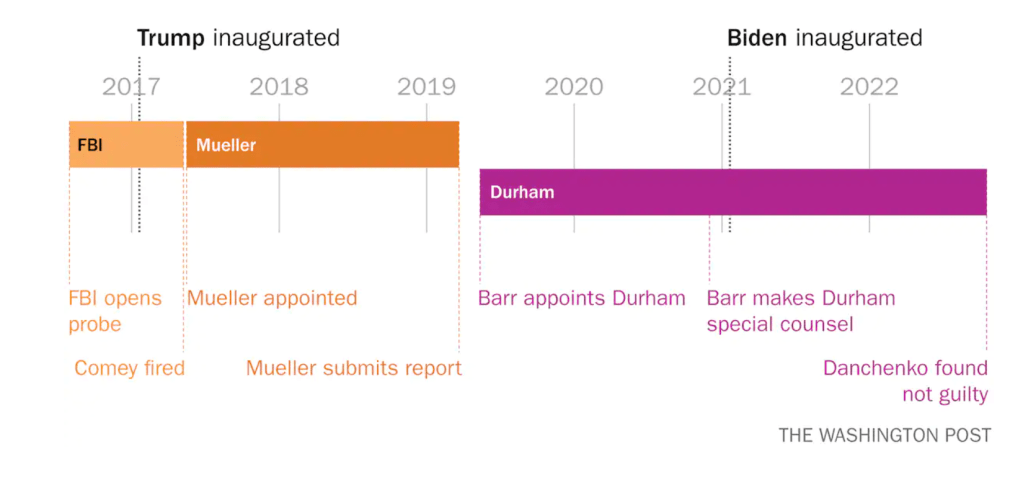
Philip Bump WaPo
- Operation Crossfire Hurricane is opened (2016)
- On July 31, 2016 the FBI opened a counterintelligence investigation, code-named Crossfire Hurricane, into “whether individuals associated with Donald Trump’s presidential campaign were coordinating, wittingly or unwittingly, with the Russian government’s efforts to interfere in the 2016 U.S. presidential election.”
- Why Crossfire Hurricane was opened
- On 22 July 2016, WikiLeaks released approximately 20,000 emails and 8,000 files sent from or received by Democratic National Committee (DNC) personnel. Wikipedia
- From the Mueller Report (2019}
- “In late July 2016, soon after WikiLeaks’s first release of stolen documents, a foreign government contacted the FBI about a May 2016 encounter with Trump Campaign foreign policy advisor George Papadopoulos. Papadopoulos had suggested to a representative of that foreign government that the Trump Campaign had received indications from the Russian government that it could assist the Campaign through the anonymous release of information damaging to Democratic presidential candidate Hillary Clinton. That information prompted the FBI on July 31, 2016, to open an investigation into whether individuals associated with the Trump Campaign were coordinating with the Russian government in its interference activities.”
- Crossfire Hurricane was not predicated on the Steele Dossier
- The Steele dossier did not trigger Mueller’s investigation. It was information from Trump campaign adviser George Papadopoulos that set the probe in motion. Politifact
- The Steele dossier was not the basis for the FBI’s investigation into Russian meddling in the 2016 election. CNN Fact Check
- Why the Discredited Dossier Does Not Undercut the Russia Investigation NYT
- FBI was justified in opening Crossfire Hurricane, per IG Report by Michael Horowitz (2019)
- “We concluded that Priestap’s exercise of discretion in opening the investigation was in compliance with Department and FBI policies, and we did not find documentary or testimonial evidence that political bias or improper motivation influenced his decision.” page iii
- The report found problems with the FISA process
- “That so many basic and fundamental errors were made on four FISA applications by three separate, handpicked teams, on one of the most sensitive FBI investigations that was briefed to the highest levels within the FBI and that FBI officials expected would eventually be subjected to close scrutiny, raised significant questions regarding the FBI chain of command’s management and supervision of the FISA process.”
- “We concluded that Priestap’s exercise of discretion in opening the investigation was in compliance with Department and FBI policies, and we did not find documentary or testimonial evidence that political bias or improper motivation influenced his decision.” page iii
- Durham told Horowitz in 2019 that the evidence supported opening a preliminary investigation, but not necessarily a full investigation. WaPo
- Durham Investigation
- In May 2019, Barr appointed Durham to oversee a DOJ probe into the origins of the FBI investigation into Russian interference. (Wikipedia)
- Jan, 2021 Guilty Plea by Kevin Clinesmith
- A federal judge has handed down a one-year sentence of probation to a former FBI lawyer who pleaded guilty to doctoring an email used to get surveillance on a former Trump campaign adviser during the Russia investigation. NPR
- May, 2022 Acquittal of Michael Sussman
- Michael Sussmann, a prominent cybersecurity lawyer with ties to Hillary Clinton’s presidential campaign, was acquitted on Tuesday of lying to the F.B.I. in 2016 when he shared a tip about possible connections between Donald J. Trump and Russia. NYT
- October, 2022 Acquittal of Igor Danchenko
- Igor Danchenko, an analyst who provided much of the research for a notorious dossier of unproven assertions and rumors about former President Donald J. Trump and Russia, was acquitted on Tuesday on four counts of lying to the F.B.I. about one of his sources. NYT
- Igor Danchenko, an analyst who provided much of the research for a notorious dossier of unproven assertions and rumors about former President Donald J. Trump and Russia, was acquitted on Tuesday on four counts of lying to the F.B.I. about one of his sources. NYT
- Durham Inquiry Appears to Wind Down as Grand Jury Expires NYT
- The grand jury that Mr. Durham has recently used to hear evidence has expired, and while he could convene another, there are currently no plans to do so, three people familiar with the matter said.
- Mr. Durham and his team are working to complete a final report by the end of the year, they said, and one of the lead prosecutors on his team is leaving for a job with a prominent law firm.
- Will Durham’s report differ significantly from Horowitz’s?
 A Philosopher's View